BSCI207 Unit 2
 Call Kai
 Learn
Learn Practice Test
 Spaced Repetition
 Match
Match Flashcards
 Knowt Play
1/125

There's no tags or description
Looks like no tags are added yet.
Name | Mastery | Learn | Test | Matching | Spaced | Call with Kai | Chat |
|---|
No analytics yet
Send a link to your students to track their progress
126 Terms
Prokaryotes
Bacteria and Archaea
Eukaryotes Groups (4)
Single celled protists
Plants
Fungi
Animals
Eukaryotes Key Processes (4)
Sexual Reproduction
Multicellularity
Development
Evolution
Key Eukaryotic Traits (6)
Flexible cell membrane (lost cell wall)
Complex Cytoskeleton
Nuclear Membrane
Digestive Vacuoles
Organelles
Sexual Reproduction (Mitosis, Meiosis/recombination)
Eukaryotic Flexible cell membrane since lost cell wall
Cells can change shape
Cells can move in new ways
Cells can pinch off bit of surrounding by endocytosis or phagocytosis
—> Cells can grow bigger + Cells can move

Eukaryotic Complex Cytoskeleton
Flagella

Eukaryotic Nuclear Membrane

Eukaryotic Origin of nuclear membrane

Eukaryotic Digestive Vacuoles

Eukaryotic Organelles
Mitochondria
Chloroplast
Diversity of energy production

Protists
Monophyletic group
Typically single celled

Traditional view of diversity
Divide based on feeding styles

Molds
Absorptive, fungus-like protists
Algae
Photosynthetic, plant-like protists
Protozoa
Ingestive, animal-like protists
Eukaryotes 5 super groups
SAR
Archaeplastida
Excavata
Amoebozoa
Opisthikonta

Late Origin Hypothesis
Basal eukaryotes split off before the evolution of mitochondria in other lineages
Early Origin Hypothesis
Mitochondria arose in eukaryotic common ancestor but were lost in some groups
Mitochondria is a key Eukaryote trait. These organelles come in several forms

Evidence that Mitochondria is a key Eukaryote trait (Relics)
Genetic: “Mitochondrial” Genes (genes with close homologs in proteobacteria) in there nuclear genomes
Structural: Mitochondrial remnants
—> Hydrogenosomes (H2 - generating organelles) - double membrane-bound organelles with some redox reactions but no organized ETC’s
—> Mitosomes have double membranes
Evidence that Mitochondria is a key Eukaryote trait (Implications)
Single origin of mitochondria at the base of the eukaryotes
Secondary loss in some lineages of Excavates (and in a number of other groups)
Metamonda (ciliated) include…
Diplomonads
Parabasilids

Diplomonads
Usually commensals in animal guts
Some parasites - camper’s diarrhea from drinking stagnant water
Parabasalids
Animal symbionts/parasites
Trichonympha - eukaryotic endosymbiont in termite guts
Bacterial endosymbionts digest cellulose
Other bacterial ectosymbionts (spirochaetes) insereted into the “collar” to make protist mobil

Euglenozoa
Kinetoplastids

Trypanosomes
Have mitochondria
Cause sleeping sickness (tse-tse fly)
May contribute to honeybee colony collapse
Euglenozoa
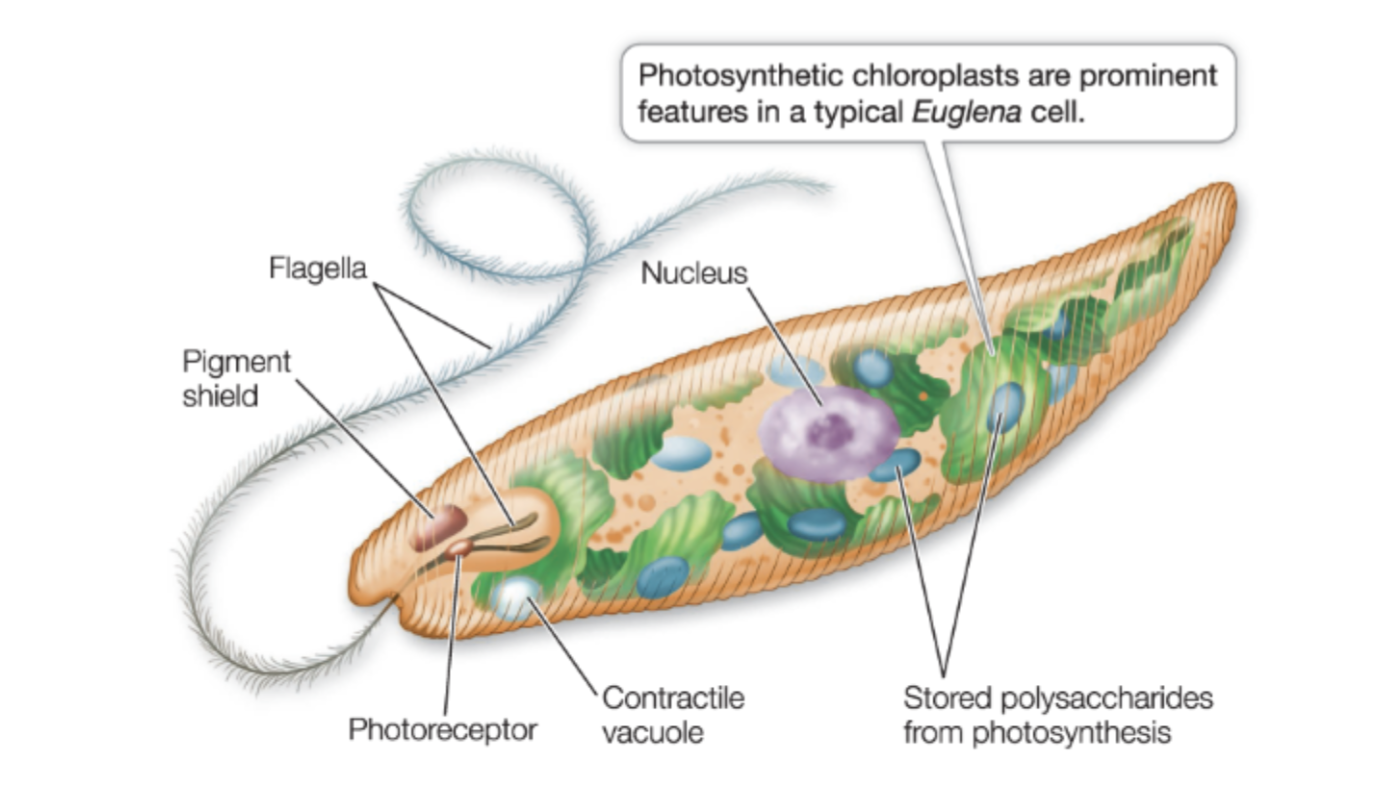
Euglenids
Single celled with flagellum
Movement takes energy/ATP: need mitochondria
Photosynthetic but can switch to being heterotrophic
SAR
Stramenopiles
Two flagella - one covered with hairs
Diatoms (Photosynthetic unicellular, O2 producer, Deposit silica in cell wall)
Brown Algae (ex. kelp, Photosynthetic and multicellular)
Oomycetes (ex. water molds, aquatic sap robes, heterophic absorber)

SAR
Alveolates
Have alveoli (sacs under cell membrane)
Dinoflagellate (Unicellular w/ 2 flagella, Most photosynthetic, Symbionts in corals; red tide “algal” bloom
Ciliates (Lots of cilia for movement, Heterotrophic, Paramecium)
Apicomplexans (Heterotrophic parasites, Plasmodium falciparum = malaria)

SAR
Rhizarians
Cercozoans (Ameoboid or flagella “algae”, may be photosynthetic, nucleomorph)
Foraminiferans (Heterotrophs that secrete CaCO3 forming limestone
Radiolarians (Radically symmetric heterotrophs, glassy endoskeletons that stiffen pseudopods)

Ancestrally, organisms replicated by…
Binary fission

Amenbozoans
Loboseans: heterotrophs that engulf food with pseudopods
Plasmal Slime Molds
Cellular Slime Molds

Haploids only have ___ of each chromosome
One

Diploids have ___ of each chromosome
Two

Asexual Reproduction
Offspring are clones of parent
Same # of chromosomes
Haploids

Sexual Reproduction using meiosis
Change # of chromosomes

Benefits of Sexual Reproduction
Asexual reproduction - makes clones of self (if azure bad mutations, can’t get rid of them)
Sexual reproduction - sex brings together new combinations of alleles (Recombination, Rescue and revitalize genotypes = phenotypes)
Why did Sexual Reproduction arise in Eukaryotes?
New mitochondria bring risks
Generalized sexual life cycle in eukaryotes
Meiosis: division of 1 diploid cell to generate 4 haploid cells
Fertilization fusion of 2 haploid gametes to form the diploid zygote
Variable cycles of mitosis in 1n or 2n stages occurs for both unicellular or multicellular

Diplontic Life Cycle
Adult is diploid
Gonads hold immature germ cells (which are haploid)
Release gametes which fuse (fertilization) to produce diploid zygote
Diploid zygote grows to diploid adult
Humans and most animals
Not the only choice

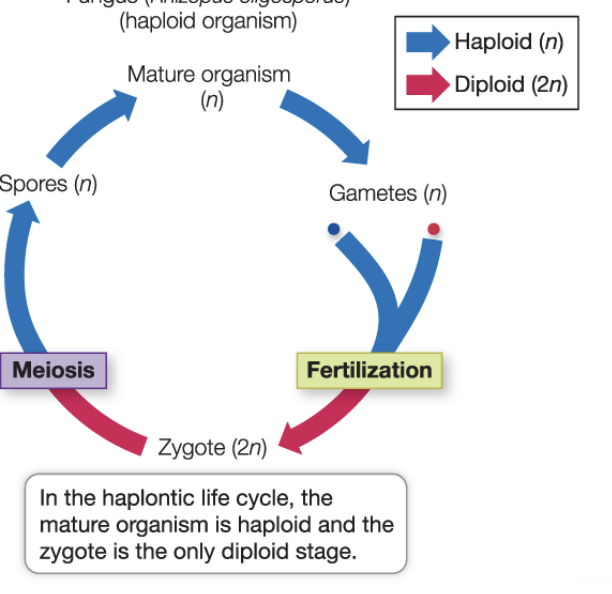
Haplontic Life Cycle
Adult is haploid
Spend significant time undergoing mitosis to replicate
Only infrequently form gametes
Fertilization of gametes forms zygotes
Zygotes can survive harsh conditions
Alternation of generations

Typical protist (unicellular eukaryote) - haplontic life cycle

Evolved new gene with two alleles
Haploid individual has either gsp or gsm so forms either + or - gamete
Each is a transaction factor that turns on a suite of genes

gsm/gsp protiens form a heterodimer transcription factor in the zygote
The mating type gene is a transcription factor that initiates the expression of genes to make one type of gamete
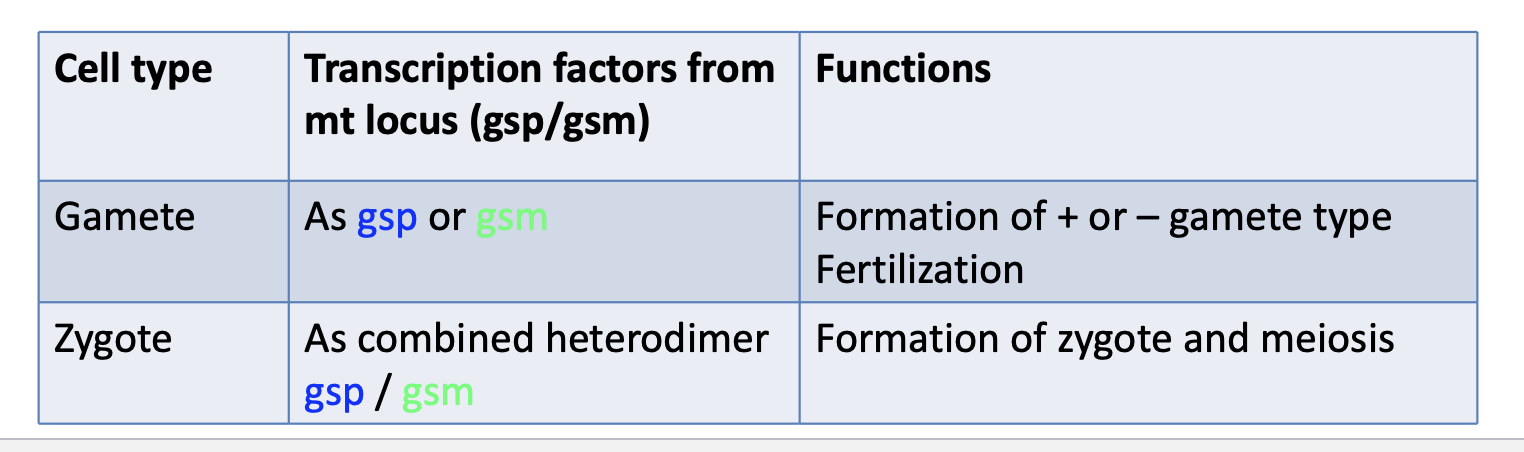
Two versions (alleles) of the mating-type locus control the entire sexual cycle
The mating type locus encodes the integrated genetic machinery that:
Transforms cells into two gamete types (+ and -)
Enables fertilization
In Zygote drives development of zygote
Enables meiosis to form 4 haploid spores
Haploid life cycles in eukaryotes result from ____
Evolution of the mating-type locus in the haploid common ancestor of eukaryotes
Key Ideas of Eukaryotes
What are key characteristics of eukaryotes?
How do you know that mitochondria are shared eukaryotic trait?
How do protists differ from other eukaryotes? (Few key examples)
How did sexual reproduction arise? (What were its original benefits, How do mitosis and meiosis differ? How do vegetative vs. reproductive cells differ?)
What is a simple model for the evolution of sex using a mating type locus? How does it work?
When did multicellular organisms first arise?
Stomatolites are colonies of cyanobacteria (These were discovered in Australia in protected bay, similar to those in fossil record back to 3+ BY)

History of multicellular life

Phanerozoic
Visible life
Fossil evidence for multicellular organisms

Paleozoic
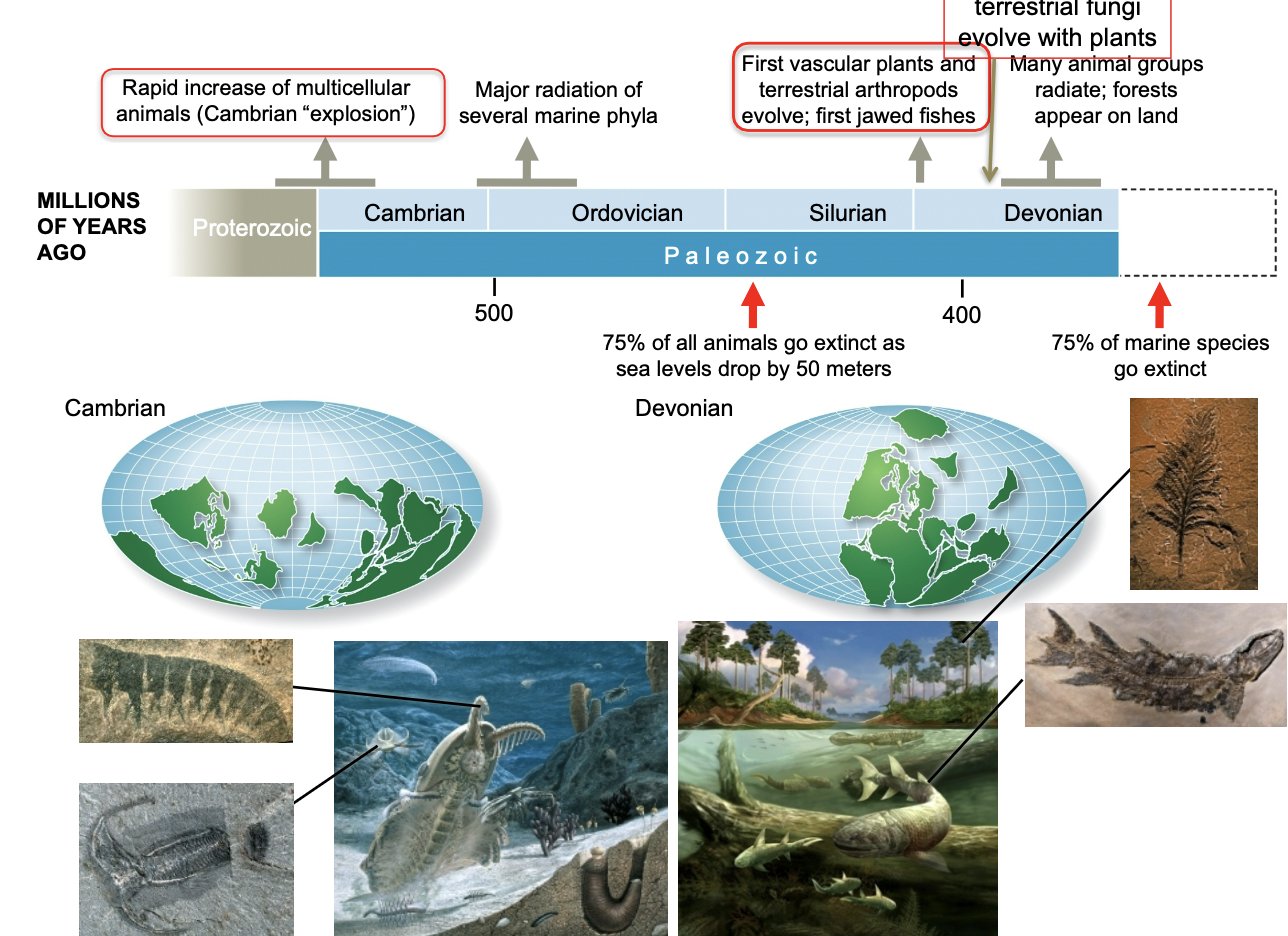
Mesozoic

Cenozoic

Multicellularity is…
Cooperation among cells for “good” of organism
Close association of many cells carrying out specialized vegetative and reproductive functions
5 requirements for multicellularity
Extracellular environment
Division of labor
Resource allocation
Proliferation inhibition
Programmed cell death
Prevalence of cheating/cancer across life
Cancer cells are “selfish”, act opposite of normal cells working together
Several convergent designs of multicellular eukaryotes related to their nutrition (3)
Photosynthetic organisms
Absorptive organisms
Ingestive Organisms (animals)
Multicellular Photosynthetic Organisms
Convergent design - flat “leave”, tubular “stems and attaching “roots/holdfasts”

Multicellular absorptive organism
Unicellular or filamentous vegetative stages and multicellular reproductive/dispersal stages

Multicellular Ingestive Organisms
Multicellular ingestive organisms have specialized tissues:
Digestive - to ingest
Muscular - to move
Nervous - to coordinate

Who are the closest unicellular relatives of multicellular eukaryotes? (3 of 4 major multicellular clades)
Land Plants: Green algae
Animals: Choanoflagellates
Fungi: Unicellular opsthokonts (exact one still being debated)
Land Plants
Green Algae
Brown Algae and others also evolved multicellularity
Multicellular green plants arose in fresh water

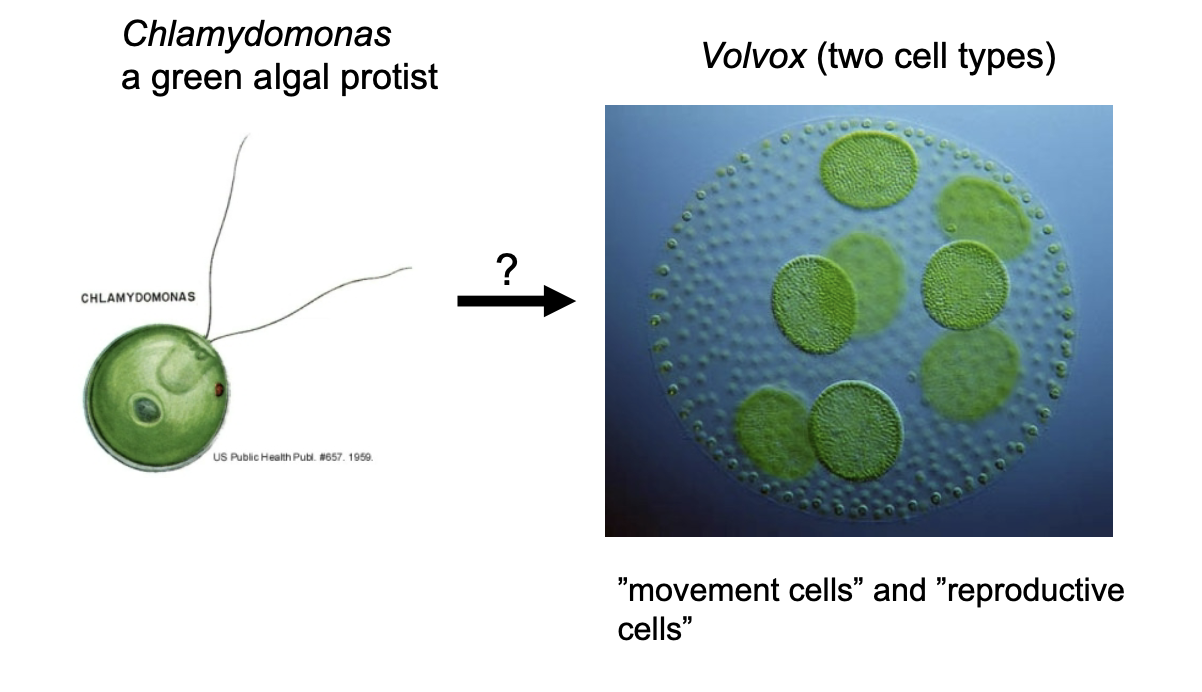
Volvox
Two cell types
Movement cells and reproductive cells
Closest relative to land plants..
Two candidates (Coleochaete and Chara vulgaris)
How to tell which? Molecular phylogeny solves mystery
Charales is closest relative

Multicellularity is part of a series…..
Unicellular—> Colonial —> Filamentous —> Parenchymatous

Animals
Choanoflagellates
Why would a Choanoflagellates benefit from being reversibly colonial?
Hypothesis: Maybe it helps feeding? Colonies are induced by chemicals from bacterial food (testable)
Experiment: Reduce bacteria in choanoflagellate cultures
Result: Choanoflagellats only spontaneously form rosette colonies in presence of bacteria. Authors when on to isolate specific chem from one bacteria

Fungi
Unicellular opisthokonts

Opisthokont’s dilemma

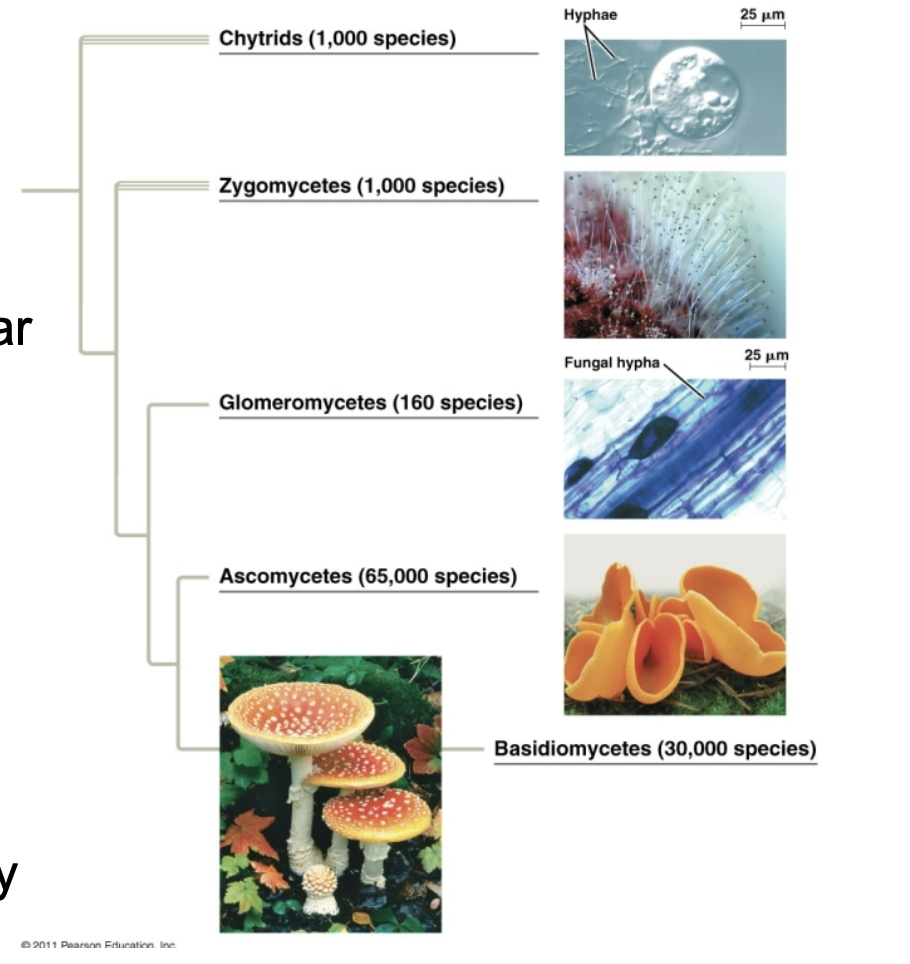
5 major fungal clades
Chytrids
Zygomycetes
Glomeromycetes
Ascomycetes
Basidiomycetes
Ancestor probably similar to chytrids: aquatic and flagellated
Lile plants and animals, fungi only colonize land after becoming fairly sophisticated
How fungo “get around”
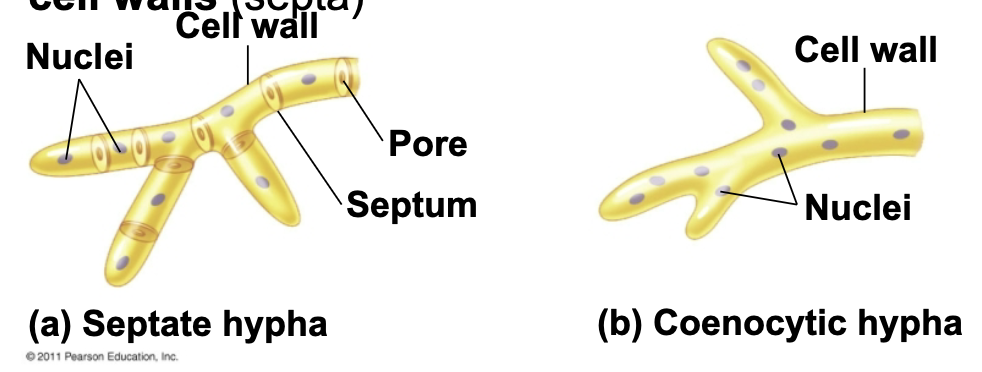
Fungal bodies: mycelia, networks of branched hyphae
Hyphae syncytial (no cell separations) or have only partial cell walls (septa)
Filamentous
Tissue divides along 1 axis
Parenchymatous
tissue can divide along all 3 axes
Psuedoparenchyma
Filaments that resemble parenchymatous tissue
Multicellularity Benefits
Overcome Diffusion
Link operate cells together by adhesion
Task division: Cells differentiate into different types
Unicellular reproduction
Binary fussion/budding (Asexual)
Multicellular reproduction
Can also use budding
(Typically sexual) produce a single celled spore or gamete (typically coupled with meiosis and sex
Who gets to reproduce?
Only some cells are sexual and replicate
Others cede that function
Solution: Tight control over mitotic and meiotic potential
Does an organism need to have sex organs to have sex?
Does an organism need to even be multicellular to have sex?
No
No
What does an organism need to have sex?
Diploid phase of life cycle
Meiosis to form haploid gametes
Union of haploid meiotic products (“syngamy” or “fertilization”)
Multicellular organisms use same sequences as in unicellular organisms
Sexual Lifestyles

Haplontic sex in unicellular Chlamydomonas
A green alga
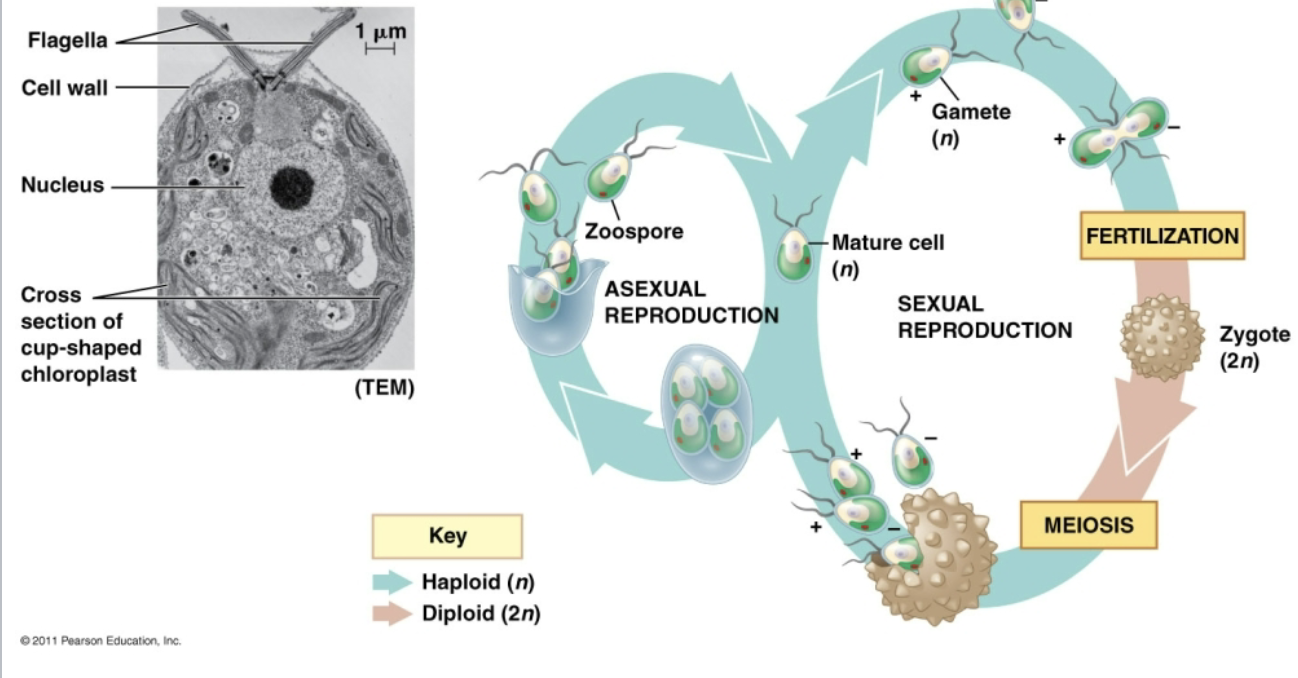
Animals have ____ sexual cycles
Diplontic
Key Ideas Multicellularity (4)
What are 5 requirements of multicellularity?
Multicellularity occurred in multiple lineages (Closest relatives show evolution for cells sticking together as colony, Sometimes colonial phase is reversible)
Ultimately multicellarity becomes permanent (need to sort out which cells will be reproductive and get to pass on their genes
Sexual reproduction can occur in single celled organisms (In many multicellular organisms, alternation of single and multicellular stages)
What are key eukaryotic trait that facilitated cell movement?
Flexible cell membrane
Complex cytoskeleton
How do we know that excavata once had mitochondria but lost them?
They have homologs to proteobacterial genes in their nuclear DNA
They have hydrogenosomes with double membranes
Which of the following are not a stramenopile?
Dinoflagellates
Diatoms
Brown algae
Oomycetes
Dinoflagellates
In Chlamydomonas, how does the mating type locus affect the zygote?
Expression of the gsp and gsm alleles together makes a heterodimer that causes a zygote to develop
Plants are composed of ___ primary parts made up of ___ tissues
3 primary parts: Leaf, Stem, Root
3 tissues: Dermal tissue, Ground tissue, Vascular tissue


Plant Primary Growth
Small plants grow by primary growth —> which is the growth of the stem, including phloem (carries sugar and water) and xylem (carries only water)
Herbaceous plants like flowers or grasses only undergo primary growth
When woody plants get large enough they undergo secondary growth
Plant Secondary Growth
Secondary growth involves adding additional tissue which greatly increases their diameter
This includes much more xylem and phloem
Because this tissue is added during secondary growth, we call it secondary xylem and secondary phloem
Woody plant stems have layers specialized for different tasks
Xylem: Conducts water, supports stem
Phloem: conducts water + sugars
Cork: protects inner layer

Vascular Tissue
Xylem
Phloem

Plant Primary Body
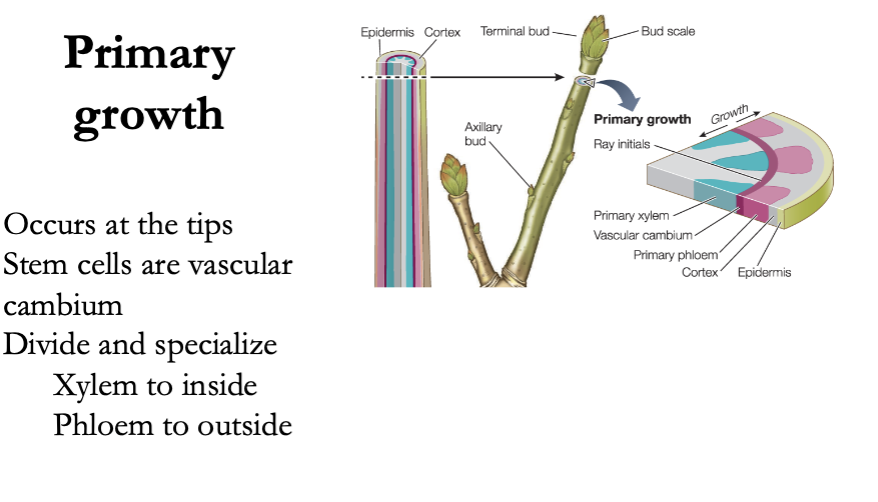
Formed by apical meristems in the terminal buds, axillary buds, and root tips
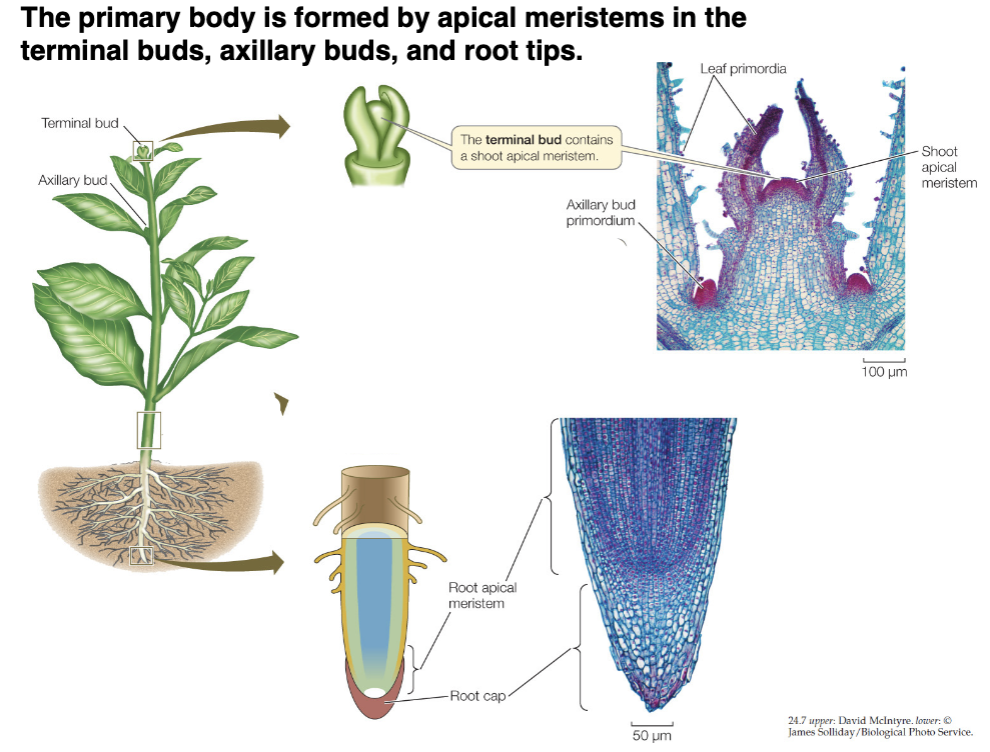
Plant Primary Growth
Occurs at the tips
Stem cells are vascular cambium
Divide and specialize (Xylem to inside, Phloem to outside)