advance clinical anatomy - BONES
 Call Kai
 Learn
 Practice Test
 Spaced Repetition
 Match
 Flashcards
 Knowt Play
1/38

There's no tags or description
Looks like no tags are added yet.
39 Terms
tubercle
A bumpy area of the bone where muscle tendons and ligaments attach.
From the Latin word tuberculum - a small swelling

trochanter
is similar to a tubercle
Only found on the femur
Tendons and ligaments attach to the greater and lesser trochanters of the femur.

condyle
smooth, convex (rounded or curved outward)articular (joint) surface.
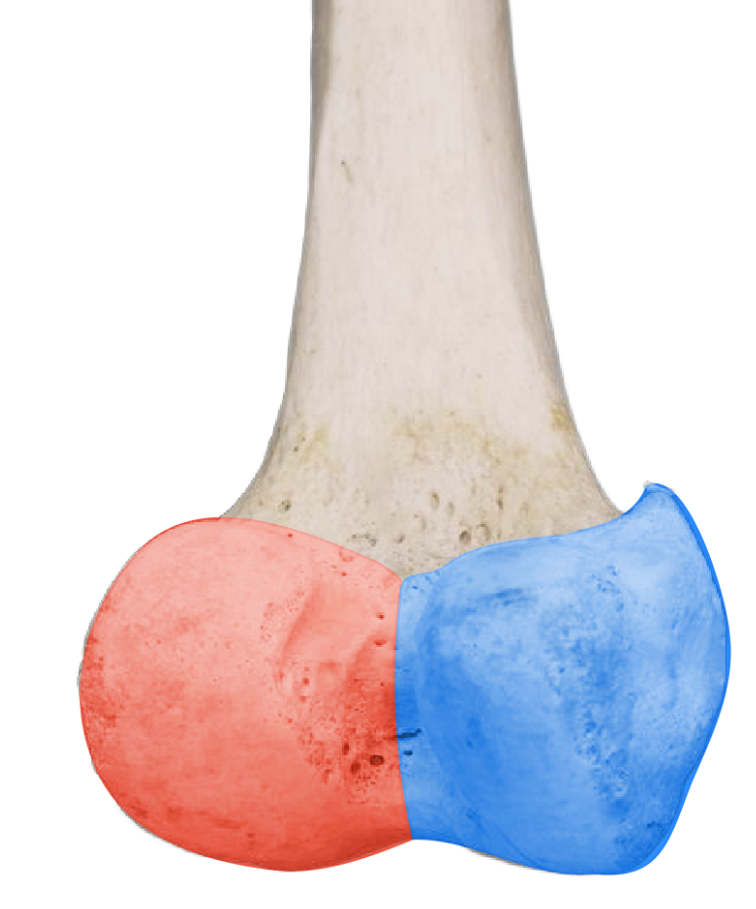
fossa
a hollow or depressed area
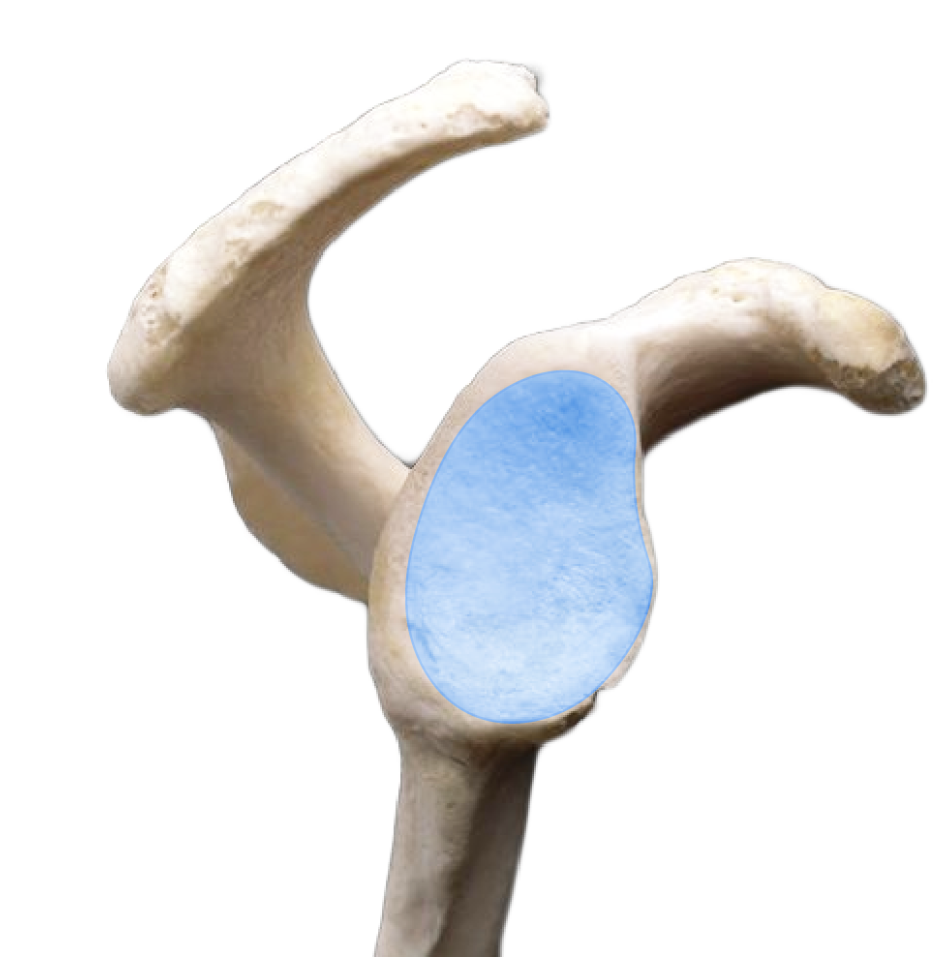
foramen
a hole
A channel in the bone that allows other structures (nerves and blood vessels) to pass through the bone

process
a projection, bump, or outgrowth of tissue—most commonly bone—extending from a larger body or structure
fissure
narrow slit, groove, cleft, or deep furrow that divides an organ (such as the brain, liver, or lung) or separates tissues

Identify the numbers/bones
parietal bone
frontal bone
occipital bone
temporal bone
sphenoid bone (greater wing)
zygomatic bone
ethmoid bone
lacrimal bone
nasal bone
maxilla bone
mandible bone
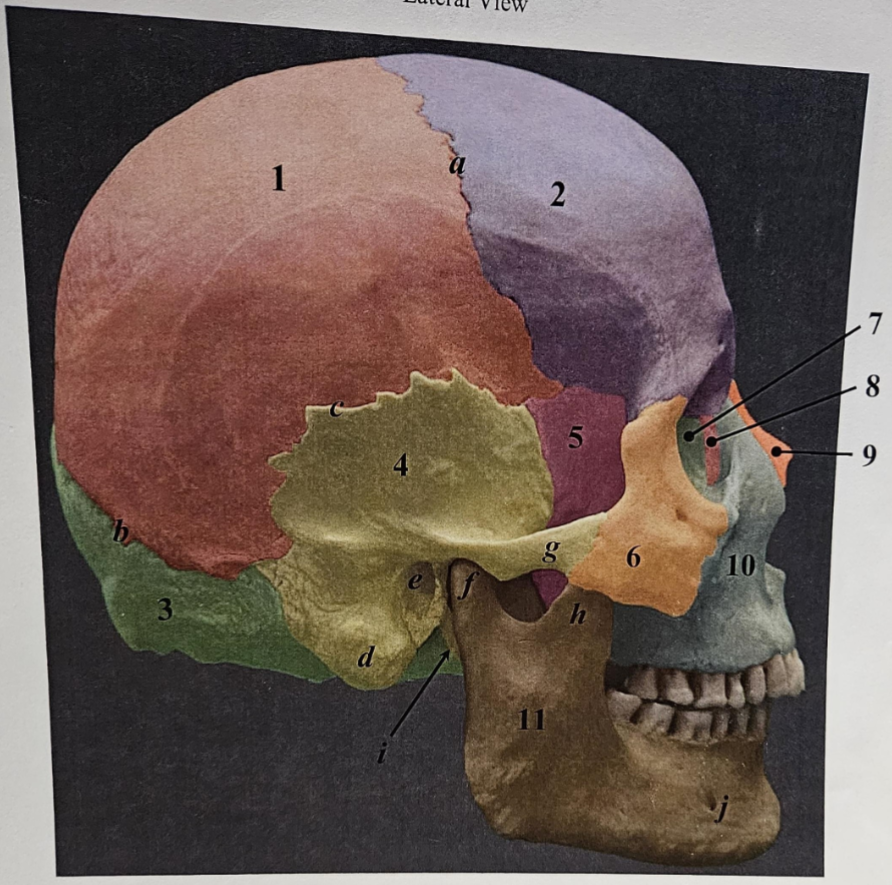
Identify the feature/letters (a-j)
a. coronal suture
b. lambdoid suture
c. squamous suture
d. mastoid process
e. external acoustic meatus
f. mandibular condyle
g. zygomatic process
h. coronoid process
i. styloid process
j. mental foramen
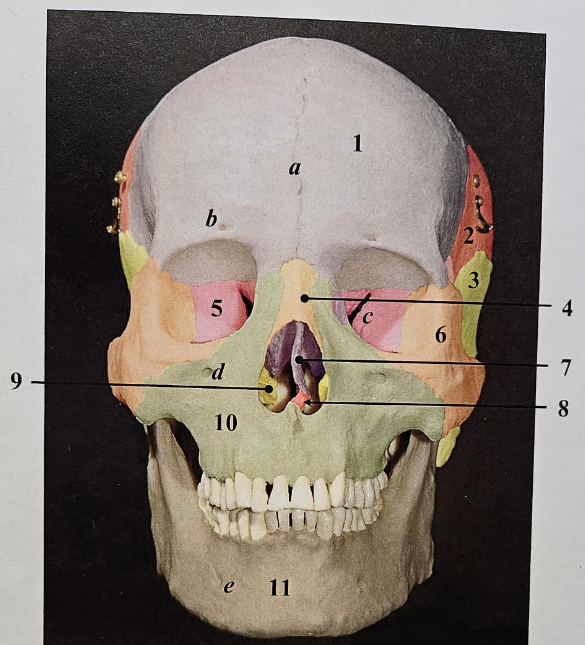
Identify the numbers/bones
frontal bone
parietal bone
temporal bone
nasal bone
sphenoid bone (greater bone)
zygomatic bone
ethmoid bone
vomer bone
inferior nasal concha bone
maxilla bone
mandible bone
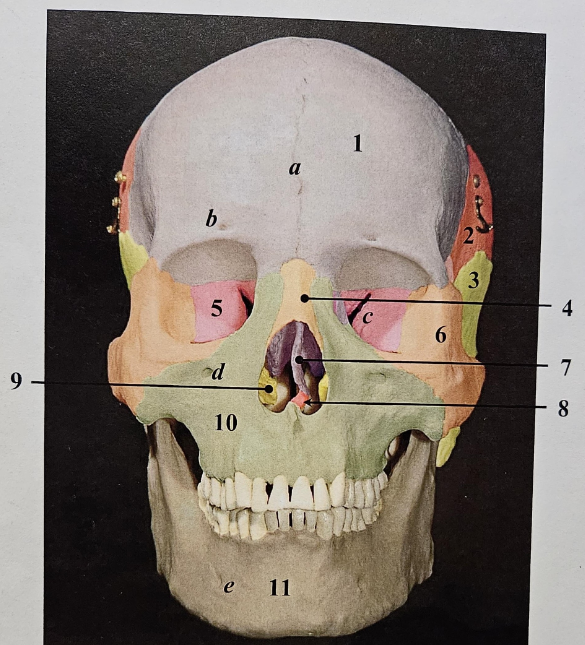
Identify the feature/letters (a-e)
a. metopic suture
b. supraorbital foramen/notch
c. superior orbital fissure
d. inferior orbital foramen
e. mental foramen
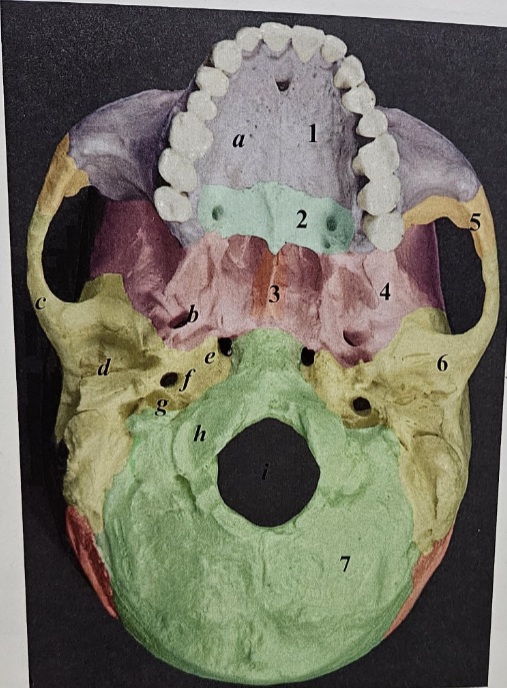
Identify the numbers/bones
maxilla
palatine bone
vomer bone
sphenoid bone
zygomatic bone
temporal bone
occipital bone

Identify the feature/letters (a-i)
a. Palantine process of the bone
b. foramen ovale
c. zygomatic process of the temporal bone
d. mandibular fossa
e. foramen lacerum
f. carotid canal
g. jugular foramen
h. occipital condyle
i. foramen magnum
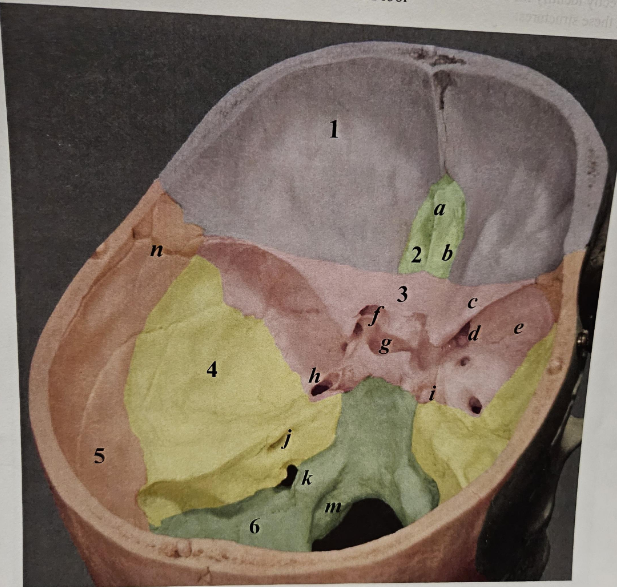
Identify the numbers/bones
frontal bone
ethmoid bone
sphenoid bone
temporal bone
parietal bone
occipital bone
Identify the feature/letters (a-n)
a. Crista galli
b. cribriform plate
c. lesser wing
d. orbital fissure
e. greater wing
f. optic canal
g. sella turcica
h. foramen ovale
i. foramen lacerum
j. internal acoustic meatus
k. jugular foramen
m. hypoglossal canal
n. sulci

Identify the numbers/bones
vertebral body
vertebral foramen
spinous process
transverse process
transverse foramen (cervical vertebra)
vertebral arch

identify the structures
PINK - costal demifacets
BLUE - superior articular process
YELLOW - inferior articular process
GREEN - transverse costal facet
body
spinous process


identify the features/numbers
medial border
lateral border
superior border
acromion
coracoid process
glenoid cavity
subscapular fossa

identify the features/numbers
acromial end
conoid tubercle
sternal end

identify the features/numbers
medial border
lateral border
superior border
infraspinous fossa
supraspinous fossa
spine
acromion
coracoid process

Identify the features/numbers of the anterior view of the right humerus
head
greater tubercle
lesser tubercle
intertubercular groove
lateral epicondyle
capitulum
trochlea
medial epicondyle
olecranon fossa
deltoid tuberosity

Identify the features/numbers of the posterior view of the right humerus