SCIENCE DCA
 Call Kai
 Learn
 Practice Test
 Spaced Repetition
 Match
 Flashcards
 Knowt Play
1/35

There's no tags or description
Looks like no tags are added yet.
36 Terms
List the seven layers of the Earth form MOST dense to LEAST dense
inner core
outer core
lower mantle
upper mantle
uppermost mantle
lithosphere
crust
Explain how density helped form and organzie the layers in the Earth
Density causes the molten rock to form the layers of Earth we have today. The denset materials sunk an formed the inner layer, while the least dense materials stayed at the surface.
Which layer contains Earth’s crust and solid upper mantle that is broken into tectonic plates
Lithosphere
List and explain three pieces of evidence that we have to explain plate motion
Climate clues – Similar climate evidence is found on different continents.
Fossil clues – The same fossils are found on different continents.
Rock clues – Similar rock formations are found on different continents.
Describe the process of seafloor spreading. Make sure to include what feature is formed.
As oceanic crust forms along a mid-ocean ridge, older crust moves away from the ridge as magma rises up from the mantle.

Label the following diagram with the relative ages of the rock and explain why it is this age. Use the words "youngest" and "oldest" when labeling the boxes below.
Oldest (white): Farther away from the mid-ocean ridge.
Youngest (red): Closest to the mid-ocean ridge.
Explanation: When the magma rises, the rock is formed at the ridge and gets pushed outward, making the new rock the youngest.
What causes tectonic plates to move? Describe this process and draw a picture to show your understanding of how this process causes the plates to move.
Convection currents in the mantle cause tectonic plates to move.

What is the definition, movement, and features of Convergent (continental-continental)
Convergent (continental-continental)
Definition: Forms where two plates collide. Both plates are continental plates.
Movement: Toward each other.
Features formed: Earthquakes and mountains.
What is the definition, movement, and features of Convergent (continental-oceanic)
Convergent (continental-oceanic)
Definition: When the edge of an oceanic plate collides with a continental plate, the oceanic plate may sink beneath the continental plate.
Movement: Toward each other.
Features formed: Trenches and volcanic mountains.
What is the definition, movement, and features of divergent
Divergent
Definition: Forms when two plates separate and move away from each other.
Movement: Away from each other.
Features formed: Mid-ocean ridges and rift valleys.
Which plate boundary creates new crust? Which plate boundary destroys old crust? Explain how you know.
Divergent plate boundaries create new crust. Plates move apart, magma rises up in the gap and cools, creating new crust.
Convergent plate boundaries destroy old crust. When plates collide, the oceanic plate is pushed beneath the other plate and old crust is destroyed.
At an ocean-continent convergent plate boundary where subduction is occurring, which plate is being subducted? Explain why.
The oceanic plate because in Earth's mantle, the oceanic plate is more dense, which causes it to sink.
What is a fault?
A break in Earth's lithosphere where one block of rock moves toward, away from, or past another block of rock.
Describe how volcanoes form at convergent plate boundaries.
The process of subduction creates volcanic mountains when the oceanic plate subducts and magma rises.
Describe how volcanoes form at divergent plate boundaries.
Seafloor spreading and continental rifting allow magma to rise through the crust.
What is the relationship between earthquakes and volcanoes? When looking at a map, what patterns do we see between earthquakes and volcanoes?
They form along similar tectonic plate boundaries because they are caused by convection currents.
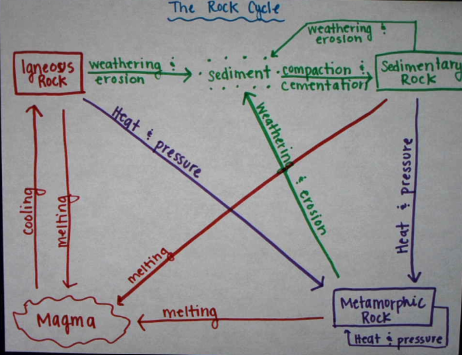
Draw and label the rock cycle in the space below. Be sure to include the processes that move rock material from one part of the cycle to another.
What is the difference between magma and lava?
Magma – Molten rock below Earth's surface.
Lava – Molten rock above Earth's surface.
Mark whether each word/statement describes rocks (R), minerals (M), or both (B).
Solid
Inorganic
Diamond
Limestone
Quartz
Definite chemical composition
Mixture of materials
Orderly arrangement of atoms
Naturally occurring
Obsidian
Solid – B
Inorganic – B
Diamond – M
Limestone – R
Quartz – M
Definite chemical composition – M
Mixture of materials – R
Orderly arrangement of atoms – M
Naturally occurring – B
Obsidian – R
Which type of rock forms from magma?
igneous rock
What is created by weathering and erosion?
sediment
What type of rock would be created if pieces of sand were pressed together over time?
sedimentary rock
What type of rock is created when other rocks are changed over time due to the extreme conditions below the surface?
metamorphic rock
What process turns igneous rock into sediment?
Weathering and erosion.
In the rock cycle, which processes are caused by energy from the sun? Explain how you know.
Weathering and erosion because the sun heats up the rocks, and water and wind help break down the rocks that turn into sediment.
In the rock cycle, which processes are caused by energy from Earth's interior? Explain how you know.
Melting, heat, cooling/crystallization, and pressure because they require heat from Earth's mantle.
In two to three sentences, explain why there is no beginning or end to the rock cycle.
There is no beginning or end because everything has a process that turns it into something else. Everything is always being recycled, so it never begins or ends.
Mark whether each statement describes sedimentary (S), igneous (I), or metamorphic (M) rock.
May contain fossils
Has ribbonlike layers
Looks shiny or glasslike
Created by melting and cooling of melted rock
Created by heat and pressure
Created by compaction and cementation
May contain fossils – S
Has ribbonlike layers – M
Looks shiny or glasslike – I
Created by melting and cooling of melted rock – I
Created by heat and pressure – M
Created by compaction and cementation – S
What is weathering?
The mechanical and chemical processes that change objects on Earth's surface over time.
What is erosion?
The process of moving weathered rock away from its original location.
What is deposition?
The laying down or settling of eroded material.
Label the following examples as either weathering (W), erosion (E), or deposition (D).
-The roots of a plant grow in the cracks of a sidewalk. As the roots grow larger, the cement begins to crack.
-Ice melts in a large boulder and carries away loose sediment.
-A delta is formed at the mouth of a river.
-Due to rain, the paint on an outside bench begins to crack.
-A rabbit burrows into the crack of a large rock and widens and splits the rock.
-Blowing sand comes to a rest forming a sand dune.
-The dropping of sediment to a new location.
-The moving of weathered sediment.
-Dust and sand are blowing in the air during a windstorm.
The wearing down or breaking of rocks.
The roots of a plant grow in the cracks of a sidewalk. As the roots grow larger, the cement begins to crack. – W
Ice melts in a large boulder and carries away loose sediment. – E
A delta is formed at the mouth of a river. – D
Due to rain, the paint on an outside bench begins to crack. – W
A rabbit burrows into the crack of a large rock and widens and splits the rock. – W
Blowing sand comes to a rest forming a sand dune. – D
The dropping of sediment to a new location. – D
The moving of weathered sediment. – E
Dust and sand are blowing in the air during a windstorm. – E
The wearing down or breaking of rocks. – W
What are the two factors that can affect the rate of chemical weathering? Give an example of a place on Earth where chemical weathering would happen the quickest.
Amount of water present.
Temperature.
Warm, wet places, like tropical rainforests.
Determine whether the following is an example of physical (P) or chemical (C) weathering. Explain the process/definition of each example.
Abrasion
Thermal Expansion
Acid Rain
Oxidation
Frost Wedging
Abrasion – P
The grinding away of rock by friction or impact.
Thermal Expansion – P
Heat causes rocks to expand and crack.
Acid Rain – C
Sulfur dioxide and nitrogen oxides are released into the atmosphere and react with water droplets.
Oxidation – C
Oxygen reacts with another element.
Frost Wedging – P
As water freezes in the cracks in rock, the water expands and breaks the rock.
List the four agents of erosion and describe one landform that each agent of erosion forms.
Water - Canyons
Wind - Arches
Ice (glaciers) - U-shaped valleys
Gravity - Mudslides, rockslides, avalanches
What is one way that we can decrease the amount of erosion that occurs in an area?
Humans can slow the rates of erosion by altering the landscape.
Examples: Dams, Retaining walls, Jetties, Mulch/gravel, Terraces, Landscaping