Chem 3B: Week 5
 Call Kai
 Learn
Learn Practice Test
 Spaced Repetition
 Match
Match Flashcards
 Knowt Play
1/18

There's no tags or description
Looks like no tags are added yet.
Name | Mastery | Learn | Test | Matching | Spaced | Call with Kai | Chat |
|---|
No analytics yet
Send a link to your students to track their progress
19 Terms
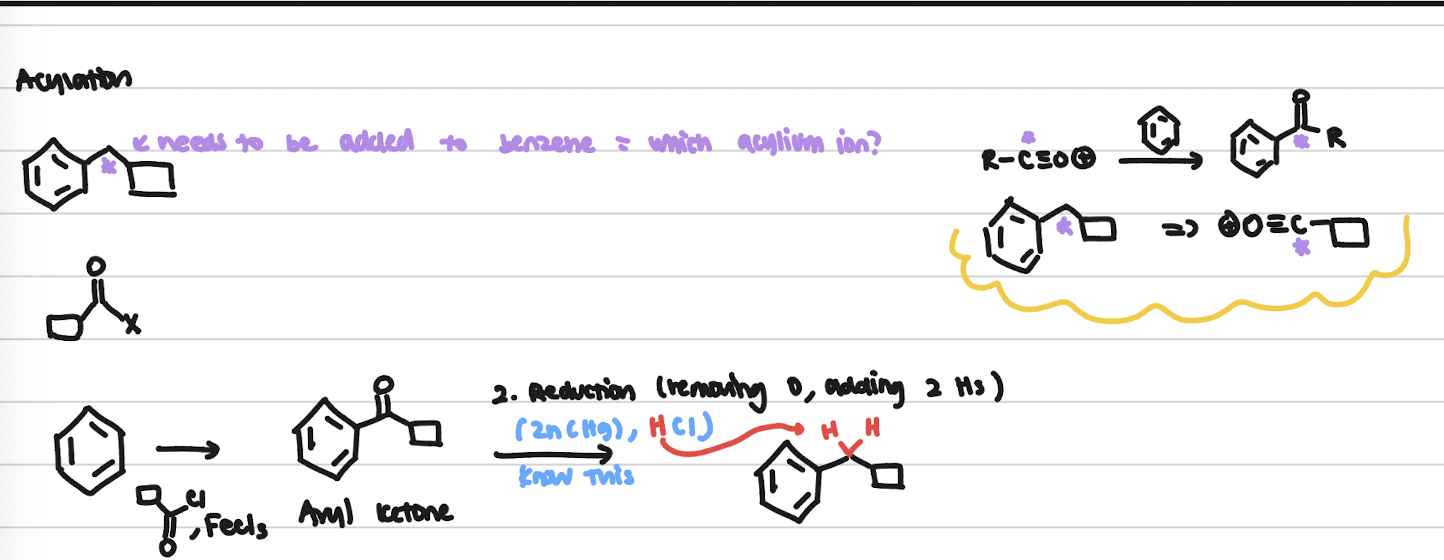
What are the reagents and steps of acylation?
For acylation, an acyl group is added to a substrate molecule.
Overall, the LG bound to the acylium group attacks a Lewis acid, and then, with resonance from the oxygen, an acylium ion is formed as it kicks out the activated leaving group.
The benzene attacks the acylium ion at the carbon to put the lone pair back on oxygen and to make it neutral. The Br-AlBr3 (-)’s Br-Al bond acts as a base to deprotonate H and rearomatize.


Fix synthesis
Approach:
1) Draw the actual product first
2) State the issue
3) Fix the issue
In this case, the actual product is a cyclopentane bonded to the benzene ring, because as the activated leaving group leaves, there is rearrangement to avoid an unfavorable primary carbocation. To fix it, do acylation and then reduction.
The purple starred carbon needs to be added to the benzene ring. Remember, you can use an acylium ion! This is C=O where the C is bonded to an R group and a leaving group.
Make the leaving group anything (in this example, we have Cl), and then have it with a lewis acid in order to activate it. Then, as the leaving group leaves, O resonates to form a acylium ion. The benzene would attack the c bonded to O.
To get to the final structure, use Zn (Hg), and HCl. This basically makes an aldehyde or ketone into an alkane (replaces with hydrogens).
Always keep in mind which carbon is of interest, or where the reaction occurs.
EAS can be directed by group(s) on the aromatic ring. How do you figure this out?
Figure it out with resonance.
A. Original molecule nucleophilicity (delta - on ring)
B. Look at the arenium ions (benzene with E and carbocation)
Remember, the importance ranks like:
Filled octets
Number of contributors
Quality (filled octets > no charges > charges match EN > charge distance)
Sigma bond hyperconjugation (tertiary, secondary, primary carbocation)
Inductive effective, coulombic considerations

How does this reaction proceed?
Phenol should do EAs where carbons are partially negative. Use resonance to analyze nucleophilicity!
Start resonance at the oxygen and put the - on the carbon. Then, continue moving that - charge around the benzene structure to see which carbons hold a - charge. Remember, start with a lone pair and end with a lone pair
Negative charges are placed on ortho and para positions. This makes these positions the most nucleophilic, or where the super electrophile will attach.
Once you attack the H next to the super electrophile, resonance will put the lone pair back on O, and the ring will rearomatize, so the final product just shows E on the most nucleophilic sites.


Cyanobenzene
This time, when doing resonance itll put the lone pairs on N and the pi bond from the benzene will move into the cyano group. This will make carbocations around the ring (places the E+ wont attach)
The carbocations are at the ortho and para, so the E+ must only attach on the meta locations.
The phenol reaction would however be faster because its the better nucleophile and it could put the - on multiple locations around the benzene.


Toulene and rate analysis for arenium formation
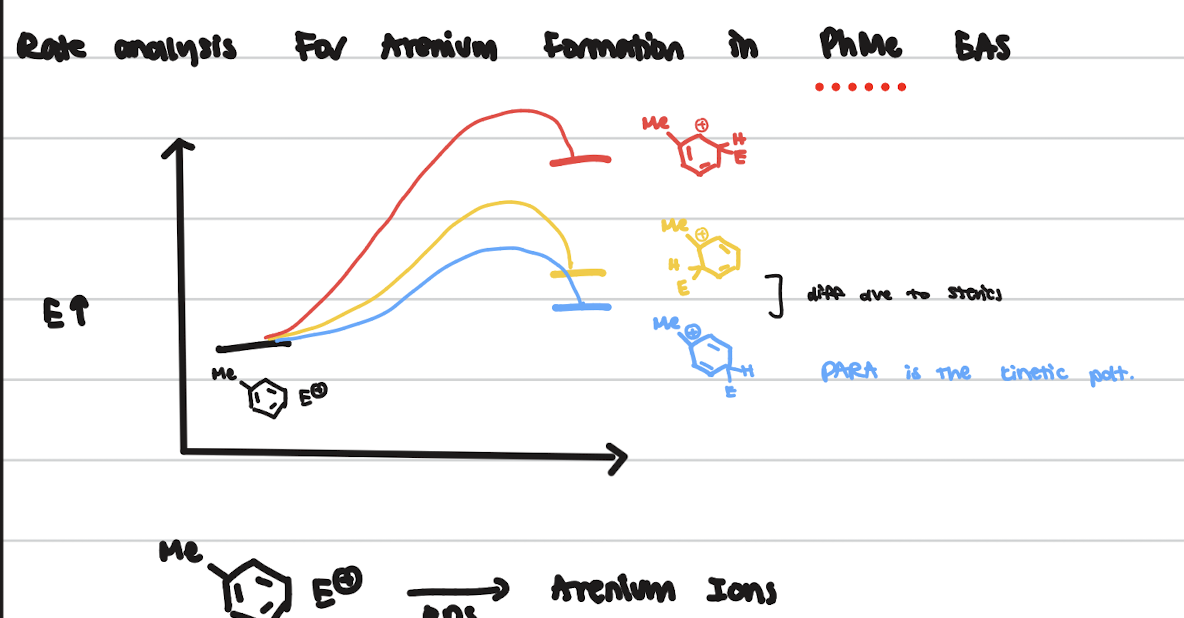
For toulene, there can’t be resonance so evaluate using the arenium ion by placing E on ortho, meta, or para location, and then doing resonance. For analysis:
Filled octets: none
the number of contributors are the same → each have 3
Quality (filled octet → charges → EN → distance): same
Sigma hyperconjugation: ortho and para have tertiary character so they’re lower in energy than meta. However, para is even lower energy than ortho because there’s less sterics → para is the kinetic product.

Trifluoromethyl benzene and energy analysis
For this, there’s no resonance but there is inductive effect! When placing the E on ortho, meta, or para locations, there is repulsion when the carbocation is placed next to the fluoromethyl group because the c is partially positive.
Ortho and para are not stable because there is repulsion (while the + can move around the benzene, we look at one snapshot where the + is most stabilized, which is at its tertiary location)
This puts meta at the lowest energy, and the para second highest, and then ortho highest (bc sterics)

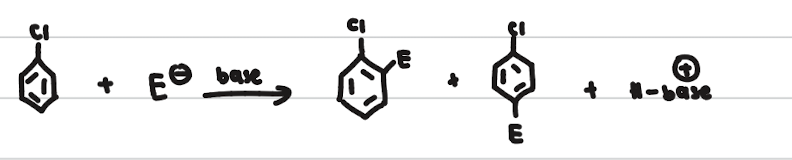
Justify the observed reactivity. Why is it surprising? Analyze the arenium ion
The super electrophile is attached at the ortho and para locations. This is because there is a dipole in the C-Cl bond, which makes the carbon bonded to the Cl partially positive. Thus, there is repulsion at the position that puts the positive charge at that carbon. However, if you use cl’s lone pairs to make double bond, you get filled octets.
With meta, there is no way the + will go on the carbon bonded to Cl, so there will not be filled octets with resonance from the Cl’s lone pairs.
How do you go from a carbonyl to CH2 and from nitrobenzene to aniline?
For both: Zn (Hg), HCl.
The aniline group can undergo an acid-base reaction with HCl, forming NH3+.


What are the steps to go from aniline to diazonium?
Essentially, the first step is to draw NaNO2, which is ionic, as two separate ions, and have the oxygen attack HCl’s proton twice in order to get a good leaving group (H2O). Then, do resonance with the other oxygen to kick out the LG. This water will be used as a base later on.
The aniline group then attacks the N-O group and resonates the pi bond back onto oxygen. The H2O then deprotonates the aniline-N-O group. Then, the O on the aniline-N-O group deprotonates the oxonium group, and the resulting water deprotonates the H of the aniline to create oxonium again. Then, the oxygen of the aniline-N-OH attacks the oxonium to make a good Lg, and then the N resonates into the other N to kick off the water.

What is a nucleophilic aromatic substitution? (NAS, SNAr)
This reaction has the aromatic ring as the electrophile.
A. Diazonium chemistry
B. Addition/elimination
Diazonium chemistry
The +N2 is a good Lg, and so it leaves the benzene with an empty C, sp2 orbital that has a positive charge. This can react with various nucleophiles, including ROH, -CN, -X, and RSH, which essentially results in benzene substituted with OH, CN, X, and SR. Nuc has to be very strong (preferred to have -, and limit is neutral N because benzene is very stable).

How do you get to the products?
The first step makes NO2, which adds to the benzene. Then, the NO2 becomes NH2. Then, with NaNO2 and 2HCL, the diazonium is created, and then, since N2 is a good leaving group, the nucleophile attacks and N2 leaves.

Addition/Elimination
In this reaction, overall, the nucleophile replaces the Lg and kicks it out, taking its position.
For SN2: sigma c-LG and nb, nuc. Our nuc can’t reach into the ring due to sterics. RA is the resonance acceptor.
Molecule needs at least one RA (ie. ketone, cyano, nitro, N) to accept pi electrons from the aromatic ring. Nuc has to be strong (ie. -CN, -N3, -RO, -R3) because it breaks aromaticity.

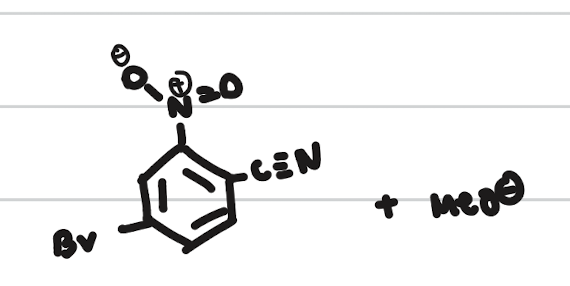
Draw the mechanism
The nucleophile can’t do SN2 because it can’t reach into the ring due to sterics. The LG in this situation is the Br, so we know the nuc has to attack that carbon and resonate into a resonance acceptor. There’s 2 candidates, but only the cyano works. With resonance going backwards as aromaticity reforms, the Br Lg is kicked out.

Kinetic PDT dictated by RDS → Predict SnAr products and Lg(s)
Approach:
1) Attack each carbon bonded to a LG to see if the resonance acceptor works.
2) If there are two that work, then look at dipole between the LG and C → the greater the dipole, the better the Lg is at leaving.
Kinetics are most affected by the partial positive on the electrophilic C. C-F has the largest partial positive, so its the easiest to attack.


Predict SM
Notice firstly that OTs is a good leaving group, and the the H2NMe2 must have been acting like a base. If its a SnAr, it means the product replaced OTs w something. Since there is excess HNME2 and we see the product has a H2NMe2, this means they reacted with each other and the thing that replaces OTs must be -NMe2.
Next, see where the ring is partially positive due to the resonance acceptor. There are two possible positions that the -NMe2 could have attacked (where the two NMe2’s are). The only RA is N, so resonate both positions back to the N. If we did the bottom one, it would just circulate the pi bonds in a circle so this is not the answer. It must be the top one!
As a though experiment, have the LG attack the carbon with the nucleophile! This helps to see the connectivity of the RA. Your goal is to ultimately get the lone pair on N.

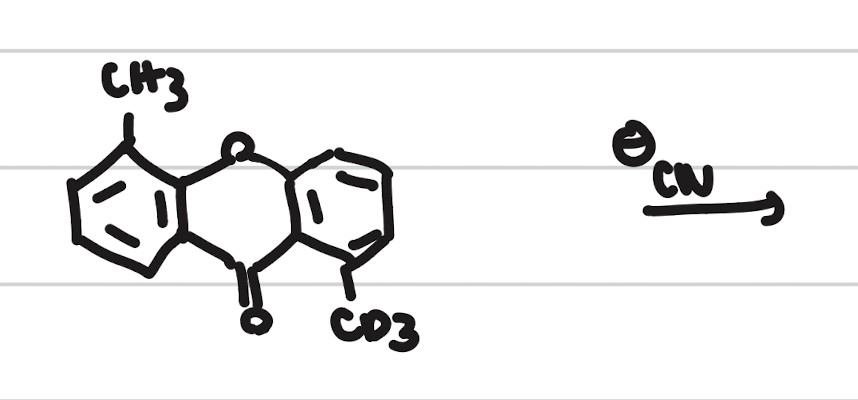
Guess product and show mechanism and justify Lg
Think first which group could be the leaving group. It cannot be methyls because -ch3 is NOT stable. Next, the ketone O is not a leaving group because by resonance itll just make a carbocation attached to O-, but everything is still attached. The only Lg is the O, as you can make the bond become a lone pair on it.
The nucleophile must attach to the C bonded to the Lg, so itll attach either to the left or right of the c bonded to O depending on how it connects to the RA. The only possible RA is the ketone oxygen.
Phenolate is a good leaving group bc the conjugate acid pka is less than 10. Phenol pka is 10 but its slightly lower in this form because of the ketone RA.
In the last step, use the RA and do resonance with it in the same places but backwards to kick out the leaving group.


Predict SM
The n bonded to the cyclic propane must be the group that replaces the LG. Since theres two cl-, these must be the leaving group! The 2 +H3N-cyclopropane indicate that these groups reacted twice in acid base to deprotonate.
Theres two possible resonance acceptors so attack the c bonded to the cl and move up the electron density to the RA. Do resonance backwards to kick out LG, then do acid base to neutralize the attached N. The neutralized N then attacks the second carbon attached to the other cl LG, and uses the ketone as an RA. Resonance pushes it back and kicks out Cl. Then, acid base happens again to deprotonate the N.
