MCB CH5 ex2
 Call Kai
 Learn
Learn Practice Test
 Spaced Repetition
 Match
Match Flashcards
 Knowt Play
1/55

There's no tags or description
Looks like no tags are added yet.
Name | Mastery | Learn | Test | Matching | Spaced | Call with Kai | Chat |
|---|
No analytics yet
Send a link to your students to track their progress
56 Terms
metabolism
Collect of controlled biochem react that take place within microbe
Ultimate funct of metabolism is to reproduce the organism
Metabolic processes guided - 8 Elem Statements
Every cell acquires nutrients
Metabolism req energy from light (PHOTOTROPE) / catabolism (CHEMOTROPE) of nutrients
Energy stored in ATP
Cells catabolize nutrients to form precursor metabolites
Precursor Metabolites, energy from ATP, and enzymes are used in anabolic reactions
Enzymes plus ATP form macromolecules
Cells grow by assembling macromolecules
Cells reproduce once they doubled in size
Catabolism & Anabolism
2 major class of metabolic reactions
Catabolic path:
Break larger molecules > smaller prod
Exergonic (release energy)
Anabolic path:
Synthesize large molecules from small prod of catabolism
Endergonic (require more energy than released)
oxidation & reduction react
Transfer of electrons from electron donor > electron acceptor
Reaction always occur simultaneously
Cells use electron carriers to carry electrons (often H atoms)
3 important electron carriers:
Nicotinamide adenine dinucleotide (NAD+)
Nicotinamide adenine dinucleotide Phosphate (NADP+)
Flavin adenine dinucleotide (FAD)
“LEO THE LION GOES GRR”
L E O — lose electron oxidized(lost elect so more +)
G E R —gain electron reduced( more -)

ATP production & energy storage

Roles of Enzymes in Metabolism
Enzymes are organic catalysts → Speed up Chem React
increases likelihood of reaction
Name & Classify Enzymes
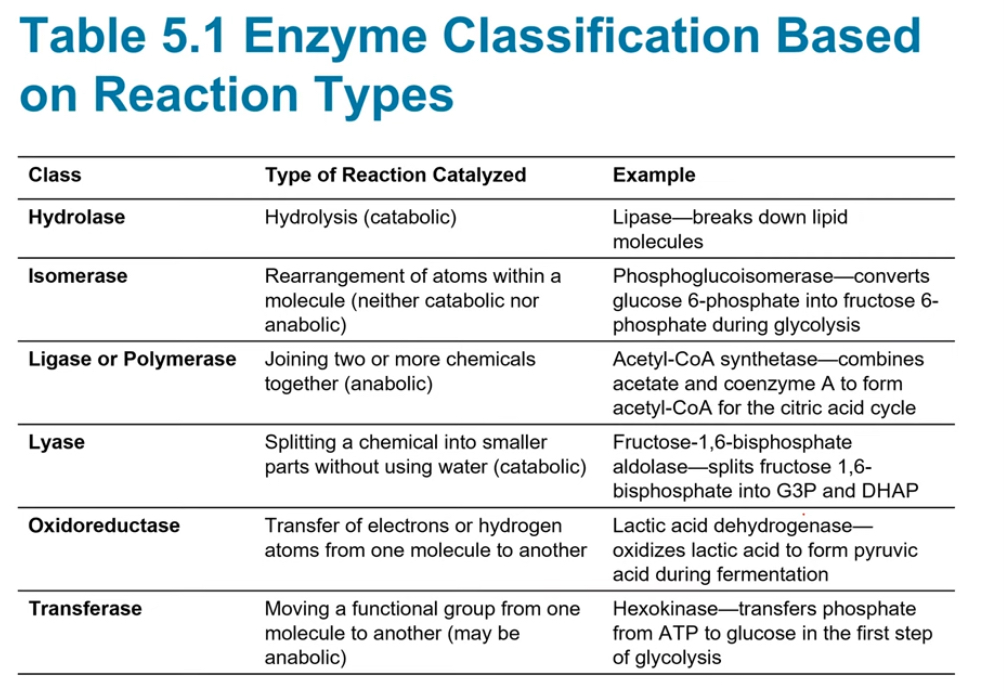
(6) enzymes based on mode of action:
Hydrolases — splitting molecules apart H2O
Isomerases — Rearranging atoms in molecule
Ligases/ polymerases — sealing / joining together “superglue”, DNA Ligases
Lyases — seperation
Oxidoreductases — transferring electron from 1 molecule → another ex: NADH → NAD+
Transferases — moves functional group from one molecule to another group
Enzyme Class based on Reaction
Role of enzymes in metabolism
Makeup of enzymes
Many protein enzymes complete in self
Apoenzymes are inactive if not bound to nonprotein cofactors (inorganic ions or coenzymes)
Bind of apoenzyme + its cofactor(s) yields holoenzyme
Some RNA molecules called ribozymes
Holoenzyme makeup

Cofactors of Enzymes

Process of Enzymatic Activity

Enzymes in Metabolism
Enzyme activity
Many factors influence rate of enzymatic reactions:
Temperature
pH
Enzyme + Substrate concentrations
Presence of inhibitors
Enzyme activity Activators
Control of enzymatic activity
Activators
Some enzymes activated when cofactor binds to side other than active site
Allosteric Activation

Enzyme activity Inhibitors
Control of enzymatic activity
Inhibitors
Substances that block an enzyme’s activity
Include competitive (binds to ACTIVE site) and noncompetitive inhibitors (binds to ALLOSTERIC site)
Feedback inhibition controls action of some enzymes (change of shape through enzyme)
Noncompetitive inhibition @ Allosteric site

Allosteric Activation visual

Feedback inhibition visual

Carbohydrate Catabolism
Many organisms oxidize carbohydrates - primary energy source for anabolic reactions
Glucose is most common carb used
Glucose catabolized by 2 process:
Cellular respiration & Fermentation (anaerobic)
Aerobic respiration — oxygen as terminal e- acceptor
Anaerobic respiration — absence of oxygen, use terminal e- acceptor (Fumerate, Nitrate, Sulfate)
Glycolysis process
Glucose → Glucose-6-Phos → Fructose-6-Phos →
ATP→ ADP^ (consume ATP to prod ADP)—^
→ Fructose 1,6 Bis Phos -v
>DHAP AND→ >G3P(→ 1,3 BPGA, → 3PGA, → 2PGA, → PEP → Pyruvate
Remember
For every NADH → 3 ATP
For every FADH2 → 2 ATP

Glycolysis Stages
Divides Into 3 stages involving 10 total steps
Energy-investment stage
Lysis stage
Energy-conserving stage
Cellular respiration
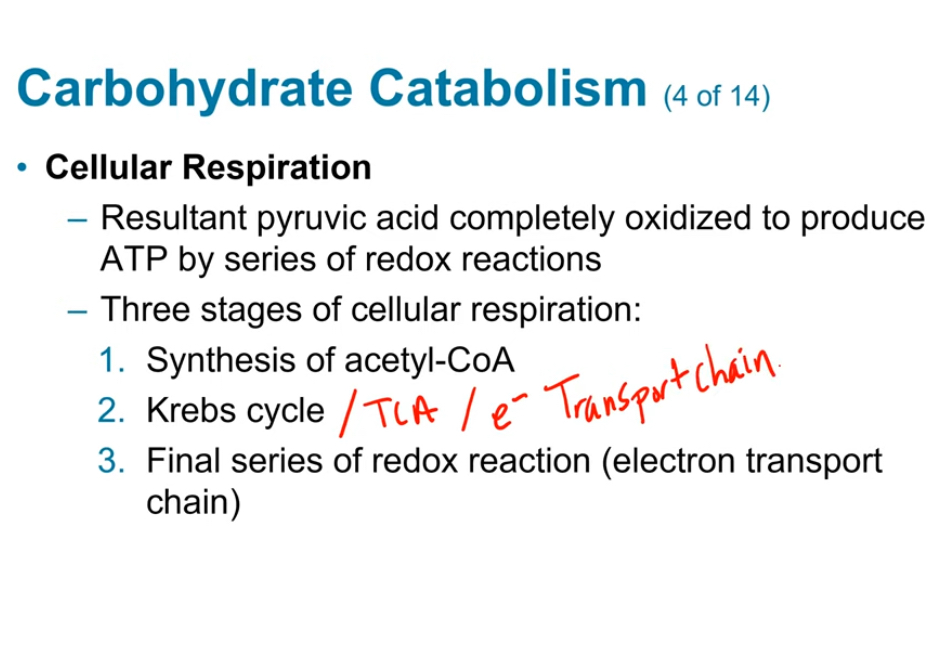
Result pyruvic acid completely oxidized to produce ATP by series of redox reactions
3 stages of cellular respiration:
Synthesis of acetyl-CoA
Kreb’s cycle
Final series of redox reaction (electron transport chain)
Synthesis of acetyl-C o A
(Cellular Respiration)
Results in:
–Two molecules of acetyl-C o A
–Two molecules of C O2
–Two molecules of N A D H
Krebs cycle Info
(Cellular Respiration)
▪Great amount of energy remains in bonds of acetyl-C o A
▪Transfers much of this energy to coenzymes N A D+and F A D
▪Occurs in cytosol of prokaryotes and in matrix of mitochondria in eukaryotes
Krebs cycle reactions
(Cellular Respiration)
Six types of reactions in Krebs cycle:
–Anabolism (of citric acid)
–Isomerization
–Redox reactions
–Decarboxylations
–Substrate-level phosphorylation
–Hydration
Krebs cycle result
(Cellular Respiration)
Results in:
–Two molecules of A T P
–Two molecules of F A D H2
–Six molecules of N A D H
–Four molecules of C O2
Electron Transport
(Cellular Respiration)
▪Most significant production of A T P occurs from series of redox reactions known as an electron transport chain (E T C)
▪Series of carrier molecules that pass electrons from one to another to final electron acceptor
▪Energy from electrons used to pump protons (H+) across the membrane, establishing a proton gradient
▪Located in inner mitochondrial membrane of eukaryotes and in cytoplasmic membrane of prokaryotes
Electron Transport Categories
(Cellular Respiration) DO NOT NEED TO MEMORIZE (4)
▪Four categories of carrier molecules:
–Flavoproteins
–Ubiquinones
–Metal-containing proteins
–Cytochromes
Vvvvv
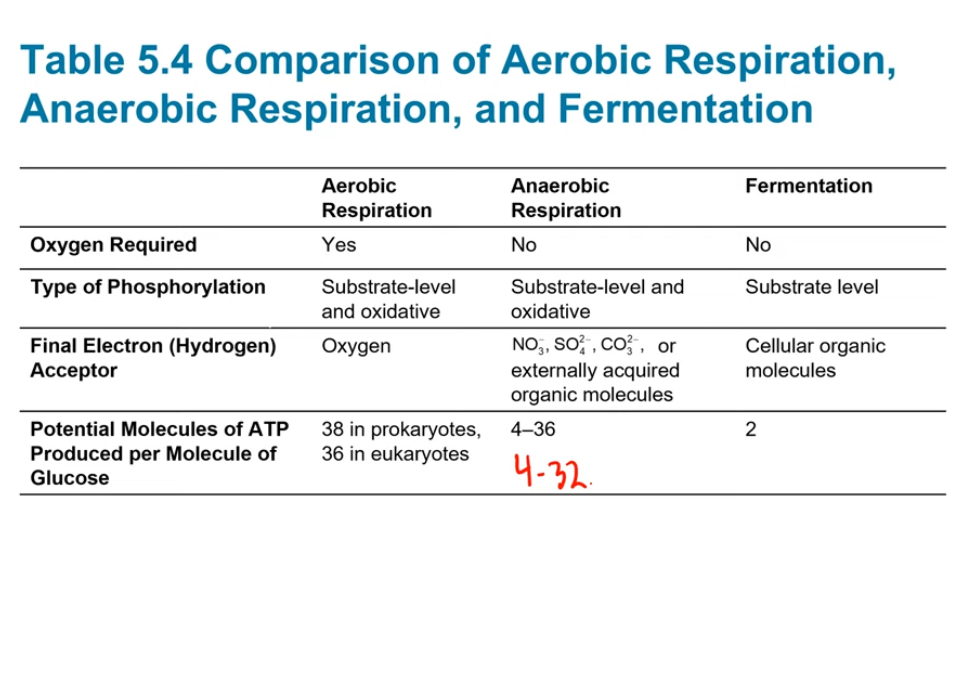
▪Aerobic respiration: oxygen serves as final electron acceptor.
▪Anaerobic respiration: molecule other than oxygen serves as final electron acceptor.

Chemiosmosis
(Cellular Respiration)
▪Use of electrochemical gradients to generate A T P
▪Cells use energy released in redox reactions of E T C
to create proton gradient.
▪Protons flow down electrochemical gradient through AT P synthases that phosphorylate A D P to A T P.
▪Called oxidative phosphorylation because proton gradient is created by oxidation of components of E T C
▪Total of ~34 A T P molecules formed from one molecule of glucose
Metabolic Diversity
–Entner-Doudoroff (E D) pathway
▪Some bacteria substitute this pathway for the E M P pathway.
▪Discovered only in prokaryotes
▪E D pathway produces only one A T P, N A D H, and N A D P H.
–Pentose phosphate pathway
▪Alternative to glycolysis
▪Less energy efficient than glycolysis
▪Produces precursor metabolites and N A D P3H
–Used to make D N A nucleotides, steroids, fatty acids
Fermentation
Sometimes cells cannot completely oxidize glucose by cellular respiration.
–Cells require constant source of N A D+.
▪Cannot be obtained simply using glycolysis and Krebs cycle
–Fermentation pathways provide cells with alternative source of N A D+.
▪Partial oxidation of sugar (or other metabolites) to release energy using an organic molecule from within the cell as final electron acceptor
Lipids and proteins contain…
…energy in their chemical bonds.
–Can be converted into precursor metabolites
–Serve as substrates in glycolysis and the Krebs cycle
Photosynthesis
•Many organisms synthesize their own organic molecules from inorganic carbon dioxide.
•Most of these organisms capture light energy and use it to synthesize carbohydrates from C O2 and H2O by a process called photosynthesis.
Chlorophylls
(Photosynthesis)
▪Important to organisms that capture light energy with pigment molecules
▪Composed of hydrocarbon tail attached to light-absorbing active site centered on magnesium ion
–Active sites structurally similar to cytochrome molecules in E T C
▪Structural differences cause absorption at different wavelengths.
Photosystems
(Photosynthesis)
▪Arrangement of molecules of chlorophyll and other pigments to form light-harvesting matrices
▪Embedded in cellular membranes called thylakoids
▪In prokaryotes—infolding of cytoplasmic membrane
▪In eukaryotes—formed from inner membrane of chloroplasts
▪Arranged in stacks called grana
▪Stroma is space between outer membrane of grana and thylakoid membrane.
Two types of photosystems
▪Photosystem I (PS I)
▪Photosystem II (PS II)
–Photosystems absorb light energy and use redox reactions to store energy in the form of A T P and N A D P H.
–Light-dependent reactions depend on light energy.
–Light-independent reactions synthesize glucose from carbon dioxide and water.
Light-Dependent Reactions
–As electrons move down the chain, their energy is used to pump protons across the membrane.
–Photophosphorylation uses proton motive force to generate A T P.
–Photophosphorylation can be cyclic or noncyclic.
Light-Independent Reactions
–Do not require light directly
–Use A T P and N A D P H generated by light-dependent reactions
–Key reaction is carbon fixation by Calvin-Benson cycle
▪Three steps:
1.Fixation of C O2
2.Reduction
3.Regeneration of R u B P
Other Anabolic Pathways
Anabolic reactions are synthesis reactions requiring energy and a source of precursor metabolites.
•Energy derived from A T P from catabolic reactions
•Many anabolic pathways are the reverse of catabolic pathways.
–Reactions that can proceed in either direction are amphibolic.
Integration and Regulation of Metabolic Function 1
•Cells synthesize or degrade channel and transport proteins.
•Cells often synthesize enzymes only when substrate is available.
•Cells catabolize the more energy-efficient choice if two energy sources are available.
•Cells synthesize metabolites they need, cease synthesis if metabolite is available.
Integration and Regulation of Metabolic Function 2
•Eukaryotic cells isolate enzymes of different metabolic pathways within membrane-bounded organelles.
•Cells use allosteric sites on enzymes to control activity of enzymes.
•Feedback inhibition slows/stops anabolic pathways when product is in abundance.
•Cells regulate amphibolic pathways by requiring different coenzymes for each pathway.
Two Types of Regulatory Mechanisms
–Control of gene expression
▪Cells control amount and timing of protein (enzyme) production.
–Control of metabolic expression
▪Cells control activity of proteins (enzymes) once produced.
Summary of Glucose Catabolism

E- Transport Chain Overview

Possible Arrangement E- trans chain

Ideal Prokaryotic Aerobic Respiration

Aerobic, Anaerobic, and Fermentation
Fermentation Products

Fat
(FATS) 6 NADH, 6 FADH — total 9 Acetyl CoA → TCA cycle
For every turn of TCA cycle, Generate 3 NADH, 1 FADH2, 1 ATP

TCA cycle & Acetyl CoA
For every turn of TCA cycle, Generate 3 NADH, 1 FADH2, 1 ATP

Pt2 Fat metabolism w/ TCA


Breakdown Glycerol Molecule
at end -1 ATP, so = 2 ATP, 5 NADH, 1 FADH2
^ 5 × 3 = 15 ATPs
^ 1 × 2 = 2 ATP
= 19 ATP

Lipid Catabolism End Result
At end, 157 total ATP
