ECON 101 - Midterm Exam #2
 Call Kai
 Learn
 Practice Test
 Spaced Repetition
 Match
 Flashcards
 Knowt Play
1/289

There's no tags or description
Looks like no tags are added yet.
290 Terms
(Lesson 8 Notes) What is MACROECONOMICS?
Macroeconomics is the study of the economy as a whole (as opposed to specific markets or decisions of individual people and firms)
(Lesson 8 Notes) GDP
How do we measure “the economy”?
Gross Domestic Product (GDP)
(Lesson 8 Notes) GDP
What is GDP?
the market value of all final goods and services produced in a country in a year
market value: not quantities, but what output is worth at market prices
final goods and services: bought for use by their final user (eg. NOT intermediate goods)
produced: production, not sales
in a country: within a country’s borders
(Lesson 8 Notes) GDP
Describe GDP over the years.

(Lesson 8 Notes) GDP
GDP = _____ __________ = _____ ______
Total Production
Total Income
(Lesson 8 Notes) GDP = Total Production = Total Income
Draw the CIRCULAR FLOW DIAGRAM to show how households and businesses are linked.

(Lesson 8 Notes) GDP = Total Production = Total Income
What is the EXPENDITURE METHOD?
add up spending on goods and services
(Lesson 8 Notes) GDP = Total Production = Total Income
What is the INCOME METHOD?
add up income generated by production
(Lesson 8 Notes) GDP = Total Production = Total Income
What is the VALUE-ADDED APPROACH?
add up additional value created in each stage of production process
(Lesson 8 Notes) Components of GDP (expenditure methods)
Write the equation for GDP.
Y (GDP/output/income) = C (Consumption Spending) + I (Household Spending) + G (Government Spending) + NX (Net Exports)
(Lesson 8 Notes) Components of GDP (expenditure methods)
What is CONSUMPTION SPENDING?
household spending on goods and services
(Lesson 8 Notes) Components of GDP (expenditure methods)
What is HOUSEHOLD SPENDING?
firm spending on capital goods (factories, buildings, machinery, etc.) AND change in inventories (goods produced but not sold)
(Lesson 8 Notes) Components of GDP (expenditure methods)
What is GOVERNMENT SPENDING?
government purchases of goods and services
doesn’t include transfer payments → government writing checks to people
(Lesson 8 Notes) Components of GDP (expenditure methods)
What are NET EXPORTS?
Exports - Imports (X - M)
(Lesson 8 Notes) Measuring GDP: The Value-Added Methods
What is VALUE ADDED?
the market value that a firm adds to a product from its origins through each intermediate stage, to its final stage
(Lesson 8 Notes) Measuring GDP: The Value-Added Methods
Example: A Cup of Coffee, P = $1.90 → Calculate the value added using the value-added method.
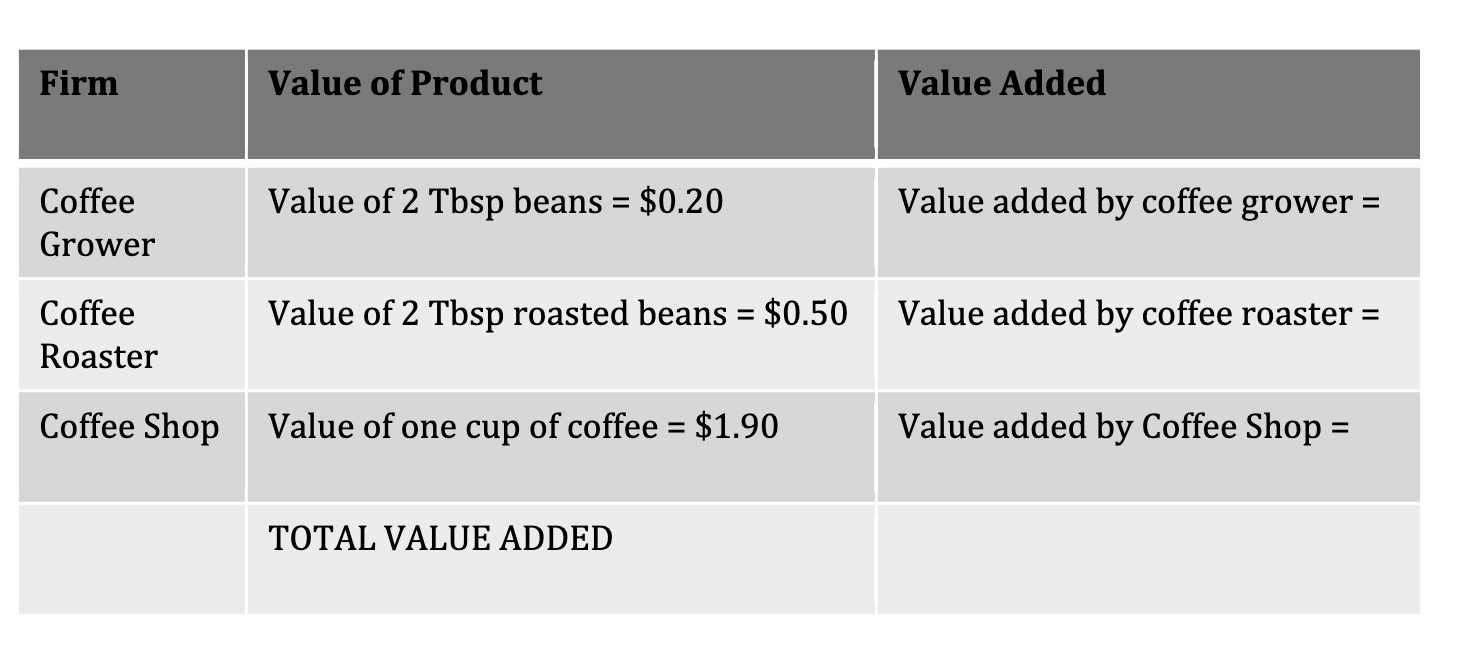

(Lesson 8 Notes) Measuring GDP: The Value-Added Methods
Example: A Cup of Coffee, P = $1.90 → Use the income method to find total value added by the coffee.

(Lesson 8 Notes) Limitations of GDP (Poll Everywhere)
Which of the following is an example of an intermediate good?
stocks and bonds purchased by a business executive
a cellular telephone purchased by a college student
a wedding ring purchased by an engineer for his fiancée
tires purchased from Goodyear by General Motors for newly produced electric cars
tires purchased from Goodyear by General Motors for newly produced electric cars
(Lesson 8 Notes) Limitations of GDP (Poll Everywhere)
Which of the following transactions would add to the value of U.S. GDP?
You buy a used car.
You sell your college textbooks from last semester back to the bookstore.
You buy a UNC shirt from student stores that was made in Bangladesh.
You buy a cup of coffee from the Open Eye Cafe.
You buy a cup of coffee from the Open Eye Cafe.
(Lesson 8 Notes) Limitations of GDP (Poll Everywhere)
Which of the following is not a limitation of GDP as discussed in the textbook?
Prices do not actually measure value
Non-market activities are not counted
The value of labor is not included
The value of leisure is not included
Environmental degradation is not counted
The shadow economy is not counted
GDP ignores distribution
The value of labor is not included
(Lesson 8 Notes) GDP
What is GDP PER CAPITA?
= GDP per person = GDP / population
→ This allows us to conceptualize a very large number and also compare “living standards” across countries
(Lesson 8 Notes) GDP as a Measure of Well-Being
Is there a positive or negative correlation between GDP and average life satisfaction?
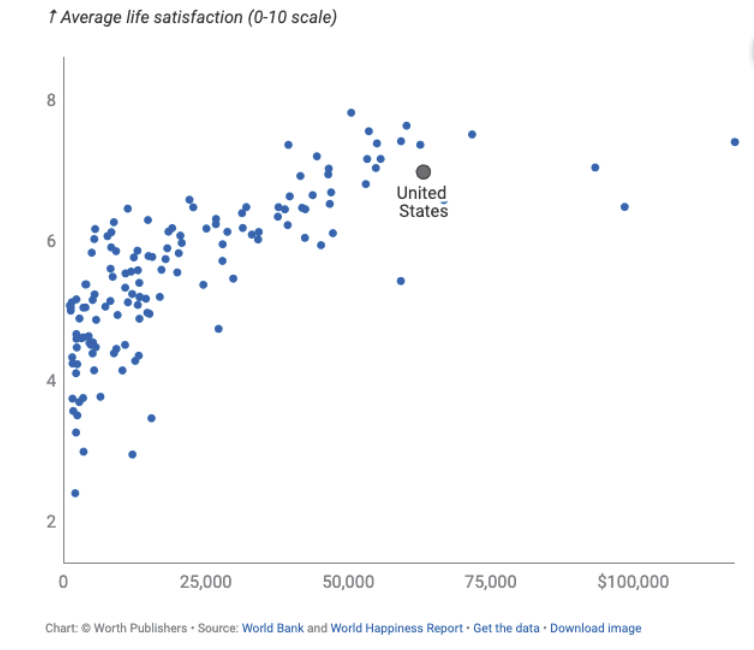

(Lesson 8 Notes) GDP as a Measure of Well-Being
Is there a positive or negative correlation between GDP and average years of schooling?
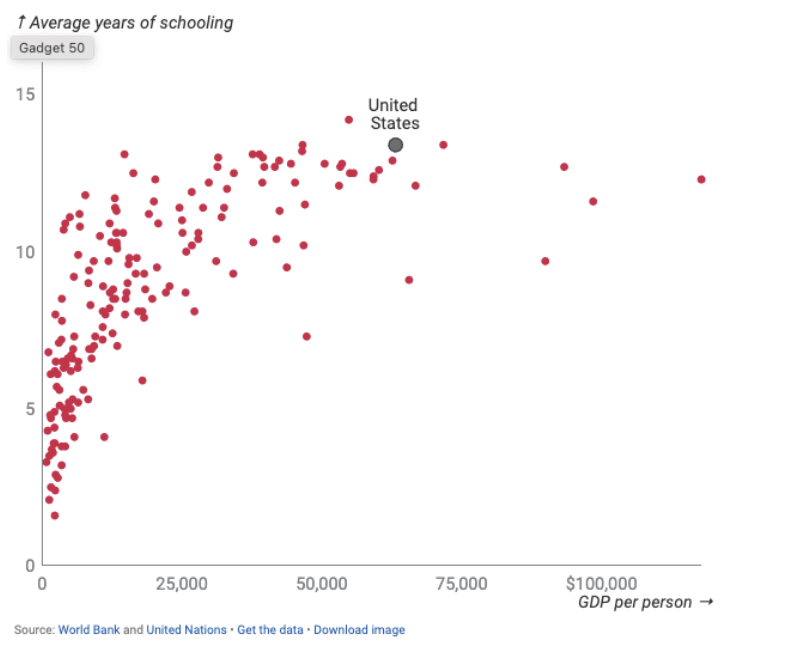

(Lesson 8 Notes) GDP as a Measure of Well-Being
Is there a positive or negative correlation between GDP and infant mortality?

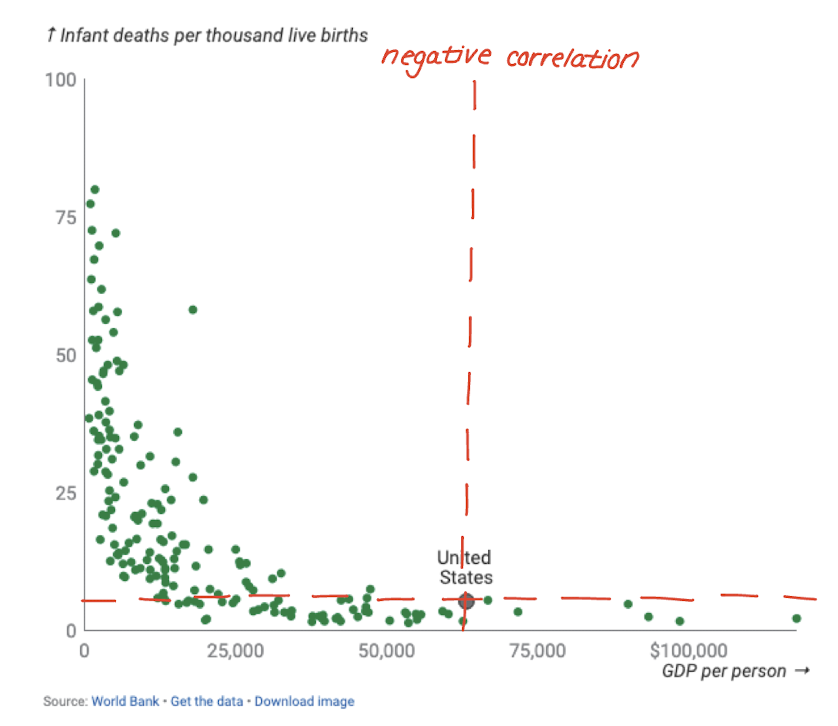
(Lesson 8 Notes) GDP as a Measure of Well-Being
Is there a positive or negative correlation between GDP and life expectancy at birth?
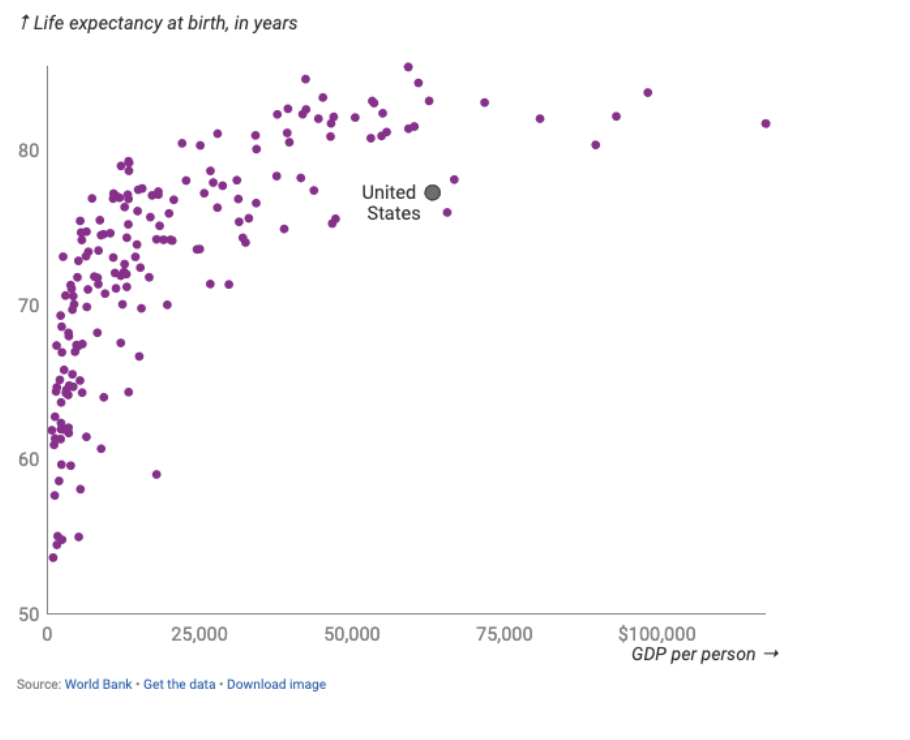

(Lesson 8 Notes) Alternative Measure of Production and Income
What are the alternative measures?
GDP = value of final goods and services produced IN THE US
Gross National Product (GNP) = value of final goods and services produced BY AMERICANS
World Happiness Index (alternative measure of well-being)
3 happiest countries: Finland, Denmark, Iceland, and Sweden
US = 24th (down 15 places from 2 years ago)
3 least happiest countries: Lebanon, Sierra Leone, and Afghanistan
(Lesson 8 Notes) Nominal vs. Real GDP
What is NOMINAL GDP?
Nominal GDP is the value of all final goods and services measured in current year prices.

(Lesson 8 Notes) Nominal vs. Real GDP
What is REAL GDP?
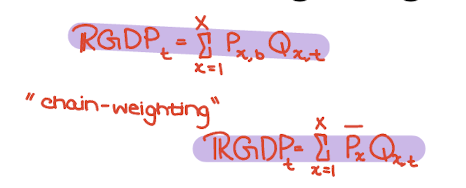
Real GDP is the value of all final goods and services measured in constant prices
Sometimes a base year (= b) will be specified
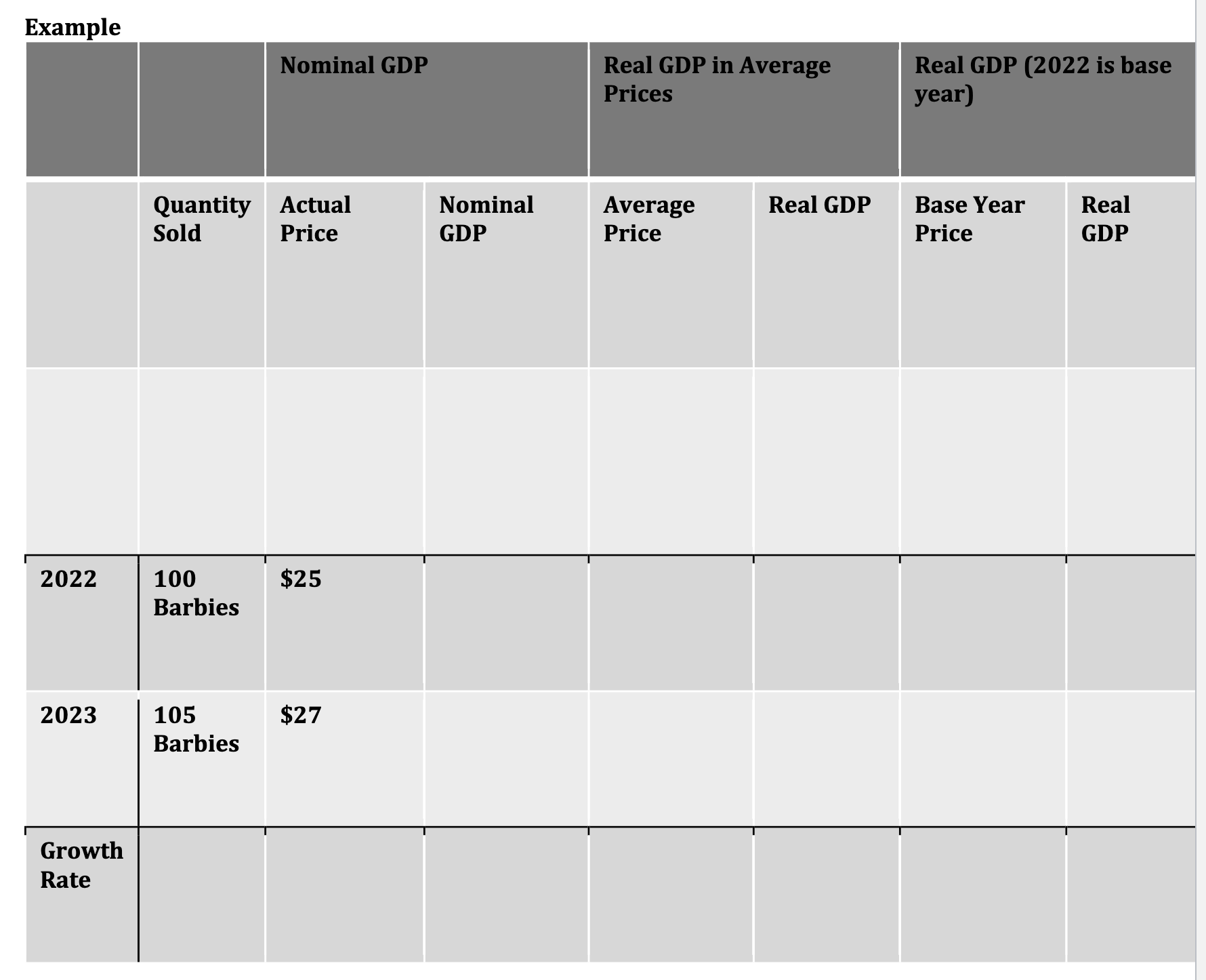
When calculating GDP growth between two years, we use average prices between the two years
(Lesson 8 Notes) Nominal vs. Real GDP
Example: Barbies Sold in 2022 and 2023 → Fill out the chart calculating Nominal GDP & Real GDP.

(Lesson 8 Notes) Conceptualizing Large Numbers
What are some ways to conceptualize large numbers?
Evaluate per person
Compare big numbers to the size of the economy (e.g. deficit spending or national debt as a fraction of GDP_
Compare big numbers to their own history (e.g. measure growth rates)
Use the rule of 70 to evaluate growth rates
(Lesson 8 Notes) The Rule of 70
How long will it take something to double?
70 / g years to double
g = annual growth rate (eg. 2% per year)
eg. 70/2 = 35 years to double (2% growth rate)
(Lesson 9 Notes) The Business Cycle v. Long-Run Growth
Describe the graph.

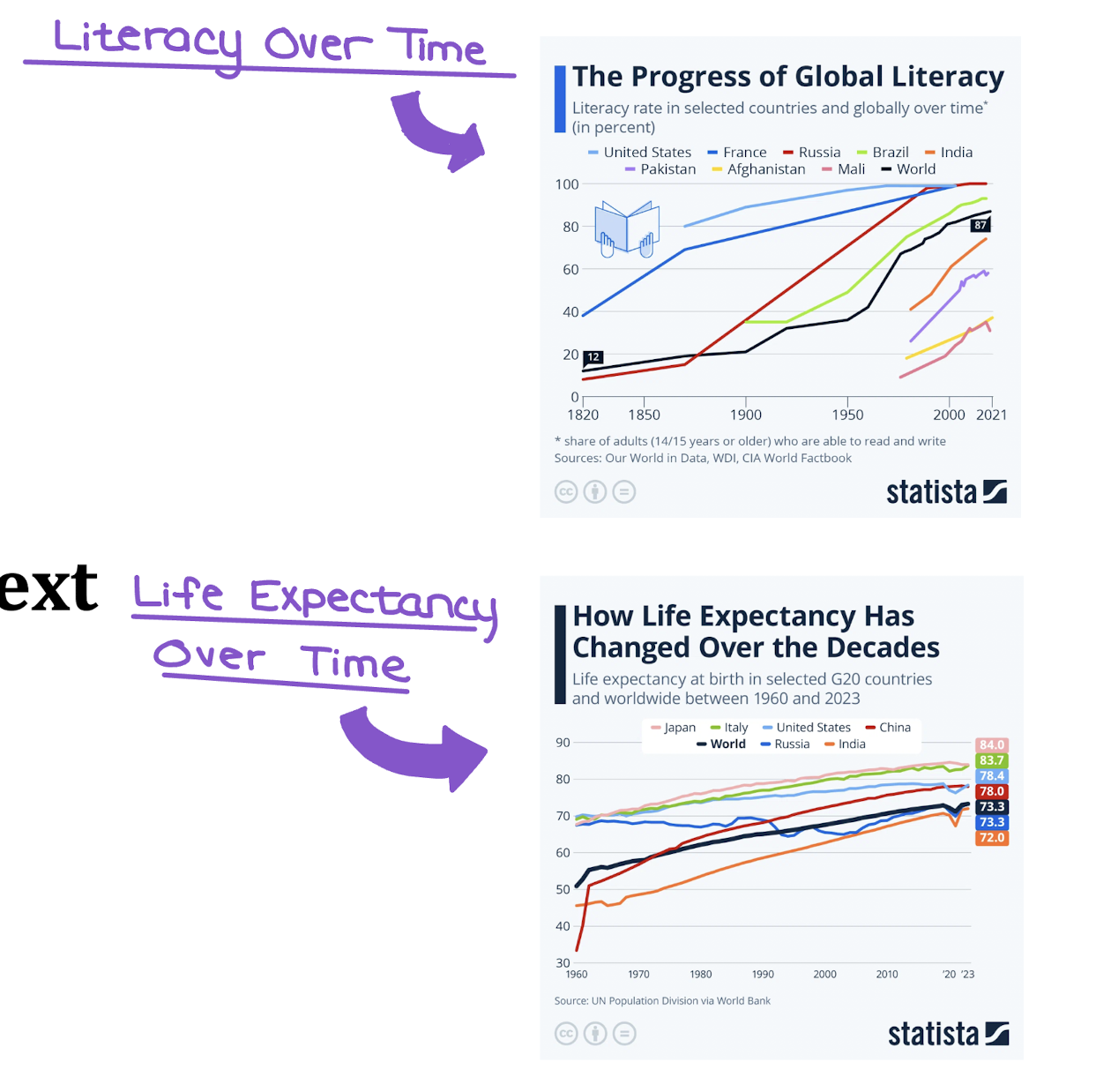
doesn’t go up smoothly…
fluctuations = business cycle (expansion + recession (gray patches))
over time = economic growth (upward trend)
(Lesson 9 Notes) Growth Rates (percentage change)
How do you calculate growth rates between one year and the next?
Growth rate b/w one year (t-1) and the next (t) =

(Lesson 9 Notes) Growth Rates (percentage change)
What does it mean if percent change from year ago of real GDP per capita is above 0 and below 0?

above 0 = real GDP per capital is grow
below 0 = real GDP per capital is dipping
(Lesson 9 Notes) Economic Growth Model
What is ECONOMIC GROWTH?
increasing real GDP per capita (standard of living)
(Lesson 9 Notes) Economic Growth Model
What is PRODUCTION FUNCTION?


(Lesson 9 Notes) Economic Growth Model
What is CONSTANT RETURNS TO SCALE?
increasing all inputs by some proportion will cause output to rise by the same proportion
(Lesson 9 Notes) Economic Growth Model
How can we increase output?
More labor (L) → more workers
More physical capital (K) → equipment, buildings, factories
More human capital (H) → knowledge/skills
Technological progress
(Lesson 9 Notes) The Aggregate Production Function
Draw the graph.
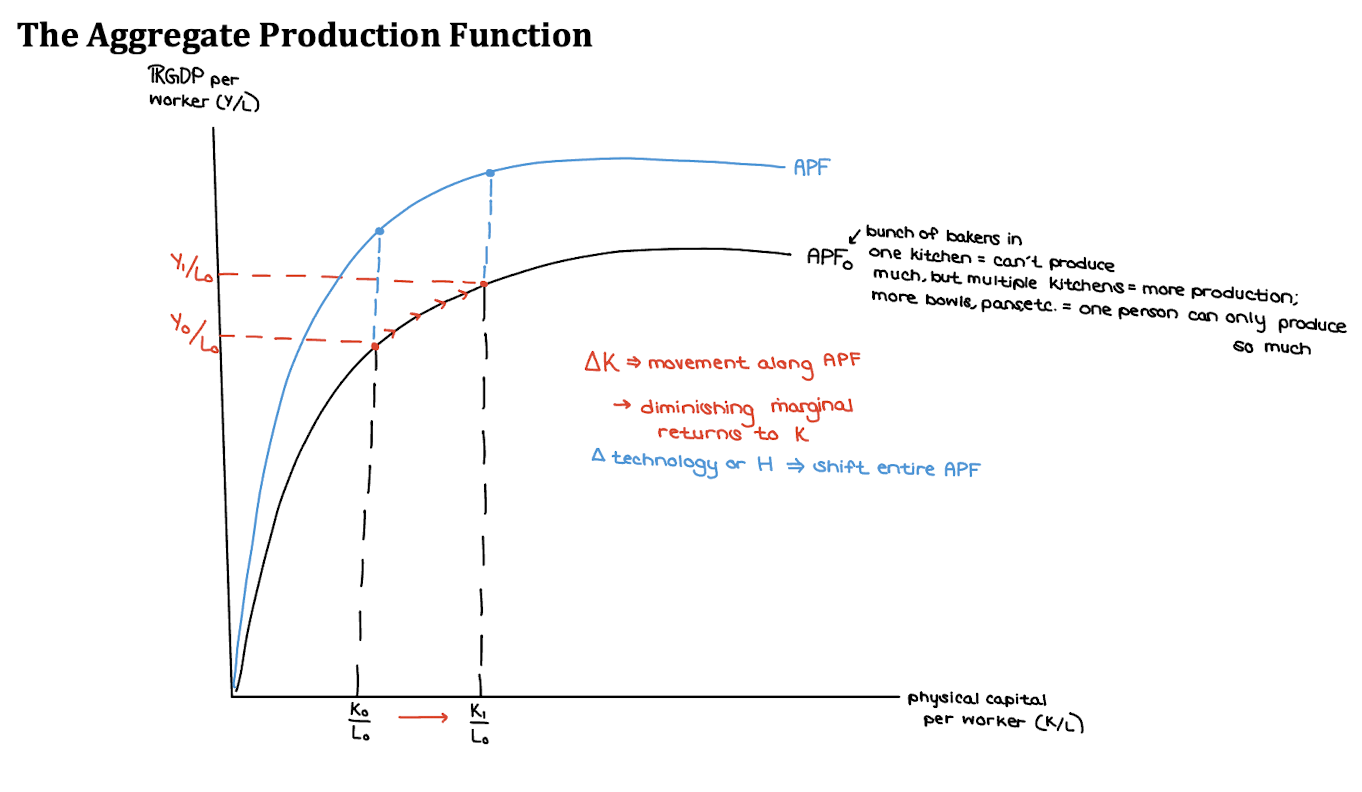
(Lesson 9 Notes) The Aggregate Production Function
What is the LAW OF DIMINISHING RETURNS?
when one input is held constant, increases in the other inputs will, at some point, begin to yield smaller and smaller increases in output
(Lesson 9 Notes) _____________ _________ is the key to economic growth.
Technological progress
(Lesson 9 Notes) Technological Progress
Ideas…
Can be freely shared
nonrival (one person’s consumption doesn’t reduce available amount for others)
Do not depreciate with use (don’t wear out)
Promote other ideas
Can be nonexcludable (can’t prevent use)
(Lesson 9 Notes) Technological Progress
Why do economics fail to grow?
because of governments and institutions
(Lesson 9 Notes) Technological Progress
What factors can encourage innovation and economic growth?
Secure property rights
Political stability and rule of law
Effective (not arbitrary) regulation
Strong R&D innovation policies
Investment in human capital
Investment in physical capital that embodies new ideas
Competition and openness to trade
(Lesson 9 Notes) Technological Progress
What factors can inhibit growth?
Weak or insecure property rights
Political instability, conflict, or high corruption
Bad or unpredictable regulation (red tape)
Poor R&D and education systems
Underdeveloped or decaying infrastructure and capital
Trade barriers and lack of competition
(Lesson 9 Notes) Poll Everywhere
Which of the following is NOT counted as a part of GDP?
the purchase of 100 shares of AT&T stock by your grandmother
the purchase of a snow plough by the city of Minneapolis
the unsold additions to inventory at an appliances store
the purchase of flour by your father
the purchase of 100 shares of AT&T stock by your grandmother
(Lesson 9 Notes) Poll Everywhere
Which of the following accurately describes what happens to US GDP and each of its components?
US GDP increases by $5 million, net exports increase by $2 million, consumption increases by $2 million, and investment increases by $1 million
US GDP increases by $4 million, net exports increase by $2 million, consumption increases by $2 million
US GDP increases by $3 million, net exports decreases by $2 million, consumption increases by $2 million, and investment increases by $1 million
US GDP increases by $1 million, net exports decreases by $2 million, consumption increases by 2 million, and investment decreases by $1 million
There is no change to US GDP, net exports decreases by $2 million and consumption increases by $2 million

US GDP increases by $5 million, net exports increase by $2 million, consumption increases by $2 million, and investment increases by $1 million
(Lesson 9 Notes) Poll Everywhere
If Real GDP is growing at 5% per year, how many years will it take for Real GDP to double?
1400 years
35 years
14 years
3.5 years
It's impossible to say
14 years
(Lesson 9 Notes) Poll Everywhere
Assume the US and the UK both have real GDP per capita of $50,000 today, but the RGDP per capita in the US is growing at 3% per year while in the UK it is only growing at 2% per year. How many MORE years than the US will it take for the RGDP per capita in the UK to reach $100,000.
11.67
14
23.33
35
11.67
(Lesson 9 Notes) Poll Everywhere
Which of the following would NOT be considered technological change?
A dry cleaner buys 2 more steam presses
An accounting firm purchases new software that cuts the time to complete an audit in half
A dry cleaner adopts a more efficient and specialized production technique where they have one employee each sorting, cleaning, pressing, and organizing the garments, and one employee to deal with customers
A dry cleaner buys 2 more steam presses
(Lesson 9 Notes) Poll Everywhere
Based on the reading, which of the following would NOT encourage innovation and economic growth?
Clearly defined and enforced property rights
Regulations that involve large bureaucracies and red tape
Intellectual property laws
Subsidized education
Political stability
Subsidies for research and development
Regulations that involve large bureaucracies and red tape
(Poll Everywhere: Lesson 9 Review) If US GDP is currently $27 trillion, and it were to grow at a constant rate of 1% per year, what would US GDP be after 100 years?
$27.27 trillion
$7303 trillion
$1,890 trillion
$2,727 trillion

(Poll Everywhere: Lesson 9 Review) Which of the following is consistent with a move from point A to point B?

An increase in literacy rates Increased rates of college attendance
Companies replacing their broken copiers
Development of quicker copiers
Companies buying new copiers
Increased rates of college attendance
Tornadoes rip through NC damaging many homes and businesses
Companies buying new copiers

(Lesson 10 Notes: Unemployment) Why do we care about unemployment? The Economic Costs
_____ ___ for decades → loss of ______/____/_____________ _______ ____-_____ __________
Men laid off in a mass layoff lose ___ years of earnings, on average (____ years when the unemployment rate is high)
Lower pay
skills
hope
discrimination against long-term unemployed
1.4
2.8
(Lesson 10 Notes: Unemployment) Why do we care about unemployment? The Economic Costs
What is HYSTERESIS?
a period of. high unemployment leads to a higher equilibrium employment rate → if unemployment spikes, it can stay high for longer
(Lesson 10 Notes: Unemployment) Why do we care about unemployment? The Economic Costs
Explain a squeezed government budget.
The government receives lower tax revenues but spends ore.
(Lesson 10 Notes: Unemployment) Why do we care about unemployment? The Social Costs
What are the SOCIAL COSTS for the UNEMPLOYED?
Less structured days, more stress and isolation
More depression, anxiety, divorce, and poverty
Higher risk of death, including suicide
Permanent earnings losses and more health problems
(Lesson 10 Notes: Unemployment) Why do we care about unemployment? The Social Costs
What are the SOCIAL COSTS for the CHILDREN OF LAID-OFF WORKERS?
Worse academic outcomes
Worse mental health outcomes
Worse employment outcomes, and lower earnings as adults
(Lesson 10 Notes: Unemployment) Classifying the Population
Who makes up the WORKING AGE POPULATION (P)?
All people 16 years old and older who are civilians are are non-institutionalized (not in prison/military)

(Lesson 10 Notes: Unemployment) Classifying the Population
Who makes up those NOT IN THE LABOR FORCE (NLF)?
Not working or seeking work
(Lesson 10 Notes: Unemployment) Classifying the Population
Who makes up those IN THE LABOR FORCE (LF)?
# employed + # unemployed
(Lesson 10 Notes: Unemployment) Classifying the Population
Who makes up the EMPLOYED (E)?
Anyone with a job
(Lesson 10 Notes: Unemployment) Classifying the Population
Who makes up the UNEMPLOYED (U)?
Not working, but seeking work
(Lesson 10 Notes: Unemployment) Labor Force Participation Rate
What is the LABOR FORCE PARTICIPATION RATE?
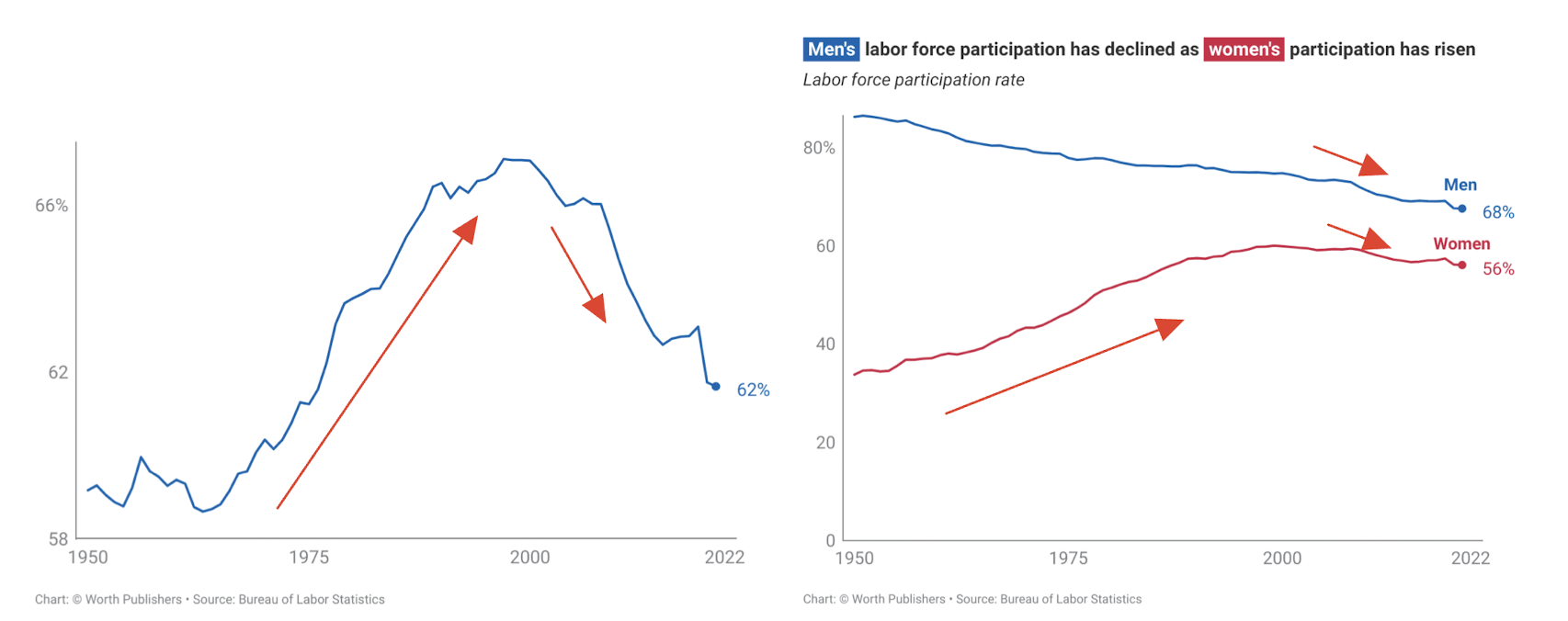

(Lesson 10 Notes: Unemployment) Labor Force Participation Rate
What is the labor force participation rate today?


(Lesson 10 Notes: Unemployment) Employment-Population Ratio
What is the EMPLOYMENT-POPULATION RATIO?


(Lesson 10 Notes: Unemployment) Employment-Population Ratio
What is the employment-population ratio today?

(Lesson 10 Notes: Unemployment) Unemployment Rate
What is the UNEMPLOYMENT RATE?
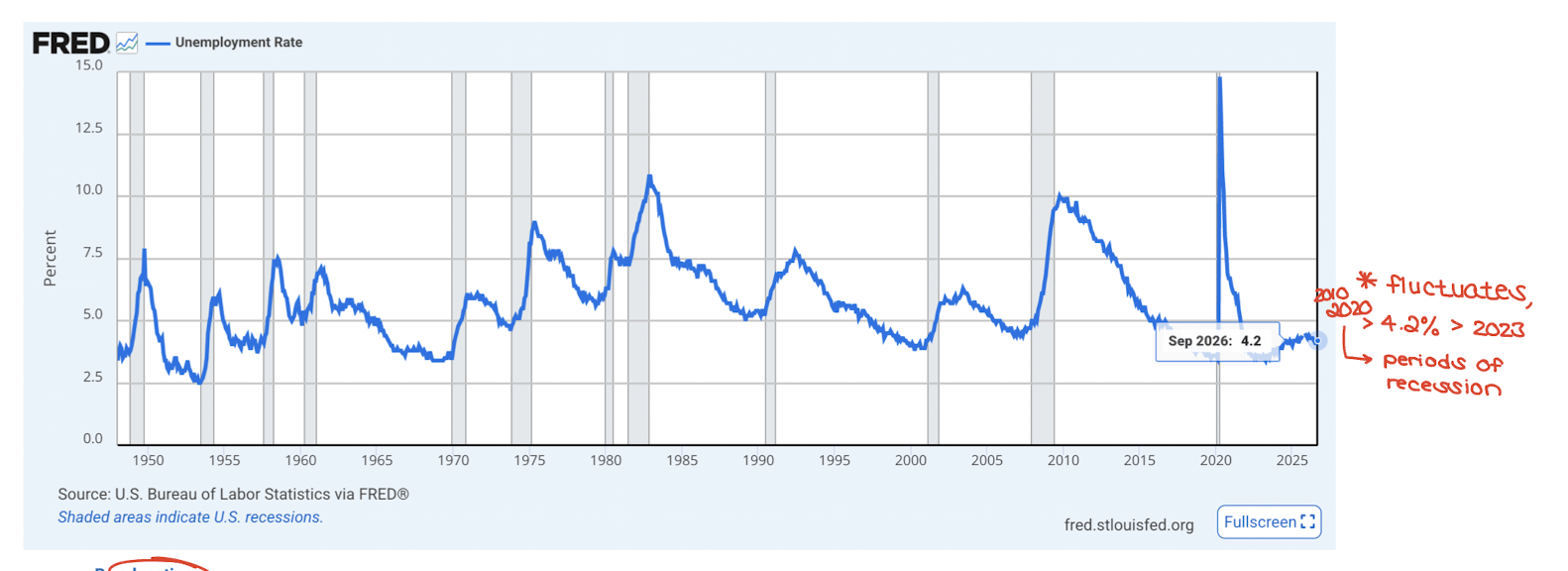
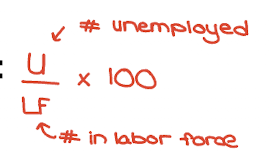
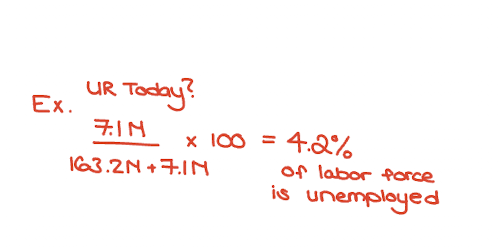
(Lesson 10 Notes: Unemployment) Unemployment Rate
What is the unemployment rate today?
(Lesson 10 Notes: Unemployment) Unemployment Rate
Unemployment rate varies by group…

(Lesson 10 Notes: Unemployment) Unemployment Rate
Unemployment rate varies by country…

(Lesson 10 Notes: Unemployment) Types of Unemployment
What is FRICTIONAL UNEMPLOYMENT?
unemployment due to time spent searching for a good job match
(Lesson 10 Notes: Unemployment) Types of Unemployment
What is STRUCTURAL UNEMPLOYMENT?
arises from persistent mismatch between skills of workers and skills needed by employers OR from wages above the equilibrium level (excess supply of labor)
(Lesson 10 Notes: Unemployment) Types of Unemployment
What is CYCLICAL UNEMPLOYMENT?
unemployment caused by recessions int he business cycle
(Lesson 10 Notes: Unemployment) Types of Unemployment
What is the NATURAL RATE OF UNEMPLOYMENT/EQUILIBRIUM LEVEL OF UNEMPLOYMENT?
rate of unemployment if economy were operating at capacity; only includes frictional and structural unemployment (no cyclical unemployment)
@ full employment
(Lesson 10 Notes: Unemployment) Types of Unemployment
What are MARGINALLY ATTACHED WORKERS?
would like to be working and has searched in the last year but not currently searching
(Lesson 10 Notes: Unemployment) Types of Unemployment
What are DISCOURAGED WORKERS?
do not believe jobs are available
(Lesson 10 Notes: Unemployment) Types of Unemployment
What does it mean to be UNDEREMPLOYED / INVOLUNTARY PART TIME?
people who are overqualified for their job or who are working fewer jours than they would like to be working
(Lesson 10 Notes: Unemployment) Alternative Methods of Calculating Unemployment

(Lesson 10 Notes: Unemployment) Protecting Yourself from the Harmful Effects of Unemployment
What are some methods?
Do more job searching than you really want to do.
Consider the marginal benefits and marginal costs of filling out an additional application.
Build up a nest egg.
Save three to six months of expenses.
Build new skills.
Keep an eye out for better opportunities when you’re employed.
Begin searching long before you think your current position emds.
Build a strong professional network and tap into it if you become unemployed.
More likely to get hired if you have a referral.
Avoid long-term unemployment.
Settle for Mr. Not-So-Right Job, and then keep searching for a better job.
(Lesson 10 Notes: Unemployment) Poll Everywhere
According to the textbook, which of the following is NOT a reason that we have seen large increases in female LFP over time?
A decrease in infant mortality
Increased access to birth control
Change in societal norms
New household production technology
Anti-discrimination laws
A decrease in infant mortality
(Lesson 10 Notes: Unemployment) Poll Everywhere
Barbieland, a small country, has a working age population of 250,000. 120,500 people are employed, and 4,050 people do not have jobs but are looking for work. Calculate the unemployment rate in Barbieland.
1.62%
3.25%
3.36%
48.2%
49.82%
3.25%
(Lesson 10 Notes: Unemployment) Lesson 10 HW
Frictional, Structural Unemployment, or Neither?
_____ unemployment includes those involved in job search.
____ unemployment can be caused by a minimum wage.
____ unemployment includes cyclical unemployment.
____ unemployment is affected by the pace of technological progress.
_____ unemployment can be caused by efficiency wages.
_____ unemployment arises from a labor surplus in a given market.
_____ unemployment can result from new people entering the labor force.
_____ unemployment typical declines in times of high economic growth.
_____ unemployment can arise from the actions of labor unions,
Frictional
Structural
Neither
Structural
Structural
Structural
Frictional
Neither
Structural
(Lesson 10 Notes: Unemployment) Poll Everywhere
Which of the following statements is FALSE?
A full-time student would be counted as being out of the labor force.
An economics major who has just graduated from college, but has not yet found a job is frictionally unemployed.
Jen's company had to lay her off due to a downturn in sales. She is cyclically unemployed.
As steel plants shut down in Pennsylvania, the workers become structurally unemployed.
A housewife is unemployed.
A housewife is unemployed.
(Lesson 10 Notes: Unemployment) Poll Everywhere
Eagleton has a total population of 1,000 people. 25% of that population is not of working age, and 80 of the total population are unemployed. How many people are in the labor force?
895
750
670
330
Need more information
Need more information
(Lesson 10 Notes: Unemployment) Poll Everywhere
If the working age population in Pawnee, Indiana is 45,000, the number of people with jobs is 30,000, and the number of people who aren't working but have been submitting applications is 2,000, by how many percentage points will Leslie's soda tax increase the unemployment rate?
6.25 percentage points
.0625 percentage points
0.3 percentage points
0.003 percentage points
.2 percentage points.
002 percentage points.
0.3 percentage points
(Lesson 11 Notes: Inflation, Money, and Banking) Inflation
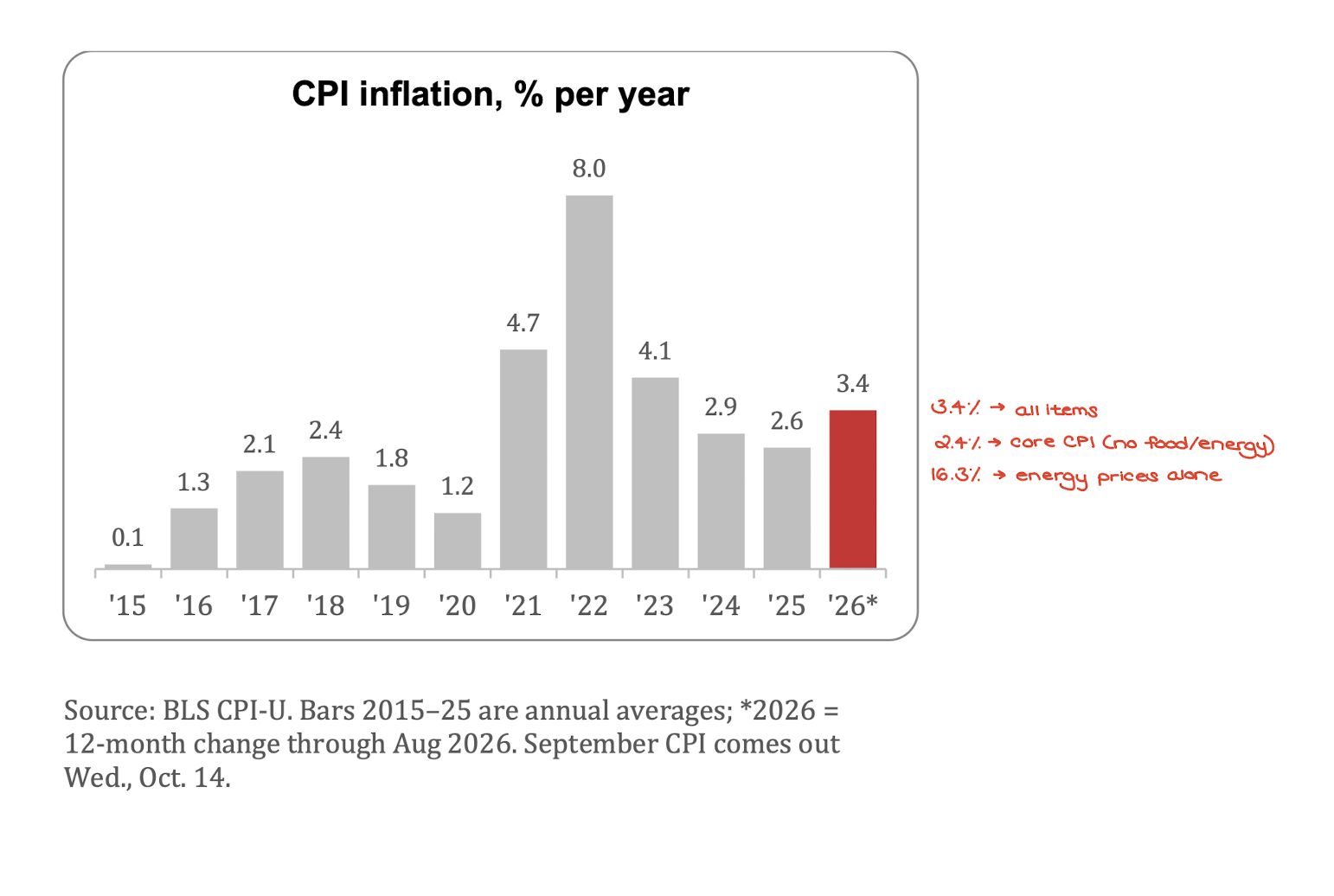
What is INFLATION?
a generalized rise (not a rise in price of a single good/service) in the overall level of prices (decline in the purchasing power of money / a rise in the cost of living)
(Lesson 11 Notes: Inflation, Money, and Banking) Inflation
What is INFLATION RATE?

(Lesson 11 Notes: Inflation, Money, and Banking) Measures of the Price Level
What are the measures of the price level?
CPI
Personal Consumption Expenditure Deflator (PCE deflator)
GDP Deflator
Producer Price Index (PPI)
(Lesson 11 Notes: Inflation, Money, and Banking) Measures of the Price Level
What is the PERSONAL CONSUMPTION EXPENDITURE DEFLATOR (PCE DEFLATOR)?
used by the Federal Reserve
similar to CPI with continuously updated basket

(Lesson 11 Notes: Inflation, Money, and Banking) Measures of the Price Level
What is the PRODUCER PRICE INDEX (PPI)?
measures prices producers face
can be an early warning of an increase in consumer prices
(Lesson 11 Notes: Inflation, Money, and Banking) Consumer Price Index (CPI)
What is the CONSUMER PRICE INDEX (CPI)?
measures the cost of purchasing a market basket of a typical household’s consumption, where the cost is normalized so that it is equal to 100 int he selected base year
(Lesson 11 Notes: Inflation, Money, and Banking) Consumer Price Index (CPI)
How do you solve for CPI?

(Lesson 11 Notes: Inflation, Money, and Banking) Consumer Price Index (CPI)
What do the different values of CPI mean?
= 100 in the base year
> 100 if prices in t > prices in b
< 100 if prices in t < prices in b
(Lesson 11 Notes: Inflation, Money, and Banking) Consumer Price Index (CPI)
What’s in the CPI Basket?

(Lesson 11 Notes: Inflation, Money, and Banking) Consumer Price Index (CPI)
Example:
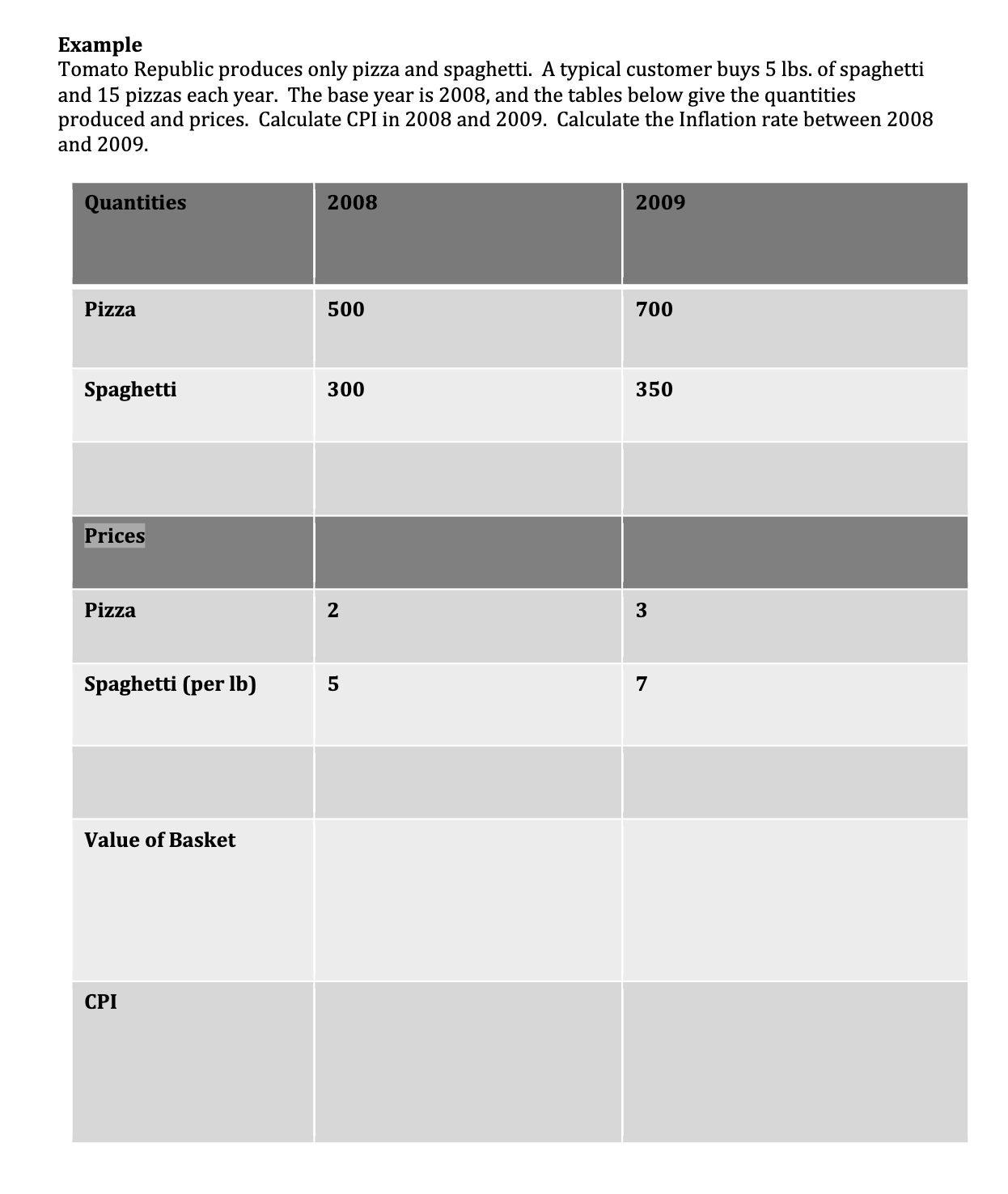
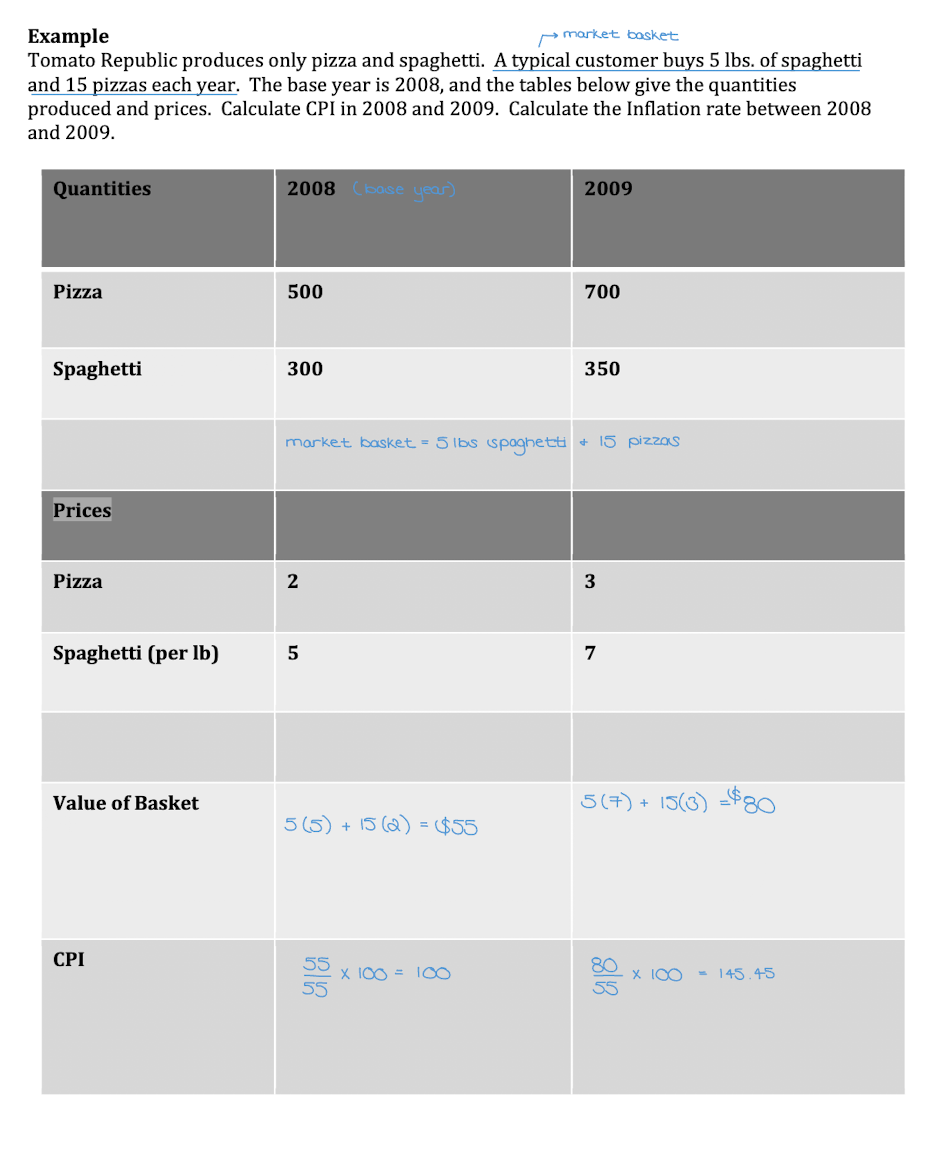
(Lesson 11 Notes: Inflation, Money, and Banking) Consumer Price Index (CPI)
Example: Calculating Inflation Using CPI

(Lesson 11 Notes: Inflation, Money, and Banking) CPI Challenges
What do CPI challenges lead to?
lead CPI to slightly overstate inflation consumers face
(Lesson 11 Notes: Inflation, Money, and Banking) CPI Challenges
What is SUBSTITUTION BIAS?
people switch away from things that get pricier
Ex> beef prices jump 20%, so you buy chicken instead
(Lesson 11 Notes: Inflation, Money, and Banking) CPI Challenges
What is QUALITY BIAS?
higher price can mean a better product
Ex> this year’s laptop costs $100 more, but its battery lasts 2x longer