Solving Inverse Problems
 Call Kai
 Learn
 Practice Test
 Spaced Repetition
 Match
 Flashcards
 Knowt Play
1/40

There's no tags or description
Looks like no tags are added yet.
41 Terms
Numerical Methods
Algorithms for approximating solutions to mathematical problems that are difficult/impossible to solve analytically
Inverse Problems
Known output + model and unknown input OR known input + output and unknown model
Time Invariant
System properties do not change with time
Linear
System response satisfies superposition principle
Linear and Time-Invariant
LTI System (closed loop)
Closed-Loop Poles
Determine the stability and performance of a closed-loop system
Bisection Method
Iterative method for finding roots predicated on the Intermediate Value Theorem
Bisection Method

Root lies between m and b
If f(m) > 0 for the bisection method
Root lies between a and m
If f(m) < 0 for the bisection method
Root found
If f(m) = 0 within tolerance for the bisection method
Linear
Convergence rate of bisection method
Newton-Raphson Method
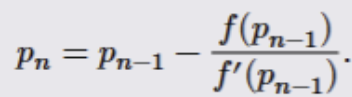
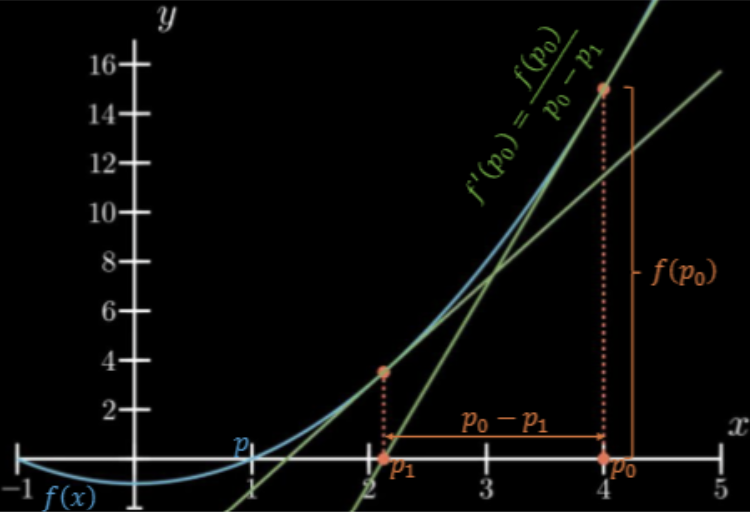
Uses the rate of change of f(x) to speed up bisection method (also: 1st order Taylor approximation)
Newton-Raphson Method Formula
Newton-Raphson Method
Quadratic
Convergence rate of Newton-Raphson method
Secant Method
Uses Newton-Raphson method formula but approximated f’(x) when unable to find analytically
Backward Finite Difference
Approximates f’(x) for secant method

Secant Method Formula

Secant Method
Draw a line between f(p0) and f(p1), x-int of line is p2 → repeat w/ p1 and p2

Superlinear
Convergence rate of secant method
a and b
Initial guesses for bisection method
p0
Initial guess for Newton-Raphson method
p0 and p1
Initial guesses for secant method
Yes
Convergence guarantee for bisection method?
No
Convergence guarantee for Newton-Raphson method?
No
Convergence guarantee for secant method?
Lambda Function
Anonymous functions, simple enough to be defined in one line and only used once
Lamba Function Syntax
lambda x: [func]Import Callable
from collections.abc import CallableCallable
Used to define the input and output types of a function
Callable Syntax
def function(param_1: Callable[[type], type], param_2: type) -> typeLIFO
Last in, first out
Call Stack
Memory area where items are stored and retrieved on a LIFO basis → from functions calling each other
Stack Frame
When function is called, frame is created to hold all info needed to execute function call
Stack Overflow
Stack storage is filled (recursion cannot go arbitrarily deep)
RecursionError
Max depth exceeded
Returns current value of recursion limit
sys.getrecursionlimitSets recursion limit
sys.setrecursionlimitRecursive Limitation
Can return a RecursionError → memory fills up quickly and can only calculate smaller numbers/recursions