Anatomy Lab 1
 Call Kai
 Learn
Learn Practice Test
 Spaced Repetition
 Match
Match Flashcards
 Knowt Play
1/11

There's no tags or description
Looks like no tags are added yet.
Name | Mastery | Learn | Test | Matching | Spaced | Call with Kai | Chat |
|---|
No analytics yet
Send a link to your students to track their progress
12 Terms
list & describe the three cardinal planes
frontal/coronal plane
divides body into anterior/ventral (in front of) and posterior/dorsal (behind) portions
transverse/horizontal/axial plane
divides body into superior (above) & inferior (below) portions
sagittal/longitudinal plane
divides body into right & left portions
closer to midline = medial
farther to side = lateral
terms regarding respect to a point of origin?
proximal = closer
distal = farther
terms regarding respect to the surface of the body?
superficial = closer to the surface
deep = farther from the surface
what is the function of the skeleton?
serves as internal scaffolding of the human body, providing support, protection, & mobility to all the body’s structures
which are the axial bones?
skull
mandible
cervical vertebrae
thoracic vertebrae
lumbar vertebrae
sacrum
coccyx
ribs
sternum
manubrium of sternum
which are the appendicular bones?
clavicle
scapula
humerus
radius
ulna
carpals
metacarpals
phalanges
pelvic bone
femur
patella
tibia
fibula
tarsals
metatarsals
phalanges
important parts & functions of the vertebrate
vertebral canal between C1 and L2 houses the spinal cord
vertebral foramina allows passage of spinal nerves out from the spinal cord
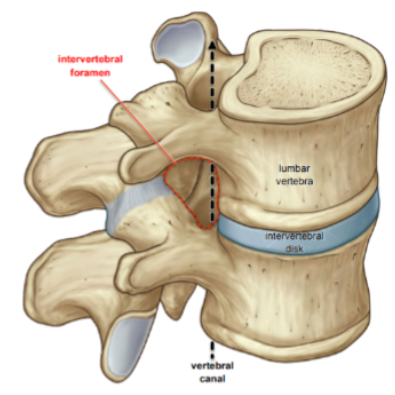
different kinds of vertebrae
cervical vertebrae
numbered C1-C7
have the smallest vertebral bodies
thoracic vertebrae
numbered T1-T12
have smooth patches where they articulate with the 12 ribs
lumbar vertebrae
numbered L1-L5
have the largest vertebral bodies & no transverse foramina
medical applications for the clavicle
the clavicle is the only bony connection between the arm and the trunk & is vulnerable to injury or fracture from forceful blows to the shoulder
features of the humerus
head: articulating w/ scapula, forms the glenohumeral joint (shoulder joint), a ball-and-socket joint
trochlea: articulating w/ ulna, forms part of the elbow joint, a hinge joint
capitulum: articulating w/ radius
radius has less secure attachment to the humerus, which allows increased mobility of forearm

physiology/function of the pelvic bone
pelvic bone is analogous to the scapula & clavicle, but is adapted for much greater stability (and therefore decreased mobility) compared to the pectoral girdle
list & explain the functions of the two bones of the leg
tibia
positioned medially, its the major weight bearing bone of the leg & is much larger than the fibula
fibula
positioned laterally, it does not articulate w/ the femur
stabilizes the ankle joint, giving more stability/less mobility compared to the wrist