week 3: pharmacology
 Call Kai
 Learn
Learn Practice Test
 Spaced Repetition
 Match
Match Flashcards
 Knowt Play
1/153

There's no tags or description
Looks like no tags are added yet.
Name | Mastery | Learn | Test | Matching | Spaced | Call with Kai | Chat |
|---|
No analytics yet
Send a link to your students to track their progress
154 Terms
what are the 3 drug classification?
chemical name
generic name
brand name
what is a chemical name?
chemistry nomenclature
exact description/chemical compound
ex. N-Acetyl-para-aminophenol
what is a generic name?
unique and most universal; class
ex. Acetaminophen (Antipyretic/Non-opioid)
what is a brand name?
marketing name
trade or business
ex. Tylenol
since Tylenol can be effective for treating pain and fever, it is classified as both?
analgesic (pain reliever)
antipyretic (fever reducer)
what different groups are drugs classified into based on?
therapeutic use
mechanism of action
legal scheduling
psychoactive effect on the body
what is the Health Protection Branch (HPD) of Federal government?
federal authority within Health Canada responsible for regulating, evaluating, and monitoring the safety of medications
what are medication standards?
federal legislation (Food & Drug Act (FDA)) → standards for manufacturing & sale of all food/cosmetics/medications/certain medical devices
Canada Formulary → officially sets standards for medication quality/packaging/safety
is it safe and efficient?
any adverse side effects
what are medication controls?
Controlled Drugs & Substances Act (CDSA)
abuse or dependence?
do nurses in MB have legal authorization to perform medication administration?
yes, they have to operate within federal and provincial regulations
high risk medication?
controlled substance?
2 nurses need to check high dose drugs before it reaches a patient
what is the definition if inpatient?
you are admitted to a hospital or residential facility and stay overnight
medications that we administer
what does inpatient medication include?
prescriber orders
what exactly has been ordered
administration records
helps tract medications, how much, who gave, what route?
what is the definition of outpatient
you receive medical treatment, therapy, or diagnostic test but go home on the same day
what does outpatient medication include?
prescription
regulate
to be used by ONE person only
ordered by family doctor and administered by pharmacy
behind the counter
don’t require a prescription but bit more risky and requires ID
can become addicting
dependent
i.e. gravol and plan B
over the counter (OTC)
Tylenol, Alive
can be bought on shelf and no ID and no lmits
in obtaining inpatient and outpatient medication what must prescriber orders and perscriptions clearly include?
patient details (specifics about who this is for?
drug info (name, dose, form/route, frequency, total quantity if applicable)
prescriber info (name, professional registration and license #)
who made the order?
authorization (date and signature)
what is the “ideal drug”
achieves the therapeutic objective → “do the most good/benefit with minimal harm”
DOES NOT EXIST
what is the “big 3” in ideal drugs?
effective
safe
selective
what is expected in for effective in an ideal drug?
elicits the response for which it’s given
justifies the need for it
what is expected for safe in an indeal drug?
cannot cause harm (inevitable with high doses and prolonged use)
reduction of harm by proper drug selection and dosing
benefit > potential risks
what is expected in selective for an ideal drug?
elicits only the response for which it is given
additional “ideal drug” properties include
reversible
don’t want antibiotics to be reversible
predictable
know exactly how patient will react
ease of administration
oral is the best method f
lack of drug interactions
polypharmacy (more than 2 drugs being taken)
low cost
chemical stability
stay for very long time where they are
what are nurses accountable for knowing?
what meds are prescribed
med purpose (why are they taking it?)
appropriate dosages and routes
therapeutic and adverse effects
assessment and monitoring requirements
patient education needs
if the patient is appropriate for this patient at this time

what are we thinking about when performing a patient physical assessment?
think about how the drug works
what should you assess?
does this patient have any risk factors
is the drug safe to give
will it have time to have adverse effects
allergies?
what are we thinking about when performing an analysis?
is the medication safe to give right now? why/why not?
if hypotensive NOT safe to give bp meds
when planning what do we think about?
is med safe to give? → how/when will you give it
if multiple meds are due at once, which is highest priority
what should the drug do?
what could it do?
do you need to monitor after? for what/when
med not safe to give → why? who did you notify and next steps
need to tell immediately, bad to withhold
what do we do in implementation?
medication admin
10 rights of medication administration
what do we reflect on during evaluation?
was the medication effective? → did we achieve the intended therapeutic effect?
what info do we need to gather to determine that?
patient education needed?
what are the 10 right medication administration?
the right medication
the right dose
the right patient
the right route
the right time and frequency
critical to check done 3 times before given
the right documentation
the right reason
the right to refuse
the right patient education
the right evaluation
speak to before medication administered
what can be found on a patient care card of physician’s orders?
drug name (s)
dosage
route
time
patient name
what are medication errors?
any preventable event that may cause or lead to inappropriate medications use or patient harm while the medication is in the control of the healthcare professional, patient, or consumer
what are types of medication errors?
wrong patient
wrong drug
wrong route
wrong time
wrong dose - omitted dose - wrong dosage form
what are causes of medication errors?
human error
communication mistakes (documented and orders)
name confusion
what are ways of prevention of medical errors?
institutional culture
infrastructure
clinical practice
technology
application of pharmacology in patient care - nursing assessment and considerations
pre-administration assessment
dosage and administration
promoting therapeutic effects
minimize adverse effects
minimizing adverse interactions
making PRN decisions
evaluating responses to medication
managing toxicity
what do we do in pre-administration assessment?
collect baseline data
identifying high risk patients
what do we think about when collecting baseline data?
what should I assess for that might indicate
therapeutic effect (i.e.169/92 → 138/83)
adverse effects
how do I know what to assess for?
need to know what this drug does/the effects it is likely to produce
identifying high risk patients
pathophysiology
generic factors
drug allergies
life span considerations (young/old/pregnancy)
age related deteriorations
how to identify? (who at higher risk of reacting adversely)
patient history
physical assessment
laboratory data
how do I know what risk(s) to look for?
need to know how the drug works and what risk factors could increase the risk of severe reactions
what are guidlines for administration?
clarify any unclear orders
confirm checks with required data sources…
verify any dosage calculations (double check your work!!)
do not administer any drug if you don’t know what it is for or how it works!!
if no order sheet stamped with patient name and/if no wrist band always double check
what do we need to considered with dosage and aministration?
must be familiar with 10 medication rights and appropriately carry these out for safe medication administration
is it safe for me to do at this time
what kind of route?
→
cannot be safely implemented without knowledge of pharmacology
what are some nonpharmacological approaches?
breathing exercises
positioning
emotional support
exercise
rest
diet restrictions
ex. broken ankle
already have pain meds
rest
what must you know when administering drugs?
major adverse effects
when reactions could occur
early/warning signs
interventions to minimize harm
what can we considered to minimize adverse effects?
identify high risk patients
ensure proper administration
patient education → what to avoid?
what could affects be
early signs
do not give drug if you don’t know side effects
patients who are taking 2 or more medications (polypharmacy) are potentially at risk!
how can we help reduce the risk?
take a thorough drug history
patient education
avoid OTC drugs that are known to interact
what signs to watch out for re: interaction effects
monitoring for adverse interactions known to occur between drugs (could make things worse)
making PRN decisions
as needed, dose range, time range
nurse use discretion
when to give?
how much to give?
know
reason of drug
assess patient’s needs
is it harm
did we get therapeutic effect?
evaluating responses to medications
was it beneficial or harmful?
know
rationale for drug
onset of action
what to do when it is harmful
managing toxicity
extremely dangerous
someone had too much
drug is known
know
early signs
procedure for toxicity management
mechanism of action
summarizes how drug works at the molecular/biochemical level to produce a pharmacological effect within the body. includes what enzyme, receptor, or neurotransmitter (s) the drug binds to or modulates
nursing considerations
key components/knowledge required by the nurse to safely administer a drug
may include assessments, monitoring/evaluation, administration specifics, contraindications, and required education
indications
the specific disease (s), symptom (s), or condition (s) a medication is officially approved to treat/prevent/cure
contraindications
the specific condition (s) or circumstance (s) which makes a specific drug particularly harmful
therapeutic effects
the intended/expected outcome of a medication has positively affected the patient’s health/symptoms/disease management
adverse drug effect
any noxious, unintended, and undesired effect that occurs at normal drug doses
can range from mild to severe and life-threatening
toxicity: excessive dosage (OD)
detrimental effect from overdose
ex. hypoglycemia from insulin
toxicity: organ-specific
drugs which damage specific organs
hepatotoxic → can cause liver damage
nephrotoxic → can damage kidneys
cardiotoxic → can damage the heart or alter function
allergic reaction
immune response to a drug
intensity of reaction = degree of sensitization of immune system
paradoxical effect
drug has opposite effect of intended drug response
physical dependence
body has adapted to drug exposure; abrupt discontinuation can cause an “abstinence” syndrome
carcinogenic
ability to cause cancer(s) in one’s lifetime
tetratogenic
ability to induce birth defects/abnormal fetal development or demise if taken while pregnant
what should we consider when providing patient education?
no medical jargon
use simplest way to breakdown to a patient
dosage and administration
when and how they will take it
promoting therapeutic effects
rest, ice, evaluation
minimize adverse effects and interactions
education patients on drugs they are on
stay away from
adverse effects: what to expect
What does the nurse do during the Assess and Analyze steps?
Assess:
Is the patient’s BP high?
Is it related to hypertension?
Could it be related to a head injury?
Analyze:
Determine the likely cause of the findings.
Example: headache may be related to high BP.
How does the nurse plan care for a patient with a headache related to high BP?
Goal: reduce pain/headache
If related to high BP → work to reduce BP
Check MAR for medication orders
Review history for risks/contraindications
Consider whether PO medication is safe, especially with poor LOC
What does the nurse do when implementing and evaluating the intervention?
Implement:
Administer acetaminophen 500 mg PO PRN using the 10 Rights
Evaluate:
Reassess after 30–45 minutes
Patient reports pain is relieved
administration
medication errors
patient adherence
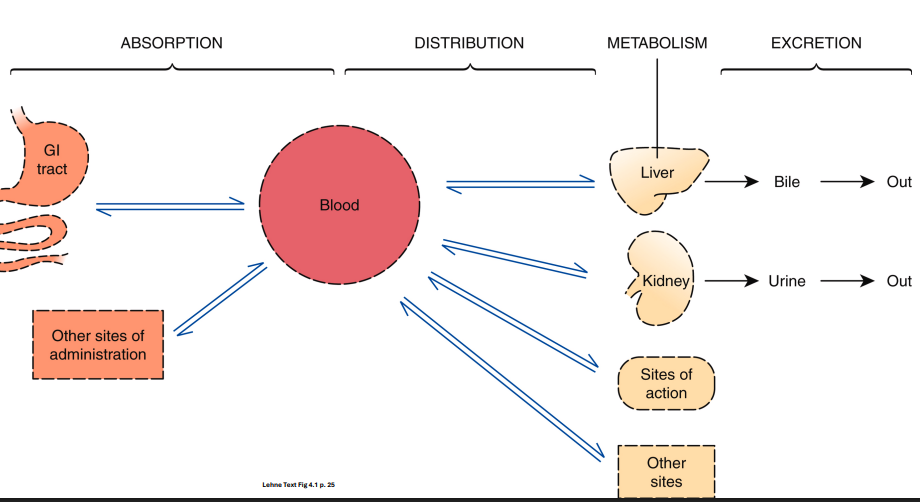
pharmacokinetics
absorption
distribution
metabolism
excretion
how much of administered dose gets to site
movement of drug in body and body effect
pharmacodynamics
drug-receptor interaction
patient’s functional state
placebo effect
effect of drug in the body
bind drug to receptor
sources of individual variation
physiologic variables
weight
pathologic variables
impaired and/or kidney function
genetic variables
pharmacokinetics 4 stages
absorption
drug movement from site of administration to blood stream
distribution
blood stream, from blood to target cells
metabolism
breaking down drugs structure
increase likelihood of being peed out
excretion
**all 4 phases involves drug movement and membrane corssing
how does pharmacokinetics passage of drugs across membranes?
channel/pores
only very ting things and specific of what comes through
transport systems
move from one side to another
very selective
uses ATP
direction penetration (main means)
lipid soluble vs water soluble
ionized vs nonionized
pH dependent
non-ionized
lipid-soluble and easily crosses membrane
ionized
water soluble and will not cross membrane easily
pH of environment may ionize drug
acidic drug: acidic environment
nonionized
acidic drug: basic/alkaline environment
ionized
basic drug: acidic environment
ionized
basic drug: basic/alkaline environment
nonionzed
stomach pH
ex. aspirin (ASA)
is LOW (acidic) pH 1-3
therefore, ASA is nonionized in this environment and crosses cell membrane of stomach epithelial cells
small intestine pH
ex. aspirin (ASA)
is HIGH (alkaline) pH 6-7.5
therefore, ASA is ionized in this environment and absorption of ASA from the intestines is impeded
how is food a pH buffer?
empty stomach = lower pH
with food = higher pH (less acidic)
take certain meds with food and some without
some oral medication considerations include
take with food
take on empty stomach
do not crush - enteric coated
do not crush - sustained released
environment pH can affect drug ionization
therefore if or how fast it will cross membranes
drug properties may require specific pH for absorption speeds or locations within the GI tract
take food with a medication can help reduce damage
enteric coated
protective barrier to prevent drug from being dissolved and absorbed in the stomach
DO NOT CRUSH
sustained release
capsules designed for slow and steady drug release
DO NOT CRUSH
what is absorption affected by?
rate of dissolution
surface area
blood flow
lipid solubility
pH partitioning
rate of dissolution
faster drug dissolves = faster it can be absorbed
absorption: surface area
larger the surface area (of admin site) = faster absorption
absorption site: blood flow
High flow/vascularity = faster absorption
absorption site: lipid solubility
Highly lipid-soluble drugs cross membranes faster = faster absorption
crosses lipid membranes faster
absorption: pH partitioning
When the difference in pH of plasma & admin site makes it more likely the drug molecules will be ionized in the plasma = faster absorption. (aka ion trapping).
pH on one side different than other
pH particles
go to favours
what are the routes of administration?
enteral
parental
other
enteral: oral (PO)
easy, convenient, inexpensive way to take medications. Absorption highly variable d/t:
2 barriers to cross: Epithelial cells lining GI tract & Capillary wall. (cells quiet permeable, BBB)
Inactivation/drug losses from digestive enzymes or liver metabolism (first pass effect, part of drug lost or passed) (move through cells that cant absorb)
enteral: sublingual/buccal
(under tongue or back of cheek; tablet or spray) (absorbed, not digested)
don’t involve digestion
oral mucus is quick
eternal: rectal
suppository or enema (absorbed, not digested)
parenteral: intravenous IV
rapid and complete
parenteral: intramuscular (IM)
absorption can be rapid or slow; drugs pass directly through capillary wall.
deep into muscle
big gaps between cells
parenteral: subcutaneous (subQ or subcut)
absorption can be fast or slow; drugs pass directly through capillary wall
pass between cells of capillary beds
high absorption
route of administration: topical
ointment/cream; must move through skin layers through capillary walls.
route of administration: transdermal
similar to topical but medication is in patch-form
clear like patch
applied to skim
systematically
route of administration: inhalation
inhaled aerosolized drug deposited into lungs & crosses capillary walls
pass to alveoli
What is drug distribution?
Distribution = movement of a drug from the bloodstream to the tissues/site of action.
Better blood flow/perfusion → better drug distribution
Drug travels through the circulation to the target organ/tissue
How does a drug leave the vascular system to reach tissues?
Drug reaches the target organ/tissue
Leaves the blood through capillary beds
Most capillary walls allow drug movement through their large pores
Exception: Blood-brain barrier (BBB) is more restrictive