Biology; Membrane Transport
 Call Kai
 Learn
 Practice Test
 Spaced Repetition
 Match
 Flashcards
 Knowt Play
1/57

There's no tags or description
Looks like no tags are added yet.
58 Terms
Isotonic solution
The amount of water and the size of the cell will stay the same
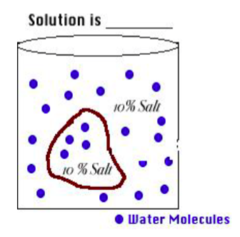
Hypertonic solution
Water will move out of the cell

Hypotonic solution
the cell will swell (water entering the cell)

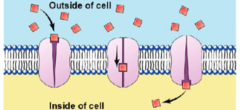
facilitated diffusion
When large molecules can't cross the plasma membrane, and are "helped" across by carrier proteins
**Diffusion and osmosis are both types of
**passive transport
passive transport
no energy is required for the molecules to move into or out of the cell.
Diffusion
the process by which molecules spread from areas of high concentration, to areas of low concentration
equilibrium
When the molecules are even throughout a space

concentration gradient
a difference between concentrations in a space
If you are moving from high concentration to low concentration, molecules are moving _____the gradient
down
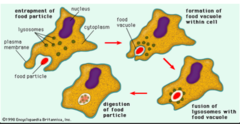
endocytosis (phagocytosis)
-requires energy
-active transport
-cell eating

endocytosis (pinocytosis)
-requires energy
-active transport
-cell drinking
-forming a vesicle
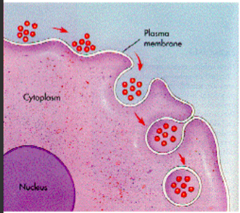
The energy comes in the form of ____________
ATP
When ATP is used up it becomes __________
ATP becomes ADP
exocytosis
-The cellular process by which cells excrete waste products or chemical transmitters
-Requires energy

What is the cell membrane made of?
Phospholipids, carb chains, lipid cholesterol
phosphate group head (hydrophilic) and two fatty acid tails (hydrophobic)

selective permeability
The cell membrane allows some materials to cross and keeps others out
phospholipid diagram
polar head
non polar tail

Diagram of hypertonic, isotonic, hypotonic
hyper-water will exit
iso-will stay the same
hypo-water enters cell

**diffusion
**-passive transport
-does not require energy

In this type of diffusion the molecule is too large to pass across, so it needs the help of a carrier protein. What type of diffusion is this?
Facilitated diffusion
-does not require energy
-passive transport
-molecules are moving down the concentration gradient
endocytosis diagram
-this is active transport
-phagocytosis
When a P is added to ADP what is created?
ATP
When a P is removed what is created?
AMP
Which has more energy ATP or ADP?
ATP
How do we get the energy to make ADP into ATP?
the energy comes from food
What process creates ATP?
cellular respiration
What process creates ADP?
using energy from ATP creates ADP
Hydrophilic
loving or attracting water
Hydrophobic
fail to mix with water
functions of chloesterol
-helps strengthen plasma membrane
-keeps tails of phospholipids separated or non polar
carrier proteins

functions of proteins
-transport substances into and out of cell that are unable to pass through bilayer
-a collage of proteins and other materials embedded in the fluid matrix of the lipid bilayer
-determine membranes specific function
integral proteins
-transport proteins
-embedded in surface of bilayer with H bonds

how are materials transported across the cell membrane?
Molecules will move across difference in space called a concentration gradient
Molecules tend to move from high concentration to low until equilibrium is reached
What happened when equilibrium is reached?
The solute or particles will move equally into and out of the membrane
What is passive transport?
-no energy required
-high to low concentration
-move down concentration gradient
What are the types of passive transport?
Diffusion, facilitated diffusion, osmosis
Diffusion
-The movement of particles from high to low without energy until equilibrium reach
-move down
Nonwater
Facilitated diffusion
Particles move through a carrier protein down their concentration gradient until equilibrium is reached. Nonwater
Hypertonic
More solute
Cells shrink
Lose water
Isotonic
Equal state
Cells stay the same
Hypotonic
Less solute
Cells swell
Gain water
What is active transport?
Requires energy (ATP nucleic acid)
Low to high
Agaisnt concentration gradients
Types of active transport?
Sodium Potassium pump
endocytosis
exocytosis
Sodium potassium pump
moves 3 Na+ out and 2K+ in
Energy from ATP
low to high
Uses membrane protein called pumps to move molecule
How are vesicles used to transport material out of the cell?
Vesicles are small membrane sacs pinch off of cell membranes used by cells for transporting molecules
2 kinds of endocytosis
Pinocytosis (drinking)
Phagocytosis (eating)
Ion channel
membrane protein complexes and their function is to facilitate the diffusion of ions across biological membranes.
carbohydrate chains
cell to cell recognition
antigen
polysaccharide can cause immune response
What type of transport does not require ATP?
Osmosis
Molecules that can diffuse across the membrane include
Many nonpolar molecules
The diffusion of water through a selectively permeable membrane is called
Osmosis
Active transport is the movement of a substance from....
An area of low concentration to an area of higher concentration
When particles move out of the cell through facilitated diffusion the cell...
Does not require energy
Molecules that are too large to be moved through the cell membrane can be transported out of the cell by
Exocytosis
Diagram of transport
A
B facilitated diffusion
C Requires energy, active transport
D hydrophobic region, fatty acid tails
E phospholipid heads
