CH.13 Host Defenses 2: Adaptive Immunity
 Call Kai
 Learn
 Practice Test
 Spaced Repetition
 Match
 Flashcards
 Knowt Play
1/63

There's no tags or description
Looks like no tags are added yet.
64 Terms
Adaptive immunity
The third and final line of defense; acquired after an immunizing event such as infection or vaccination.
• B and T lymphocytes undergo a selective process that prepares them for
reacting only to one specific antigen or immunogen
Chart for Innate vs. Adaptive **important

Nonspecific vs. Specific cells

Immunocompetence
The ability of the body to react with countless foreign substances.
What are the two types of adaptive immunity?
Humoral (antibody-mediated) immunity (HMI) 2. Cell-mediated immunity (CMI).
HMI best for extracellular pathogens (important)
CMI best for intracellular pathogens: destroys infected or defective cells

Humoral immunity (HMI)
Produces antibodies; best protects against extracellular pathogens (outside host cells).
Cell-mediated immunity (CMI)
Uses T cells and cytokines to destroy infected or defective cells; best against intracellular pathogens.
What is the main function of B cells?
Produce antibodies against specific epitopes.
What is the main function of T cells?
Provide resistance by destroying infected or abnormal cells; they do NOT produce antibodies.
contrasting properties of B and T cells


Six characteristics of adaptive immunity
Specificity, diversity, inducibility, clonality, tolerance, and memory.
Specificity
An immune response targets a particular antigen; antibodies against chickenpox will not work against measles.
Immunological memory
Lymphocytes remember previous exposure and respond faster upon encountering the same antigen again.
What are the four stages of immunologic development and interaction?
Lymphocyte development and clonal deletion 2. Antigen presentation and clonal selection 3. Antigen challenge of B and T cells 4. B- and T-cell responses.
Clonal deletion
Removal of T cells that attack the body's own cells.
Where do B cells and T cells mature?
B cells mature in the bone marrow; T cells mature in the thymus.
What are plasma cells?
Cells derived from activated B cells that produce antibodies; they cannot divide.
-Plasma cells stay in lymph nodes
-Plasma cells Produce antibodies
What is the function of antigen-presenting cells (APCs)?
Process antigens and present them to T cells to activate an immune response.
What is a dendritic cell?
An important antigen-presenting cell (APC).
MHC I vs. MHC II
MHC I identifies self molecules; MHC II presents antigens to T cells and is found on macrophages, dendritic cells, and B cells.
How are B cells activated in T-dependent immunity?
An APC presents an antigen with MHC II to a specific T helper cell, helping activate B cells.
How are B cells activated in T-independent immunity?
A B cell encounters an antigen directly and becomes an APC; no T helper cell is required.
What happens when B cells are activated?
They divide and develop into plasma cells that release antibodies and memory B cells.
What are memory B cells?
Long-lived activated B cells that allow a faster response upon future exposure to the same antigen.
Anamnestic response
The secondary immune response following a second exposure to an antigen.

What do T cells release to help destroy pathogens?
Cytokines; T cells do not produce antibodies.
Types of T cells chart

What is the main role of TH1 cells?
Help cell-mediated immunity (CMI).
What is the main role of TH2 cells?
Help antibody-mediated (humoral) immunity (HMI).
MHC I vs. MHC II chart

Anergy
A state in which a lymphocyte becomes unresponsive to an antigen.
• HMI: protects against organisms outside host cells
• CMI: better at protecting against organisms inside host cells
• HMI & CMI occur simultaneously
What is an antigen?
Any substance that specifically binds to an antibody or T-cell receptor.
What is an immunogen?
A substance that stimulates an immune response; also called an antigen in the notes.
Most good immunogens fall into the following chemical categories:
• Proteins and polypeptide: enzymes, cell surface structures, and exotoxins
• Lipoproteins: cell membranes
• Glycoproteins: blood cell markers
• Nucleoproteins: DNA complexed to proteins, but not pure DNA
• Polysaccharides (certain bacterial capsules)
• Lipopolysaccharides
Characteristics of a good immunogen
a) their chemical composition;
b) their context, meaning what types of
cytokines are present; and
c) their size

What is a hapten?
A molecule too small to trigger an immune response by itself; becomes immunogenic when attached to a carrier protein.

What are epitopes (antigenic determinants)?
Specific parts of an antigen recognized by antibodies, B-cell receptors, or T-cell receptors.
• Microorganisms have many Ag sites
What are alloantigens?
Cell-surface antigens found in some members of the same species but not others; example: blood groups;
• Responsible for incompatibilities that can occur in blood transfusion or organ grafting
What are superantigens?
Antigens that activate T cells at extremely high rates, causing excessive cytokine release and potentially cell death.
• Toxic shock syndrome and certain autoimmune diseases are associated with superantigens
What are allergens?
Antigens that trigger allergic reactions.
What are the two regions of an antibody?
Fab (variable region): binds a specific epitope. Fc (constant/crystalline region): determines antibody class and helps activate immune defenses.

What is the structure of an antibody?
Four polypeptide chains: two identical heavy chains and two identical light chains.
What are the main functions of antibodies?
Act as opsonins, activate complement, neutralize toxins, cause cell lysis, and block microorganism attachment.
Six antigen-antibody interactions
Inhibition, neutralization, opsonization, agglutination, precipitation, and phagocytosis.

Primary vs. secondary immune response
Primary: first exposure to an antigen. Secondary: later exposure to the same antigen; faster and stronger due to memory cells.

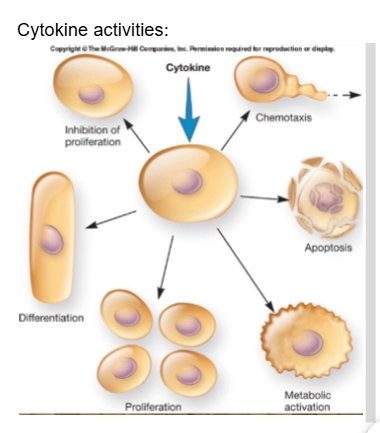
What are cytokines?
Proteins released by one cell population that regulate or affect another cell population.
Examples of cytokines
• Monokines: from mononuclear cells
• Lymphokines: from lymphocytes
• Interleukin (IL): from WBC
• IL1, IL-2, etc.
HOW THE H5N1 INFLUENZA VIRUS TRIGGERS A CYTOKINE STORM.

What are monokines, lymphokines, and interleukins?
Monokines: from mononuclear cells. Lymphokines: from lymphocytes. Interleukins: from white blood cells.
What is an antibody titer?
The level or amount of antibodies in the blood serum over time.
Memory B and T cells are created from clones activated by a specific antigen
• New research suggests that exposure to a particular antigen can result in memory cells that are chemically related to it, even if those antigens have not been seen by the host
• Activation of specific memory occurs via recognition of epitopes
• May lead to the use of nonpathogenic microbes in vaccines against more dangerous ones
Natural active vs. natural passive immunity
Active: develops after infection when the body makes its own response. Passive: antibodies received from the mother after birth.
Artificial active vs. artificial passive immunity
Active: vaccination stimulates the body's own immune response. Passive: injection of ready-made antibodies.
Chart of active vs. passive immunity

What is colostrum?
The mother's early milk, which provides antibodies to the newborn.
What is convalescent serum?
Serum containing antibodies collected from someone who recovered from an infection; provides passive immunity.
What is the purpose of vaccination?
Stimulate a primary and memory response so the immune system responds quickly and strongly to future exposure.
Killed (inactivated) vaccines
Contain killed pathogens; safer because they cannot cause disease, but produce a weaker response and often require boosters. Examples: Hepatitis A, influenza, rabies.
Live attenuated vaccines
Contain weakened living microbes that produce a strong response and may provide lifelong immunity; avoid in immunocompromised individuals.

Toxoid vaccines
Contain inactivated toxins; boosters are required. Example: DTaP.
Subunit and conjugate vaccines
Subunit vaccines contain selected microbial components. Conjugate vaccines attach bacterial capsule polysaccharides to a carrier protein to strengthen the response.
Recombinant vaccines
Use genetic engineering to produce pathogen antigens; example: Hepatitis B vaccine. Subunits cannot cause disease.
DNA and mRNA vaccines
DNA vaccines use genetic material that cells take up and translate; mRNA vaccines provide instructions for cells to make an antigen.

Plant Derived
• Original attempt was “edible vaccine”
• More now with recombinant with plants
IgG
Antibody class that crosses the placenta and provides passive immunity to the fetus.
What are the qualities of an ideal vaccine?
Protects against natural pathogens, has few side effects, stimulates B- and T-cell responses, provides lasting memory, requires few boosters, and is inexpensive and easy to administer.