MCB lecture ch 1 book
 Call Kai
 Learn
 Practice Test
 Spaced Repetition
 Match
 Flashcards
 Knowt Play
1/52

There's no tags or description
Looks like no tags are added yet.
53 Terms
Which of the following microorganisms are not eukaryotic?
a. bacteria
b. yeasts
c. molds
d. protozoa
a
Which microorganisms are used to make microbiological growth media?
a. bacteria
b. fungi
c. algae
d. protozoa
c
In which habitat would you most likely find archaea?
a. acidic hot springs
b. swamp mud
c. Great Salt Lake
d. all of the above
d
Of the following scientists, who first promulgated the theory of abiogenesis?
a. Aristotle
b.Pasteur
c. Needham
d. Spallanzani
a
Which of the following scientists hypothesized that a bacterial colony arises from a single bacterial cell?
a. Antoni van Leeuwenhoek
b. Louis Pasteur
c. Robert Koch
d. Richard Petri
c
Which scientist first hypothesized that medical personnel can infect patients with pathogens?
a. Florence Nightingale
b. Joseph Lister
c. John Snow
d. Ignaz Semmelweis
d
Van Leeuwenhoek described microorganisms as .
a. animalcules
b. prokaryotes
c. eukaryotes
d. protozoa
a
Which of the following favored the theory of spontaneous generation?
a. Spallanzani
b. Needham
c. Pasteur
d. Koch
b
A scientist who studies the role of microorganisms in the environment is a(n) .
a. genetic technologist
b. earth microbiologist
c. epidemiologist
d. environmental microbiologist
d
The laboratory of Robert Koch contributed which of the following to the field of microbiology?
a. simple staining technique
b. use of Petri dishes
c. first photomicrograph of bacteria
d. all of the above
d
Fill in the blanks with the name(s) of the scientist(s) whose investigations led to the following fields of study in microbiology.
Environmental microbiology ____ and______
Biochemistry ____and____
Chemotherapy_____
Martinus Beijerinck and Sergei Winogradsky
Louis Pasteur and Eduard Buchner
Paul Ehrlich
Fill in the blanks with the name(s) of the scientist(s) whose investigations led to the following fields of study in microbiology.
Immunology_____
Infection control_____
Etiology ______
Edward Jenner;
John Snow;
Robert Koch;
Fill in the blanks with the name(s) of the scientist(s) whose investigations led to the following fields of study in microbiology.
Epidemiology ______
Biotechnology ______
Food microbiology ______
John Snow;
Louis Pasteur;
Louis Pasteur
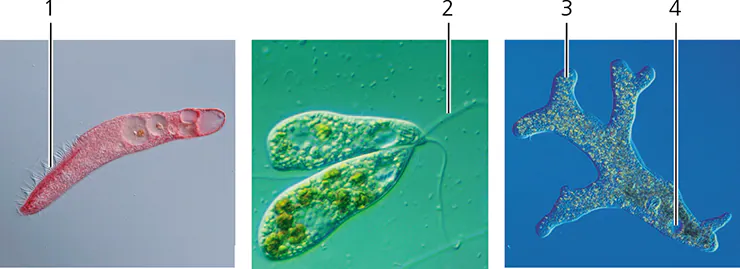
On the following photos, label cilium, flagellum, nucleus, and pseudopod.
cilium
flagellum
pseudopod
nucleus
Match each of the following descriptions with the person it best describes more than once or not at all. An answer may be used more than once.
Developed smallpox immunization
First photomicrograph of bacteria
Used mathematical data to improve nursing
Germs cause disease
Sought a “magic bullet” to destroy pathogens
Early epidemiologist
Father of Microbiology
Classification system
Discoverer of bacteria
Discoverer of protozoa
Founder of antiseptic surgery
Developed the most widely used bacterial staining technique
A. John Snow
B. Paul Ehrlich
C. Louis Pasteur
D. Antoni van Leeuwenhoek
E.Carolus Linnaeus
F. John Needham
G. Eduard Buchner
H. Robert Koch
I. Joseph Lister
J. Edward Jenner
K.Girolamo Fracastoro
L. Hans Christian Gram
M. Florence Nightingale
J
H
M
C,H,K
B
A
C
E
D
D
I
L
If Robert Koch had become interested in a viral disease, such as influenza, instead of anthrax (caused by a bacterium), how might his list of lifetime accomplishments be different? Why?
If Robert Koch had studied influenza instead of anthrax, he might not have made as many discoveries. Viruses are much smaller than bacteria and cannot grow on regular laboratory media. Koch developed methods for growing and studying bacteria, so studying viruses would have been much more difficult with the technology available during his time.
In 1911, the Polish scientist Casimir Funk proposed that a limited diet of polished white rice (rice without the husks) caused beriberi, a disease of the central nervous system. Even though history has proven him correct—beriberi is caused by a thiamine deficiency, which in his day resulted from unsophisticated milling techniques that removed the thiamine-rich husks—Funk was criticized by his contemporaries, who told him to find the microbe that caused beriberi. Explain how the prevailing scientific philosophy of the day shaped the point of view of Funk’s detractors.
During Funk's time, many scientists believed that all diseases were caused by microorganisms. His critics expected him to find a microbe responsible for beriberi instead of considering a nutritional deficiency. They did not yet fully understand that a lack of vitamins could also cause disease.
Haemophilus influenzae does not cause flu, but it received its name because it was once thought to be the cause. Explain how a proper application of Koch’s postulates would have prevented this error in nomenclature.
If scientists had properly followed Koch's postulates, they would have discovered that Haemophilus influenzae does not cause influenza. They would have found that the bacterium was not present in every person with the flu and that it could not reproduce the disease in a healthy host. This would have prevented the incorrect name.
Just before winter break in early December, your roommate stocks the refrigerator with a gallon of milk, but both of you leave before opening it. When you return in January, the milk has soured. Your roommate is annoyed because the milk was pasteurized and thus should not have spoiled. Explain why your roommate’s position is unreasonable.
Pasteurization kills most harmful bacteria and reduces the number of microorganisms in milk, but it does not make milk completely sterile. Some bacteria can survive pasteurization, and others can enter the milk afterward. Over time, these bacteria multiply and cause the milk to spoil.
Design an experiment to prove that microbes do not spontaneously generate in milk.
I would perform an experiment using two containers of boiled milk.
Container 1: Leave it open to the air.
Container 2: Seal it completely to prevent microorganisms from entering.
After several days, observe both containers. The open milk should develop microbial growth, while the sealed milk should remain free of growth if it was properly sterilized.
This would show that microorganisms come from other microorganisms rather than appearing on their own.
The British General Board of Health concluded in 1855 that the Broad Street cholera epidemic discuss
The British General Board of Health concluded in 1855 that the Broad Street cholera epidemic was caused by bad air (miasma). However, John Snow believed that cholera was spreading through contaminated water. He investigated the outbreak and connected many cases to a public water pump on Broad Street. His work helped establish that cholera spreads through contaminated water, not bad air.
Compare and contrast the investigations of Redi, Needham, Spallanzani, and Pasteur in relation to the idea of spontaneous generation.
All four scientists investigated whether living organisms could appear from nonliving matter.
Scientist | Experiment and conclusion |
|---|---|
Redi | Covered meat in jars and showed that maggots came from flies laying eggs, not from the meat. |
Needham | Briefly boiled broth and sealed it. Microorganisms still appeared, so he supported spontaneous generation. |
Spallanzani | Boiled broth for a longer time and sealed the containers. No microorganisms appeared, supporting biogenesis. |
Pasteur | Used swan-neck flasks that allowed air in but trapped dust and microorganisms. The broth remained free of growth, disproving spontaneous generation. |
Remember: Biogenesis means living things come from other living things.
If you were a career counselor directing a student in the field of applied microbiology, describe three possible disciplines you could suggest.
Three possible careers or disciplines include:
Medical microbiology: Studies microorganisms that cause diseases and helps develop treatments and vaccines.
Food microbiology: Studies microorganisms in food to prevent spoilage and food poisoning.
Environmental microbiology: Studies microorganisms in soil and water and how they help with pollution cleanup and waste treatment.
A few bacteria produce disease because they derive nutrition from human cells and produce toxic wastes. Algae do not typically cause disease. Why not?
Most algae do not cause disease because they usually make their own food through photosynthesis instead of taking nutrients from human cells. Many bacteria that cause disease obtain nutrients from the body and produce harmful toxins. However, some algae can produce toxins that cause illness.
How might the debate over spontaneous generation have been different if Buchner had conducted his experiments in 1857 instead of 1897?
If Buchner had performed his experiments in 1857 instead of 1897, scientists might have had a harder time understanding his results. His experiments showed that enzymes could carry out fermentation without living yeast cells. This supported the idea that chemical substances produced by living cells could perform certain life processes without the cells themselves being alive. In 1857, scientists had not yet developed enough knowledge about enzymes to fully understand these results.
French microbiologists, led by Pasteur, tried to isolate a single bacterium by diluting liquid media until only a single type of bacterium could be microscopically observed in a sample of the diluted medium. What advantages does Koch’s method have over the French method?
Koch's method had several advantages over the French dilution method.
Koch used solid culture media to grow separate bacterial colonies.
Each colony could be isolated and grown into a pure culture.
It was easier to study and identify one specific type of bacterium.
It reduced the chance of having multiple types of bacteria mixed together.
The French method relied on dilution, which did not always guarantee that only one type of bacterium was present.
Why aren’t Koch’s postulates always useful in proving the cause of a given disease? Consider a variety of diseases, such as cholera, pneumonia, Alzheimer’s, AIDS, Down syndrome, and lung cancer.
Koch's postulates do not work for every disease because not all diseases are caused by microorganisms.
Examples:
Cholera: Caused by a bacterium, so Koch's postulates can help identify its cause.
Pneumonia: Can be caused by bacteria, viruses, or fungi, making it harder to identify one cause.
Alzheimer's: Is a complex neurological disease and is not established as being caused by one microorganism.
AIDS: Caused by HIV, but the virus cannot be grown easily using traditional methods.
Down syndrome: Caused by an extra copy of chromosome 21, not a microorganism.
Lung cancer: Can develop from genetic changes and environmental exposures, such as smoking, rather than one infectious agent.
Therefore, Koch's postulates have limitations because not all diseases are caused by microorganisms, and some pathogens cannot be grown or studied using traditional methods.
Albert Kluyver said, “From elephant to . . . bacterium—it is all the same!” What did he mean?
When Kluyver said, "From elephant to bacterium—it is all the same!" he meant that all living organisms share basic biochemical processes. Even though organisms look very different, they use similar chemical reactions to obtain energy, grow, and survive.
The ability of farmers around the world to produce crops such as corn, wheat, and rice is often limited by the lack of nitrogen-based fertilizer. How might scientists use Beijerinck’s discovery to increase world supplies of grain?
Beijerinck discovered nitrogen-fixing bacteria, which can convert nitrogen gas from the atmosphere into forms that plants can use. Scientists could use these bacteria as natural fertilizers by introducing them into soil or associating them with crops. This could help crops such as corn, wheat, and rice grow better while reducing the need for chemical fertilizers.
Two students are arguing about who is the "father" of microbiology. One claims that van Leeuwenhoek deserves the title, while the other insists that Pasteur should be so honored. What facts can you bring to the argument to support each of their positions?
Both scientists deserve recognition because they made different but important contributions.
Antonie van Leeuwenhoek:
Known as the father of microbiology.
First to observe and describe living microorganisms using microscopes he made.
Observed bacteria and protozoa.
Helped reveal that an invisible world of microorganisms existed.
Louis Pasteur:
Known as one of the founders of modern microbiology.
Disproved spontaneous generation using his swan-neck flask experiment.
Showed that microorganisms cause fermentation and food spoilage.
Developed pasteurization.
Made important contributions to vaccines, including rabies and anthrax vaccines.
Conclusion: Van Leeuwenhoek deserves recognition for discovering and observing microorganisms, while Pasteur deserves recognition for establishing many of the scientific principles behind modern microbiology.
Who discovered microbes/microorganisms?
Van Leeuwenhoek
Who made the first microscope?
Van Leeuwenhoek
Relatively large microscopic eukaryotic fungi include what?
mold and yeasts
what plantlike eukaryotic microorganism are important providers of oxygen, serve as food for many marine animals, and make chemicals used in microbiological growth media?
algae
what are the smallest microbes?
Viruses
what emerged after the disproval of spontaneus generation?
The scientific method
Who worked to disprove the spontaneous generation?
Redi, Spallanzani, and Pasteur