OCEAN NAV METEROLGOY PRESSURE AND WIND
 Call Kai
 Learn
 Practice Test
 Spaced Repetition
 Match
 Flashcards
 Knowt Play
1/26

There's no tags or description
Looks like no tags are added yet.
27 Terms
Formation of wind
Pressure differences causes pressure gradient force and different temperatures
High pressure to low pressure results in wind
Is high pressure colder or warmer than low pressure
colder
Isobar
is a line on a weather chart connecting places having the same atmospheric pressure. Each isobar varies by 40 meter
Pressure gradient
rate of change of pressure with distance, measured perpendicular to the isobars.
Pressure tendancy
the rate of change of atmospheric pressure with time, standardised as the change in pressure over three hours.
Diurnal variation of pressure
Pressure varies through the day in a regular cycle due to tidal effects caused by heating of the upper atmosphere
Coriolis force
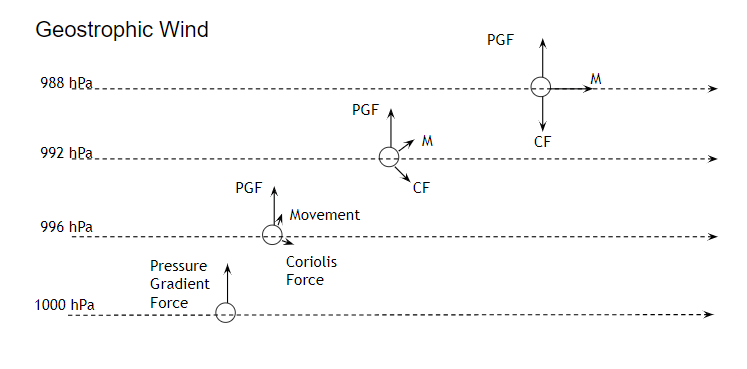
Any moving body on the surface of a rotating planet experiences a deflection to one side of its direction of movement except at the equator.
Coriolis force acts more strongly further away from the equator
Coriolis Force acts perpendicularly to the direction of movement, to the right of the direction of movement in the northern hemisphere and to the left in the southern hemisphere.
Geostrophic wind
Pressure gradient force goes from high to low cutting isobars at a right angle but due to rotation and curvature, reflected right in North hemisphere and left in south hemisphere. This is called geostrophic wind
Variations with lattitude
The magnitude of Coriolis Force varies directly as Latitude. In low Latitude greater speed is required to generate the balancing Coriolis Force than in high Latitude. The speed of the Geostrophic Wind is therefore greater in low Latitude than in high Latitude for the same Pressure Gradient.
Gradient wind
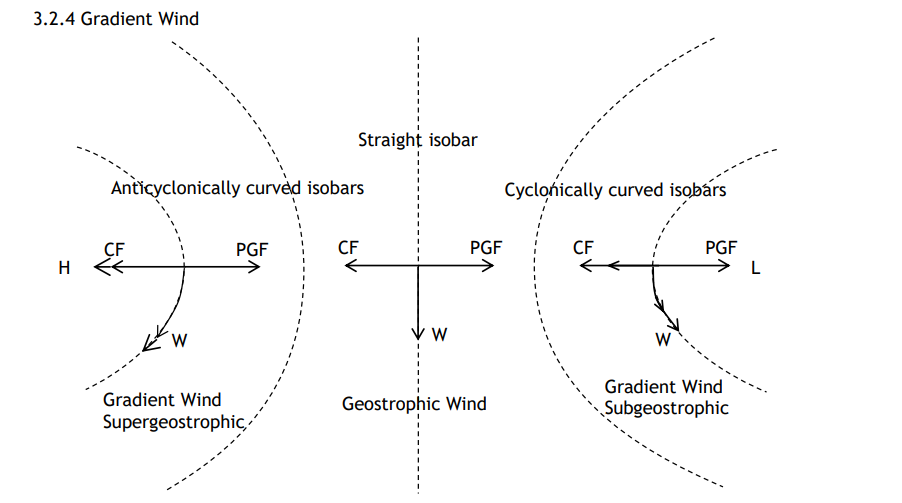
The Gradient Wind is the wind flowing in an area with curved isobars.
Air flowing parallel to curved isobars will follow a curved path.
Air flowing around an anticyclone must increase speed in order to generate increased Coriolis Force toward the centre of the system to achieve a curved path.
Air flowing around a depression must decrease speed in order to decrease Coriolis Force away from the centre of the system and achieve a curved path.
super geostrophic
Gradient wind is super-geostrophic where isobars are curved anticyclonically and sub-geostrophic where isobars are curved cyclonically. The amount of modification of the geostrophic wind speed depends on isobar curvature, latitude and wind speed.
anticyclone
high pressure system
cyclone
low pressure system
High pressure systems gradient wind
In high pressure systems, there is more gradient wind (super geostrophic) anticyclone
low pressure systems gradient wind
In low pressure systems, there is less gradient ewind (subgeostrophic wind) cyclone
If parallel
dont need to find the gradient wind
Veering
clockwise wind direction
Backing
anticlockwise wind direction
surface wind
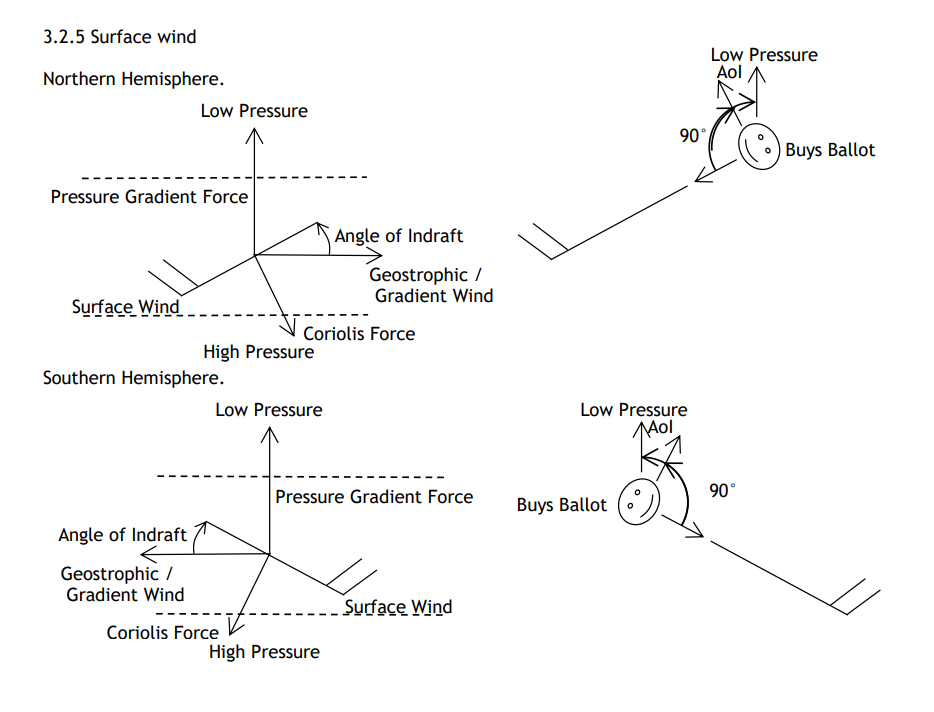
Pressure gradient force acts high towards
low pressure
Pressure gradient force acts perpendicular to
the isobar
air moves in response
to the pressure gradient force
Coriolis force deflects flow to the right
in the north hemisphere
coriololis force deflects flow left
in the southern hemisphere
Corilosis forece geostropgic wind
parallel to the isobars
Gradient wind describes flow along curved Isobars, higher than Geostrophic if anticyclonically curved, lower if cyclonically curved.
Gradient wind describes flow along curved Isobars, higher than Geostrophic if anticyclonically curved, lower if cyclonically curved.
Surface Wind flows in toward low pressure, crossing the Isobars at the Angle of Indraft.