Optical Minerology Study Guide
 Call Kai
 Learn
 Practice Test
 Spaced Repetition
 Match
 Flashcards
 Knowt Play
1/63

There's no tags or description
Looks like no tags are added yet.
64 Terms
Wave Speed Equation
Frequency is fixed

Velocity
c
Frequency
f
Wavelength
λ
Refractive Index
n is always positive

Retardation and Birefringence

Vector Resolution

Retardation
Δ
Thickness
d
Birefringence
δ
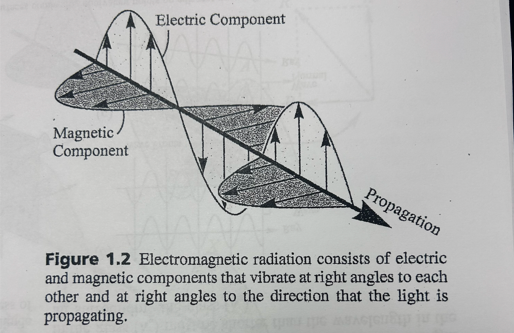
Electric and Magnetic Vectors
Vibrate perpendicular to each other and perpendicular to the ray
Visible Light
400-700 nm
Particle Theory
Stream of photons
Factors that Affect Electric and Magnetic Vectors
Refraction, Polarization, and Interference
Wave Front
Surfaces connecting equivalent points on adjacent waves (dark planes)

Wave Normal
Lines perpendicular to wave front

Isotropic Wave Front
Wave normal and light rays are perpendicular to the wave front

Anisotropic Wave Front
Light rays are typically not parallel to the wave normal

Wave Interference
Where waves vibrate in the same plane
In Phase Wave Interference
Perfectly constructive, A+B=R

Out of Phase Wave Interference
Perfectly destructive, A+B=R

Double Refraction
Mineral forces light to vibrate in only 2 orientations that are mutually perpendicular
Refraction
Light slows down and is bent toward the normal when it passes through two materials

Polarization
Restricting vibration directions of light waves so that they vibrate in a specific, orderly plane rather than randomly in all directions
Unpolarized Light
The light vibrates in all directions perpendicular to propagation direction

Plane Polarized Light
The electric vector vibrates in a single plane

Vibration Direction
Specific geometric orientation along which the electric vector of light wave vibrates as it travels through a medium
Indicatrix
Sphere or ellipsoid created by plotting the refractive indices of a mineral as radii parallel to the vibration directions of light
2 Things that the Indicatrix Tracks
Vibration Direction and Refraction Index
What is seen when we look down the X plane?
Y and Z planes
What is seen when we look down Z plane?
X and Y planes
Preferred Vibration Direction of Upper Polar
Perpendicular to Lower Polar
Isotropic Indicatrix Shape
Sphere
Anisotropic Indicatrix Shape
Ellipsoid (Frisbee or Football)
Isotropic Behavior Under Crossed Polars
Stays completely dark as stage rotates
Anisotropic Behavior Under Crossed Polars
Goes extinct every 90 degrees when it rotates and shows birefringence
Isotropic Behavior of Light
Light slows down uniformly and doesn’t split
Anisotropic Behavior of Light
Undergoes double refraction, splitting unpolarized light into two perpendicular rays (fast and slow)
Orientations Where Mineral Behaves Isotropically
Uniaxial and Biaxial
Retardation
Distance that the fast ray is ahead of the slow ray
Extinction
Anisotropic minerals go extinct (dark) every 90 degrees of rotation
How to Identify Slow Ray
If color order rises after putting in the accessory plate
How to Identify Fast Ray
If color order falls after putting in the accessory plate
Pleochroism
Minerals exhibit changing body colors when viewed under plane polarized light as the stage is rotated
Rules for Ordinary Ray (ω)
1.) Vibrates in 001/0001 plane
2.) Vibrates perpendicular to c axis
3.) Coincident with wave normal

Rules for Extraordinary Ray (ε)
1.) Vibrates perpendicular to ordinary ray
2.) Vibrates in a plane that contains the c axis and extraordinary ray

Optically Positive
Extraordinary ray is larger than the ordinary ray
Optically Negative
Ordinary ray is larger than the extraordinary ray
Prolate Spheroid
Football shape
Oblate Spheroid
Frisbee shape
Piercing Point
Construct the line perpendicular to the wave normal that strikes indicatrix as a tangent
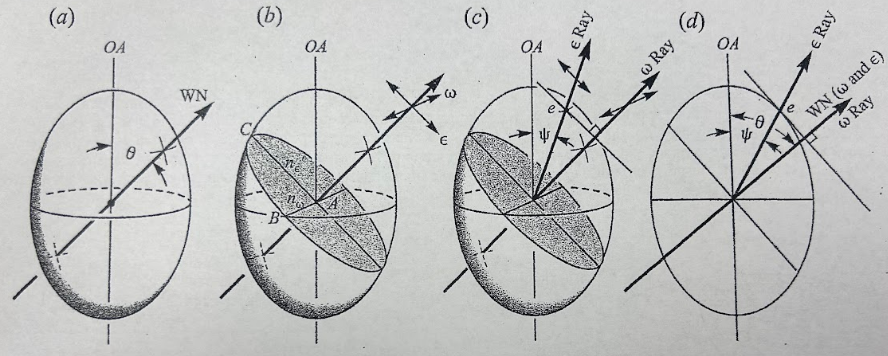
Principal Section
High birefringence, largest difference between ordinary and extraordinary rays

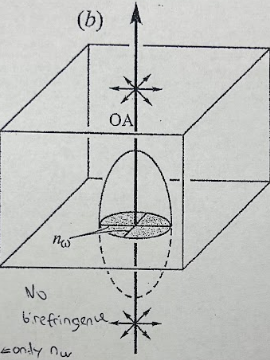
Circular Section
No birefringence, only the ordinary ray
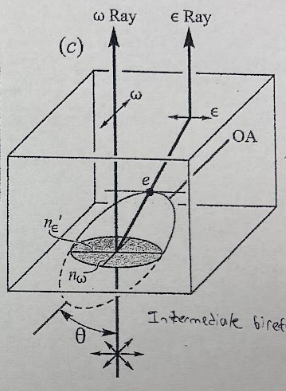
Random Section
Intermediate birefringence
Isochrome
“Rings” around isogyre

Isogyre
Cross looking thing
1.) Ordinary ray vibration direction is along latitudinal lines
2.) Extraordinary ray direction is along longitudinal lines

Melatope
The center

Optically Positive Sign
1.) Extraordinary ray is slow
2.) Ordinary ray is fast
Optically Negative Sign
1.) Ordinary ray is slow
2.) Extraordinary ray is fast
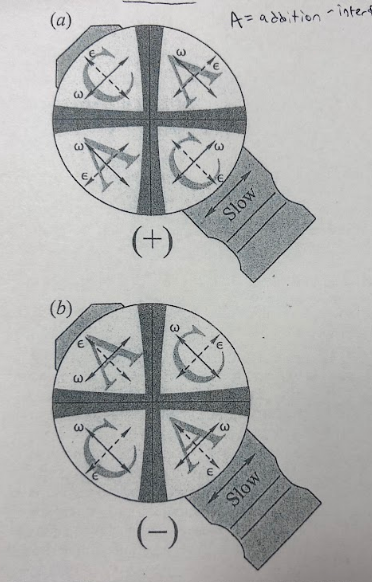
Definition of A
Addition - Interference colors INCREASE
Definition of C
Subtraction - Interference colors DECREASE
Off-Centered Optic Axis

Flash Figure
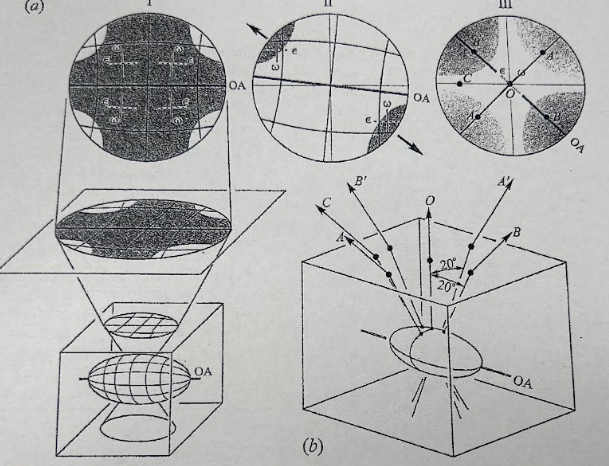
Why does entirety of FOV go extinct for a flash figure?
It reorients lat/long