Bone Marrow Failure & Megaloblastic Anemia: Chapters 15, 18, 19
 Call Kai
 Learn
 Practice Test
 Spaced Repetition
 Match
 Flashcards
 Knowt Play
1/106

There's no tags or description
Looks like no tags are added yet.
107 Terms
What does global failure in bone marrow examination indicate?
All lineages are decreased.

What is selective failure in bone marrow?
One lineage is mainly affected while others may be normal.
What is the significance of marrow cellularity?
It helps identify the production problem based on lineage distribution, maturation, and architecture.

What does ineffective output in bone marrow mean?
Active marrow is present, but there is poor release of cells.
What does under-stimulated marrow indicate?
The signal for production is too low.
What is the first step in diagnosing cytopenias?
Start with the Peripheral Blood and analyze the CBC.
What does a decreased reticulocyte count indicate?
Effective RBC production is inadequate.
What is pancytopenia?
A pattern where RBCs, WBCs, and platelets are all decreased.
What is the next question after identifying pancytopenia?
Is production insufficient, ineffective, replaced, selective, or under-stimulated?
What does a dry tap during a bone marrow aspiration indicate?
It can suggest fibrosis or other marrow problems.

What are the strengths of an aspirate in bone marrow examination?
It provides details on individual cells and their maturation.

What does a core biopsy reveal in bone marrow examination?
It preserves tissue architecture and assesses cellularity.

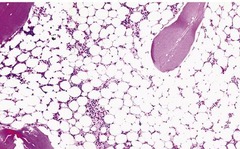
How does cellularity relate to hematopoietic tissue?
Cellularity compares hematopoietic tissue with fat and indicates marrow activity.

What does a hypocellular marrow indicate in the context of pancytopenia?
It suggests a different diagnosis than a hypercellular marrow in the same CBC pattern.
What are the three hematopoietic lineages?
Myeloid, erythroid, and megakaryocytic.

What does a high M:E ratio suggest?
Myeloid expansion or erythroid decrease.
What is the normal adult reference range for the M:E ratio?
Approximately 1.5:1 to 3.3:1.
What does marrow iron indicate in a bone marrow examination?
It helps assess iron stores and potential deficiencies.
What is the role of ancillary studies in bone marrow examination?
They refine the diagnosis when morphology raises specific questions.
What does the term 'replacement' refer to in bone marrow failure?
It indicates that normal hematopoietic tissue is replaced by abnormal cells.
What is the importance of interpreting cellularity in context?
Cellularity must be paired with clinical context, age, and peripheral blood findings.
What does the presence of blasts or abnormal cells in blood suggest?
It may indicate suspected marrow failure or malignancy.

What is the significance of performing a differential count in aspirate analysis?
It assesses the proportions of different cell types in the marrow.

How does the architecture of bone marrow affect diagnosis?
It can indicate conditions like fibrosis or infiltration.
What does a core biopsy help assess that an aspirate cannot?
Tissue architecture and overall cellularity.
What does it mean if the marrow is described as 'packed'?
It indicates a high density of cells, possibly due to fibrosis or infiltration.
What does a low reticulocyte count in the presence of cytopenias suggest?
It indicates that the marrow is not responding adequately to the need for new blood cells.
What is the primary question to ask when interpreting marrow findings?
What is the mechanism causing the observed blood pattern?
What is cytopenia?
A condition characterized by a reduction in the number of blood cells.
What are the five production-failure patterns?
Global failure, selective failure, ineffective output, replacement, under-stimulated.
What does global failure in bone marrow indicate?
All major lineages of blood cells are low due to ineffective production.
What is ineffective output in bone marrow failure?
Marrow is active but fails to release mature blood cells.
What does replacement mean in the context of bone marrow?
Normal marrow architecture is displaced by abnormal cells or fibrosis.
What is under-stimulation in bone marrow?
Marrow is capable of producing cells but receives insufficient growth signals.
What is aplastic anemia?
A condition characterized by global production failure and hypocellular marrow.
What are the peripheral blood findings in aplastic anemia?
Pancytopenia, low reticulocytes, and no immature blood cells expected.
What causes acquired aplastic anemia?
Injury or suppression of hematopoietic stem/progenitor cells due to immune attack, drugs, or radiation.
What is Pure Red Cell Aplasia (PRCA)?
A selective erythroid production failure where the RBC line is severely decreased.
How does megaloblastic anemia differ from aplastic anemia?
Megaloblastic anemia has hypercellular marrow and ineffective hematopoiesis.
What is myelophthisic anemia?
A condition where normal marrow architecture is disrupted by infiltration or replacement.
What is the best discriminator for diagnosing aplastic anemia?
The marrow pattern, specifically cellularity and the presence of abnormal cells.
What laboratory findings indicate chronic kidney disease (CKD) anemia?
Normocytic anemia with low reticulocytes and structurally capable marrow.
What is the significance of reticulocyte count in diagnosing anemia?
A low reticulocyte count indicates inadequate production of red blood cells.
What does a leukoerythroblastic smear indicate?
Disrupted marrow architecture, often seen in myelophthisic anemia.
What are the clinical features of aplastic anemia?
Pancytopenia, low reticulocyte count, and absence of immature blood cells.
What is the role of erythropoietin (EPO) in anemia?
EPO stimulates red blood cell production; low EPO levels can lead to under-stimulation of marrow.
What is the impact of marrow replacement on blood cell production?
Replacement disrupts normal hematopoiesis, leading to cytopenias.
How can the severity of marrow failure be classified?
Based on marrow cellularity and the depth of peripheral blood count abnormalities.
What is the relationship between stem/progenitor cell injury and cytopenias?
Injury leads to decreased output of all blood lineages, resulting in cytopenias.
What are the expected findings in a bone marrow biopsy for aplastic anemia?
Hypocellular marrow with decreased hematopoietic cells and no blasts.
What is the significance of macrocytosis in megaloblastic anemia?
It indicates ineffective hematopoiesis and abnormal maturation of red blood cells.
What are the causes of marrow failure that may be inherited?
Conditions like Fanconi anemia, Shwachman-Diamond syndrome, and telomere biology disorders.
What is the role of chromosome-breakage testing in diagnosing inherited marrow failure?
It supports the diagnosis of inherited marrow-failure syndromes.
What does the term 'hypocellular' refer to in bone marrow analysis?
A condition where the marrow has a significantly reduced number of hematopoietic cells.
What is the typical laboratory pattern in CKD anemia?
Normocytic, normochromic anemia with low reticulocyte counts.
What is the importance of understanding marrow patterns in diagnosing blood disorders?
Different marrow patterns help differentiate between various types of anemia and their causes.
What is macrocytic anemia?
A type of anemia characterized by larger than normal red blood cells (MCV >100 fL).
What are the key features of megaloblastic anemia?
It is caused by impaired DNA synthesis, leading to larger cells and ineffective hematopoiesis.
What are the main causes of megaloblastic anemia?
Vitamin B12 deficiency and folate deficiency.
What is the significance of reticulocyte count in macrocytic anemia?
A low reticulocyte count indicates inadequate marrow response to anemia.
What are hypersegmented neutrophils indicative of?
They are a classic finding in megaloblastic anemia.
What does an MCV of 122 fL suggest?
It suggests macrocytic anemia.
What is the role of vitamin B12 in DNA synthesis?
Vitamin B12 is essential for recycling folate into a usable form for DNA synthesis.
How does folate deficiency affect DNA synthesis?
It leads to incomplete DNA replication and slower cell division.
What is the relationship between vitamin B12 and folate in megaloblastic anemia?
Vitamin B12 deficiency can trap folate in an unusable form, leading to ineffective DNA synthesis.
What is pernicious anemia?
An autoimmune condition that results in vitamin B12 malabsorption due to intrinsic factor deficiency.
What laboratory test helps distinguish between B12 and folate deficiency?
Methylmalonic acid (MMA) levels; elevated in B12 deficiency and usually normal in folate deficiency.
What are common causes of folate deficiency?
Poor diet, increased demand (e.g., pregnancy), malabsorption, and certain medications.
What is the typical blood pattern in megaloblastic anemia?
Macrocytic anemia with oval macrocytes, hypersegmented neutrophils, and low reticulocyte response.
What does a high homocysteine level indicate?
It can indicate either vitamin B12 or folate deficiency.
What is the clinical significance of glossitis in megaloblastic anemia?
It may occur due to vitamin B12 or folate deficiency.
What does the term 'nuclear-cytoplasmic asynchrony' refer to?
It describes the condition where the cytoplasm matures normally while the nucleus lags, characteristic of megaloblastic anemia.
What is the role of intrinsic factor in vitamin B12 absorption?
Intrinsic factor is necessary for the absorption of vitamin B12 in the terminal ileum.
What can cause impaired absorption of vitamin B12?
Conditions like pernicious anemia, gastric surgery, or inflammatory bowel disease.
What is the typical presentation of a patient with vitamin B12 deficiency?
Symptoms may include neurologic findings, such as paresthesias and gait difficulties.
What is the typical presentation of a patient with folate deficiency?
Symptoms often relate to increased demand or poor intake, especially in pregnancy.
What is the importance of the reticulocyte response in diagnosing anemia?
It helps determine if the bone marrow is adequately responding to the anemia.
What does a low effective reticulocyte response indicate?
It suggests decreased or ineffective red blood cell production.
What is the significance of a high RDW in macrocytic anemia?
It indicates increased variability in red blood cell size, often seen in nutrient deficiencies.
What is the impact of vitamin B12 deficiency on folate metabolism?
It blocks the conversion of 5-methyl THF to THF, leading to a folate trap.
What is the role of dietary factors in folate deficiency?
Poor diet, overcooking foods, and alcohol can lead to inadequate folate intake.
What are the clinical implications of megaloblastic anemia?
It can lead to significant health issues if not diagnosed and treated, including neurological damage in B12 deficiency.
What does macrocytic anemia typically indicate?
It often suggests megaloblastic anemia due to B12 or folate deficiency.
What peripheral smear findings support megaloblastic maturation?
Oval macrocytes and hypersegmented neutrophils.
What does a hypercellular bone marrow indicate in megaloblastic anemia?
It suggests erythroid hyperplasia but ineffective output.
What is the role of lactate dehydrogenase (LDH) in ineffective hematopoiesis?
LDH levels increase due to precursor death during maturation.
What is a key marker for B12 deficiency?
Methylmalonic acid (MMA) usually increases.
What indicates folate deficiency in serum testing?
Low serum folate with normal MMA levels.
What is the interpretation of indirect bilirubin levels in megaloblastic anemia?
Indirect bilirubin levels increase due to intramedullary destruction.
What is the significance of hypersegmented neutrophils?
They are characteristic of megaloblastic maturation.
What is the treatment approach for folate deficiency?
Replace folate and address the underlying cause.
What is the treatment for vitamin B12 deficiency?
Replace vitamin B12 and identify the cause of deficiency.
What does a reticulocyte response indicate in the context of treatment?
An increase in reticulocytes indicates effective treatment.
What is the typical response time for reticulocytes after treatment?
A substantial reticulocyte response is expected at about 1 week.
What is the importance of differentiating between megaloblastic and nonmegaloblastic macrocytosis?
It helps identify the underlying cause of macrocytosis.
What are common nonmegaloblastic causes of macrocytosis?
Liver disease, alcohol use, reticulocytosis, and bone marrow failure.
What does the presence of oval macrocytes indicate?
It is characteristic of megaloblastic macrocytosis.
What is the role of the Schilling test?
It historically assessed vitamin B12 absorption but is not routinely used.
What does a negative intrinsic-factor antibody indicate?
It does not completely exclude pernicious anemia.
What is the significance of reticulocyte count in peripheral hemolysis?
It may be increased if the marrow responds to peripheral destruction.