PHYSL 210 Special Senses 2
 Call Kai
 Learn
 Practice Test
 Spaced Repetition
 Match
 Flashcards
 Knowt Play
1/32

There's no tags or description
Looks like no tags are added yet.
33 Terms
Central control of sensory signals
Sensory signals can be extensively modified before reaching higher central nervous system levels.
Lateral inhibition
Ascending neurons inhibit other neurons through collateral connections.
Presynaptic inhibition of sensory input
Synapses on primary afferent terminals can reduce transmitter release.
Inhibition in pain pathways
Ongoing inhibition can be decreased to increase transmission or increased to suppress it.
Anterolateral system
Carries afferent information from pain and temperature receptors.

Dorsal column system
Carries information about body movement, limb position, fine touch discrimination, and pressure.
Optical component of the eye
Focuses the visual image on receptor cells.

Neural component of the eye
Transforms the visual image into graded and action potentials.
Cornea and refraction
The cornea is primarily responsible for refraction.

Lens and focusing
The lens focuses the visual image on the retina.
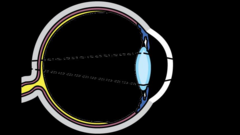
Distant vision
Relaxed ciliary muscles maintain zonular fiber tension and flatten the lens.
Light from nearby objects
Light rays from near objects diverge.
Near accommodation
Parasympathetic activation contracts ciliary muscles, slackens zonular fibers, and rounds the lens.
Presbyopia
Loss of lens elasticity impairs accommodation for near vision.
Myopia
The eye is too long in relation to the focusing power of the lens.
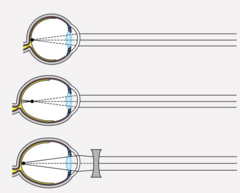
Myopia correction
A concave lens corrects nearsightedness.

Hyperopia
The eye is too short in relation to the focusing power of the lens.
Hyperopia correction
A convex lens corrects farsightedness.
Astigmatism
The lens or corneal surface is not smoothly spherical.
Glaucoma
Increased intraocular pressure damages the retina.

Cataracts
Clouding of the lens.
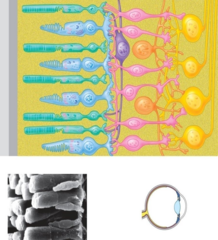
Rods
Photoreceptors that function in low-light conditions.

Cones
Photoreceptors that function best in bright light and provide color vision.
Horizontal cells
Retinal interneurons.
Bipolar cells
Retinal interneurons.
Amacrine cells
Retinal interneurons.
Retinal ganglion cells
Their axons form the optic nerve, which transmits visual information toward the cortex.
Cyclic guanosine monophosphate
cGMP binds to photoreceptor cation channels, opening them.
Photoreceptor cation channels
Open channels permit sodium and calcium entry.
Phototransduction components
Light activates processes involving photopigment, transducin, and cGMP-phosphodiesterase.
Photoreceptor response to light
Cones release less glutamate in light than in darkness.
ON-center bipolar cells
Glutamate inhibits them.
OFF-center bipolar cells
Glutamate excites them.