Solicitors Accounts
 Call Kai
 Learn
 Practice Test
 Spaced Repetition
 Match
 Flashcards
 Knowt Play
1/111

There's no tags or description
Looks like no tags are added yet.
112 Terms
What is one of the SRA’s priority risks?
client money
Solicitors must look after cleint money and keep it safe
they must also keep it separate from money belonging to the firm
Client money is money held or recieved by a law firm:
for regulated services delivered by law firm to a client
on behalf of a third party in relation to regulated services (held as an agent or stakeholder)
as a trustee or the holder of an office e.g. donee of power of attorney or trustee of an occupational pension scheme
in respect of law firm’s fees and any unpaid disbursements if held or received prior to delivery of a bill
how many bank accounts do law firms have and what are they?
client account - holds money belonging to the clients of the law firm which must be paid promptly into the account
business account - holds money belonging to the law firm
What is rule 8.1 on records?
It requires a law firm to keep accurate, cintemporaneoous and chronological records of all receipts and payments of client money and non client money, bills of costs and transactions through the law firm’s client account
how many client ledger accounts should there be?
one for every matter which includes the client’s name and a description of the matter or transaction
what is a cash sheet for client account?
used ro record payments into and out of the law firm’s client account
what is the double entry principle?
every financial transaction is recorded twice
once as a credit entry (CR) and once as a debit entry (DR)
The 2 entries are for the same amount of money but in different accounting records e.g. client ledger client account and cash sheet client account
Client money should be paid promptly into a client account unless:
the money is held as trustee or holder of a specified office and to do so would conflict with your obligations under rules or regulations relating to your specified office
the money represnts payments from the Legal Aid Agency for your costs
an alternative arrangment in writing is agreed with the client or a 3P for whom the money is held
what happens to client money that you no longer have a reason to hold on to?
money must be returned proptly to the client or the 3P for who the money is held
what are the rules regarding a client account?
the account must be with a bank or building society in E&W
must be named appropriately (include the name of the authorised body and the word client)
cannot be used to provide banking facilities to clients or 3P (payments in and out must be for reason of regulated services by you)
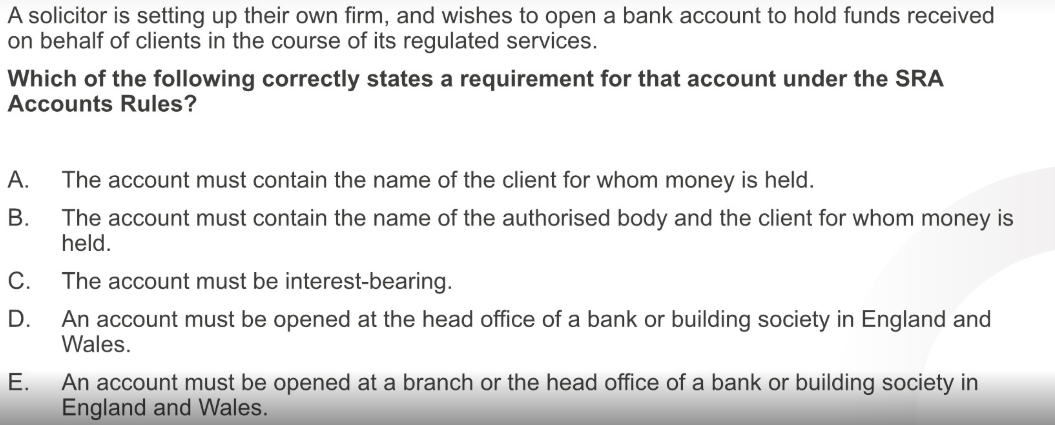
E
what should you do if client money is lost and taken even if it has been replaced?
report this breach to the SRA
what can happen to solicitors that have client money breaches?
face serious sanction including striking off the roll if they have been dishonest
what liability do do authorised’s body’s managers face for compliance with the rules
joint and several liability

B

A
what are the rules for basic client ledger entries?
non-client money paid out from petty cash
Debit client ledger business account for that client
credit cash sheet petty cash

What happens in the client ledger when a firm pays money on behalf of the client to another company?
The withdrawal will appear in the debit/DR column.
What happens in the cash sheet client account when a firm pays money on behalf of the client to another company?
The withdrawal will appear in the credit/ CR column
How is money taken out written in the client ledger account on the business account?
The amount is written in the debit section/ DR and in the Balance section the amount is written with a minus (e.g. -14) showing that the client now owns the firm that amount
a second entry must be made in the cash sheet business account - amount written in the CR column
How do you transfer money from client account to business account on the client account ledger?
2 lines:
First line would show the amount deducted on the balance column in the business account as a minus (e.g. -14) and in the DR column in the client account
Second line would show the amount in the CR column of the business account and a 0 in the balance in the business account
Double bookkeeping means that this would also be mirrored in the cash sheet:
The amount in the client account in the DR column would be repeated in the CR column of the cash sheet
the amount in the CR business account in the CR column would be repeated in the DR column in the cash sheet business account
when can you withdraw money from a client account? rule 5.1
a) for purpose for which it is held
b) following receipt of instructions from the client or the 3P for whom the money is held
c) on the SRA’s prior written authorisation or in prescribed circumstances e.g. a client disappeared
what does rule 3.3 state regarding provision of banking facilities to clients or 3Ps?
You must not do it. Payments into and transfers or withdrawals from a client account must be in respect of the delivery by you of regulated services
Can money be withdrawn if there are not sufficient funds in the client account?
No - rule 5.3
what must you do when there is a breach of the client money rules?
Rule 6.1 - any breaches must be corrected promptly upon discovery. Any money improperly withheld or withdrawn from a client account must be immediately paid into the account or replaced
what is a mixed payment?
payment to the firm containing non client money and client money e.g. Firm asks Tara for: £240 to settle a bill raised = non client money and £500 on account of future costs = client money
the money must be allocated promptly to the correct client account or business account
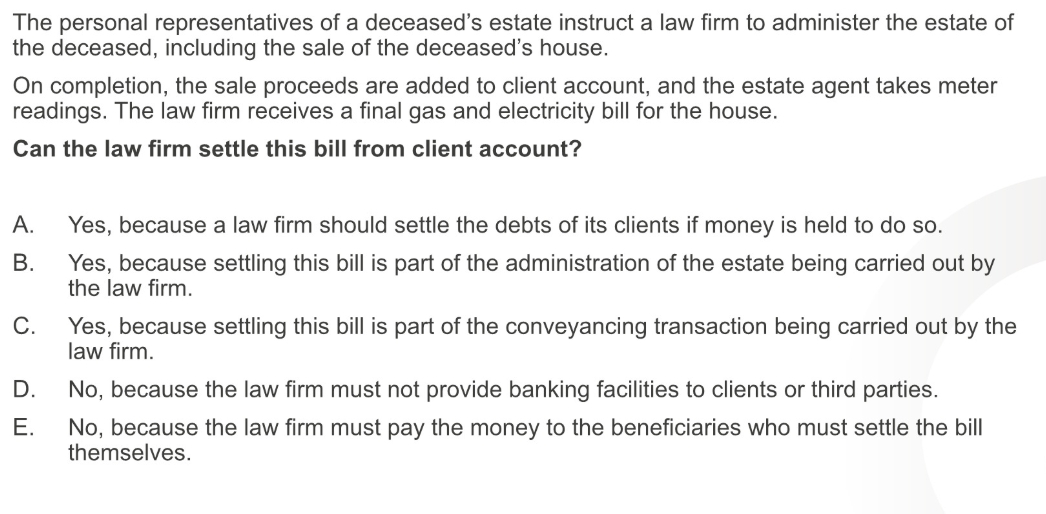
B - not banking facilities to pay money out that relates directly to the service being provided
what is it called when a law firm pays an expense on behalf of a client because they are holding money for that client and the supply is made to the client and the invoice is adressed to the client? How is it shown in the client ledger account?
agency basis
Debit (DR) in client account and Credit (CR) in cash sheet
examples of disbursements normally made by the agency method

what is the principal method?
the supply is made to the law firm and the invoice is addressed to the law firm.
the law firm pays the invoice (out of business account and will need to in turn invoice the client)
examples of principal method

how is a fee registered in the accounts under the principal method?
In the business account of the client ledger insert the fee amount in the debit (DR) + the fee amount with a minus in front in the balance column
In the cash sheet business account there will be a credit (CR) entry of the fee
where is VAT accounted for?
In a VAT account
How do you show a payment of VAT in a VAT account?
Amount placed in the debit (DR) column and an X in the balance
In the cash sheet business account a credit (CR) entry of the amount
under the principal method how is a fee and VAT shown in the cash sheet business account?
Both appear as separate entries in the credit (CR) column and an X in the balance

D

E
What does the client ledger include?
client side = where receipts and payments of that client’s money are recorded
business side = where receipts and payments of non-client money and bills of costs relating to that client are shown
what is a cash book?
It shows transactions through the client bank account. This is known as the cash sheet client account
where will entries for transactions involving client money be recorded?
The receipt or payment of client money will be recorded in the following two places:
a client [account] cash book aka the cash sheet client account records the receipts into and payments out of the client account (the bank account in which the authorised body holds client money) i.e. a running total of the transactions through the client account.
the client side of the client ledger [account] for the individual client aka the client ledger client account which records the receipts in of client money and payments out of client money for that particular client. Its balance shows how much client money the authorised body holds on behalf of that particular client.
What are the entries for deposit received by solicitor from buyer client
Buyer will send the deposit money to their solicitor to hold ready for exchange of contracts
this is client money so the usual entries apply:
Credit client ledger client account for that buyer client
Debit cash sheet client account
what are the entries for deposit paid by the buyer’s solicitor to seller’s solicitor
Client money should be used where possible (office money should only be used if the client has insufficient funds in the client account)
Accounting entries are the usual ones for payment out of client money:
debit client ledger account for that buyer client
credit cash sheet client account
What happens on receipt of deposit by the seller’s solicitor
Deposit received by the seller’s solicitor from the buyer’s solicitor is money received on behalf of a third party in relation to regulated services delivered by the seller’s solicitor = client money
The deposit will be paid into the client account of the seller’s solicitor
ledger entry will depend on whether the deposit is held by the seller’s solicitor as agent or stakeholder (this would be stated in the contract for the sale of the property in question)
what happens to a deposit received by seller’s solicitor to be held as stakeholder
Stakeholder arrangement = trust under which the seller’s solicitor holds the deposit on trust for both the byer and the seller until the completion date, when the money can be paid to the seller
When a solicitor acts as stakeholder, the deposit money cannot be handed over (or back) to one party without the consent of the other or until the sale of the property completes.
However, the deposit money cannot be ‘allocated’ to the seller (i.e. shown as a credit in the seller’s client ledger client account), as this would indicate that the deposit money belongs to the seller and can be used freely by him or her.
Instead, a separate client ledger called ‘stakeholder’ is used to record the receipt of the deposit.
The deposit money is not credited to the seller client’s own client ledger client account until the completion date.
what are the entries for deposit received by seller’s solicitor to be held as stakeholder
At exchange of contracts the seller’s solicitor records the receipt of the deposit to be held as stakeholder with these entries:
Credit client ledger stakeholder (often referred to as stakeholder ledger)
Debit cash sheet client account
On completion of the property sale, the deposit money is transferred from the stakeholder ledger to the seller’s client ledger (client side) as follows:
Debit stakeholder ledger
Credit client ledger client account for that (seller) client
At completion, as the deposit money is already in the client account, there is no need to take it out and pay it back in again. Instead, the transfer is from one client (the stakeholder) to another client (the seller) and both the credit and debit entries are made in the client ledgers to show the money now belongs to the seller client rather than the stakeholder ‘client’.
what are the entries for deposit received by seller’s solicitor to be held as agent?
When a seller’s solicitor holds a deposit as agent for the seller, the agent (solicitor) can hand the money over to the seller before completion. The agreement of the buyer is not required to enable the solicitor to do this.
So, the deposit belongs to the seller from exchange and the seller’s solicitor just records receipt of the deposit at exchange with the usual accounting entries for receipt of client money.
Client money received
Credit client ledger client account for that (seller) client
Debit cash sheet client account
Do transactions that do not involve money need to be recorded?
Yes e.g. bills of costs
what does issuing a bill of costs create
a debt that the client now owes the authorised body
Where do all receipts and payments which are not client money and bills of costs need to be recorded?
Business side of the client ledger account
where will the entries for issuing a bill be recorded?
business side of the client ledger account
profit costs account (central record of all bills or other written notifications of costs given by you)
what are the entries made to record the issuing of a bill?
debit the client ledger business account for that client
credit the profit costs account
The client ledger business account shows how much money that client owes the authorised body - as a bill has been sent to the client they now owe the authorised body that amount of money so it appears as a debit in their client ledger business account
Is VAT chargeable on the supply of legal services?
Yes VAT is chargeable on the supply of legal services at the point of supply which means when the bill of costs/invoice is issued to the client
Standard rate of VAT is 20% on top of the fees for the services e.g. a bill of costs charging £1,000 for legal services will also charge VAT on the sum at 20% = further £200. Total due from the client will be £1,200
If there is no mention of VAT when the solicitor infoms the client what the costs are then the costs are deemed to be inclusive of VAT
Record kept of VAT paid or charged by the authorised body is the VAT account [ledger]
what are the entries when an authorised body sends a bill of costs plus VAT to a client?
debit the client ledger business account for that client
credit the VAT account [ledger]
The client ledger business account shows how much money that client owes the authorised body - as VAT has been charged to the client, the client now owes the authorised body that amount of money so it appears as a debit in their client ledger business account
what are the entries for issuing a bill plus VAT?
there are 2 sets of double entries to record in the accounts:
one for the bill of costs
another for the VAT
The 2 debit client ledger business account entries must not be combined - must be separate as each has its own other half of its pair entry

what happens when the client pays the bill and VAT?
the money is non-client money belonging to the authorised body so it is paid into the business account
it is also recorded in the client’s client ledger business account where a credit of the receipt of the payment shows that the client no longer owes the authorised body that sum the money
what are the entries to record the receipt of the payment of the bill and VAT
Usual entries to record of non-client money:
credit client ledger business account
debit cash sheet business account
If the client sends a total amount of money which is more than the amount of the bill and VAT then if the extra money is client money (because it has been sent generally on account of costs) there is a mixed payment = should be recorded with 2 separate double entries:
record the receipt of the non-client money amount (bill + VAT)
record receipt of the client money amount
what happens when the client pays the bill plus VAT by transfer from the client account?
You must ensure there is sufficient money held in the client account on behalf of the client before transferring the amount to pay the bill plus VAT
Transfer of money out of the client account and into the business account will involve 2 steps (2 sets of double entries):
taking of money out of client account
paying the money into the business account
entries for each step:
withdraw money from the client account:
debit the client ledger client account for the client
credit the cash sheet client account
pay the money into the business account
credit the client ledger business account for the client
debit the cash sheet business account

What are the 2 ways in which the lender’s bill could be recorded in the accounts if a client is buying property (with a mortgage) / selling a property (and redeeming an existing mortgage) and the authorised body is also acting for their lender?
The lender’s bill plus VAT will:
either be recorded in the lender’s separate client ledger (if the authorised body has set one up); or
it will be recorded in the borrower client’s (the buyer/seller) client ledger (if there is no separate client ledger for the lender).
It is usual for there to be a term in a loan agreement that the borrower will pay the lender’s legal fees plus VAT
If the lender’s bill plus VAT has been recorded in the lender’s separate client ledger, the debt will need to be transferred to the borrower client’s client ledger first before they can pay it.
How do you bill a lender when there is no separate ledge for the lender?
If there is no separate client ledger for the lender, the entries for the bill and VAT are made in the borrower’s client ledger and are the same as for sending a bill plus VAT to the borrower but the details added to the entries will state the bill is for the lender:
1)
Debit client ledger business account (for the borrower) with the amount of the profit costs charged to the lender
Credit profit costs [account] with the amount of the profit costs charged to the lender
2)
Debit client ledger business account (for the borrower) with the amount of the VAT charged to the lender
Credit VAT account [ledger] with the amount of the VAT charged to the lender
How do you bill a lender when there is a separate ledge for the lender?
If there is a separate client ledger for the lender, the entries for the bill and VAT are made in the lender’s own client ledgerand are the same as for sending a bill plus VAT to the borrower (the buyer/seller) or any other client with a client ledger:
1)
Debit client ledger business account (for the lender) with the amount of the profit costs charged to the lender
Credit profit costs [account] with the amount of the profit costs charged to the lender
2)
Debit client ledger business account (for the lender) with the amount of the VAT charged to the lender
Credit VAT account [ledger] with the amount of the VAT charged to the lender
What are the 2 ways that payment of the lender’s costs by borrower is made when the lender does not have a separate ledger?
If the lender’s bill plus VAT was recorded in the borrower’s client ledger because there is no separate client ledger for the lender and the borrower is paying it, then it will be paid in one of the same two ways as the borrower paid its own bill plus VAT:
either receipt of non-client money from the borrower client; or
a transfer is made of the borrower’s money from client account to business account
What are the entries when the borrower sends money to pay the lender’s bull plus VAT?
The entries are the usual ones to record receipt of non-client money and are:
Credit client ledger business account for the (borrower) client
Debit cash sheet business account
If the client sends a total amount of money which is more than the amount of the bill and VAT then, if the extra money is client money (e.g. because it has been sent generally on account of costs), this is a mixed payment. It could be recorded with two separate double entries. One to record the receipt of the non-client money amount (the bill and VAT amount) as above and one recording receipt of the client money amount.
what are the entries when the borrower instructs the law firm to use money in client account?
You must ensure there is sufficient money held in the client account on behalf of the client before transferring the amount to pay the bill plus VAT
Transfer of money out of the client account and into the business account will involve 2 steps (2 sets of double entries):
taking of money out of client account
paying the money into the business account
entries for each step:
withdraw money from the borrower client account:
debit the client ledger client account for the borrower client
credit the cash sheet client account
pay the money into the business account
credit the client ledger business account for the borrower client
debit the cash sheet business account
what happens when there is payment of lender’s costs by borrower when the lender does have a separate ledger?
If the lender’s bill plus VAT was recorded in the lender’s own client ledger, then the debt that’s owed needs to be transferred to the borrower’s client ledger (so that it is owed by the borrower to the law firm) before the borrower can pay it.
This is the case for any client’s bill (not just a lender’s) if another client has agreed to pay it.
what are the entries when transferring costs from one client to another?
The transfer of the debt that the lender owes the authorised body (for the bill plus VAT to the lender) from the lender client to the borrower (the buyer/ seller) client is recorded by the following pair of accounting entries:
Debit client ledger business account (of the borrower) (for the total amount of the profit costs and VAT)
Credit client ledger business account (of the lender) (for the total amount of the profit costs and VAT)
No money is moving – these entries are just removing the debt from the lender’s client ledger (business side) and reallocating it to the borrower’s client ledger (business side) which is why the debit is in the borrower’s client ledger business account - as the amount the borrower owes the authorised body has increased.
This transfer of the costs reallocates them from the lender to the borrower and following this, they can be paid in the same two ways as the borrower paid its own bill plus VAT – receipt of non-client money from the borrower or transfer of the borrower’s money from client account to business account.

C

C

C

D
Who do the SRA Accounts Rules apply to?
The SRA Accounts Rules state that they apply to authorised bodies, their managers and employees.
Authorised bodies are bodies authorised by the SRA to practise as either bodies licensed by the SRA or bodies recognised by the SRA.
Managers are: the sole principal in a recognised sole practice; members of a LLP; directors of a company; partners in a partnership; or in relation to any other body, a member of its governing body.
Who is responsible with compliance with the SRA Accounts Rules?
The SRA Accounts Rules state that the authorised body’s managers are jointly and severally responsible for compliance with the rules by the authorised body, its managers and its employees.
Rule 12.1 - requirement to obtain and deliver an accountant’s report
Rule 12.1 requires authorised bodies that hold or receive client money (or operate a joint account or a client’s own account as signatory) to obtain an within six months of the end of the accounting period to which the report relates
if the authorised body has NOT held client money for the accounting period, then it will not be required to obtain an accountant’s report.
The accountants’ report should only be delivered to the SRA if it is qualified = it shows a failure to comply with the SRA Accounts Rules so that the client's (or third party's) money is/has been/is likely to be at risk.
If the accountant’s report is NOT qualified, then it does not need to be delivered to the SRA.
What are some factors that would lead to a report being qualified?
‘a significant and/or unreplaced shortfall (including client debit balances or business credit balances)on client account…unless caused by bank error and rectified promptly’;
‘Actual or suspected fraud or dishonesty by the managers or employees of the firm (that may impact upon the safety of money belonging to clients or third parties)’;
‘Accounting records not available or bank accounts/ledgers failing to include reference to a client’;
‘Client account bank reconciliations not being carried out’; and
‘The client account ...improperly used as a banking facility’.
When can the SRA require an accountant’s report?
SRA can require an authorised body to obtain or deliver an accountant’s report to the SRA on reasonable notice if the authorised body has ceased to operate as an authorised body and to hold or operate a client account (ie a final report) and the SRA can also require an authorised body to obtain or deliver an accountant’s report to the SRA if the SRA considers it is in the public interest to do so.
when are you not required to obtain an accountant’s report?
You are not required to obtain an accountant's report if:
(a) all of the client money held or received during an accounting period is money received from the Legal Aid Agency; or
(b) in the accounting period, the statement or passbook balance of client money you have held or received does not exceed:
i. an average of £10,000; and
ii. a maximum of £250,000,
or the equivalent in foreign currency.
'statement or passbook balance' is the total balance of:
(a) all client accounts held or operated by you; and
(b) any joint accounts and clients’ own accounts operated by you,
as shown by the statements obtained under rule 8.2.
[NB Rule 8.2 is the obligation to obtain, at least every five weeks, bank/building society statements for all of the authorised body's client accounts and business accounts. These are required to complete the client account reconciliations required by Rule 8.3].
What are the exemptions from requirement to obtain an accountant’s report
1) Where all of an authorised body’s client money held or received during an accounting period is money from the Legal Aid Agency, it will not be required to obtain an accountant’s report (Rule 12.2(a)) under Rule 12.1 (it may still be required to provide one under Rule 12.4 ie where ceasing to operate as an authorised body and operate a client account or where the SRA consider it in the public interest).
2) If, during the accounting period, the average balance on its client account(s) does not exceed £10,000 AND the maximum balance does not exceed £250,000, the authorised body is not required to obtain an accountant’s report (Rule 12.2(b)) under Rule 12.1 (it may still be required to provide one under Rule 12.4).
NB these exemptions only apply to that accounting period (usually a year). It may be that the following accounting period, the authorised body does not fall within the exemptions and so needs to obtain an accountant’s report.
Rules on the form of the accountant’s report
The accountant needs to be both a member of a chartered accountancy body AND work for or be a registered auditor.
The report must be in the form prescribed by the SRA.
why might the SRA disqualify an accountant from preparing a report
(a) the accountant has been found guilty by their professional body of professional misconduct or equivalent; or
(b) the SRAis satisfied that the accountant has failed to exercise due care and skill in the preparation of a report under these rules.
What is the rule for the storage and retention of accounting records?
Store all accounting records securely and retain these for at least six years.
Accounting records = include bank and building society statements, the accountants’ reports (whether qualified or not) any client’s written instructions to hold client money other than in accordance with the SRA Accounts Rules, records relating to third party managed accounts and any other records or documents necessary to show compliance with the SRA Accounts Rules.
what are joint accounts?
joint accounts = allows the solicitor/authorised body to operate and manage the account and money in it along with another person e.g. the client, another law firm or a 3P
not a client account but money held in a joint account is still client money
May be used where a firm’s solicitor is named as a joint executor with a lay person on the administration of an estate
what is a solicitor’s duty in regards to joint accounts?
Safeguard the money and consider any action you can take to mitigate against risks e.g. making sure the joint account has a joint signature mandate
which SRA accounts rules apply to a joint account?
Rule 1 - who the Accounts Rules apply to
Rule 8.2 –obtain, at least every five weeks, statements from banks, building societies etc for all client accounts and business accounts [ie so this also includes joint accounts because of Rule 9.1]
Rule 8.4 – to keep readily accessible a central record of all bills or other written notifications of costs given by you
Rule 12.1 clearly states that the requirement to obtain an accountant’s report applies if you have operated a joint account (although the exceptions for Legal Aid money and for average and maximum balances in Rule 12.2 may apply).
The bills and bank statements for the joint account are the accounting records for the joint account and need to be kept securely and retained for at least six years – Rule 13.1.
Which rules apply to the operation of a client’s own account?
Rule 8.2 –obtain, at least every five weeks, statements from banks, building societies etc for all client accounts and business accounts
Rule 8.3 - requires you to complete, at least every five weeks, a reconciliation of the bank/building society statements balance for the account with the cash book balance and client ledger total so that you can promptly investigate and resolve any differences shown by the reconciliation.
Rule 8.4 – to keep readily accessible a central record of all bills or other written notifications of costs given by you
Rule 12.1 clearly states that the requirement to obtain an accountant’s report applies if you have operated a client’s own account as signatory (although the exceptions for Legal Aid money and for average and maximum balances in Rule 12.2 may apply).
The bank statements, reconciliations and bills for the client’s own account as signatory are the accounting records for it and need to be kept securely and retained for at least six years – Rule 13.1.
When can the SRA use a third party managed account (TPMA)
A TPMA can be used as an alternative to a client account or alongside a client account.
Money held in a TPMA does not fall under the definition of client money as it is not held or received by the authorised body = it does not have to be held in accordance with the SRA Accounts Rules relating to the holding of client money
what rule does apply to the authorised body using a TPMA?
To comply with Rule 11:
The authorised body has to ensure use of the TPMA does not result in them receiving or holding the client’s money (Rule 11.1(a)).
The authorised body must take reasonable steps to ensure the client is informed of and understands: their rights and obligations and what use of the TPMA means in their case, in particular any charges or fees they are liable to pay (Rule 11.1(b)(i)); and their right to terminate the agreement and dispute payment requests you make (Rule 11.1(b)(ii).
The authorised body must obtain regular statements and ensure these reflect transactions on the account correctly (Rule 11.2).
What must a TPMA be?
regulated by the FCA (Financial Conduct Authority);
an authorised payment institution/ EEA authorised payment institution/ small payment institution which has adopted voluntary safeguarding arrangements to the same level as an authorised payment institution;
an account at a bank/ building society;
operated as an escrow payment service (the third party receives and disburses money on your and your client’s behalf); and
the monies in the TPMA must be owned beneficially by the third party.
Does an authorised body need the SRA’s permission to use a TPMA?
an authorised body does not need the SRA’s permission to use a TPMA but that the SRA expect to be notified if a TPMA is being used (by filling out a TPMA form). If more than one TPMA provider is used, the SRA expect to be notified of all the providers used and to be informed of any switches between providers or if the authorised body stops using a TPMA provider so they can update their records.
Are receipts of mortgage funds and payment to redeem an existing mortgage client money?
Yes
what are the 2 methods of dealing with receipt of funds for buying a property?
Buyer’s solicitor may open a separate client ledger for the lender (their client)
transactions involving the lender may be recorded in the buyer’s client ledger provided the ledgers contain narratives alongside the entries which identify and provide adequate info about the transactions
what are the entries for receiving mortgage funds when the solicitor does not open a separate ledger for the lender
solicitor acting for the buyer and the lender
all transactions involving the lender’s mortgage funds will have to be recorded in the client ledger of the buyer client
accounting entries would be the usual ones for client money recieved and the details would state that the mortgage funds have come from the lender:
credit client ledger client account for the buyer client
debit cash sheet client account
what are the entries for receiving mortgage funds when the solicitor does open a separate ledger for the lender
The receipt of the mortgage funds from the lender would first be accounted for in the lender’s client ledger using the usual account entries for client money received:
credit client ledger client account for the (lender) client
Debit cash sheet client account
The mortgage funds would then be moved from the lender’s client ledger to the buyer’s client ledger at completion (to show the money already held in the client account is now held for the buyer instead of the lender) with these entries:
Transfer of mortgage funds between clients
Debit client ledger client account for the (lender) client
Credit client ledger client account for the (buyer) client
what are the entries for mortgage redemption (repaying a mortgage) if the solicitor does not open a separate ledger for the lender
If the seller’s and lender’s solicitor records transactions involving the lender’s mortgage funds in the client ledger of the seller client, the accounting entries would simply be the usual ones for client money paid out and the details would state that the redemption money has been sent to the lender to redeem the seller’s mortgage:
Client money paid out
debit client ledger client account for the (seller) client
Credit cash sheet client account
what are the entries for mortgage redemption (repaying a mortgage) if the solicitor does open a separate ledger for the lender
If the solicitor has a separate client ledger for the lender then the mortgage redemption money would first be moved from the seller’s client ledger to the lender’s client ledger (to show the money already held in the client account is now held for the lender instead of the seller) with these entries:
Transfer of mortgage redemption monies between clients
Debit client ledger client account for the (seller) client
Credit client ledger client account for the (lender) client
The redemption money would then be sent to the lender using the usual accounting entries for client money paid out.
Client money paid out
Debit client ledger client account for the (lender) client
Credit cash sheet client account
what happens when two of the clients of the authorised body have arranged a private loan between themselves?
This involves a transfer from one client to another.
Where the authorised body has a separate client ledger for the client who is loaning the money, the entries would only affect the client ledgers of the clients (as the money is already in the client account and will stay there) and will be:
Transfer of loan monies between clients
Debit client ledger client account for the client loaning the money
Credit client ledger client account for the client receiving the money
The written authority of both clients for the private loan must be obtained and kept.
What is interest earnt in the general/main client account?
non-client money/money belonging to the authorised body
as interest earnt on money in the general/main client account is not client money what must happen?
client money must be kept separate from money belonging to the authorised body. The authorised body should arrange with its bank for all interest earned on the general/main client account to be paid into the authorised body’s business account
the fair sum of interest should be paid to each client
interest received and then paid out by the authorised body is recorded on the interest receivable and the interest payable ledgers
what are the entries for the receipt of the interest earnt by the client account in the authorised body’s business account?
Credit interest receivable ledger (note the interest receivable ledger is used here)
Debit cash sheet business account
what are the steps to pay a sum of interest to a client
This involves a transfer from one bank account (the business account) to another (the client account).
1) Recording the withdrawing of the interest from the business account
Debit interest payable ledger (note the interest payable ledger is used here)
Credit cash sheet business account
2) Recording the receipt of the interest into the client account
Credit client ledger client account for the client (being paid the interest) (note the client ledger is used here)
Debit cash sheet client account
what are separate designated client accounts?
Some authorised bodies may open one or more separate designated client account(s) (additional client bank accounts), each to hold an individual client’s money in.
This is not very practical, particularly if the authorised body has a lot of clients, and so a separate designated client account is usually only opened for a client when the authorised body is holding a significant amount of money for a client, especially if it is likely to be held for some time before being used.
These must must still be at a branch or head office of a bank or building society in England and Wales and have a name which includes the name of the authorised body and has the word ‘client’ in (Rule 3)
what are separate designated client ledgers?
If the authorised body has opened a separate designated client account to keep an individual client’s client money in, it must also set up a separate designated client ledger for that client to record transactions affecting the separate designated client account in.
Transactions involving the receipt or payment of client money into/out of the separate designated client account will therefore be recorded in the record for the separate designated client account (which may be referred to as the cash sheet separate designated client account) and in the client ledger for the separate designated client account (which only has a client side) which may be referred to as client ledger separate designated client account.