BIO 1R Exam 2 Flashcard Hell mod 3
 Call Kai
 Learn
 Practice Test
 Spaced Repetition
 Match
 Flashcards
 Knowt Play
1/80

There's no tags or description
Looks like no tags are added yet.
81 Terms
What four basic components are shared by all cells?
Plasma Membrane (regultes what leaeves and enters cell), Cytoplasm (contains cystol + cellular components + where many meetablolic rxns occur), DNA, Ribosomes (translate mRNA into proteins)
Which Cell was the first to evolve
Prokaryotic
What are the key differences between eukaryotic cells and prokaryotic cells (4)
Much bigger in size
Genetic material is bounded by a nucleus - seperation of the genome from the rest of the cell allows for more complexity
Extensive internal array of membrane-bound organelles (compartments with specialized functions)
Dynamic cytoskeleton allows cells to change shape, move, and engluf material while maintaining proper function
Describe the functions of the Nucleus, Rough and Smooth ER, Golgi Apparatus, Vesicles, Lysosomes, and Vacuoles
Nucleus —> Separates genetic material
Rough ER —> Protein synthesis + folding
Smooth ER —> Hormone synthesis + calcium storage + release
Golgi Apparatus —> Modifies + packages proteins and lipids
Vesicles —> Transport + stores materials inside cells
Lysosomes —> Digest + recycle cellular components
Vacuoles —> Store substances and help maintain turgor pressure (in plants)
What are the three domains of life and how are they related?
Bacteria —> Prokaryptes that include cyanobacteria
Archae —> Prokaryotes with distinct membrane chemistry — inhabit extreme environments
Eukarya —> organisms with eularyotic cells (animals, plants, fungi)
Share ancestory to last universal common ancestor (LUCA)

What are the advantages of cellular compartmentalization? (5)
Cell specialization
Efficiency (because enzymes and substrates can be concentrated in the same location)
Regulation (different environments in each compartment, IE lysosomes is very acidic)
Protection
Simultaneous rxns
How do materials move among organelles and the plasma membrane?
Using transport vesicles
Rough ER —> Golgi —> Membrane (exocytosis)
What evidence connects eukaryotes evolutionarily to Asgardarchaea?
Genetic similarity: Asgardachaea also has genes involved in cytoskeleton organization, membrane remodeling, and intracellular regulation
What is meant by the mixed evolutionary Ancestry of eukaryotic cells?
Eukaryotes contain evolutionary contributions from different ancestral lingeages
Archael —> share genetic processing
Bacterial —> mitochondria originated from bacteria + bacterial genes transferred into the ancestral eukaryotic nuclear genome
Bacterial (plants) —> chloroplast came from cyanobacteria
Define endosymbiosis and explain the origins of mitochondria and chloroplasts (who discovered it and how)
Endosymbiosis = when one cell lives inside another and eventually becomes an integral part of it
Mitochondria and chloroplast both came from bacteria that the eukaryotes engulfed.
Lynn Margulis uses electron microscope to show similarities between cyanobacteria and chloroplast
What evidence supports the endosymbiotic origin of mitochondria and chloroplasts (4)?
their own DNA
bacteral-like ribosomes
a double membrane
division resembling binary fission
Primary versus secondary endosymbiosis (compare their results)
Primary: a eukaryotic cell engulfed a cyanobacterium. Results in a eukaryote with a chlorplast
Secondary: Another eukaryotic cell engulfed a photosynthetic eukaryote that already contained a chloroplast. Results in a new photosynthetic lineage
How does endosymbiosis explain the distribution of photosynthesis among eukaryotes?
Photosynthesis in distantly related eukaryotic groups because of multiple, repeated endosymbiosis
IE primary endosymbiosis establishes photosynthesis in ancestral eukaryotic lineages, but secondary endosymbiosis transferred the bacteria into different eukaryotic groups which were sometimes lost
Why do organisms need both carbon and energy?
Carbon —> supplies framework of organic molecules
Energy —> powers the work needed to build and maintain an organism (movement, active transport, building molecules, growing..)
Distinguish autotrophs from heterotrophs and phototrophs from chemotrophs.
Autotrophs —> use inorganic carbon to build organic molecules (IE CO2)
Heterotrophs —> obtain carbon from existing organic molecules
Chemotrophs —> use chemical compounds to obtain energy
Why are carbon and energy sources independent classifications?
Carbon source does not equal energy source
How do the laws of thermodynamics apply to living systems? Why is energy released as heat?
Energy can only be transferred or transformed (light energy is transformed into chemical energy in organic compounds)
Energy cannot be fully transformed from one form to another — some has to be lost to the environment as heat through molecular motion
What does ATP stand for and what is it made out of
Adenosine triphosphate (Adenine, Ribose, Three phosphate groups)
What is ATP hydrolysis?
What ATP is hydrolyzed, H2O is added to remove a terminal phosphate group, creating ADP, inorganic phosphate, and free energy
Hydroloysis releases the energy in ATP

Anabolic versus Catabolic pathways
Anabolic —> makes complex molecules, REQUIRING energy
Catabolic —> breaks down molecules, RELEASING energy
State the overall purpose and interpret the overall equation for photosynthesis.
Photosynthesis: converts light energy into chemical energy using CO2 (the making of sugar)

Redox reaction
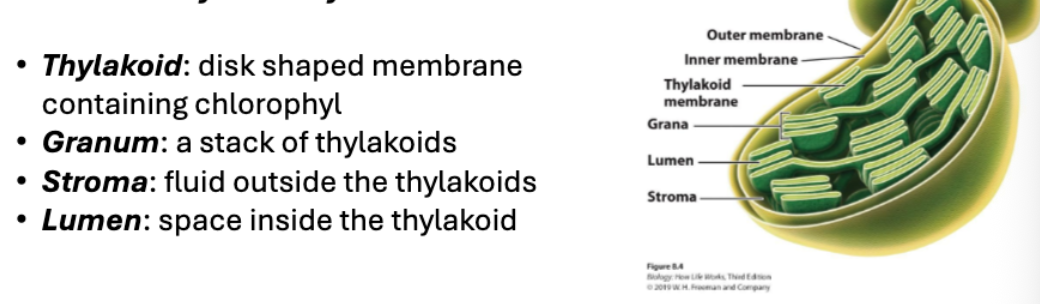
Identify the stroma, thylakoids, thylakoid lumen, and grana.

What are the two steps of photosynthesis?
Light Dependent > Light Independent
How is light energy absorbed?
Chlorophyll absorbs red and blue light
Carotenoids absorbs other wavelengths that protect photosynthetic cells
They work together in a photosystem
What are the steps to the light dependent reactions of photosynthesis (6)
Light excites electrons in Photosystems I and II
Splitting water supplies electrons and releases O2
Electron transport and the splitting of water builds up a proton gradient
ATP synthase uses proton gradient to make ATP
Electrons reduce NADP+ to NADPH (now carrying a proton)
ATP and NADP —> Calvin Cycle
What are the light independent reactions called and what are its steps (3)
The Calvin Cycle
CO2 enters the cycle by being combined with RuBP and RuBisCO
ATP and NADPH are used to convert fixed carbon into G3P (G3P goes on to supply carbon for sugars and other molecules)
5 out of the 6 G3Ps regenerate RuBP
Where does the oxygen released by photosynthesis orginate?
Water, not CO2

Water gets split during light dependent reactions at Photosystem II
What is cellular respiration?
Converting food energy into ATP energy using redox reactions — glucose is oxidized into a series of small steps

How does the proton gradient drive ATP synthesis?
Chemiosmosis:

Concentration of H+ is increased inside thylakoid lumen using electron transport
proton electrochemical gradient develops across the thylakoid membrane
H+ moves from lumen into stroma via ATP synthase
Proton flow causes ATP synthase to spin, catalyzing ATP production
Explain the roles of RuBisCO and RuBP in carbon fixation.
RuBisCO - enzyme that catalyzes CO2 into RuBP
RuBP - a five carbon molecule that accepts CO2
Identify the four main stages, their locations, and major products of cellular respiration (note where CO2 is released)
Glycolysis — Cystol — Produces 2 net Pyruvate, 2 net ATP, and 2 NADH
Pyruvate Oxidation — mitochondrial matrix — 2 acetyl-CoA, 2 CO2, 2 NADH
Citric Acid Cycle (Krebs Cycle) - mitochondrial matrix - 4 CO2, 2 ATP/GTP, 6NADH, 2 FADH2
Oxidative phosphorylation - inner mitochondrial membrane - up to 28 ATP and 1 water
How does the electron transport chain support ATP production?
Located on inner mitochondrial membnrane — NADH and FADH2 donate electrons from the Krebs Cycle. Complexes in the membrane pump protons from the matrix into intermembarne space, and forms an electrochemical gradient. H+ flows back through ATP synthase and ATP is made.
What is oxygen's role in cellular respiration and which stage yields most ATP?
Oxygen = final electron acceptor — accepts electrons, and combines with prtons to form water. Oxydative phosphorylation produces the most of the ATP.
Identify the major membrane components (5) and explain phospholipid amphipathicity.
Integral proteins — embedded in the membrane
Peripheral proteins — associated with the membrane surface
Cholesterol — helps regulate membrane fluidity
Glycoproteins — proteins with carb chains for reognixtion and communication
Glycolipids — lipids with carb groups, also involved in recognition and stability
Heads are hydrophillic — tails are hydrophobic
Explain the fluid mosaic model and why fluidity matters.
Fluid mosaic = membranes are dynamic ; proteins and lipids can move within the membrane. This is important for trasport protein function, membrane fusion, vesicle formation, cell growth, cell signaling, and redistributing membrane proteins.
How does cholesterol affect fluidity at high and low temperatures?
Cholesterol is a fluidity buffer in animal cell membranes
High temp —> phospholipid mvmt is restrained, reducing fluidity
Low temp —> phospholipids do not pack too tighlty, maintaining fluidity
Distinguish passive from active transport and simple from facilitated diffusion.
Passive transport - no ATP needed
Active transport — energy is needed to move substances against chemical gradient
Simple diffusion — substances pass directly through lipid bilayer (O2 and CO2)
Facillitated diffusion — substances pass through ion channel or carrier proteins
How do channel proteins, carrier proteins, and aquaporins work?
Channel proteins — form hydrophillic pathways through membrains for specifici ions/molecules to pass
Carrier proteins — bind to a specific substance, undergoes a function change, and releases substance on the other side. works for active and passive transport
Aquaporins — allow rapid mvment of water, but does not pump water against its water-potential gradient
Distinguish primary and secondary active transport.
Primary active transport = directly uses an energy source to move against a gradient
Secondary = uses the potential energy stored in the electrochemical gradient created by another transport process
Why does diffusion alone become inadequate in large, thick organisms?
Diffusion is inefficnet over long distances because interior cells become farther from the external supply of oxygen and nutrients
What is bulk flow, and how does it differ from diffusion?
Bulk flow = movment of a fluid and its dissolved/suspende dmaterials together, driven by a pressure gradient. differs from diffusion in its driving force. Bulk flow transports many different substances simutainiously across a long distance
How do animal circulatory systems and plant vascular systems overcome transport limitations?
Animals - the heart creates pressure differences to encourage bulk flow
Blood transports oxygen, nutrients, signaling molecules, and waste
Plants — xylem and phloem are used to transport water and sugars from roots, to shoots, and between sources and sinks. works on pressure and cohesion-tension
Why is diffusion still needed even when bulk transport systems exist?
Materials still need to cross short distances between transport systems and individual cells (local exchanges)
Why are cell adhesion, specialization, and communication important?
Cell adhesion — maintains tissue structure and mechanical stability
Cell specialization — complex division of labor
Cell communication — coordates growth, metabolism, and responses to environmental changes
What is an alga?
Photosynthetic eukaryotes outside the land plants
Why do algae not form a single evolutionary lineage?
Because of plastic history (secondary endosymbiosis)
Why are cyanobacteria not eukaryotic algae? (4)
they lack a membrane bound nucleus
they lack chloroplast
they have prokaryotic cellular organization
they do photosynthesis using internal photosynthetic membranes instead of chloroplast
What ecological roles do algae play, including habitat creation by seaweeds? (5)
primary producers in aquatic ecosystems
convert CO2 into organic matter
create physical structures that provide shelter and food
contribute to global photosynthetic oxygen production
support aquatic consumers
What are the pigments in green algae
Chlorphyll a, Chlorophyll b
Green plants and green algae belong to the lineage ___
Viridiplantae
Green algae consist of two seperate lineages: ___ and ___. Land plants belong within ___
Chlorophyta and Stretophyta, Stretophyta
Red algae (__) belongs to the ___ super group.
Rhodophtyta, Archeplastida
Pigments for red algae?
Phycoerythrin
Ecological roll of red algae (3)
build reefs
food (nori)
usefull cell-wall materials that we use in labs
Red algae do not have ___ stages in their life cycles. Why is this significant?
Flagellated - significant because it means their sperm cells are genearlly nonmotile and fertilization must depend on water movement or other mechanisms that will bring their gametes together
What is frustule composition
A silica cell wall that has two overlapping halves, like a box and lid, that provide structural protection to diatoms
Ecological importance of diatoms (4)
major contributors to aquatic primary production
participate in global carbon cycling
silical shells contribute to sediment formation after death
foundation to marine and freshwater foodwebs
Brown algae belong to the group ___
Phaeophyceae
Characteristic pigments of brown algae
Chlorphyll a, Chlorphyll C, and fucoxanthin
What do the holdfast, stipe, and blade do for algae
holdfast - achors to substrate
stipe - supports and connects holdfast to blades
blad - photosynthetic surface
How do dinoflagellates eat
photoautotrphic (obtain energy from light and carbon from Co2)
mixotrophic (some photosynthesize, others feed on prey, some do both)
Ecological importance of dinoflagellates (2)
live as symbionts in corals
bioluminescnece

What type of body form is this, what is an example, what are its advantages/limitations
Unicellular - chlamydomonas - efficient exchange because of simple structure, but small overall size
What type of body form is this, what is an example, what are its advantages/limitations

Term
Colonial - volvox - division of labor - requires cell cooperation
What type of body form is this, what is an example, what are its advantages/limitations
Term
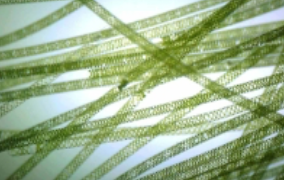
Filaments -- spirogyra - large exposed surface - may be vulnerable to fragmentation
What type of body form is this, what is an example, what are its advantages/limitations

Term
Sheets - Ulva - efficnet light absorption and exchange - may be vulnerable to tearing
What type of body form is this, what is an example, what are its advantages/limitations

Term
Differentatied thalli - kelp - different regions perform different functions - greater transport and support requirements.
How do body forms affect material exchange?
Material exchange depends strongly on surface-area-to-volume ratio and diffusion distance
Why does body form not determine sexual life-cycle type?
Body form describes an organism's physical structure, while sexual life-cycle type describes the timing of meiosis, fertilization, and haploid/diploid development
Define haploid, diploid, gamete, spore, and zygote.
haploid - one complete set of chromosomes
diploid - two complete sets of chromosomes
gamete - reproductive cell that fuses with another gamete during fertilization
spore - reproductive cell that can develop without fertilization
zygote - diploid cell produced by the fusion of two haploid gametes
How do mitosis, meiosis, and fertilization affect chromosome number?
Mitosis - produces daughter nuclei with same ploidy as parent nucleus. no affect on chromosome number
n —> n + n
2n —> 2n + 2n
Meiosis - chromosome number is halved
2n —> n
Fertilization - combines two haploid gametes
n + n —> 2n
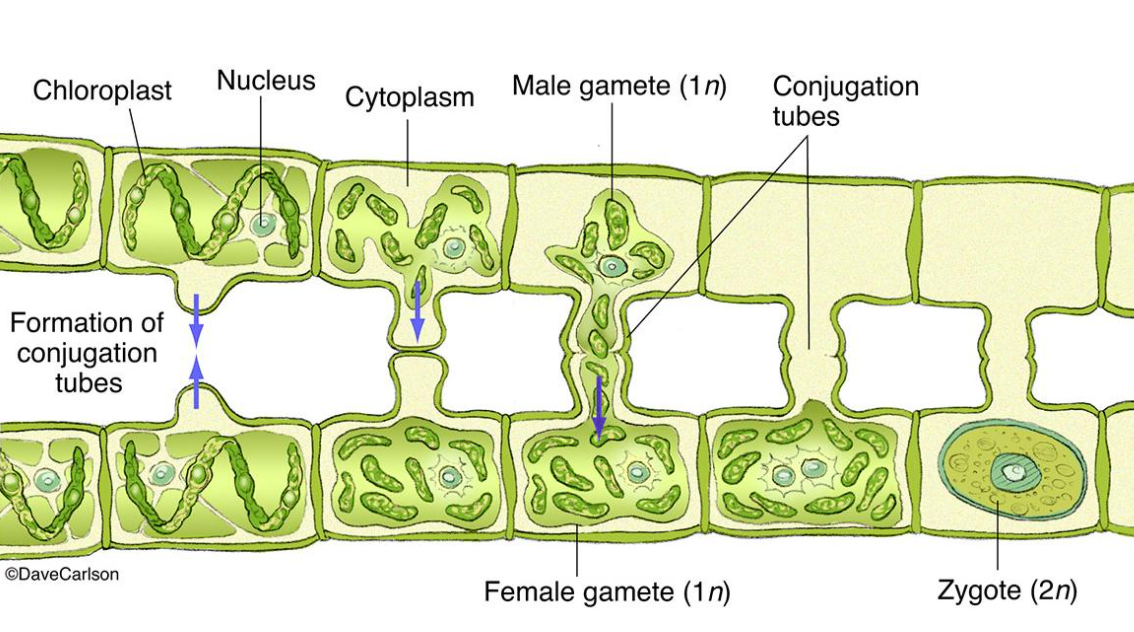
Explain conjugation and zygospore formation in Spirogyram (7 steps)
two haploid filaments allign
conjugation tubes form between corresponding cells in the filaments
the contents of one cell move through the tube into the other
haploid nuclei in the filaments fuse, making a diploid zygote
the zygote developes a resistant wall and becomes a zygospore
zygospore udergoes meiosis
haploid products form new haploid filaments
Spirogrya have a haplontic life cycle
Discuss possible benefits and limitations of predominantly haploid growth.
Benefits: all alleles are expressed because there is only one chromosome set
selection acts directly on recessive alleles,
Limitations: harmful recessive mutations cannot be masked by a second allele
genetic damage may have more immediate consequences
Define diplontic and identify when meiosis occurs.
A diplontic life cycle is one in which the main growing organism is diploid.
The haploid stage (meiosis) is restricted to gametes.

Define haplontic and identify the diploid stage.
A haplontic life cycle is one in which the main growing organism is haploid.
The only diploid stage is typically the zygote.

Explain reproduction in Fucus and the role of conceptacles. (4 steps)
The fucus has a diplontic life cycle
diploid adult developes reproductive structures (oogonia that makes eggs, antheridia that makes sperm)
Meiosis occurs during gamete production
haploid eggs and sperm are released into the surrounding water
fertizlation makes a diploid zygote
zygote developes via mitosis into a new diploid adult
conceptacles are small cavities in the organism that contain the oogonia or antheridia
Discuss potential benefits and disadvantages of masking recessive alleles in diploids.
Benefits: a function allele can mask a harmful recessive allel in a herterozygote
masking can allow individual carrying that allele to survive and reproduce
Costs: masking makes selection less effective and removing harmful recessive allels, meaning those alleles cna persist and affect offspring that inherit two harmful copies
Define alternation of generations. Distinguish gametophyte and sporophyte.
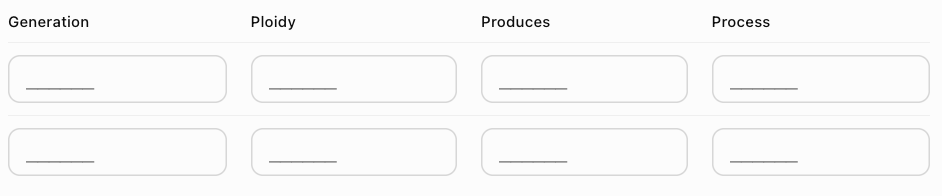
Alternation of generations is a life cycle in which both haploid and diploid stages undergo multicellular growth.
The two generations are:
Gametophyte (n): Haploid generation that produces gametes by mitosis.
Sporophyte (2n): Diploid generation that produces haploid spores by meiosis.
Which generation produces gametes and which produces spores? (Fill out the table)

Discuss potential benefits and costs of having both growing generations.

Fill in the table

