Extracorpuscular Hemolytic Anemia
 Call Kai
 Learn
Learn Practice Test
 Spaced Repetition
 Match
Match Flashcards
 Knowt Play
1/13

There's no tags or description
Looks like no tags are added yet.
Name | Mastery | Learn | Test | Matching | Spaced | Call with Kai | Chat |
|---|
No analytics yet
Send a link to your students to track their progress
14 Terms
Intravascular vs Extravascular Hemolysis Clinical Results
Plasma free Hb
Haptoglobin
Hemoglobinemia
Hemoglobinuria
Hemosiderinuria
LDH
Indirect bilirubin
Urobilinogen
Splenomegaly
Finding | Intravascular hemolysis | Extravascular hemolysis |
|---|---|---|
RBC destruction | Inside blood vessels | Mainly spleen/liver macrophages |
Plasma free Hb | ↑↑ | Normal or slight ↑ |
Haptoglobin | ↓↓↓ | Normal or mildly ↓ |
Hemoglobinemia | Present | Usually absent |
Hemoglobinuria | Present | Usually absent |
Hemosiderinuria | May be present | Absent |
Lactate dehydrogenase (LDH) | ↑↑↑ | ↑ |
Indirect/Unconjugated bilirubin | ↑ | ↑↑ |
Urine bilirubin | Usually negative for intact Hb; urine dipstick detects Hb | Usually negative |
Urobilinogen | ↑ | ↑ |
Splenomegaly | Usually less prominent | Common |
Peripheral smear | Schistocytes may occur depending on cause | Spherocytes can occur |
Main Hb breakdown site | Plasma → kidney/liver | Macrophages → spleen/liver |
Classical Pathway {Trigger Condition}
Triggers when Igs bind to microbial Ags and the Fc region is opened
C1q binds Fc region to activate C1r & C1s
C1s cleaves both C4 & C2
IgG3 is the most efficient at activating complement, while IgG4 is not capable

Alternate/Properdin Pathway {Trigger Condition}
Triggers when C3b (hydrolyze from C3) opsonizes the microbe (binds to factor b)
Factor D then cleaves it into C3 convertase (C3bBb) and Ba
Properdin stabilizes the C3 convertase

Lectin Pathway {Trigger Condition}
Initiates by mannose-bind lectin (MBL) attaches to mannose of microbes
MBL-associated serine proteases (MASP-1 & MASP-2) becomes activated
MASP-1 & MASP-2 performs similar job as C1s by cleaving C4 & C2

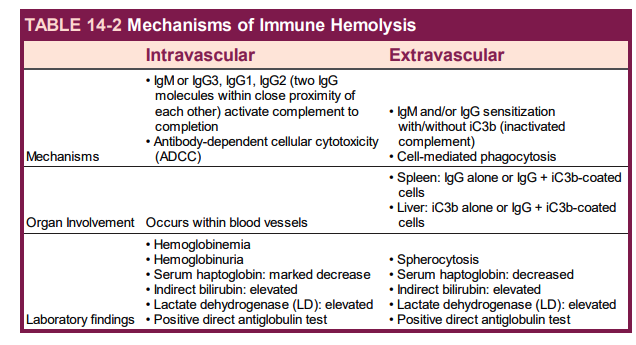
Intravascular Hemolysis
Occurs from complete activation of the complement system where MAC is generated and lyse the RBC
Cannot determined by decreased haptoglobin alone

Antibody-Dependent Cellular Cytotoxicity (ADCC)
A mechanism where RBCs are opsonized with Ig1/Ig3/C3b/iC3b. Then the effectors cells FcR (recognized Igs) or complement receptor CR bind to RBCs
Hemoglobinuria vs Hematuria {Etiology}
Hemoglobinuria | Hematuria | |
|---|---|---|
What is in urine? | Free hemoglobin | Intact RBCs |
Source | Intravascular RBC destruction | Bleeding from urinary tract |
Urine dipstick for "blood" | Positive | Positive |
RBCs on urine microscopy | Absent or very few | Present |
Plasma free Hb | ↑ | Usually normal |
Haptoglobin | Often ↓ | Usually normal |
Classic association | Intravascular hemolysis | UTI, kidney stones, trauma, glomerular disease |
Extravascular Hemolysis
RBC destroyed by MPS of the spleen and liver
Complement system can opsonize RBC with C3b/iC3b without MAC generation
When partial phagocytosis occurs, RBC can repair itself by converting biconcave disk to a sphere-shape becoming spherocytes
Classification of Immune Hemolytic Anemia
Alloimmune: patient produces alloantibodies to foreign red cell introduced through transfusions, pregnancy, transplants
Autoimmune: autoreactive antibodies are not being destroyed and now directed against patient’s cells
Drug-induced: antibodies directed at the red cells coated with the drug
Polyspecific DAT (Direct Antiglobulin Test)
Detect both IgG and complement (C3d, C3b) that are attached to the RBCs
Acute Hemolytic Transfusion Reaction {Intra/Extra}
Associated with ABO blood group and intravascular hemolysis
Involved IgM (group A & B) , IgG (group O), and IgA
Must be monitored during transfusion because the reaction is immediate
Administered IV fluid to prevent hemolyzed red cells from clogging the renal glomeruli
Delayed Hemolytic Transfusion Reaction {Intra/Extra}
Most common type of transfusion reaction that is caused by IgG that are not ABO antigens
Associated with extravascular hemolysis
Post-transfusion, the Hct level is expected to rise by 3. Otherwise, it may due to hemolytic transfusion
Hemolytic Disease of Fetus Newborn (HDFN) {Intra/Extra}
Only IgG can cross the placenta so only IgG is involved
Associate with extravascular hemolysis
Warm Autoimmune Hemolytic Anemia
Most common, accounts for 70% in adults
Antibodies’ reactivity is optimal at 37 degree
Positive for both IgG and C3D in 70% cases, 20% with only IgG
Treat the present underlying disease. Otherwise corticosteroid → splenectomy → Rituximab (monoclonal antibody)