properties of matter
 Call Kai
 Learn
 Practice Test
 Spaced Repetition
 Match
 Flashcards
 Knowt Play
1/68

There's no tags or description
Looks like no tags are added yet.
69 Terms
equation for kinetic energy

what is intoparticle binding energy
if larger than KE - particles held in position by bonds and vibrate - solid
if same as KE - particles can escape each other and start flowing - liquid
if lower than KE - particles keep away from eachother - gas
what is stress
force / unit area
what is strain
fractional change of length
dl / l
what is young’s modulus
stress / strain
what is poissons ratio
perpendicular expansion / parallel expansion

what is the shear modulus
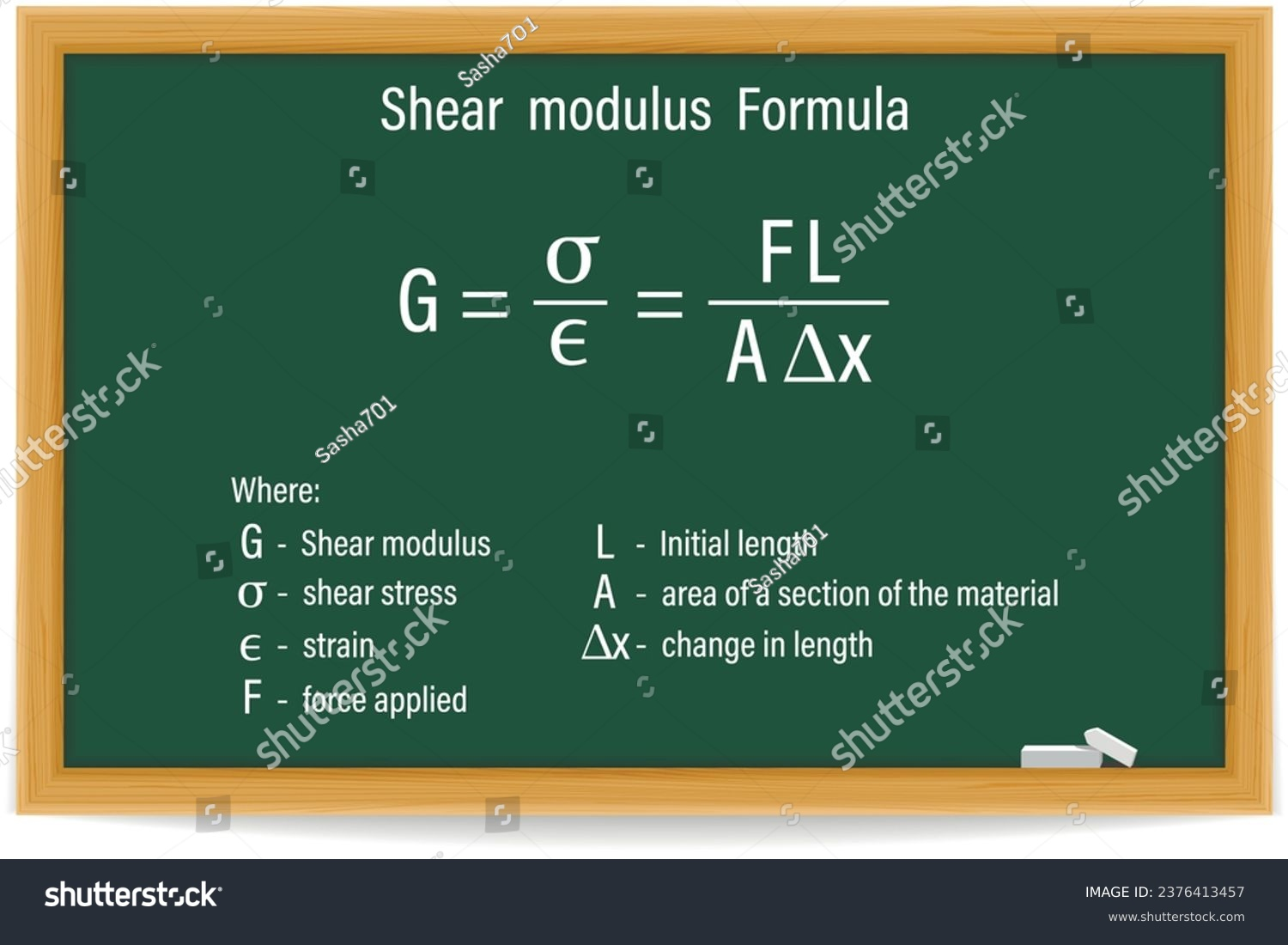
what is the bulk modulus

general equation for elastic potential energy

compressibilty of object formula

equation for hydrostatic pressure

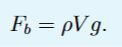
buoyancy force
bernoulli’s equation

conservation of energy and velocity

what is viscosity
how strongly a fluid is shear
what is steady laminar flow
symmetric and smooth streamlines, drag force due to viscous shear, low velocity
what is stoke’s law / equation for laminar flow drag for a sphere

what is turbulent flow
not a smooth streamline, high velocity
what is the equation for turbulent flow

equation for reynold’s number

what is reynold’s number
ratio of inertial and viscous forces
if Re > 1, turbulent flow due to eddies
if Re < 1, laminar flow no eddies
what is a liquid free surface
liquid and a vacuum
what is surface free energy
free energy per unit area [ J/m² ]
what happens at liquid-liquid interface for each surface free energy per unit area
positive - liquids dont mix
negative - liquids mix
what happens at liquid-solid interface for each surface free energy per unit area
positive - liquid does not want to wet / spread, contact angle > pi/2
negative - liquid spreads over solid to maximise interface called wetting, contact angle < pi/2
what is the young equation
relates contact angle and surface free energy

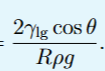
equation to find capillary height
equation for double sided interface surface tension

what is an intensive variable
their value is not proportional to the substance, non-additive
what is an extensive variable
their value is linearly proportional to the substance, additive
what if value of substance is not linearly proportional
it is neither extensive or intensive
equation for extensive and intensive variables
intensive x extensive = extensive
eg density x volume = mass
what is real gas behaviour
energy is lost in collisions, finite volume particle, intermolecular force
what is ideal gas behaviour
collisions are elastic, particles have no volume, no intermolecular forces
when do real gases behave like ideal gas
high temp and low pressure
what is ideal gas equation with n

what is ideal gas equation with N
where N = n x Na

what is the first law of thermodynamics
conservation of energy

what is heat
work that changes microscopic properties of system NOT temperature
what is a function of state
internal energies that depend only on state variables and not on the path/process
what is the joule expansion system
isolated system where heat = 0 due to isolation, volume and pressure have changed, no work done as moles did not push barrier, so no change in internal energy
what is isothermal expansion
heat enters from temp resevoir so Q > 0, work is done by gas pn surroundings against external pressure so W < 0, Q = -W so change in energy is 0
what is work done for compression of a gas

what is work done for an ideal gas at constant temp
from PV = nRT

what is work done for stretching a string/wire
‘g’ - tension

what is work done for fluid with increased surface area
gamma = tension

work done for moving charge

what is a quasiastatic process
very slow process that makes it reversible
what is an adiabatic process
no heat flow, dQ = 0
what is an isochoric process
constant volume, dW = 0
what is an isothermal process
constant temp, dE = 0
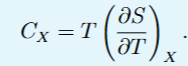
equation for heat capacity
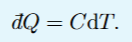
what is heat capacity at constant volume

what is heat capacity at constant pressure

what is heat capacity for an ideal gas

what is the adiabatic index

how are pressure and volume linked in adiabatic process

how are temp and volume linked in an adiabtic process

PV diagaram for stirling cycle
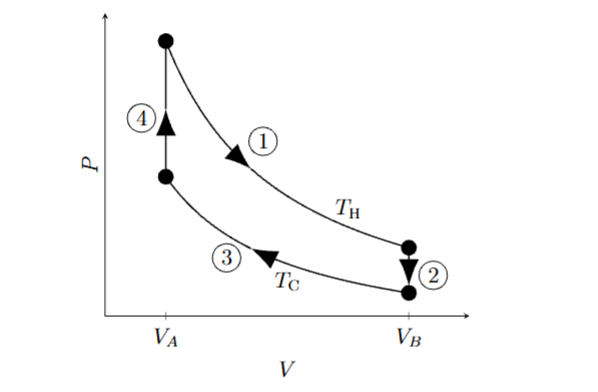
equation for efficiency non reversible cycles

efficiency of a refridgerator
>1

what is the efficincy of a refridgerator called
coefficient of performance as efficiency cannot be more than 1
what are the carnot relations
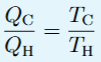
PV diagram of carnot cycle

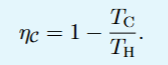
what is the carnot efficiency
what is the kevin-planck statement
impossible to construct a cycle where there is no loss of heat and where efficincy is 100%
clausius inequality for any cycle

equation for entropy
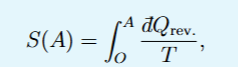
specific heat capacity for entropy