Unit 3, AOS1 - Biodiversity
 Call Kai
 Learn
 Practice Test
 Spaced Repetition
 Match
 Flashcards
 Knowt Play
1/95

Earn XP
96 Terms
Define Biodiversity
The variety of plant and animal life in the world or in a particular habitat (a high level of which is usually considered to be important and desirable)
Identify the three levels of biodiversity
Genetic
Species
Ecosystem
Define Genetic Diversity
Variation in genotype within a population
Define Species Diversity
Variation in species within an ecosystem
Define Ecosystem Diversity
Variation in habitats, natural communities and ecological processes (includes biotic and abiotic factors)
Differentiate Species Richness and Species Diversity
Species Richness refers to the number of different species in an ecosystem while Species Diversity refers to both the richness and relative abundance of each species.
Define a Keystone Species
A species that has a disproportionately large effect on the communities in which it lives, making it critical to the survival of the other species in the system or the ecosystem itself.
Describe Trophic Cascade
An ecological phenomenon caused by the addition or removal of top predators that triggers reciprocal changes in the relative populations of predators and prey through a food chain.
Identify 2 reasons why genetic diversity is desirable
Genetic variation creates resilience to change within a species and lessens the expression of undesirable traits (phenotypes) that can lower survivability
Identify the 3 broad types of genetic mutation
Insertion, deletion and base substitution
Identify the 2 worst types and why
Insertion and Deletion mutations result in a frame-shift that changes the reading of subsequent codons, altering the entire amino acid sequence following the mutation
Identify the less harmful type of genetic mutation and why
Base substitution mutations only alter a single amino acid.
Define Genetic Drift
Genetic drift is the change in frequency of an existing gene variant in the population due to random chance (opposite to natural selection)
Define Genetic Swamping
When the gene pool of a smaller population is overwhelmed by the genes of a larger population
Identify why Genetic Swamping is detrimental to genetic diversity
The unique genetic variations of the smaller populations can be lost
Describe Demographic Variation
Populations of a species (not necessarily isolated) that live in slightly different environments, with different survival pressures, develop genetic variety between individuals.
Identify what causes Adaptive Radiation
When an environment changes dramatically and free ecological niches become available
Identify the result of Adaptive Radiation
A massive increase in diversity as organisms rapidly evolve to fill the requirements of the available niches
Define Ecosystem Services
The many and varied benefits to humans provided by the healthy and diverse ecosystems that surround them.
Identify the 4 types of ecosystem services
1. Provisioning
2. Regulating
3. Supporting
4. Cultural

Define Provisioning Services
Ecosystem services in the form of ecosystem outputs of materials, nutrients and energy
Provide 3 examples of Provisioning Services
- Food
- Drinking water
- Raw materials (fibres, wood, metal ores)
- Natural medicines (aspirin, penicillin)
- Natural fuels
Define Regulating Services
A service that regulates ecosystem processes
Provide 3 examples of Regulating Services
- Carbon sequestration/storage by plants
- Vegetation stabilising temperature
- Vegetation anchoring soil/resisting erosion
- Wind walls created by trees
- Natural microclimates & climate stability
- Natural pest regulation
- Pollination
Define Supporting Services
The underlying natural processes that keep an ecosystem functioning
Provide 3 examples of Supporting Services
- Nutrient cycles
- Soil formation
- Pollution breakdown and absorption
- Water cycle
- Rock cycle
Define Cultural Services
The non-material benefits humans derive from interactions with surrounding ecosystems
Provide 3 examples of Cultural Services
- Recreation
- Research
- Education
- Cultural values
- Aesthetic values
- Ethical values
- Spiritual and religious values
- Mental and physical health/wellbeing
Relate fossil evidence to our understanding of biodiversity
The geological record/fossil record provides a snapshot of past ecosystems, allowing us to track historical changes to ecosystems and biodiversity.
Identify 2 things that a fossil record may reveal/provide
(in relation to organisms, ecosystems and biodiversity)
- Timelines of evolution
- Predator-prey relationships
- Animals' diets and behaviour
- Relationship between species and their environments
- Biodiversity changes over time
Identify the 2 methods of fossil dating
- Relative dating
- Numerical dating
Outline how relative dating works
Relative dating looks at strata to determine the age of a fossil based on what surrounds it.
Identify 2 assumptions of relative dating
- New sedimentary layers will cover older ones (superposition)
- The formation of crust/geological processes are the same in the past as they are today (uniformitarianism)
Provide 2 accuracy issues with relative dating
- Existence of inclusions and components (rock embedded in sedimentary rock must have been formed before it cemented)
- Tilting and folding can interupt strata
Outline how numerical dating works
Numerical dating uses the constant decay rate of radioactive isotopes to calculate age (based on the proportion of parent and daughter isotopes)
Identify the 3 types of ecosystem changes
1. Short-term changes
2. Medium-term changes
3. Long-term changes
Provide 3 examples of an ecosystem change that would impact biodiversity
- global warming or cooling
- desertification
- introduction of species
- change in water salinity
- change in atmospheric oxygen levels
Provide 3 examples of NATURAL short term changes
- fires
- floods
- landslides
- earthquakes
- insect/pest outbreaks
- hurricanes/cyclones/tsunamis
Provide 3 examples of HUMAN INDUCED short term changes
- oil spills
- pollution discharge
- chemical runoff
Provide 3 examples of NATURAL medium term changes
- El Nino Southern Oscillation
- Changes in a river's course over time
- Shifting forest boundaries
- Changes in predator-prey populations
Provide 3 examples of HUMAN INDUCED medium term changes
- Deforestation
- Overexploitation of resources
- Introduction of invasive species
- Many of the effects of climate change
Provide 3 examples of long term changes
- Global temperature fluctuations
- Tectonic drift
- Primary succession
Identify 3 sampling methods (or try for 7!)
- Quadrats
- Transects
- Indirect Signs
- Spotlighting
- Direct Observation
- Capture
- Capture, Mark and recapture
Identify 3 basic issues to consider when collecting data (or try for 7!)
- Acquire permission to access site
- Do you NEED to collect or can you simply survey?
- A permit to collect (sometimes)
- Minimise damage to the ecosystem
- Safety first (personal safety)
- Inform authorities if needed
- Clean up upon completion
What do quadrats record?
The variety and quantity of a species within a randomly or periodically placed square
How much area should quadrats cover
They should represent 10% of the total area
Define Transects
Quadrats evenly spaces along a straight line to observe the change in taxa over an extended area
Identify 3 examples of indirect signs
- tracks
- droppings
- rubbings
- fur/feather/skin deposits
- burrows
- food remains
Identify a benefit and complication of direct observation
Benefits:
- more impactful findings
- clear observation of physical traits
- clearer picture of quantity, health, and spread of a species
Complications:
- species may act differently around humans
- can disturb species
- some animals are very hard to observe
Identify when spotlighting may be used
To directly or indirectly observe a nocturnal or crepuscular species (often using red light to minimise impact)
Identify a benefit and complication of capture
Benefits:
- Prolonged/controlled direct observation
- Very specific data
(eg. blood samples, weight, size, sex, health etc.)
Complications:
- Very direct impact on the species being observed
- Permits are required for capturing wildlife
What does Capture, Mark and Recapture allow researchers to do?
- Prevent accidental recapturing
- Track the movement of an individual
- Attach tags with GPS or camera systems
- GPS/cameras moniter activities of an individual over an extended period with no impact of human presence
Identify the 6 levels of the Scale of Abundance (hint: ACFORE)
- Abundant
- Common
- Frequent
- Occasional
- Rare
- Extinct
Write the equation for Simpson's Index of Diversity
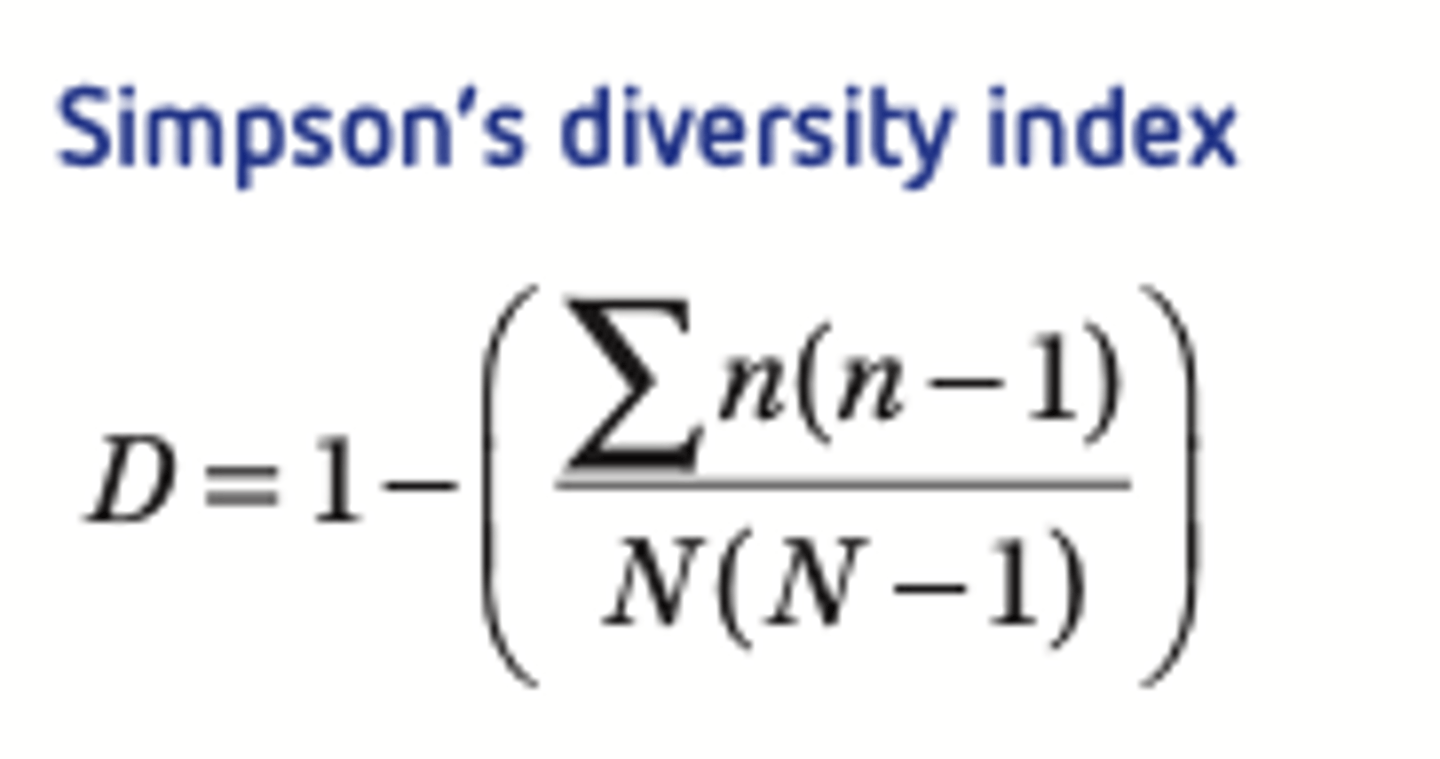
Identify the 3 factors of species rarity
1. Population size
2. Geographic range
3. Specificity of habitat
NOTE: (rare ≠ risk of extinction)
Identify the 3 factors that determine a species' conservation status
1. Natural rarity
2. Analysis of current population levels
3. Risk of extinction
Identify the 9 conservation statuses
1. Extinct
2. Extinct in the Wild
3. Critically Endangered
4. Endangered
5. Vulnerable
6. Near Threatened
7. Least Concern
8. Data Deficient (inadequate info)
9. Not Evaluated (currently unassesed)
Provide 3 different biodiversity conservation strategies
- Conservation reserves
- Remant vegetation patches (areas that escaped clearing)
- Wildlife corridors
- Reintroducing taxa
- Gene banking
Identify the 4 levels of conservation
1. Genetic
2. Population
3. Species
4. Ecosystem
Suggest a strategy for each level of conservation
EXAMPLE
Genetic ---> gene banking
Population ---> remnant vegetation (combats fragmentation)
Species ---> re-introducing taxa
Ecosystem ---> conservation reserves
Differentiate conservation from restoration
Conservation strategies are actions taken to protect an ecosystem while restoration efforts are put in place to restore damaged ecosystems
Provide 3 methods for restoring an ecosystem to full functioning
- Habitat restoration/reconstruction
- Erosion control
- Revegetating river banks
- Reducing peak flow
- Introduction of invasive species
- Reintroduction of native species
- Removal of invasive species
- Removal/control of pollutants
Outline Modification as a threat to biodiversity
Changes in local environmental conditions, from natural or human-induced events, result in physical changes to an ecosystem
Outline Degradation as a threat to biodiversity
A reduction in the quality of a habitat
Outline Habitat Loss and Fragmentation as a threat to biodiversity
The fragmentation of habitats resulting in seperation of populations and the increased vulnerability of the fragmented species
Outline Over-exploitation as a threat to biodiversity
The use of resources faster than they can be replenished, impacting food webs and the broader ecosystem
Outline Inbreeding as a threat to biodiversity
Fragmented, isolated or reduced populations have an increased chance of homozygous young expressing undesirable inherited traits
Outline Loss of Critical Species as a threat to biodiversity
Loss of keystone species can result in the loss of dependent species and the restructuring of their ecosystems
Outline Biological Pollutants as a threat to biodiversity
Bioaccumulation - pollutants accumulate within an organism
Biomagnification - pollutant concentrations in organisms increase up the food chain
Outline Climate Change as a threat to biodiversity
Climate change exacerbates extreme and unpredictable weather events, changes ecosystem conditions and pushes species away from the equator as temperatures rise
Outline Disease as a threat to biodiversity
Deadlier diseases cause bottlenecks in genetics (sudden significant reductions in population size) or remove populations. They can effect multiple species.
Outline Introduced Species as a threat to biodiversity
Once successful, they are extremely hard to remove and can:
- spread foreign disease
- increase pressure on niches
- restructuring of trophic levels
- have damaging defensive strategies (eg. cane toad)
- even collapse ecosystems
CHALLENGE: Recall 10 threats to biodiversity
- Modification
- Degradation
- Habitat Loss and Fragmentation
- Over-exploitation
- Inbreeding
- Loss of Critical Species
- Biological Pollutants
- Climate Change
- Disease
- Introduced Species
Outline the precautionary principle
The precautionary principle states that a lack of full scientific certainty for a proposal with high environmental risk should NOT be used as a reason for postponing measures to minimise or prevent environmental degradation
Differentiate Intergenerational and Intragenerational Equity
IntERgenerational equity refers to preserving natural resources and the environment for the benefit of FUTURE generations, while intRAgenerational equity refers to CURRENT generations
(think: intER = futER and intRA = curRAnt)
Outline the Conservation of Biological Diversity and Ecological Integrity principle
Prioritising maintainence of:
- species abundance
- genetic diversity in a population
- resilience of an ecosystem in the face of change
- an ecosystems capacity for self-renewal
Outline the User Pays principle
The user pays principle calls upon the users who benefit from a service or product to cover the costs associated with its provision and any environmental damages resulting from its use or production
Outline the Improved Valuation, Pricing and Incentive Mechanisms principle
- Including environmental factors in valuation of assets
- 'Polluter pays' incentive
- Consumers pay based on product lifecycle
- Environmental goals should be as cost-effective as possible
- Incentives to environmental goals should be established
Identify the 5 value systems
1. Anthropocentrism
2. Biocentrism
3. Sentientism
4. Ecocentrism
5. Technocentrism
Define Anthropocentrism
A viewpoint that human beings are the central or most significant entities in the world (or alone possess intrinsic value), interpreting the world in terms of human values and experiences.
Define Biocentrism
A viewpoint that gives inherent value to all living things and that all life deserves equal moral consideration and standing.
Define Sentientism
A viewpoint that values and prioritises the moral consideration of all sentient beings.
(often emphasising their capacity to experience suffering encouraging empathy towards beings capable of feeling)
Define Ecocentrism
Ecocentrism values all of nature as having intrinsic value - including living and non-living componenents of ecosystems.
(often is a more holistic view of ecosystems, prioritising the natural state of the whole rather than individuals and populations)
Define Technocentrism
Technocentrism centres around the ability of technology to control and protect the environment and adress environmental problems.
Identify the 3 levels of legal and policy mechanisms
- International Agreements and Protocols
- Domestic Legislation and Policies
- Local Legislation and Policies
Outline what legal policy mechanisms cover
International, state and local:
- legal treaties
- agreements
- regulatory frameworks
Outline the purpose of legal policy mechanisms
They are carefully curated to coordinate impactful and widespread movement towards conservation
Identify 2-3 benefits with International Agreements and Protocols
- Often the most impactful
- Form an international agreement on a way forward
- Enact programs with global benefit to biodiversity
Identify a drawback with International Agreements and Protocols
- There are a LOT of stakeholder perspectives
- To recieve international attention and action, it must be a very significant issue
Identify 2-3 examples of International Agreements and Protocols
- Conservation on Biological Diversity (CBD)
- World Heritage Convention
- Convention on International Trade in Endangered Species of Wild Fauna and Flora (CITES)
Briefly outline the aim of one of these International Agreements and Protocols
- CBD: requires participants to programs for biodiveristy conservation, sustainable resource use and fair and equitable sharing of benefits from resource use.
- WHC: identify, protect and conserve cultural and natural heritage sites for future generations
- CITES: protect endangered plants and animals from the threats of international trade and commercial exploitation
Identify a benefit with Domestic Legislation and Policies
- Allow for quick action
- Protect important endemic species and national biodiversity
Identify a drawback with Domestic Legislation and Policies
- Can be hindered by insuffiecient resources
- Can be undermined by political influence
- Potential lack of international cooperation/support
- May conflict with domestic economic intrests
Identify 2-3 examples of Domestic Legislation and Policies
- Environmental Protection and Biodiversity Conservation (EPBC Act)
- Flora and Fauna Guarantee Act
- Victoria's Biodiversity Strategy
Briefly outline the aim of one of these Domestic Legislation and Policies
- EPBC Act: includes identifying and monitoring biodiversity, listing at risk species, identifying threats, preparing protection and recovery plans, managing invasive species etc.
- FFG Act: recognise, identify and manage the processes that are leading to extinction of endemic species
- VBS: strategy for the conservation of native species, communities and gene pools as well as threat prevention
Provide 2-3 examples Local Legislation and Policies
- Local planning and development controls
- Local waste, pollution and noise management
- Local infrastructure standards and guidelines
- Local biodiversity and ecosystem protection
- Local renewable energy adoption policies