Criminal Law
 Call Kai
 Learn
 Practice Test
 Spaced Repetition
 Match
 Flashcards
 Knowt Play
1/102

There's no tags or description
Looks like no tags are added yet.
103 Terms
what are the different elements of liability?
Elements of liability = AR + MR + lack of defence
Different burdens of proof
Burden of proof on prosecution = beyond reasonable doubt (Woolmington v DPP)
Burden of proof for a defence - balance of probabilities
What is AR?
Actus reus = actions of D prohibited by law. Can be conduct (an act committed by D), result (D’s action leads to a specified consequence), circumstances (an act must be done in particular circumstances) or omissions.
What is factual causation and what is relevant to it?
Factual - jury must be satisfied that the acts or omissions of the accused were in fact the cause of the relevant consequence
But for test - but for the acts or omissions of D, the relevant consequences would not have occurred
Absence of an intervening act which breaks the chain of causation
what is novus actus interveniens and what are the diff types?
Medical negligence - R v Smith ( D stabbed victim dueing a fight, on the way to the medical station the victim was dropped twice, treatment given by medics was innapropriate and harmful and he died a couple hours later. D was cinvicted of murder because his actions remained a substantial and operating cause because the medical negligence did not sever the chain of causation - the negligence was not so overwhelming as to render the stabbing part of the history) // R v Cheshire ( D shit the victim twice, after surgery the victim developed respiratory prblems leading to a tracheotomy tube to be inserted into his windpipe causing difficulty breathing which was dismissed by medical staff and he died). Medical treatment did not break chian of causation)
Acts of a 3rd party - R v Pagett ( D shot at the police while using his pregant gf as a shield, the police shot back and killed her. To break the chain of causation the actions of the third party had to be ‘free, deliberate and informed’, this was not the case here for the police officers.
Acts of the victim - 1. Fright and flight - R v Roberts ( D was in the acr with V making unwanted sexual advances, V jumped out the mocing car getting injured. D convicted of assault occasioining ABH. V’s actions would only break the chian of causation if they were so daft that no reasonable person could have foreseen it.) R v Williams & Davis (D gave a lift to a hitchhiker and tried to rob him at knifepoint so he jumped from the moving car and died of head injuries. Convicted of manslaughter - ‘there must be some proportionality between the gravity of the threat and the action of the deceased in seeking to escape from it’ + ‘bear in mind particular characteristics of the victim and the fact that in the agiony of the moment he may act wrongly’) 2. Refusing medical Treatment - R v Blaue ( D stabbed V who refused bllod transfusion because of religion so she died. D was convicted of manslaughter as D must take victim as they find them) // R v Holland ( D attacked V and cut his finger, doctor suggested to V that the finger should be amputated but V refused leading to it becoming infected and him dying. D still liable because it does not matter whether ther would instantly mortal or whether it because the cause of death because of V’s refusal) 3. Suicide - R v Wallace
Thin skull rule - D cannot escape liability of the victim, owing to some pre-existing infirmity or peculiairty suffers greater har than would have been expected as a result of the act D did - R v Hayward ( D threated his wife and chased her leading her to collapse and die, she was suffering from a thyroid condition where any combination of physical exertion and fear might lead to death so D was guilty)
Natural events - must be extradinay and not reasonable foreseeable
What is legal causation and what key principles apply to it?
Legal - must be established that the acts or omissions of the accused were a legal cause of that consequence = ‘the operating and substantial’ cause (R v Pagett). Key principles:
D’s act must be the substantial cause of the harm - R v Hughes ( more than minimal)
Consequences must be caused by D’s culpable act - R v Dolloway (D driving a cart without holding reins, killing a child. Even if D held the reins he would not have been able to stop the cart in time so he was acquitted of manslaughter)
D’s act need not be the only cause of the prohibited consequence - R v Benge (Benge was the foreman of railway tracklayers, he thought next train was not due soon and ordered the track to be taken up, he sent a signal man to stop any trains but the signalman did not go the correct distance and the train driver was not keeping a good look out so the train crashed and killed several people, Benge was tried for manslaughter. If D’s negligence mainly or substantially caused the accident, it was irrelevant that it might have been avoided if ither persons had not been negligent).
general rule regarding omissions
D cannot be criminally liable for a failure to act as there is no general duty to act to prevent harm
What must P prove in order to secure a conviction based upon a failure to act?
crime is capable of being committed by an omission
accused was under a legal duty to act
accused breached that duty
the breach caused the AR of the offence to occur
should the offence so require, that the accused has the required MR
Common situations when D would be under a legal duty to act and not doing so would make them liable under omission
statute e.g. offence to fail to provide a specimen of breath under Road Traffic Act 1988
special relationship - doctors + patients, parents + children, spouses
voluntary assumption of a duty of care
contract - either to the party with whom D is contracted or to a third party
D creating a dangerous situation - e.g. if A started a fire in a house A has a duty to take reasonable steps to counteract the dangerous situation created
public office
Meaning of MR
required mental element for the crime
meaning of intention for MR
2 types of intention:
direct intention = the aim or purpose of D’s act (subjective from D’s pov)
indirect/oblique intention = where the consequence is not D’s purpose but rather a side effect that D accepts as an inevitable or certain accompaniment to D’s direct intention
what is the golden rule on direct intention
jury’s task to decide on the matter of intention - word should be given its ordinary meaning and that judges should generally avoid defining the term intention beyond explaining that it differs from desire and motive
when would there be a need to elaborate upon the meaning of intention?
jury specifically requested further guidance on the issue in which case further direction should be given to them
trial judge is of the opinion that the facts themselves or the presentation of evidence in court has meant that the jury would benefit from further guidance (though very rare)
Oblique intention test
“death or serious bodily harm was a virtual certainty as a result of D’s action and that D appreciated that such was the case”
meaning of recklessness for MR
When somebody takes an unjustifiable risk, aware of the danger that the prohibited harm may occur upon taking that risk
Recklessness is included when the MR is ‘maliciously’
what is the test for recklessness for MR
R v G: D is reckless when:
D foresaw a risk of harm and went ahead anyway and
in the circumstances known to D it was unreasonable to take the risk (in deciding this the jury will consider the social utility of what D is doing: if there is no social utility at all, then the jury will probably decide that even a tiny risk is unjustified)
meaning of knowledge and belief for MR
D who is absolutely certain as to the existence of a particular circumstance or is at least possibly aware that the particular circumstances exists
meaning of dishonesty for MR
Definition in Ivey v Genting Casinos
meaning of negligence for MR
When D’s actions fall below the standard of a reasonable person
gross negligence = negligence showed such disregard for the life and safety of others as to amount to a crime against the state and conduct deserving punishment
is motive the same as intention?
No - when D may have a motive that does not mean when D commits the AR D can automatically be taken to have the intention to kill
coincidence of AR and MR
general rule: D must have the relevant mens rea for the offence at the precise moment when D commits the AR
How can one get around the requirement for coincidence of AR and MR?
continuing act theory - D can be guilty of an offence using the continuing act theory if they form the MR for the offence at some point during the AR continuing e.g. in Fagan case D formed the MR when he realised that his vehicle was on the police officer’s foot and did not move it as he formed the MR when the AR was still continuing
one transaction principle - court categorises the actions of the accused as a series of acts making up one transaction making it sufficient for D to have the MR at some time during the transaction
e.g. Thabo Meli case where Ds hit V over the head with intent to kill him, thinking they succeeded they rolled his body over the cliff to make his death accidental and V dided for exposure. Court held D’s acts were performed in pursuance of an antecedent plan to kill the victim and could not be divided up eve if not having the intention to kill when rolling him down the steps
e.g. R v Le Brun extended the principle to cases even where there was no prior planning by viewing the act done with MR (first act) as causing subsequent acts. D’s act of knocking his wife unconscious caused him to drag her home and drop her on the pavement causing her death
What happens when it isn’t clear which of D’s acts was the AR?
D must have the MR for the relevant crime when D does each of the acts which could constitute the AR.
However, it is not necessary to prove which act caused the death
what is transferred malice
When D’s MR is transferred from the intended harm to the actual harm e.g. does not matter that D intends to kill X but misses and kills Y instead. D’s intended harm against X can be transferred to the unintended victim, Y and D will still be guilty
Limit = transferred malice will not assist where D has the MR for one crime and the AR for another. D must have the MR for the crime charged e.g. R v Pembliton: D threw a stone in a crowd of people but broke a glass window instead, he had the intention to hit people but not the window. Conviction quashed because he lacked the intention to damage property or been reckless to the same
What happens when D makes a mistake?
2 types of mistake:
ignorance of the law = not knowing that you are breaking the law will not avoid liability even if the ignorance is reasonable or if it was impossible for D to know of the prohibition in question
mistakes that negate the MR = D makes a mistake as to some element of the AR which will prevent D from having the MR. This may be a mistake of fact e.g. if D takes the wrong umbrella from the restaurant believing it is their umbrella mistakenly = not theft because D is not dishonest.
If MR is intention or recklessness = no need for the mistake to be reasonable
if MR is negligence = mistake must be reasonable
Defences: Intoxication
This may be drugs or alcohol
More likely to be successful with an intoxication defence if involuntarily intoxicated rather than voluntarily intoxicated
with involuntary intoxication the court will ask did D form the Mr even though intoxicated
with voluntary intoxication for less serious crimes of basic intent D will be deemed reckless if they would have foresaw the risk of harm if sober
If D is intoxicated can loss of control still be argued?
Yes as partial defences to murder, reducing the conviction to voluntary manslaughter if successful
loss of control: the defence must be approached without reference to D’s voluntary intoxication. If a sober individual in D’s circumstances, with normal levels of tolerance and self-restraint might have behaved in the same way as D confronted by the relevant qualifying trigger, D can have the defence.
It may even be the case that D has a severe problem with alcohol or drugs for which he was mercilessly taunted about. The condition to the extent that it constituted a qualifying trigger, the alcohol or drug problem would form part of the circumstances for consideration
If D is intoxicated can DR still be argued?
Yes as partial defences to murder, reducing the conviction to voluntary manslaughter if successful
Court have taken 2 approaches, depending on whether the intoxication is:
independent of the abnormality - D has an abnormality of mental functioning and is voluntarily intoxicated = jury must consider the effect of the matters other than the alcohol and determine whether they amounted to such abnormality of mental functioning as might have substantially impaired D’s ability to do one of the things in HA 1957, s2(1A). Test: If D was intoxicated at the time of the killing the jury should then ask themselves: has D satisfied you that, despite the drink: (1) he was suffering from mental abnormality and (2) his mental abnormality substantially impaired his mental responsibility for his fatal acts
as a result of alcohol dependency syndrome (ADS)
How con intoxication be used to negate MR?
D may use evidence of their intoxication to show that they did not form the necessary MR for murder. If there is not the necessary MR then D is entitled to an acquittal
Defences: consent
Assault/Battery = consent is available if V consented or D honestly believed that V was consenting
ABH or above = consent is not available (R v Brown) unless some of the public interest exceptions apply: medical treatment, sport, horseplay, tattooing/personal adornment and sexual gratification/accidental inlfiction of harm
defences: self-defence
can be used in protection of yourself, another or property
If successful D is acquitted
D can rely on it if: (1) D honestly believed that the use of force was necessary AND (2) level of force D used in response was objectively reasonable in the circumstances as D believed them to be
defences: mistake
mistakes that negate the MR = D makes a mistake as to some element of the AR which will prevent D from having the MR. This may be a mistake of fact e.g. if D takes the wrong umbrella from the restaurant believing it is their umbrella mistakenly = not theft because D is not dishonest.
What type of offence is murder and what is the punishment?
Murder is a common law offence
Murder carries a mandatory life sentence, judge has no discretion in sentencing other than to recommend a minimum term before a prisoner can be released on licence
What are the AR and MR elements for Murder

Murder: AR
Unlawful - lawful to kill another when killing enemy soldiers in battle, advancement of justice (application of the death penalty) or self-defence (killing will be lawful where the force used was reasonable and necessary to prevent crime or protect others or property
Killing - D caused the death of V. Both factual and legal causation must be satisfied
Human being - cannot be a corpse. A person is in being when born alive and capable of independent life = child must be fully expelled from the mother’s body and born alive but not necessary for the umbilical cord to have been cut. Pregnant woman stabbed in abdomen causing death of child = not murder as child not alive
kings peace - person can be tried for murder wherever if they are a British subject or the murder was committed within E&W
Murder: MR
Malice aforethought:
intention to kill OR
Intention to cause GBH (meaning serious harm)
No need for malice or premeditation
Mercy killings is not a defence in EL
Defences: Diminished Responsibility
Special defence = DR can only be used as a defence to murder, no other defence (not even to a charge of attemoted murder)
Partial defence = if successful, D is not acquitted but convicted of a lesser offence (voluntary manslaughter under which the judge will have discretion in sentencing and the defendant will avoid the mandatory life sentence)
Burden on D to prove on the balance of probabilities that D was acting under DR
What is required to establish DR?
Does D have an abnormality of mental functioning (AMF)?
Does the AMF arise from a recognised medical condition?
Does the AMF substantially impair D’s ability to understand the nature of their conduct, from a rational judgment and/or exercise self-control?
Does the AMF provide an explanation for D’s conduct?

DR: abnormality of mental functioning
R v Byrne: having a state of mind so different from that of ordinary human beings that the reasonable man would term it abnormal
DR: recognised medical condition
If D suffering from an undiagnosed recognised medical condition at the time of killing that is sufficient.
The abnormality must be caused by the recognised medical condition and not by something else like hatred, jealousy or bad temper
Alcohol Dependency Syndrome (ADS) = recognised medical condition but not Acute Voluntary Intoxication
DR: substantial impairment of D’s ability to do one of the things stated within HA 1957 s2(1A)
Substantial has ordinary meaning but if court felt it was necessary to provide further guidance then judge should explain that substantial means something greater than more than merely trivial
s2(1A)
conduct - boy aged 10 left to play violent video games for hours for all his life who then loses temper and kills another child but shows no real understanding that a person killed cannot simply be later revived
form a rational judgment - woman suffering with PTSD following violent abuse suffered at her husband’s hands comes to believe that only burning her husband to death will rid the world of his sins
to exercise self-control - man says devil takes control of him and implants in him a desire to kill which must be acted on before devil will go away
DR: provides an explanation for D’s acts and omissions
Causal link between the abnormality of mental functioning arising from a recognised medical condition and the killing must be established (but need not be the only cause)
DR: medical experts
R v Brennan: a judge should withdraw the murder charge from the jury when either the expert medical evidence is uncontested or when there is no other evidence which is capable of rebutting the medical evidence
Defences: Loss of control
special defence to murder
Partial defence to murder
Burden on P once the issue is raised. P need to prove that only one of the components is absent for the defence to fail
judge can decide whether the defence can be put before the jury
If successful conviction reduced from murder to voluntary manslaughter (avoid mandatory life sentence)
Loss of control elements
Key requirements:
D must have lost self-control
due to the fear and/or anger qualifying trigger
a normal person might have acted in a similar way to D
Loss of Control: (1) loss of self-control
D’s act or omission in killing must have resulted from a loss of self-control
Whether D actually lost control is a question for the jury, taking into account all of the evidence: there does not need to be a complete loss of control so that D does not know what they are doing but D must be unable to restrain themselves. Mere loss of temper is not enough.
Loss of control need not be sudden but D cannot be acting out of a considered desire for revenge (the longer the delay, the less likely it was that D lost self-control)
Loss of Control: Qualifying trigger
Fear trigger: attributes loss of self-control to D’s fear of serious violence
situation where D was justified in using defensive force but the level of force used was unreasonable preventing self-defence defence
D cannot rely on fear trigger if D incited it as an excuse to use violence
Anger trigger:
things said and/or done (D cannot rely on the anger trigger if D incited it as an excuse to use violence OR the thing said/done constituted sexual infidelity. However, second hand word of an act would count e.g. a wife calling her husband telling him she found the teacher molesting their child, the man then kills the teacher)
that constitute circumstances of an extremely grave nature (assessed objectively - the circumstances facing D must have been unusual and not part of the normal trial and disappointments of life e.g. being jostled in a shop or being sworn at) and
that caused D to have a justifiable sense of being seriously wronged (objective question - a normal person in contemporary Britain would have felt seriously wronged in the same situation)
Loss of control: normal person test
“A person of D’s sex and age, with a normal degree of tolerance and self-restraint in the circumstances of D might have reacted in the same or similar way”
2 steps:
gravity of the qualifying trigger to a person in D’s circumstances (taunting a person because of his race, physical infirmities or some shameful incident in his past will be more offensive if true than untrue)
whether as a result of that trigger a normal person might have done what D did or something similar (normal person would have the ordinary powers of tolerance and self-restraint. No taking into account circumstances that would affect normal tolerance and the ability to exercise restraint e.g. bad temper, intoxication, extreme sensitivity, PTSD or personality disorder)
Clinton case confirmed that sexual infidelity can be taken into consideration here by the jury regardless of whether it goes towards the gravity of the taunt provided that it does not only go towards the capacity to exercise self-restraint
What are limitations on the use of the loss of control defence?
in an act of considered desire for revenge
e.g. cases where there is clear evidence of planning
as an excuse to use violence
a person who is out to incite violence cannot fear violence but actively welcomes it and equally such a person would not feel a sense of being seriously wronged
however not enough that D started it to invoke this limitation. D must have had the intent from the outset to provoke the reaction that then led to the killing
if the thing said/done constituted sexual infidelity
the defence is excluded only when sexual infidelity is the sole qualifying trigger, if other things are said or done or if there is also a fear of serious violence, then sexual infidelity should be considered
in most cases where sexual infidelity has caused D to lose their self-control there will be other factors such as the threat that D will lose the children or they will lose their home. Sexual infidelity will then be included within the argument that a qualifying trigger exists
if D is charged with attempted murder
In what 2 ways can intoxication be used when it comes to murder?
negate the mens rea of murder - due to intoxication D did not form the MR of intention to kill or cause GBH to the victim
influencing factor on the special defences of loss of control and DR
Impact of intoxication on Loss of control defence
defence available even if intoxicated if a sober individual in D’s circumstances, with normal levels of tolerance and self-restraint might have behaved in the same way as D confronted by the relevant qualifying trigger
If D has a severe problem with alcohol or drugs and was taunted about the condition, to the extent that it constituted a qualifying trigger, the alcohol or drug problem would then form part of the circumstances for consideration
Impact of intoxication independent of the abnormality on DR (D has an abnormality of mental functioning and is voluntarily intoxicated)
Jury should consider: If D was intoxicated at the time of the killing, has D satisfied you that, despite the drink:
he was suffering from mental abnormality and
his mental abnormality substantially impaired his mental responsibility for his fatal acts
Jury may find the defence operates even if they consider that the alcohol may have played a part in D’s inability to do one of the factors

Impact of intoxication as a result of alcohol dependency syndrome
If the jury decide that ADS was a significant factor in leading D to consume the alcohol (even if there was an element of voluntary choice either to start drinking or not to stop at some point) they can conclude that D’s responsibility was impaired as a result of the abnormality of mental functioning
attempt to rely on voluntary and temporary drunkenness, even when based on habitual heavy binge drinking, will not be sufficient
when deciding if whether the ADS substantially impaired D’s mental responsibility - factors that may be considered: a) the extent and seriousness of D’s dependency, b) the extent to which his ability to control his drinking was reduced, c) whether he was capable of abstinence and if so for how long and d) whether he was choosing for some particular reason like a bday to decide to get drunk or to drink more than usual
same consideration will me made when determining whether D is able to do one of the things

What is involuntary manslaughter a term for?
All varieties of unlawful homicide other than murder - they lack the murder requirement of malice aforethought
Elements of unlawful act (constructive) manslaughter
DPP v Newbury and Jones:
D intentionally (voluntarily) did an act
the act was unlawful
the unlawful act was dangerous and
the unlawful act caused the death of the victim
unlawful act (constructive) manslaughter: intention/voluntary act
The intention must be with regard to the doing of the act, not to the consequences which flow from it
unlawful act (constructive) manslaughter: unlawful act
It must be:
a criminal act - this means that it cannot be a civil wrong but it need not be a serious criminal act e.g. common assault will suffice. The criminal act must be independent of the fact that it has caused death and both the AR and MR of the criminal act must be proven.
an intrinsically unlawful act - the unlawful act cannot be based on a lawful act, which becomes unlawful only because of the negligent or reckless manner in which it was performed e.g. driving
an act rather than an omission - a failure to do something while under a duty to do it would correctly be charged as gross negligence manslaughter
unlawful act (constructive) manslaughter: dangerous act
whether the act is dangerous is an objective test and depends not on the accused appreciation of the likely harm but on what the sober and reasonable person would appreciate - the risk of some harm resulting
type of harm likely to result from the unlawful act must be physical and not emotional e.g. shock
the type of harm a reasonable person would have foreseen does not have to be that actually caused
The reasonable person will have knowledge of the circumstances that they would have had if they had been in the accused’s shoes at the time of the offence.
D could become liable if they became aware of a fact during the commission of the offence which would make the act dangerous e.g. the action of burglary became dangerous once D realised the elderly man was in the house as a reasonable person would consider that there was a risk of some harm being caused to an elderly and frail man
the reasonable person will have any special knowledge with D has e.g. the difference in weight between live and blank cartridges
unlawful act (constructive) manslaughter: caused the death of the victim
Requires both factual and legal causation
Causing death by supplying drugs:
where D directly administers the drug to V e.g. by taking a syringe and injecting V with it = unlawful act manslaughter and the consent of V is no defence to this
where D merely supplies V with the drugs, or assist V, such as by mixing a particular cocktail of drugs, or filling the syringe before passing it on to V, who then takes the drugs themselves = NOT unlawful act manslaughter if V voluntarily consumes the drug in awareness of what they are taking and are a responsible adult
Manslaughter by gross negligence elements
The basis of a gross negligence manslaughter charge will be that D has breached a duty of care owed to V (no requirement of a criminal act).
Adomako:
existence of a duty of care
breach of that duty
the breach caused death
there was a risk of death
the breach of duty was so bad as to amount to ‘gross negligence’
Manslaughter by gross negligence: duty of care (DOC)
Same meaning as in the law of tort - owed to anyone where harm caused by their acts was foreseeable (everyone has a general duty to take care to avoid injury by a positive act to their neighbour)
Liability may also rise for an omission where D has a specific duty to act either from statute, contract or due to a special relationship with V where D voluntarily assumes a DOC or D creates a dangerous situation
D could still have a DOC within criminal cases, even though such liability would be avoided in tort
Manslaughter by gross negligence: breach of DOC
Normal principles of negligence apply - question is whether D’s acts fell below the standard expected of a reasonable person (attributed with any special skill used by D)
Manslaughter by gross negligence: breach causes death
Normal causation principles apply
Manslaughter by gross negligence: risk of death
there must be an obvious and serious risk not merely of injury or even serious injury but of death
the obvious and serious risk must be seen at the time of the breach of duty
Manslaughter by gross negligence: gross negligence
Examples of when gross negligence was found:
Where the defendant is responsible for a series of acts/omissions rather than a single event, this may make it easier for the jury to find gross negligence, Misra, Litchfield.
A single devastating act can be grossly negligent, Adomako.
Where the defendant's mistakes are themselves in part or in whole brought about by mistakes of others, this may be a reason for not convicting,Prentice & Sullman.
There can be gross negligence by the defendant, even if others are also responsible for the circumstances leading up to the death, for example where, despite the involvement of others, the defendant has a clear personal responsibility and the ability to discharge it, Singh.
If the defendant has knowledge/experience that should alert them to the danger, this may be a helpful fact for the jury to take into account
There is no requirement for any mental state, Adomako. However the defendant’s state of mind is not irrelevant e.g. it was a key point in Litchfield that Litchfield would have seen the serious risk of death.
If someone has seen a high risk of death or has a ‘couldn’t care less’ attitude to a high risk of death, it seems clear that they are highly likely to be convicted.
The defendant’s state of mind may also work in their favour: if the defendant genuinely did not believe there was a risk, this is a factor that the court can take into account.
Flowchart for differing between fatal offences

Comparison of the 3 fatal offences

Hierarchy of non-fatal offences (most to least serious)
Wounding or causing GBH with intent (s18 OAPA)
Wounding or causing GBH (s20 OAPA)
ABH (s47 OAPA)
Battery
Assault

Assault elements
When the victim anticipates D will use violence against them ( no touching)
Common law definition: intentionally or recklessly causing another person to apprehend immediate and unlawful personal violence (Fagan v Metropolitan Police Commissioner)

Assault: AR
Causing V to apprehend immediate and unlawful personal violence
Apprehension
Expect or anticipate but not necessarily fear immediate and unlawful personal violence (e.g. if V knows that the gun pointed at them is empty then no fear of violence, however if only D knows that gun is empty and has no means to carry out threat V can expect unlawful violence)
Some physical movement like raising a fist would suffice
words and silence sufficient
words can negate an assault - e.g. D placed hand on gun and said ‘If I did not believe in not killing children, I would kill you’, the action of putting hand on gun is threatening but it is negated by his words which imply no violence will take place. However, offence may still be made out if regardless of words V apprehends immediate and unlawful personal violence
Immediate
Not necessarily instantaneous but some time not excluding the immediate future or imminent
unlawful
Not in self-defence or with V’s consent
Personal violence
V anticipates an unwanted touch (must be physical)
Assault: MR
D intends or is reckless as to causing the victim to apprehend immediate unlawful personal violence
D intends an assault if it was D’s aim or purpose
D is reckless as to an assault if they: see a risk that their actions will cause the victim to apprehend immediate and unlawful personal violence and in the circumstances known to D, it was unreasonable to take that risk (subjective recklessness must be established)
Elements of battery
Battery is the actual intentional or reckless application of unlawful force on another person without consent (Fagan v MPC)
Maximum penalty of 6 months in prison and/or £5,000 fine

Battery: AR
Application of unlawful force on another
Application: battery can be inflicted:
Directly e.g. by D hitting the victim with or without weapon/ throwing a missile at the victim
indirectly - e.g. D digging a pit which V then falls into
by an omission
Unlawful
Battery is not done in self-defence or with V’s consent (either express or implied consent to inevitable everyday contact e.g. jostling in the supermarket, underground and busy street)
Force
Even a mere touch suffices and need not be rude, hostile or aggressive
Touching someone’s clothes is enough
An omission can constitute force e.g. having needles in your pocket and letting someone prick their finger in them by not telling them they are in your pocket
If harm resulted from battery is more than trivial, D liable for s47
Battery: MR
Intention or recklessness as to applying unlawful force on another person
Comparison of Assault and Battery

Elements of ABH (s47 OAPA)
AR:
Assault - meaning assault or battery
occasioning - causing
Actual bodily harm
MR:
Same as for assault or battery: intent or recklessness as to (i) causing the victim to apprehend immediate and unlawful personal violence or (ii) applying unlawful force upon another

ABH (s47): AR
Assault
either an assault or battery with both AR and MR established
Occasioning
assault or battery must result in actual bodily harm being caused to the victim.
normal principles of causation apply
can be committed through an omission
Actual bodily harm
Includes ‘any hurt or injury calculated to interfere with the health or comfort’ of V
Hurt need not be serious or permanent but must be more than transient and trifling
momentary loss of consciousness is capable of amounting to ABH as does cutting hair from the victim
includes psychiatric injury but not mere emotions such as fear or distress or panic
ABH (s47): MR
No MR for ABH
rather it is required there is MR for the assault or the battery
Elements of malicious wounding or inflicting GBH (s20)
AR:
wound or
infliction of GBH
MR:
D must intend or be reckless as to the causing of some harm
s20 causes 2 offences:
malicious wounding
maliciously inflicting GBH

malicious wounding: AR
Wound = break in the continuity of both layers of the skin (dermis and epidermis)
the actual injury need not be severe and any breaking of the skin would suffice but not a rupture of blood vessels internally
infliction of GBH: AR
Infliction means case and normal causation rules apply ( does not require an assault to be committed first)
GBH:
GBH = really serious harm
Psychiatric injury may amount to GBH is sufficiently serious (but cause and effect will need to be proved by an expert)
To decide whether the injuries are grievous consider the effect of the injuries on the victim taking into account V’s age and health + totality of the injuries
malicious wounding or inflicting GBH (s20): MR
D must intend or be reckless as to the causing of some harm
Elements of wounding or causing GBH with intent (s18)
AR:
wound OR
causing GBH
MR:
D must intend to cause GBH
s18 creates 2 offences:
malicious wounding with intent to cause GBH
maliciously inflicting GBH with intent to cause GBH
wounding with intent to cause GBH: AR
wound = break in the continuity if both layers of the skin
GBH = serious harm
causing GBH with intent: AR
Causing = normal rules of causation apply
GBH = serious harm
wounding or causing GBH with intent (s18): MR
D must intend to cause GBH
Intention can be direct or oblique but only when the jury feel sure: (i) serious injury was a virtual certainty as a result of D’s action (objective) and (ii) D appreciated that (subjective)
where AR is a wound, the MR is still intention to cause GBH
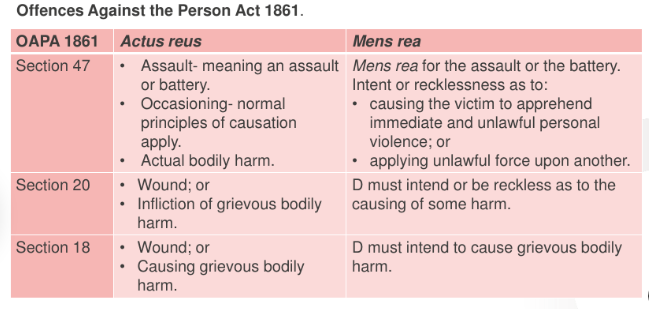
Comparison table of s47, s20 and s18
Elements of basic criminal damage + max sentence
destroy or damage
property
belonging to another
without lawful excuse
intention or recklessness as to the damage or destruction of property belonging to another
Max sentence = 10 years imprisonment
Criminal damage: AR
destroy or damage
Destroy = following D’s actions, the property ceases to exist
damage = decided by the circumstances of each case, the nature of the article and the mode in which it is affected. It need not be permanent e.g.: mud spread on walls was damage because it cost £7 to remove but spit on a policeman’s coat not damage because it can easily be removed
property
property of a tangible nature including money, wild creatures which have been tamed or are ordinarily kept in captivity.
Does not include mushrooms, flowers or fruit which is growing wild
information not included
belonging to another
This includes having the custody or control of it, having a proprietary right or interest in it (but not an equitable one arising from an agreement to transfer or grant an interest) or having a charge on it
Property can belong to more than one person, it can be co-owned
If property is mortgaged it will also belong to the bank
without lawful excuse
This may be: (1) any general defence or (2) s5(2) CDA 1971 lawful excuse defences
2 lawful excuse defences:
s5(2)(a): D believes that the owner would have consented to the damage.
This belief need not be reasonable but only honestly held.
The defence is still available even where the belief resulted from D’s intoxication
D’s motive for causing the damage is irrelevant even where the motive is to perpetrate a fraud
Limit: belief that God had given consent is not a lawful excuse
s5(2)(b): D acts to protect their or another’s property. This has 4 elements:
D must act to protect property
D must believe that the property was in immediate need of protection (subjective)
D must believe that the means of protection adopted are reasonable (subjective)
Damage caused by D must be (objectively) capable of protecting the property
This belief need not be justified but only honestly held.
criminal damage: MR
intention or recklessness as to the damage or destruction of property belonging to another
Intention
whether at the time D carried out the AR it was D’s aim or purpose to destroy or damage the property belonging to another
Recklessness
at the time of committing the AR, the accused was subjectively aware of a risk and
in the circumstances known to the accused, it was objectively unreasonable for the accused to take that risk
The MR applies to the whole of the AR, cannot have intention to damage the property only, D must also know it belonged to someone else i.e. no MR if D believes the property is his
basic arson elements
AR:
destroy or damage by fire
property
belonging to another
without lawful excuse
MR:
Intention or recklessness as to the destruction or damage of property belonging to another by fire
Aggravated criminal damage elements
destroy or damage
property
intention or recklessness as to the destruction or damage of property
intention or recklessness as to the endangerment of life by the damage or destruction
Aggravated criminal damage: AR
destroy or damage
property
D can commit aggravated criminal damage to D’s own property
lawful excuse defences in s5(2) do not apply but general defences do apply
Irrelevant whether the life of another was actually endangered
Aggravated criminal damage: MR
intention or recklessness as to the destruction or damage of property
intention or recklessness as to the endangerment of life by the damage or destruction
There has to be a causal link between the damage to property and the danger to life e.g. R v Steer: D had fired 3 shots through a window but this did not constitute aggravated criminal damage because any risk to life intended or foreseen had been by the bullets fired and not by the damaged property
aggravated arson elements
destroy or damage by fire
property
intention or recklessness as to the destruction or damage of property by fire
intention or recklessness as to the endangerment of life by the damage or destruction by fire
aggravated arson; AR
destroy or damage by fire
property
D can commit aggravated criminal damage to D’s own property
lawful excuse defences in s5(2) do not apply but general defences do apply
Irrelevant whether the life of another was actually endangered
Aggravated arson: MR
intention or recklessness as to the destruction or damage of property by fire
intention or recklessness as to the endangerment of life by the damage or destruction by fire
There has to be a causal link between the damage to property and the danger to life. If the damage is caused by fire the risk to life will always be from the damages property
Definition of theft + elements
‘He dishonestly appropriates property belonging to another with the intention of permanently depriving the other of it’
AR:
appropriation
property
belonging to another
MR:
dishonestly
with the intention to permanently deprive
Theft: AR
appropriation
Any assumption by a person of the rights of an owner amounts to an appropriation
e.g. selling it, hiring it, giving it away or destroying it
D can appropriate property even with the consent of the owner (Gomez)
D can appropriate a valid gift (Hinks - D befriended a 53 year old man of limited intelligence and took him to take out money everyday which she influenced, persuaded or coerced him into giving to her)
If D does not have the requisite MR when appropriating the property, the full offence of theft will be made out later when D forms the MR
D is exempt from liability of theft where D purchases goods in good faith and for value, then later discovers that the seller had no title to the property but decides to keep it
property
Property = money, all other property whether real or personal inc. things in action and other intangible property
Exceptions:
land: in general land cannot be stolen but a person can be guilty of theft if:
D is authorised to sell land and sells more than they are meant to
D is a trespasser or invited guest and removes a fence or a lavender plant
D is a tenant and removes or sells without removing a fixed greenhouse
wild plants: D will not be guilty of theft if they pick mushrooms, flowers, fruit or foliage from the wild.
D can be guilty of theft if the purpose of picking from the wild plant is a reward, to sell or for another commercial purpose
D can be guilty of he uproots or cuts parts of the wild plant
D can be guilty if he picks cultivated plants
wild animals: D not guilty of the theft of untamed animals or animals not ordinarily kept in captivity
D can be guilty of theft of:
Tamed animals
animals kept in captivity
animals in the course of being reduced into possession e.g. being trapped
electricity
Corpses and body parts: except those which have been taken into another’s possession e.g. corpses in hospitals, blood given to a blood bank, corpses or body parts which have acquired different attributes for scientific or teaching purposes
confidential info
services e.g. a train journey
belonging to another
Extends beyond ownership to include those having possession or control of it or a proprietary interest in it at the moment of appropriation
When is property abandoned?
Householders do not abandon goods that are put in their domestic waste so a refuse collector could be guilty of theft if appropriating goods from a bin
property is not abandoned just because the owner has stopped looking for it
Possession and control need not necessarily be over the specified property but over the land upon which it was found even if the owner of the land is unaware of its existence
D can steal their own property - Turner where D took his car to the mechanic and collected it without paying the bill. This was theft as the car belonged to another
If D receives property for a particular purpose and is under an obligation to deal with it in a specific way then the property still belongs to the person who gave it to them. Thus if D decides to use it for their own purposes, they can be guilty of theft
this will only be the case if there is a legal obligation to use the property for the purpose given
R v Hall: D was a travel agent and took money for flights. He used the money to pay off his creditors, he went bankrupt and clients lost the money. This was not theft because although the clients expected tickets in return for their money, they did not expect their money to be kept separately but rather go towards the general running of the business
obligations can be imposed upon domestic/social arrangements e.g. like using cheques given by someone else to pay off household bills
Where title has passed to D due to another’s mistake, the law allows the property to belong to another
A person who gives property by a mistake retains an equitable interest in that property

Theft: MR
dishonestly
D is not dishonest if D appropriates property in the belief that (note this beleif need not be reasonable as long as it is honest):
D has a right in law to deprive the other of the property
D would have the other’s consent if the other person knew
the person to whom the property belongs cannot be discovered by taking reasonable steps (D does not need to take reasonable steps, only need D to believe that taking such steps will not enable the owner to be found). (If the owner becomes known to the accused later then keeping the property at this later stage could be dishonest and therefore theft)
Common law test: Ivey v Genting Casinos
what was D’s knowledge and belief as to the facts?
Given that knowledge and those beliefs, was D dishonest by the standards of ordinary decent people
A person can appropriate property dishonestly despite being willing to pay for the property
Timing: dishonest intent must be formed at a time when the goods belong to another. No conviction if D only forms the dishonest intent after ownership of the property has passed to D:
ownership of property passes when it is paid for
ownership of food passes when it is eaten or before it is eaten for food ordered and cooked in a restaurant
ownership of petrol passes when put in a petrol tank
intention to permanently deprive
No requirement that the owner is actually deprived of their property permanently
Timing: the intention to deprive must be at the time of appropriation