2.2 Phospholipids and Cell Membranes
 Call Kai
 Learn
 Practice Test
 Spaced Repetition
 Match
 Flashcards
 Knowt Play
1/14

There's no tags or description
Looks like no tags are added yet.
15 Terms
Describe the structure of a phospholipid
glycerol molecule is attached to two fatty acids by two ester bonds
and one phosphate attached to the glycerol molecule
Explain the importance of the phosphate group in lipids.
the phosphate head is hydrophilic
therefore the phosphate can interact with the aqueoud environment
otherwise lipids will not form a bilayer and will not enclose the cytoplasm
State the components of a cell membrane
phospholipid bilayer (hydrophobic tails and hydrophilic heads)
cholestreol
glycoproteins
glycolipids
proteins
Describe the structure of a cell membrane
consists of a phospholipid bilayer - where the hydrophilic heads face outwards to the surface and hydrophobic tails face inwards which is selectively permeable
consists of proteins - there are instrinsic (span the whole width of the cell membrane) and extrinsic proteins
consists of cholestreol - needed to maintain membrane fluidity
glycoproteins and glycolipids - needed to cell recognition and adhesion
Explain why a bipolar lipid is a suitable molecule to form the cell membrane
this is because the two polar groups will interact with the aqueous environment on each side of the membrane and so can form hydrogen bonds with water
the rest of the molecule will provide a hydrophobic barrier allowing the transport of lipid soluble susbstances
Explain how the structure of a phospholipid molecule contributes to the partial permeability of a cell surface membrane
hydrophilic heads (phosphate head) face outwards and hydrophobic tails (fatty acids) face inwards
this allows for the interactions with the external aqueous environment as it can form hydrogen bonds with water
however, the hydrophobic tails allows only fat soluble (non-polar) substances to be transported through the cell membrane
hence pilar molecules cannot pass through the phospholipid bilayer
Explain why it is important that the lipid composition of the membrane of prokaryotic organisms changes if the temperature changes.
this is because cell membranes control permeability (what can enter and leave the cell)
such as uptake of nutrients and oxygen
as membranes need to be fluid for movement
Explain why the phospholipids are arranged in two layers in a cell surface membrane.
hydrophilic region (phosphate head) of phospholipid is orientated towards water
and hydrophobic region (fatty acid tails) is orientated away from the water
but the two layers are needed as aqueous (water-soluble) solution is on either side of the cell membrane
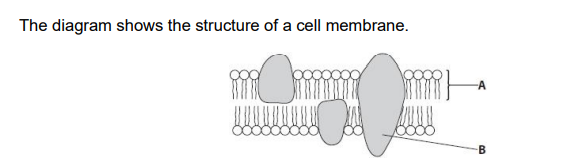
a) Name the parts labelled A and B
b) Explain how the structure of the membrane controls the transport of polar molecules
a)
A - phospholipid bilayer
B - intrinsic proteins
b)
polar molecules are hydrophilic and so water soluble
phosphate head is hydrophilic which is the outer side and fatty acids tails are hydrophobic which are on the inside
therefore polar substances (water soluble substances) cannot pass through the hydrophobic tails
and so pass through carrier proteins
Explain the importance of cholestreol in the cell membrane
cholestreol maintains cell membrane fluidity and stability
when temperatures are too high, the phospholipids have more kinetic energy and so move further apart, cholestreol ensures that the phospholipids remain closely packed together
when temperatures are too low, the phospholipids pack extremely close together yet cholestreol ensures that the phospholipids do not pack too tightly .
Name the two main types of proteins found in cell membranes
integral (instrinsic) proteins - these span across the whole bilayer (they include channel and carrier proteins)
extrinsic (peripheral) proteins - these are attached to the surface of teh bilayer
Explain the function of each of the protein found in cell membranes
integral (instrinsic) proteins - these span across the whole bilayer allowing for the transport of large molecules and ions across the cell membrane
peripheral (extrinsic) proteins - which are attached to the surface of the protein provide structural support and cell recognition and signalling
State some of the fucntions of membrane proteins
transport of molecules
cell recognition
intracellular joining
enzymatic activity
Describe the function of carrier proteins in a cell surface membrane (4)
they are involved in facilitated diffusion
whereby it is the movement of large polar molecules or ions from a high concentration to a low concentration
it is also involved in active transport
which needs ATP to move molecules against concentration gradient
Give the fucntion of glycoproteins and glycolipids
cell recognition
receptors on cell surface membrane