Topic 8A & 8B (Redox reactions & group 1,2)

0.0(0)
Studied by 0 people
call kaiCall Kai
learnLearn
examPractice Test
spaced repetitionSpaced Repetition
heart puzzleMatch
flashcardsFlashcards
GameKnowt Play
Card Sorting

1/45

encourage image

There's no tags or description

Looks like no tags are added yet.

Last updated 11:51 AM on 10/1/26
Name
Mastery
Learn
Test
Matching
Spaced
Call with Kai
Chat

No analytics yet

Send a link to your students to track their progress

46 Terms
1
New cards
term image

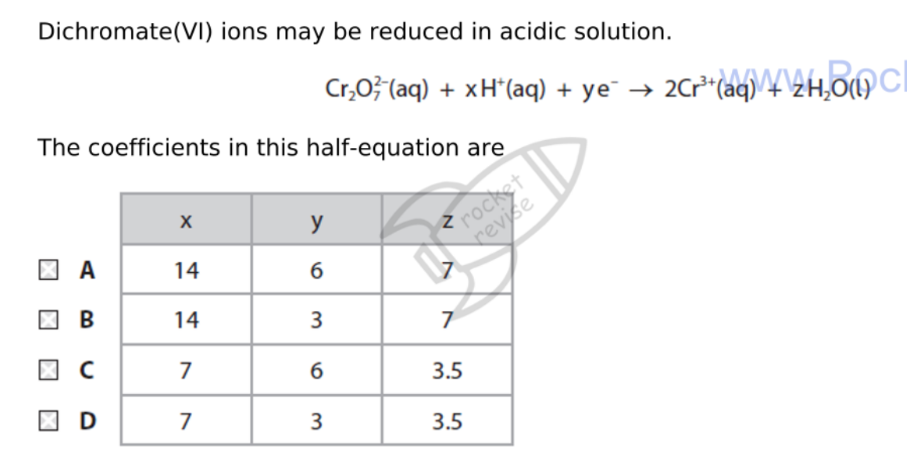
A
(14, 6, 7)

2
New cards
<p>state the reducing agent in this reaction</p>

state the reducing agent in this reaction

Explanation:

<p>Explanation:<br></p>
3
New cards
<p></p>


4
New cards
<p></p>


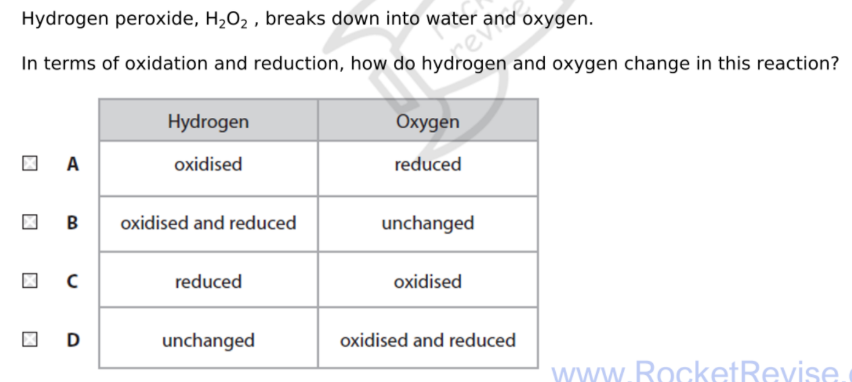
D

5
New cards
term image
knowt flashcard image
6
New cards

state the colors produced by the following ions

Li+

Na+

Ba2+

K+

Be2+

Li+ = red

Na+ = yellow

Ba2+ = green


7
New cards

state the colors produced by the following ions

Ca2+

Sr2+

Mg2+

Rb+

Cs+

Ca2+ = (brick) Red

Sr2+ = (crimson) Red

Mg2+ = no color

Rb+ = (reddish) purple

Cs+ = blue /violet

8
New cards

what is the color of:

nitrogen dioxide

K+

Be2+

brown

(or reddish-brown)


K+ = purple/ lilac

Be2+ = no color

<p>brown<br><br>(or reddish-brown)<br><br><br>K+ = purple/ lilac<br><br>Be<sup>2+</sup> = <strong><u>no color</u></strong></p>
9
New cards

state the result of nitrogen dioxide damp litmus paper test

blue litmus paper turns red

(When NO2 dissolves in water it forms an acid)

<p>blue litmus paper turns red<br><br>(When NO2 dissolves in water it forms an acid)</p>
10
New cards
What is disproportionation?
One element is both oxidised and reduced.
11
New cards

What happens to ionisation energy down Groups 1/2?

decreases

[down the group the size of the atoms are larger,
so the atomic radius is greater
there is more shielding and less nuclear attraction,
hence electrons can be removed more easily]

12
New cards
Why does ionisation energy decrease down Groups 1/2?
More shells + shielding → weaker nuclear attraction to outer electron.
13
New cards
Why does Group 1/2 reactivity increase down the group?
Outer electrons are lost more easily due to lower ionisation energy.
14
New cards
What type of agents are Group 1/2 metals?
Reducing agents.
15
New cards

Group 1 + water,

what are the products?

Metal hydroxide + hydrogen.
16
New cards

Group 2 + water

what are the products?

Metal hydroxide + hydrogen.
17
New cards
How does Group 2 hydroxide solubility change down the group?
Increases down the group.
18
New cards
How does Group 2 sulfate solubility change down the group?
Decreases down the group.
19
New cards
Why do Group 2 hydroxides become more soluble down the group?
Lattice enthalpy decreases more than hydration enthalpy.
20
New cards
Why do Group 2 sulfates become less soluble down the group?
Hydration enthalpy decreases faster than lattice enthalpy.
21
New cards
What happens to Group 2 carbonate thermal stability down the group?
It increases.
22
New cards
What happens to Group 2 nitrate thermal stability down the group?
It increases.
23
New cards
Why does Group 2 thermal stability increase down the group?
Larger cation → lower charge density → less polarisation → greater stability.
24
New cards
What do Group 2 carbonates form on heating?
Metal oxide + CO₂.
25
New cards
What do Group 2 nitrates form on heating?
Metal oxide + NO₂ + O₂.
26
New cards
Why is Li an exception in Group 1 thermal decomposition?
Li⁺ is small with high charge density and behaves like Group 2.
27
New cards
What is Na's flame colour?
Bright yellow.
28
New cards
What is K's flame colour?
Lilac/pale violet.
29
New cards
What is Ca's flame colour?
Brick red.
30
New cards
What is Ba's flame colour?
Apple green.
31
New cards
What gas turns limewater milky?
CO₂.
32
New cards
What does oxygen do to a glowing splint?
Relights it.
33
New cards
What colour is nitrogen dioxide?
Brown.
34
New cards
How do you test for carbonate ions?
Add dilute acid; CO₂ forms and turns limewater milky.
35
New cards
How do you test for ammonium ions?
Add NaOH and warm; NH₃ turns damp red litmus blue.
36
New cards
How do you test for sulfate ions?
Acidify with dilute HCl, then add BaCl₂ → white precipitate.
37
New cards
Why not use H₂SO₄ to acidify a sulfate test?
It adds sulfate ions and can cause a false positive.
38
New cards
What is concentration in mol dm⁻³?
c = n/V, with V in dm³.
39
New cards
What is the core titration sequence?
Equation → mole ratio → n=cV → unknown moles → unknown concentration.
40
New cards
How do you convert cm³ to dm³?
Divide by 1000.
41
New cards
How can percentage uncertainty be calculated?
(absolute uncertainty ÷ measured value) × 100.
42
New cards
How can percentage uncertainty in a titre be reduced?
Use a larger titre volume.
43
New cards
term image
  • more energy needed to break ionic bonds in MgCO3 lattice
    [lattice energy is more exothermic]

  • less energy released during hydration of ions


44
New cards
term image
knowt flashcard image
45
New cards
term image
  • (down group 2 the solubility of metal hydroxides increases)
    so Ca(OH)2 is more soluble than Mg(OH)2

- so more OH- ions dissolve in solution/ concentration of OH- is greater

46
New cards
What does repeating titrations achieve?
Identifies outliers and improves reliability.