THAD 101 | QUIZ 1
 Call Kai
 Learn
Learn Practice Test
 Spaced Repetition
 Match
Match Flashcards
 Knowt Play
1/27

There's no tags or description
Looks like no tags are added yet.
Name | Mastery | Learn | Test | Matching | Spaced | Call with Kai | Chat |
|---|
No analytics yet
Send a link to your students to track their progress
28 Terms

Megaloceros Gallery Cave Paintings, Chauvet Cave, France, 30,000 BP
Details:
Features over 1000+ drawings and paintings of animals of the time (corrobating with prehistoric French fauna)
Giant Deer
Naturalistic depictions of animals
Painted, pigments suspended in medium
Limestone cave, charcoal, clay, red ochre?
White pigment used, meant to shimmer under torch light
Use of perspective to counteract cave texture, use of cave texture to mimic animal hide textures
Very few human figures, and if seen, are reduced to abstract stick figure
Context & Meaning
Placed deep in cave, likely inaccessible and hard to reach
Ancestors viewed animals as potentially dangerous, and therefore transforming caves into potent, divine places
Carbon dating suggests that drawings were not created all at once, but overlapped over 1000s of years
Suggests that this was a sacred tradition or perhaps an important ritual that happened between descendants and ancestors
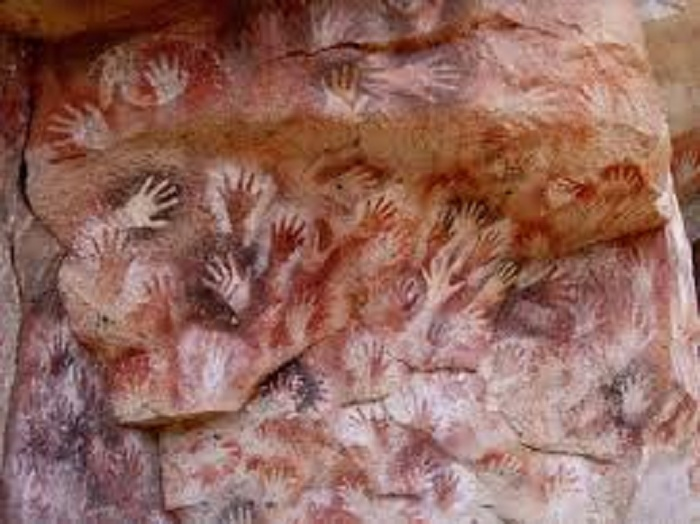
Chauvet Cave Paintings, Chauvet Cave, France, 30,000 BP
Details
Negative hand prints
Pigment placed in mouth, then blown into air, creating a negative
Context & Meaning
Handprints layered over 1000s of years
Suggests that this was a sacred tradition or perhaps an important ritual that happened between descendants and ancestors

The Lion Man, Mammoth Ivory, Stadel Cave, Baden-Wuttemberg, Germany, 40,000 BP
Details
12 inches tall, carved using stone tools
Probably required immense effort to carve
Context & Meaning
Head of a lion, posture of a man, possessing a penile shaped crotch
Possibly chauvinistic, depicting and revealing how early humans conceived gender
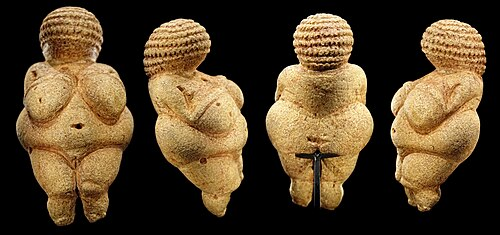
Woman of Willendorf, Oolitic limestone, Austria, 26,000-22,000 BP
Details
Exaggerated phenotype of women
Wide hips, large breasts, defined vulva
11 cm tall, possibly palm sized
Context & Meaning
Voluptuous depiction & palm-sized
Possibly a lucky charm or fortune for pregnant women engaging in labor during the Paleolithic era
Originally believed to be a Venus statue, which was used for fertility worship
Then believed to be a self-portrait, where the exaggerated proportions are due to the foreshortening of bodily limbs when looking down on oneself
McDermott Theory

Step Pyramid of King Djoser, Egypt, 2670-2650 BCE
Details
Built by Imhotep (the vizier)
Stepped Pyramid (suggesting it was made earlier) made of cut limestone, located in a desert in Egypt
Context & Meaning
Monumental stone tomb and eternal dwelling place
Houses his spirit, protects his remains, and allows him to sustain his royal status in the afterlife
Began as a flat-roofed mastaba, then Imhotep gradually expanded it by adding more rectangular layers
Reinforces Maat (cosmic order, balance) by physically symbolizing the Pharaoh’s divine role/pla

Bent Pyramid of Sneferu at Dahshur, Dynastic IV, 2613-2590 BCE
Details
Commissioned by Pharaoh Sneferu, the 4th dynasty founder
Slanted pyramid made of limestone. Sneferu’s first attempt to build a smooth (flat-planed) sided pyramid
54-degree angle on the lower half, but changed to a 43-degree angle due to failure to hold up
Context & meaning
Earlier pyramid, as it isn’t perfectly smooth yet
Monumental stone tomb and eternal dwelling place
Houses his spirit, protects his remains, and allows him to sustain his royal status in the afterlife
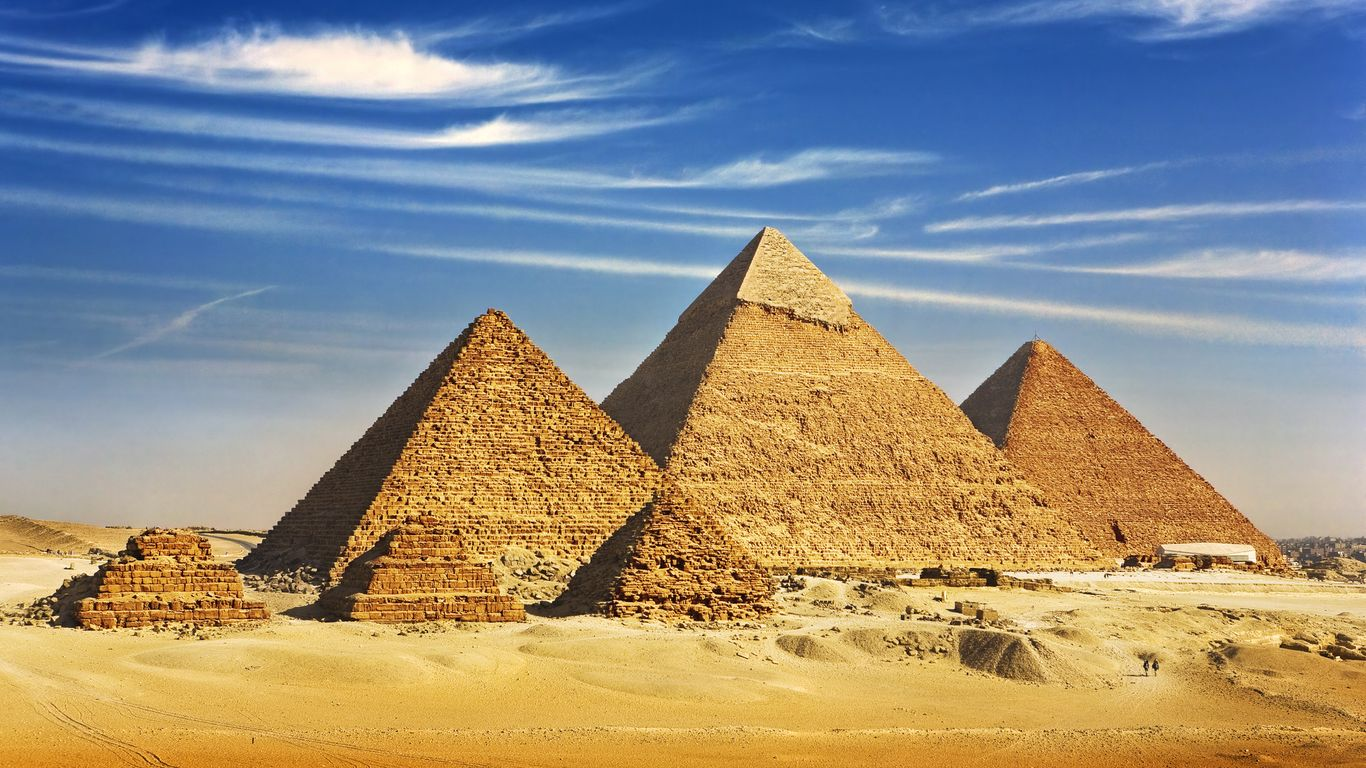
Giza Pyramids, Dynasty IV, 2600-2500 BCE
Details
Smooth-faced, slanted pyramid made of cut limestone, made to look reflective in the sun
Newer pyramid as it is slanted (thus suggesting this is a more advanced use of engineering by the Egyptians)
Located in a desert in Egypt
Context & meaning
Monumental stone tomb and eternal dwelling place
Houses his spirit, protects his remains, and allows him to sustain his royal status in the afterlife

Papyrus of Merer, ca 2563 BCE
Details
Papyrus scroll fragments, carbon black ink (soot) and red ochre ink (from hematite)
Written are hieroglyphs in hieratic script
Context & meaning
An ancient logistical logbook and daily journal to record the transport of heavy limestone blocks for building the Great Pyramid of Giza

Augustus of Prima Porta, 20 BCE, Greece
Details
Marble, polychrome
Reconstruction of pigments found in the statue, using a lack of painterly approach due to conservative efforts
Contrapposto, natural weight shift, adlocutio gesture, addressing his troops
Context & meaning
Breastplate has cosmic deities, suggesting that the universe approves of Augustus’ rule
Addressing his troops, used to solidify his authority as a powerful military commander

Doryphoros, 460-450BCE., Polykleitos, Pompeii
Details
Modelled as an ideal, perfect citizen, he is the muscular goal of citizens
Polykleitos rejects pure naturalism, uses contrapposto to achieve ABBA structure (chiasmus, relaxed and weight bearing)
Context & Meaning
Body goals, improve upon god’s work
Act as a anatomical goal for young athletes to emulate (because he was placed in a gym)

The Riace Bronzes, 450 BCE, Greece
Details
Mixed material using patina; eyes are made of glass; nipples are inlaid with warmer-toned copper
Contrapposto (similar to Doryphoros)
Context & Meaning
Heroic depiction of two warriors, enhancing Greek ideas of civic identity and heroic ideal

Head of Odysseus, 100 CE, Greece
Details
Head features intense emotion / melancholy
Theatrical, Late Hellenistic
Context & Meaning
The sculpture captures Odysseus at the absolute peak of tension, straining as he and his men prepare to thrust a red-hot wooden stake into the single eye of the sleeping giant

Hagia Sophia Cathedral, Constantinople (Now Istanbul), 532-37CE
Details
31 m times 150 m dome largest enclosed space for humans for 1000 years, Domes
Minarets added when it was converted from a Christian church to an Islamic mosque
Buttresses are used as counterweights, which leave the interior empty
Windows from the dome allow light to flood in, while gold mosaic and gilded surfaces allow light to scatter off
Context & meaning
Light symbolizes God; therefore, as much light would mean there's more holiness in this cathedral or mosque
Aims to evoke timor, the fear or reverence of God; if someone previously believed in God, they believe in god even more
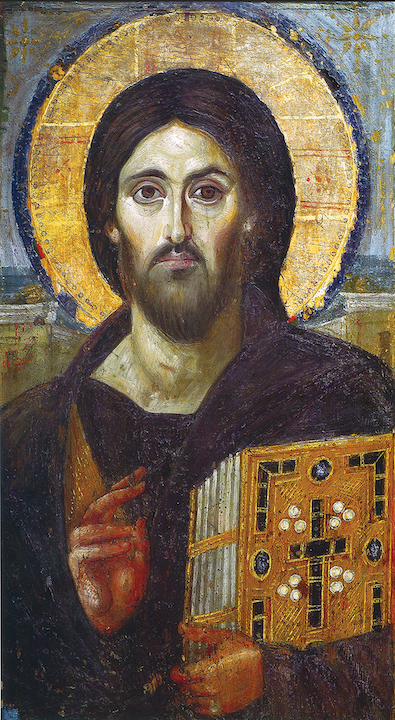
Christ Pantokrator, 600 CE, Sinai, Egypt
Details
Encaustic paint on wood panel
Half of the Christ is gentle while doing a hand sign, which is meant to be addressing his people
The other half is more hostile, more angular, harsher, more masculine, aiming to describe the power of God himself & his power
Context & Meaning
By choosing ½ and ½ method, argues that Jesus was simultaneously fully human and fully divine
His clothing (a red tunic representing divinity/passion and a blue mantle representing humanity) mirrors this dual nature

Dome of the Rock, 691 CE, Jerusalem
Details
Mosaic of swirling objects
Material variety, from marble tops (mirrored so they are symmetrical, book matching) to gold mosaics, glass tesserae
Visualizing the Gardens of Paradise, aiming to show wealth and poulence of Umayyads
Context & Meaning
Hired Byzantine workers to create the mosaic; Islamic architects try not to portray anything alive, as they think it will prevent messages to God from being intercepted
Inscribed in the dome is Tawhid (one god only) in the mosaic frieze, stating there’s only 1 god

The Blue Quar’an, 850-950CE, Tunsia
Details
The manuscript features striking angular Kufic calligraphy written in gold leaf on dark, midnight-blue parchment that was dyed using indigo
Context & Meaning
It symbolizes the divine word of God (the Quran) illuminating the cosmic darkness of the earthly world

Death of the Buddha, 711 CE, Japan
Details
Clay diorama depicting the deathbed of Buddha
Buddha passing into Nirvana
Buddha is central figure, surrounded by disciples, bodhisattvas.
Located in a 5-story pagoda, Horyu-ji Temple in Nara, Japan
Context & Meaning
Bodhisattvas remain stoic towards Buddha’s passing, while disciples are in melancholy, representing their lack of spiritual awakening and earthly attachments

Stele of the Buddha and 2 Bodhisattvas, 533 CE, Northern Wei Dynasty, Northern China
Details
The floral motifs in the two areas between the Buddha and the two Bodhisattvas are incised in very low relief. They consist of lotus leaves and lotus pods with attached petals, all growing from behind the lions.
Two bodhisattvas and 1 Buddha with almond-shaped body halo
Hierarchical / Hieratic Scale of subject matter
Draped fabrics, archaic and stoic smiles
Relief carving done in limestone
Early evidence of Chinese Buddhist art
Context & Meaning
Bodhisattvas are those who postpone their own enlightenment to teach others of the ways of Buddhism
Steles were carved often in the Northern Wei Dynasty; they were stone tablets to spread the ways of Buddha
A form of spiritual currency, used to guarantee good health, protect family members, and wipe away past sins.

Variocana Buddha, 752 CE, Nara, Japan
Details
15m tall; cast bronze with mercury gold gilding; 250- 500 tons of cast bronze
Right hand → Abhaya mudra (palm raised), fearlessness and protection
Left hand → Dhyana mudra (palm on lap facing up), meditation
Context & Meaning
Emperor Shomu commissioned this after a smallpox epidemic & political instability
Aiming to provide peace in a time of crisis

Taizokai Mandala (Womb World Mandala), 850-900CE, Kyoto, Japan
Details
Esoteric Buddhist painting style (originating in Tang Dynasty China → then introduced to Japan in the 9th century)
Buddhist mandala iconography
414 deities and 12 concentric courts
Ink, gold leaf on silk
Context & Meaning
Womb mandala → womb is nurturing, creating a realm / spiritual field of enlightenment
Paired with the Diamond World Mandala
The pair of mandalas hang facing each other on temple walls to guide practitioners toward spiritual awakening.

Jocho Amida Buddha, 1053, Kyoto, Japan
Details
Gold leaf and lacquer on wood
Made using multiple pieces of wood (joined wood block technique), which peaked in the 11th century to build large wood statues
Jochoyo Style proportions
Canonical standard, gentle, round facial contours, shallow drapery lines, resembles court refinement
Context & Meaning
Made to avoid the 3rd degeneration (Mappo), a dark age where the world falls into chaos and enlightenment is impossible
People in the 3rd degeneration prayed to this Buddha, hoping that they could be reborn into the Western paradise and have Nirvana guaranteed

Travelers Among Mountains and Streams, Fan Kuan, 1000CE, Ink on Silk scroll, Northern Song Dynasty
Details
Soft hemp fibre strokes
Slightly textured, raindrop strokes
Macrocosmic depiction of the mountain → distortion of proportion in favor of composition
Monumental, imposing nature of the mountain
Overwhelms viewers
Background of waterfall occupies most area, Foreground and middle ground occupy small area, tiny humans show insignificance of man
6ft high, monumental
Context & Meaning
Conveys the vast grandeur of the natural world and the small, fleeting place of human beings within it.
Neo-confucian & Daoist ideas of escaping into nature, how man is insignificant in comparison

Bamboo Groves in Mist and Rain, Guan Daosheng, 1308, ink on paper scroll, Taipei
Details
Literati ink-monochrome style
Calligraphic use of brush, rather than realistic
Animal fur / hemp brushes
Atmospheric Wash
Blurred, forcing eye down viewing path
Context & Meaning
During this time, invasion of the Mongols (Genghis Khan), people in China feel ambivalence, moving away from pictorial rendering and welcoming more abstraction.
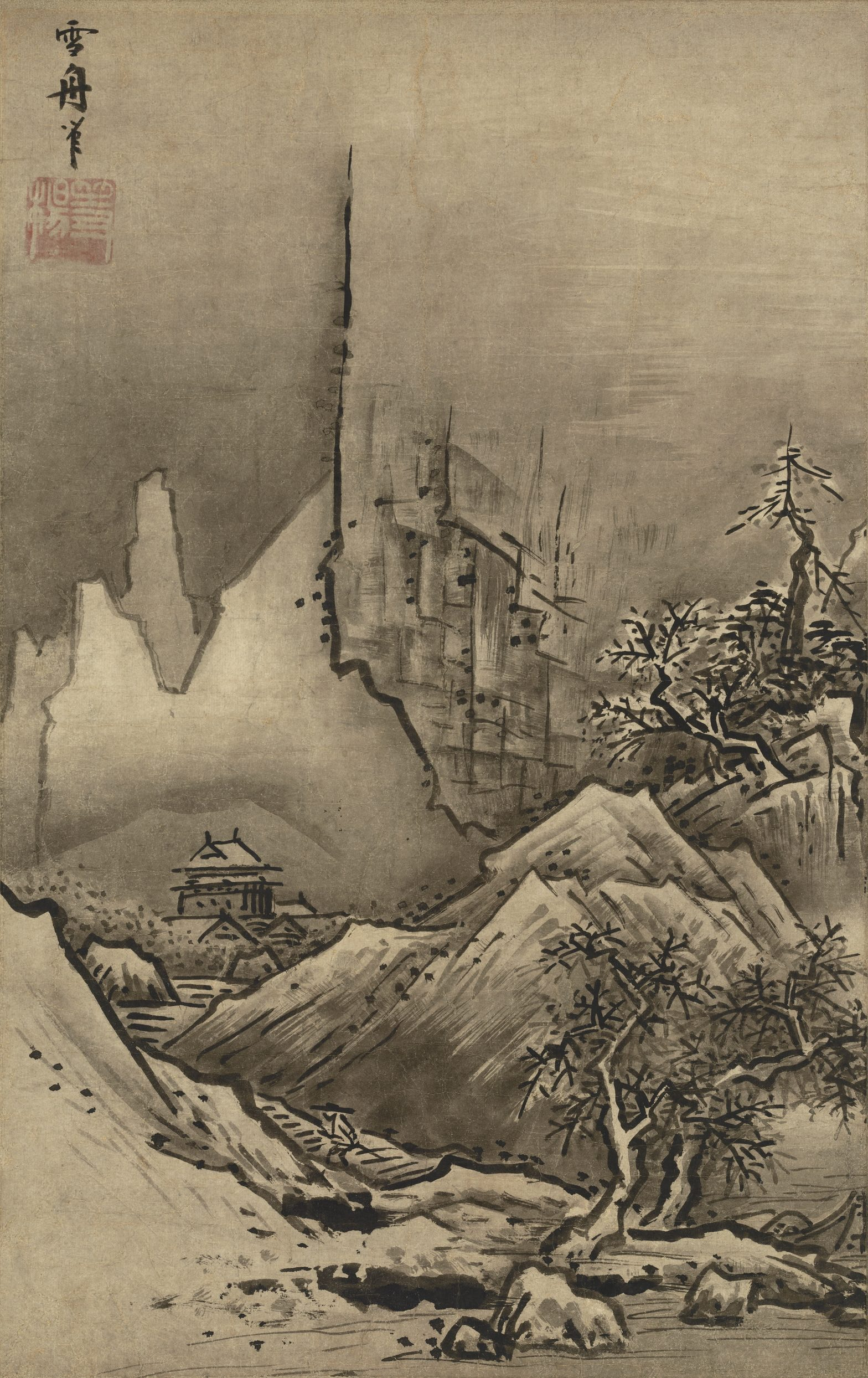
Winter Landscape, Sesshu Toyo, 1470, Ink on Paper Scroll, Tokyo
Details
Soot ink on paper scroll
Clear landscape outline
Brushstrokes are defined, choppy brushstrokes
Context & Meaning
Buddhism post civil war, where Kyoto is burned
Solemn nature of painting suggests that those should also pursue zen, removing oneself from the chaos of civil war

Katsushika Hokusai, Rough Impression of the Mitsui Shop, 1831, color woodblock print, Japan
Details
Use of prussian blue ink to delineate sky and structural lines
4-5 colors, limited color palette
V shape framing of Mt Fuji characterizes it as a Shanshui despite commercial consumerism surrounding the mountain
Context & Meaning
Mt Fuji is seen as a sacred deity

The Reliquary of St Foy, 1000CE, Conques, France
Details
Wooden core, covered in gold leaf, silver, enamel, precious stones
Covered in SPOILA → taking spoila from Roman Emperor and pasting them on St Foy → COMMENTARY on St Foy’s story
Accumulated gems through pilgrim donations
Died for her belief → respected, so placing her on a throne
Context & Meaning
Foy was a young teenager who wanted to convert to Christianity; her parents wanted her to marry a non-Christian Roman.
Was executed and killed due to this
Christian monks took her body and turned it into a reliquary, honoring her and her belief
Sacred vessel to store relics (that’s why its a reliquary!!), housing her physical remains (the relic)

Tympanum with the Last Judgment, 1130 CE, Conques, France
Details
Stone relief in limestone
Semicircular Tympanum Format → Romanesque sculpture (very stiff)
Compositional Elements
Viewer’s left side → Neat, orderly, peaceful, harmony
Calm architecture of heaven, static poses, no panic nor struggle
Right → Hell, chaos, terror, violence, lack of order
Figures are contorted, tangled, and asking for help
Hand on left raised upward, in welcoming / blessing of his people, acceptance
Hand on right downward, rejecting saving those in hell, banishing and condemning them
Inscription warning those who aren’t Christian that if they don’t convert, they would likely go to hell and suffer the fate of the people on the right
Context & Meaning
Everyone was illiterate so this a comic for them, convince public to change their views
Repentance warning, terrifying imagery

The Churning of the Sea of Milk, low relief, Angkor Wat, 1113-45CE
Details
Stone relief
Low relief = low contrast
Rhythmic, tiered composition of identical figures, wearing Angkorean helmets and pleated garments
49 meters long, gallery format forces people to walk and experience the totality of it all
Context & Meaning
Political Propaganda
At the end, Suryavarman II, the emperor, defeats enemies in battle, similar to Vishnu
Suggests that Suryavarman, similar to Vishnu, can bring divine order and peace to the Khmer kingdom