Exam 4
 Call Kai
 Learn
 Practice Test
 Spaced Repetition
 Match
 Flashcards
 Knowt Play
1/47

There's no tags or description
Looks like no tags are added yet.
48 Terms
What is evolution?
change in populations of from generations to generations
changes to genes lead to modified behavior appearance/behavior
History of Evolutionary though
Jean-Baptiste Lamarck
use and disuse
inheritance of acquired characteristics
Who was Charles Darwin?
Born 1809; wealthy family
father wanted him to be a doctor, but Charles liked plants and animals more
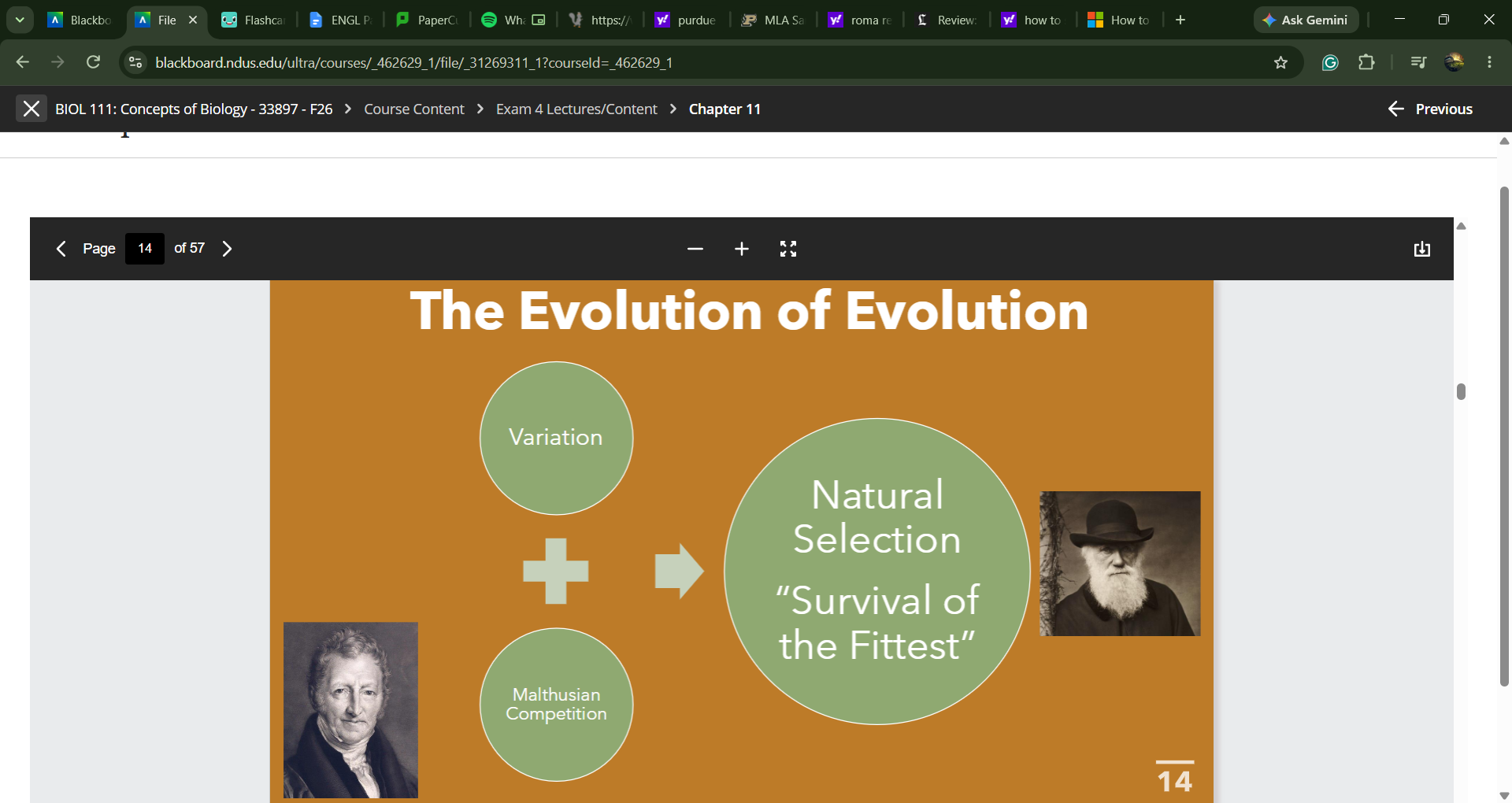
What “current” ideas influenced Darwin?
Charles Darwin (1809-1882)
• Existing knowledge that variation occurred among organisms
• Charles Lyell – geologist – uniformitarianism (geological processes
that go on today are also what shaped the earth in the past → old earth)
• Thomas Robert Malthus – economist – populations over-reproduce
(beyond sustainability → some will die)
• 5-year voyage of the Beagle
The voyage of the Beagle
12/21/1831 - 10/02/1836
Darwin observed finches
What were Darwin’s conclusions?
More offspring are often produced than can survive
(resources are limited)Traits vary among individuals (phenotypes)
Different traits affect survival/reproduction differently
Traits are passed to offspring
Future populations will have more individuals from parents
with traits that allowed them to survive/reproduce betterNATURAL SELECTION!
What did Darwin do after his trip?
Charles Darwin (1809-1882)
Return of the Beagle (1836)
→ On the Origin of Species by
Means of Natural Selection
(1859)
What did Alfred Russell Wallace do?
he embarked on a similar journey to Darwin and came to the same conclusions
he submitted his work to Darwin which led to Darwin publishing his work
What are the five steps of evolution by natural science?
Genetic Variation
Selection Pressure
Overproduction
Differential Success
Repeat
Genetic Variation
individuals of a specific species vary in their characteristics
Selection Pressure
organisms face a constant struggle to survive and reproduce
Overproduction
More offspring are produced than can survive to maturity
Differential Success
Variation causes some individuals to outperform others
Fitness
survival - feeding/growth - successfully - reproduce - young service
being able to fit and reproduce
Directional Selection
phenotype at the end of the range of variation is favored
ex: evolution of moth colour; white is more easily spotted than black
Stabilizing Selection
middle, intermediate chosen
ex: human birth weight
Disruptive Selection
Phenotypes on either end of range of variation are favored – intermediate phenotypes are selected against
ex: seedcraker birds
Artificial Selection vs Natural Selection
Artificial Selection
based on human preferences
Natural Selection
based on fitness: survival and reproduction
Artificial Selection
“human preferences”
Darwin used humans use of selective
Causes of Evolution
Natural/Artifical Selecton - not random
Mutation - random
Genetic Drift - random
Gene Flow - random
Mutation
Change in DNA
permanent
source of new alleles
70 mutations per person
Arise all the time
Limited by mitosis checkpoints
Genetic Drift
Things happen by chance
individual mortality
finding a mate
which gametes fertilize
Small populations are at greater risk
What magnifies genetic drift?
bottleneck effect
founder effect
Migration
Also called gene flow
Exchange of genes between two different populations
introduction of genes
What evidence do we have for evolution?
fossils
molecular biology
biogeography
anatomy and embryology
genes regulate the development in the same way in related organisms
Population
organisms of same species
Species
group of organisms capable of interbreeding and capable of producing viable offspring
How do biologists define space?
not always appearance
reproductive compatibility
ability to interbreeding/mate and produce visible, fertile offspring
Speciation
overtime and some sort of isolation, the variation among sub-populations becomes so great they can no longer interbreed and they become tow different species
How does speciation happen?
allopatric speciation
sympatric speciation
Allopatric Sepciation
geographic isolation
Sympatric Speciation
same geographic area
“Evolution is just a theory”
theory in science is different
scientists have theories on gravity, atoms, etc.
“Evolution explains origin of life”
evolution describes the origin of species, not origin
“Individual evolve”
individuals can’t change their genetic makeup
populations change over generations
“Organisms evolve on purpose”
evolution is not intentional
variation already exists in the population, it does not arise due to need
“Evolution is controversial among scientists”
proposed in 1859
accepted by scientists within 20 years
why?
Darwin had accumulated so much evidence
supernatural explanations can not be tested by science
How do we organize life or earth?
evolutionary relationships between organisms are shown with branching diagrams: phylogenetic trees
they show scientists best estimates of evolutionary history
phylogenetics trace patterns of shared ancestry between lineage
each lineage has a part of it’s history that is unique to it alone and parts that are shared with other lineage
ancestors that are unique to that lineage and ancestors that are shared with other lineages
How are phylogenetic trees made?
they are based on analyzing traits and grouping organisms based on shared and derived traits
How do you refer to different species?
taxonomy ( naming ) should follow phylogeny (evolutionary relationships)
both are hierarchical
Domain
Kingdom
Phylum
Class
Order
Family
Genes
Species
Subspecies
How do scientists name species?
Every organism has 2-part-name
genes - species
Rules for Binomial Nomenclature
1st name = Genus, capitalized
2nd name = species, lowercase
Latin
underlined if written
italicized if typed
Carl Linnaeus
Father of Taxonomy
Genus
group of species that share a set of traits
How do you read a phylogenetic tree?
each branch point represents a common ancestor
each taxon or group is united by shared characteristics
Sister Taxa
more closely related to each other than any other taxon on the tree
share branch point
did NOT evolve from each other but from common ancestor
Misconceptions about humans
did not evolve from chimps: share common ancestor
humans are not higher/more evolved than other
Remember: evolutional is directional, not goal-oriented, tree not a ladder