2.11: DNA Replication
 Call Kai
 Learn
 Practice Test
 Spaced Repetition
 Match
 Flashcards
 Knowt Play
1/9

There's no tags or description
Looks like no tags are added yet.
10 Terms
What is DNA replication?
the process by which DNA is copied
Why must DNA replicate>
replicating DNA ensure that the two new daughter cells after cell division both receive the full copy of the parental DNA
DNA replication is described as…
semi-conservative
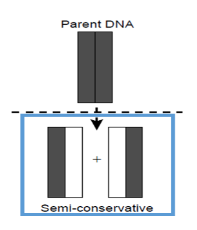
Semi-conservative DNA replication
each new DNA molecule consists of one original (parent) strand, and one new complementary strand
Why is it important to retain one original DNA strand?
to ensure genetic continuity between generations of cells (ensure that the new cells produced during cell division inherit all their genes from their parent cells)
this is important because cells in our body are replaced regularly and therefore we need the new cells to be able to do the same role as the old ones
What stage of the cell cycle does DNA replication take place in?
the S phase of interphase
Steps of DNA replication
DNA helicase unwinds the DNA double helix by breaking the hydrogen bonds between base pairs, forming to single polynucleotide strands
Each of these single polynucleotide DNA strands acts as a template for each new DNA molecule
Free nucleotides attach to exposed bases on the template strands, by complementary base pairing
The enzyme DNA polymerase joins adjacent nucleotides by forming phosphodiester bonds
Hydrogen bonds reform between complementary base pairs
DNA polymerase builds the new complementary strand in the 5’ to 3’ direction
DNA replication is semi-conservative

Meselson and Stahl
showed that DNA replication was semi-conservative by experimenting with isotopes of nitrogen
Meselson and Stahl’s Experiment
Bacteria were grown in a broth containing the heavy (15N) nitrogen isotope, until the culture of bacteria had DNA containing only heavy nitrogen (in the nitrogenous bases)
A sample of DNA was extracted and spun in a centrifuge
→ the DNA settle near the bottom of the centrifuge as it contained only heavy nitrogenThe bacteria containing the heavy DNA were removed and added to a broth containing only lighter 14N nitrogen
The bacteria were left to complete one round of DNA replication, and then their DNA was extracted and spun in a centrifuge
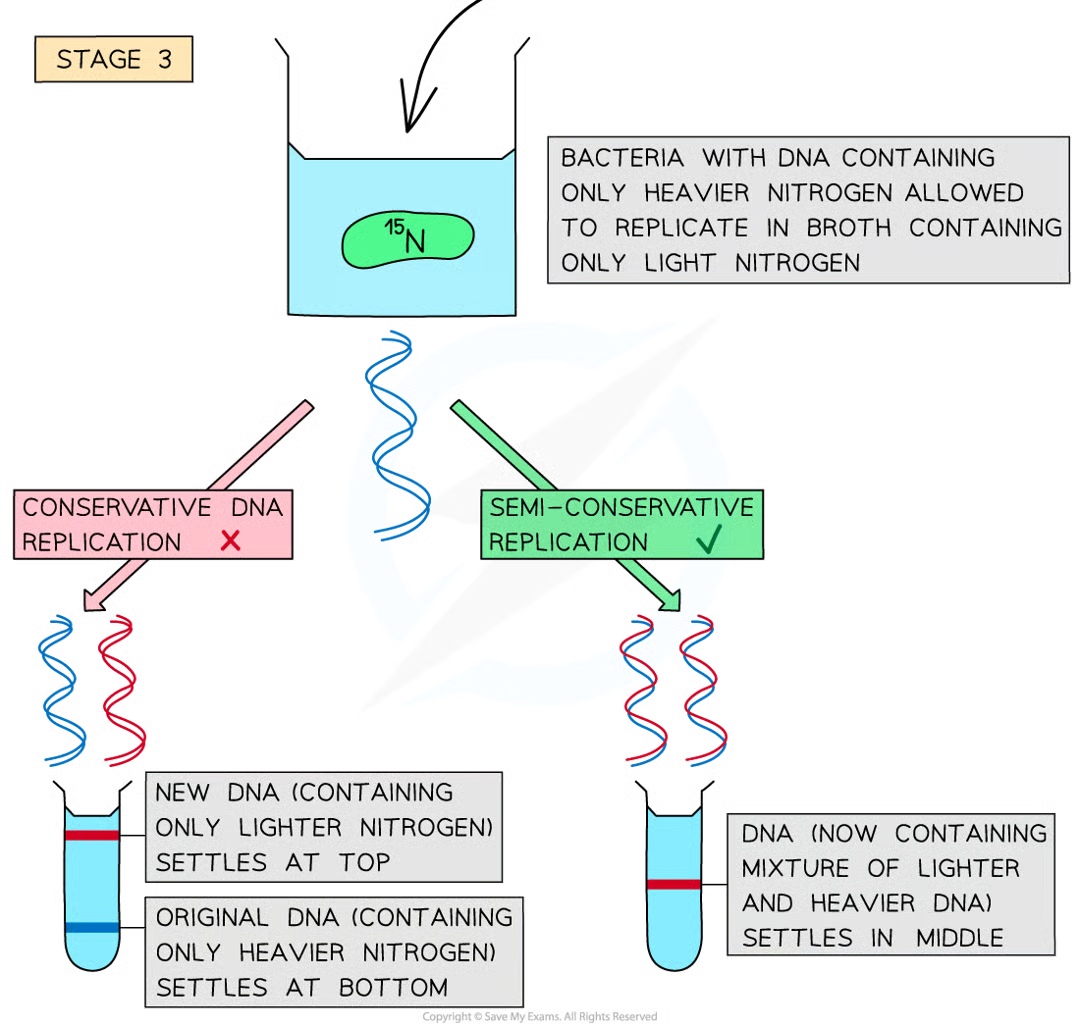
→ if DNA replication was conservative, the original template DNA molecules would only contain the heavier nitrogen and would settle at the bottom of the tube, whilst the new DNA molecules would only contain the lighter nitrogen and would settle at the top of the tube
→ However, DNA replication was semi-conservative, and all the DNA molecules contained both the heavy and light nitrogen. Therefore the DNA settled in the middle of the tube because one strand of each DNA molecule was from the original DNA (with heavy nitrogen) and the other strand was made using only lighter nitrogenThe bacteria were left to replicate several more times
→ After the second replication, two regions of DNA formed in the centrifuge: one containing a 50% light strand, and one containing a 50% mixed strand
What did Meselson and Stahl’s experiment show?
the bacterial DNA had undergone semi-conservative replication
→ the DNA from the second round of centrifugation settled in the middle of the tube, showing each DNA molecule contained a mixture of the heavier and lighter nitrogen isotopes