Herpetology Lab practical 2
 Call Kai
 Learn
 Practice Test
 Spaced Repetition
 Match
 Flashcards
 Knowt Play
1/129

There's no tags or description
Looks like no tags are added yet.
130 Terms
what means rock dwelling?
saxicolous
what means sand burrowing?
arenicolous
burrowing and grass swimming lizards tend to not have what?
limbs
what are some arboreal features?
toe pads with lamellae with microscopic setae, zygodactyly (two digits face forwards, two face backwards), prehensile tail

study this
ok

study this
ok
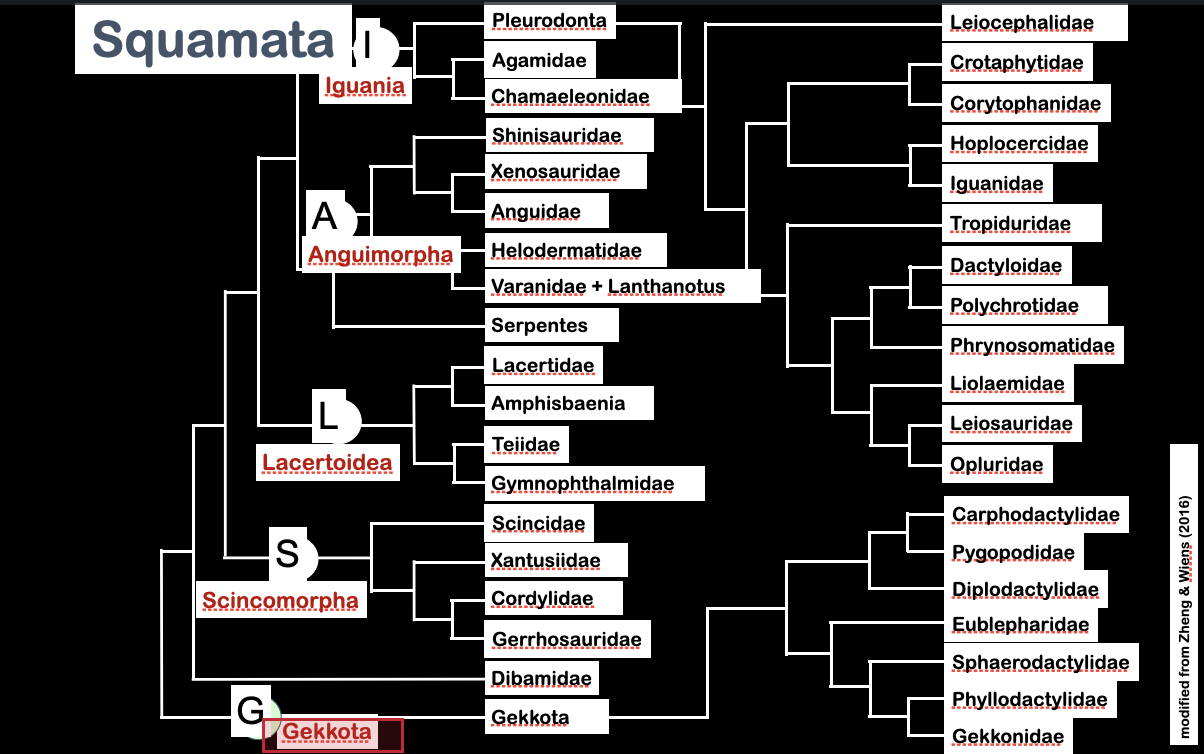
what has over 10000 species, includes lizards, amphisbaenids and snakes, have hemipenes, acrodont or pluerodont dentition, most oviparous, caudal autotomy, and tongue mediated chemoreception, and is located within lepidosauria?
squamata
study this
ok
what are the 5 sections of Squamata you need to know GILAS?
Gekkota, scincomorpha, lacertoidea, anguimorpha, iguania
what are characteristics of gekkota?
worldwide, smallish, toe pads common, most nocturnal, most oviparous with 1-2 eggs per clutch, tails easily autotomized, a few parthenogenetic

what family is this?
eublepharidae
what clade includes eublephardiae?
gekkota
what are the characteristics of eublepharidae?
36 species, nocturnal and terrestrial, no toe pads, only geckos with functional eyelids, subhumid to arid environments, somewhat pantropical
what member of eublephardiae do you have to remember (no specimen)?
Coleonyx brevis

what family and what is the scientific name?
Gekkonidae, Hemidactylus turcicus
what clade includes gekkonidae?
Gekkota
what are the characteristics of gekkonidae?
996 species, second largest lizard family, varied habitats and ecology, most have toepads, 10% use communal egg nests, worldwide

what family and what is the scientific name?
Scincidae, Plestiodon obsoletus

what family and what is the scientific name?
Scincidae, Plestiodon tetragrammus
what member of Scincidae do you have to remember (no specimen)?
Plestiodon multivirgatus
what clade includes skinks?
scincomorpha
what are the characteristics of scincidae?
1600 species, worldwide, most species rich family, highly variable body forms, diverse habitat, smooth shiny cycloid scales underlain by osteoderms

what is the family of this?
Xantusiidae
what clade includes Xantusiidae?
scincomorpha
what are the characteristics of xantusiidae?
34 species, flattish body and head, no moveable eyelids, gecko like appearance, secretive, nocturnal, relatively sedentary, can live up to 10 years, viviparous, some parts of central and north america

what is the family and scientific name?
Teiidae, Aspidoscelis gularis

what is the family and scientific name?
Teiidae, Aspidoscelis sexlineata

what is the family and scientific name?
Teiidae, Aspidoscelis tesselata
what is the member of teiidae you need to remember (no specimen)?
Aspidoscelis marmorata
what clade contains Teiidae?
Lacertoidea
what are the characteristics of teiidae?
146 species, central, south, and North America, active, diurnal, variable habitats, major in US deserts, can be large, oviarpous, parthenogenesis is common

what family and what is the scientific name?
Anguidae, Ophisaurus attenuatus
what clade includes anguidae?
anguimorpha
what are the characteristics of anguidae?
130 species, mostly terrestrial, mostly diurnal, most insectivorous, tail automizes easily, some viviparous, holarctic distribution, some limbless

what family is this?
varanidae
what clade includes varanidae?
Anguimorpha
what are the characteristics of varanidae?
74 species, active, diurnal, fast, large complex lungs, oviparous, some venomous, Africa, Southern Asia, Australia
what is the dentition of most new world iguanids?
pleurodont

what is the family and the scientific name?
Phrynosomatidae, Sceloporus olivaceus

what is the family and the scientific name?
Phrynosomatidae, Phrynosoma cornutum

what is the family and the scientific name?
Phrynosomatidae, Holbrookia maculata

what is the family and the scientific name?
Phrynosomatidae, Sceloporus consobrinus

what is the family and the scientific name?
Phrynosomatidae, Phrynosoma modestum

what is the family and the scientific name?
Phrynosomatidae, Cophosaurus texanus

what is the family and the scientific name?
Phrynosomatidae, Uta stansburiana
what is the member of Phrynosomatidae that you have to remember (no specimen)?
Sceloporus arenicolus
what clade includes Phrynosomatidae?
Iguania
what are the characteristics of phrynosomatidae?
148 species, diverse, North, Central, and South America, varied ecology, model organism for many research projects

what is the family and the scientific name?
Crotaphytidae, Crotaphytus collaris
what clade includes Crotaphytidae?
Iguania
what are the characteristics of Crotaphytidae?
12 species, arid-mesic habitats, flatlands to rocky habitats, major carnivores, no tail fracture, north and Central America

what family are these members in?
Iguanidae
what clade includes iguanidae?
iguania
what are the characteristics of iguanidae?
39 species, terrestrial, rock dwelling, or arboreal, mostly herbivorous, some central and south america
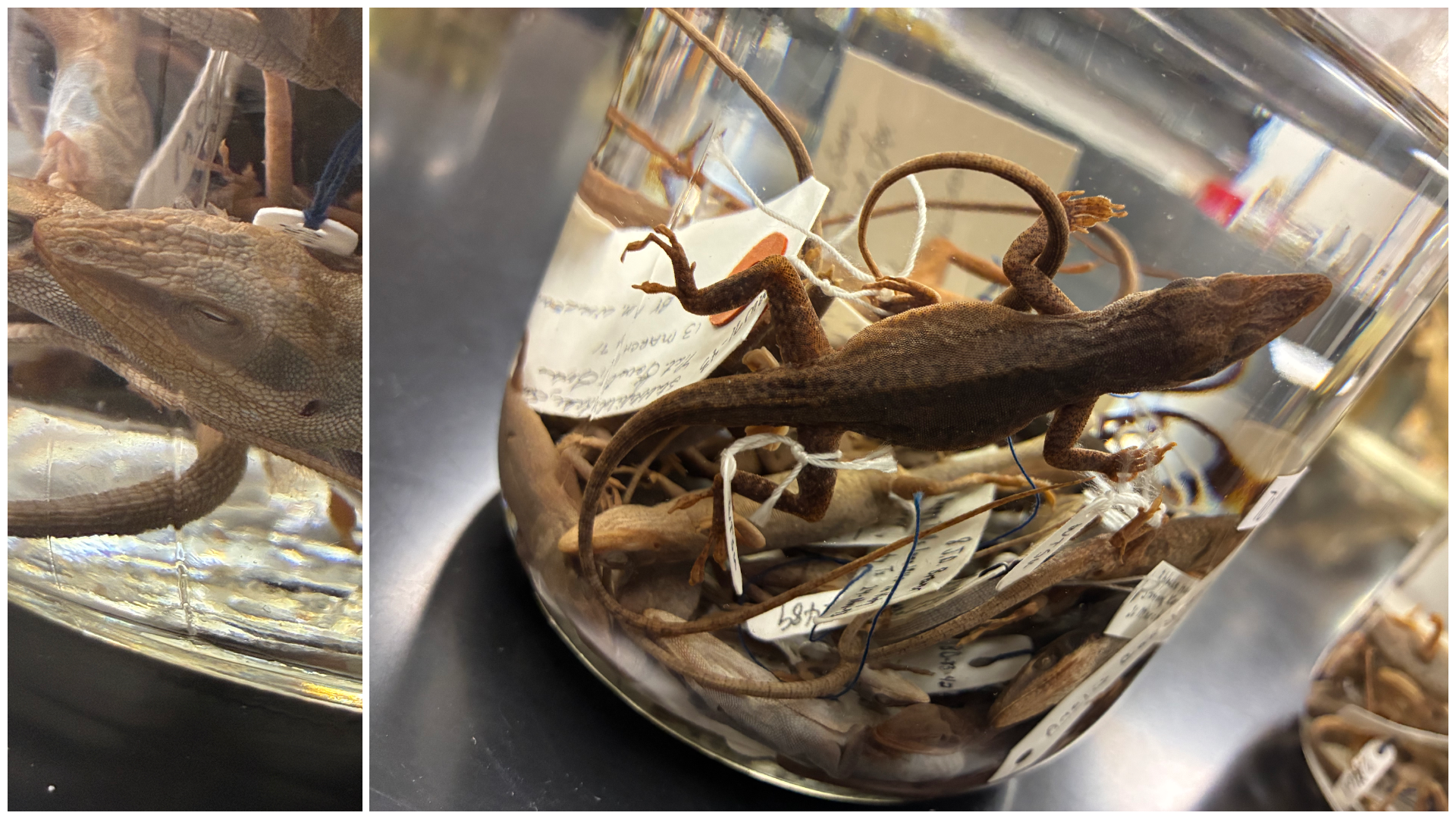
what is the family and the scientific name?
Dactyloidae, Anolis carolinensis

what is the family and the scientific name?
Dactyloidae, Anolis sagrei
what clade includes Dactyloidae?
Iguania
what are the characteristics of dactyloidae?
391 species, mostly arboreal, subdigital lamellae, brightly colored dewlaps, some central, north, and South America
what dentition do most old world iguanians have?
acrodont

what family is this?
Chamaeleonidae
what clade includes chamaeleonidae?
iguania
what are the characteristics of chamaeleonidae?
200 species, arboreal, most herbivorous, fused toes, prehensile tails, projectile tongues, eyes move independently, can change color, mostly Africa

what family includes these?
Agamidae

what family includes these?
Agamidae
what clade includes Agamidae?
Iguania
what are the characteristics of agamidae?
444 species, primarily terrestrial, diurnal, limb reduction rare, crests, frills, spines, includes Draco, most oviparous, Africa, Australia, and Southern Asia
what are the characteristics of snakes?
lack scleral ossicles, increased skull kinesis, tail breakage rare, oviparous or viviparous, females often larger than males, females with shorter tails, pleurodont dentition

study this
ok

what fang position is this?
aglyphous
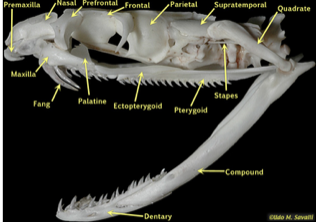
what fang position is this?
proteroglyphous

what fang position is this?
opisthoglyphous

what fang position is this?
solenoglyphous
what snakes families have evolved infrared vision?
boidae, pythonidae, viperidae
what adaptations do snakes have to swallow large meals?
quadrate bone not rigidly attached pivots allowing vertical and horizontal rotation, dentary attached by elastic ligament with each side moving independently, maxilla, pterygoid, and palatine walk food down throat

what is the family and scientific name?
Leptotyphlopidae, Rena dulcis
what clade is leptotyphlopidae in?
Scolecophidia
what are the characteristics of leptotyphlopidae?
117 species, immobile cranium and lower jaw, teeth only on denture, small, oviparous, may follow ant trails using chemoreception, smears cloacal secretions on body, used by screech owls as exterminators, somewhat worldwide
what is the scientific name of the leptotyphlopidae that we dont have?
Rena dissecta
what are the characteristics of Viperidae?
328 species, diverse ecology and habitats, worldwide, terrestrial and arboreal, solenoglyphs, small species and young mostly eat lizards, adults mostly eat mammals, includes pit vipers
what is the subfamily that pit vipers are in?
crotalinae
what are the characteristics of crotalinae?
complex pit organs, some have rattle, nearly all viviparous

what is the family and scientific name?
Viperidae, Agkistrodon contortrix

what is the family and scientific name?
Viperidae, Agkistrodon piscivorus

what is the family and scientific name?
Viperidae, Crotalus viridis

what is the family and scientific name?
Viperidae, Sistrurus tergeminus

what is the family and scientific name?
Viperidae, Crotalus atrox

what family are these included in?
viperidae
what clade is viperidae included in?
alethinophidia

what family are these in?
pythonidae
what are the characteristics of pythonidae?
40 species, similar to boidae, longest of all snakes, labial infrared receptors in pits, males with pelvis spurs, oviarpous, many create nests for eggs, some African, South Asia, Australia
what clade are pythonidae in?
alethinophidia

what family are these?
boidae
what are the characteristics of boidae?
59 species, heaviest snakes, many labial infrared sensitivity, many retain vestiges of pelvis, variable habitat, varied diet, most viviparous, some parthenogenetic, somewhat worldwide
what clade are boidae in?
alethinophidia

what family is this in?
elapidae

what family are these in?
elapidae
what are the characteristics of elapidae?
353 species, proteroglyphous, all venomous, varied ecology, may include sea snakes, oviparous or viviparous, worldwide
what clade are elapidae in?
alethinophidia
what are the characteristics of colubridae?
1800 species, worldwide, some venomous, seven subfamilies, highly variable, opisthoglyphous snakes can be dangerous

what is the family and scientific name?
Colubridae, Coluber constrictor