CPSC 253 Lecture 6: Hash Functions & Message Authentication
 Call Kai
 Learn
 Practice Test
 Spaced Repetition
 Match
 Flashcards
 Knowt Play
1/36

There's no tags or description
Looks like no tags are added yet.
37 Terms
Hash Function
In message authentication, this takes a variable-sized input message and produces a fixed-sized output
Output: hashcode/hash value/message digest
Creates efficient storage structures for associative arrays in the memory of a computer
Associative arrays are like phone directories with <name, identifier> pairs
Hashcodes in modern processing algorithms
In the MapReduce framework used in Hadoop, this function type is applied to the “keys’ related to the Map tasks in order to determine their bucket addresses, with each bucket constituting a Reduce task.
SHA-512(Secure Hash Algorithm)
Takes input messages of length up to 2128 bits and produces an output of a 512-bit message digest (MD)
A series of this algorithm type has been developed by the National Institute of Standards and Technology and published as Federal Information Processing Standards (FIPS).
Hashcode/Message digest
Fixed-size fingerprint (unique) of a variable sized message
Most commonly used hash functions range in length from 160(SHA-160) to 512(SHA-512) bits depending on the algorithm used to produce this.
Apache Project
Distributed computing of large data sets across a cluster of computers
Parallel computing

What is being depicted in this figure?
Symmetric encryption/decryption using the same key
Party B creates a new hash code after getting the message
The message and hash code are put together to make a composite message
Receiver decrypts message, seperates hashcode, and compares it to the recieved message’s hashcode
Guarantees message authentication(hashcode) and confidentiality(encryption)

What is being depicted in this figure?
Message Authentication Code(MAC)
The message is left unencrypted while the hash code is encrypted
Method to implement hashing
Useful when confidentiality is not a concern but message authentication is needed
Only the receiver with the key knows the real hash code, so they can verify the authenticity of the message.
Symmetric key

What is being depicted in this figure?
Used in digital signatures
Public key encryption
Sender encrypts Hash code of the message with their private key.
The receiver can get the hash code with the sender’s public key and authenticate that the message came from the intended sender.
Confidentiality isn’t important in this case
Message authentication is, though

What is being depicted in this figure
Guarantees message authentication and confidentiality
Symmetric-key confidentiality.

Shared secret: extra binary bits/secret string both sender and reciever know is appended to the message
No encryption
Authenticated message but no confidentiality because the message is unencrypted
For party B, the hashes must match
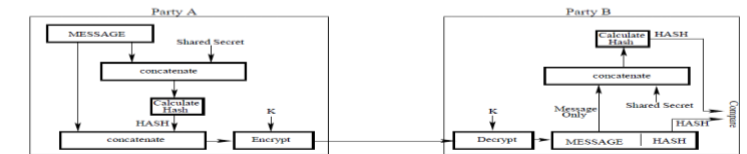
Message authentication and confidentiality are real
Symmetric key based confidentiality to the transmission between the sender and receiver.
What are the conditions for a secure hash function?
One-way property: computationally infeasible to find a message that corresponds to the given hashcode
Strong collision resistance: Computationally infeasible to find 2 different messages that hash to the same hashcode value. 1 to 1 mapping, otherwise you have a collision.
For a ___ there should not correspond another message with the same hashcode
given message
Weaker ver of strong collision resistance property
Birthday Attack
Possibility that another message has the same hashcode as your original message.
Collision resistence def on slide 19 is wrong
Authentication
Message has not been altered in anyway
Send unencrypted plaintext messages with encrypted hashcodes
Eliminates computational overhead for encryption/decryption in the main message and allows for authentication
Only works if hash function has perfect collision resistance
If it doesn’t an adversary could compute the hashcode of the message and replace it with a different message w/ the same hashcode value
How are messages processed when computing the hashcode?
Messages are sequences of n-bit blocks
Processed 1 block at a time in an iterative fashion to generate its hashcode
XOR hash algorithm
Start with 1st n-bit block
XOR it with the 2nd block bit by bit and use that result to do the same with the next one
Produces a longitudinal parity check(hashcode type)
Longitudinal parity check
Stored and fetched bits should be the same
Should add to 0 when XOR
Slide 31
25 + 423=448+64=512
How can you spot alterations of the input message?
Since message digests depend on every bit in the input message, any alteration during transmission would cause the new message/hash value not to match the original
Can be used to check for forgeries, unauthorized alterations, etc.

Why are these 2 hashcodes different?
There is an extra space in one of the messages.
Produces a 160 bit hashcode.
40 hex characters
How many distinct hashcode values can you have with n bits?
2n
This is prevent multiple messages having the same hashcode
In any given context there is some sort of upper bound on different types of possible messages
XOR hash algorithm weaknesses
Not good for message authentication
Adversary can modify the main message and add a suitable bit block before the hashcode so that the final hashcode remains unchanged.
XOR Hash Algorithm Strengths
Hashcode made can be used for data integrity checks in the presence of completely random transmissions errors.

What is this a representation of?
A hashcode produced by the XOR algorithm
{X1, X2, . . . , Xm}
The bit blocks of a message in a hashcode
∆(M)
Hashcode produced by an XOR algorithm. M is the message
M = {X1 || X2|| . . . || Xm}
Concatenated bit blocks
How could an adversary create a forgery from {M, ∆(M)}?
Replace X1 through Xm-1 with new bit blocks Y1 through Ym-1 given by the following equation


What is the hashcode for this function?
Due to the properties of the XOR operator, it will be the same as the original ∆(M)
So when the forged message is concatenated with ∆(M) the recipient won’t suspect any changes
What are some things that can increase the probability of collisions in the XOR algorithm?
Character encoding is based on ASCII or a variant
Causes the highest bit in every byte to be 0
As a result, some of the N bits in the hash code will be 0, reducing the number of unique hash code values
In an N-bit hashcode you want the probability of a hashcode value to be 1/2n

What is this table displaying?
Different characters and their Binary, Oct, decimal, hexadecimal values
Rotated-XOR algorithm
Performs a 1 bit circular shift of the partial hashcode obtained after each n-bit block is processed.
This increases the amount of distinct hashcode values available for different messages
Issues with Rotated XOR algorithm(ROXR)
The original message(M1) and its hashcode(h1) can be taken and replaced with new ones(M2 and h2)
Then you can append a block of gibberish at the end of the new message to force the hashcode of the composite to be the same as the original
Not good for authentication
How does the SHA-1 algorithm pad a message before hashing?
Goal is to make the message a multiple of 512 bits
With a message M with a length of L bits
Append 1 bit to the end of the message with K(zero bits) where K is the smallest non negative solution to:
(L+1+K) % 512 = 448
Then append the 64-bit block that’s a binary representation of the length integer L
For the message “abc” and length L = 24 bits what would the bit pattern look like?
