Tablet Coating
 Call Kai
 Learn
 Practice Test
 Spaced Repetition
 Match
 Flashcards
 Knowt Play
1/28

There's no tags or description
Looks like no tags are added yet.
29 Terms
What is tablet coating?
Applying an outer layer of coating materials to the surface of dosage form (tablets, powders, granules, capsules) to achieve a specific purpose i.e. improve appearance, protect drug, improve patient acceptability or modify drug release
Coating can be applied to:
Tablets
Granules
Capsules
Powders
Why coat tablets?
Protect drug from environmental degradation
Mask unpleasant taste
Prevent potential interaction between incompatible components
Enable ease of handling
Improve ease of swallowing
Improve product appearance
Improve product identification
Increase product resistance to damage during handling
Impart modified-release properties
Types of tablet coating
Sugar coating
Film coating
Compression coating
What is film coating?
Deposition of polymer-based liquid on the dosage form to form a thin film of coating
Can be used for tablets, capsules, powders and granules
Coating material comprises:
Polymer
Plasticizer
Colourant
Solvent
Advantages of film coating
Can be used for other dosage forms apart from tablets
Minimal weight increase due to coating materials, about 2-3%
Single stage process
Reduced processing time about 1.5 – 2 hours
Formulation flexibility – can be easily adapted for modified or controlled release
Coating allows branding and easy identification of product
Can improve taste and odour masking
Can improve appearance and swallowing
Can protect tablets from moisture, light and oxygen
Disadvantages of film coating
Retains contour of core dosage form
Use of volatile organic solvents which are:
Flammable
Toxic
Environmental pollutants
These have now been replaced with less volatile solvents and water
Coating materials can be expensive
Requires specialised coating equipment
Coating defects can occur if process conditions aren’t controlled
Water-based coatings may affect moisture-sensitive drugs
Film coating process
Spray coating liquid onto dosage form
Dry dosage form
Film coating adheres
Wet atomised droplets of coating liquid sprayed onto dosage form
Solvent evaporated and liquified droplets shrink on the surface of dosage form
Droplets coalesce into a thin solid film
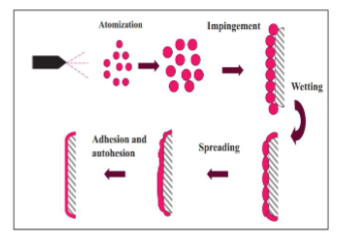
Film coating formation
For film coating to form:
Coating formulation must progress from discrete particles to continuous film
Importance of Glass transition temperature (Tg)
Polymers and plasticizers have to undergo glass transition for film coating to form
High Tg means more rigidity and brittleness
Impact on physical state of API
Tg of polymer should be a lot lower than melting point of API and all excipients in tablet being coated
Low Tg allows film coating to be more readily formed
Types of film coating - immediate-release film coating
Coating doesn’t affect drug release form final dosage form
Coating is readily soluble in gastric fluid
Immediate-release aesthetic film coating - improves product appearance
Immediate-release barrier film coating:
Maintains product stability against environmental degradation
Provide taste masking, particularly important in paediatric dosage forms
Types of film coating - modified-release film coating
Gastro-resistant coating
Coating is only soluble at pH above 5-6
Prevents drug release in the stomach
Extended-release coating
Coating are mostly insoluble in water
Allows release of drug from dosage form to occur over a prolonged duration
Film coating formulation
Film-coating formulation contains:
Polymer
Plasticizer
Colourants
These are the solid contents which make up to 5%-35%
Solvent - main component, removed by drying
Process equipment:
Conventional pan coating
Contemporary side-vented pan coating
Fluidised bed coating
What is the polymer?
Main solid content - 60%-70% of solid content
Polymer properties that affect coating process and film coating quality:
Solubility
Viscosity
Permeability
Mechanical properties
Polymer properties - solubility
Determines solubility of film-coating formed
Affects biopharmaceutics of dosage form

Polymer properties - viscosity
Determines ease of film coating application
Transfer and atomisation of coating liquid
Quality of film coating formed

Polymer properties - permeability
Determines resistance to external environment
Other components in coating formulation
IR barrier film coatings:
Taste masking
Stability against moisture and other environmental factors
MR film coatings:
Gastro-resistant formulations
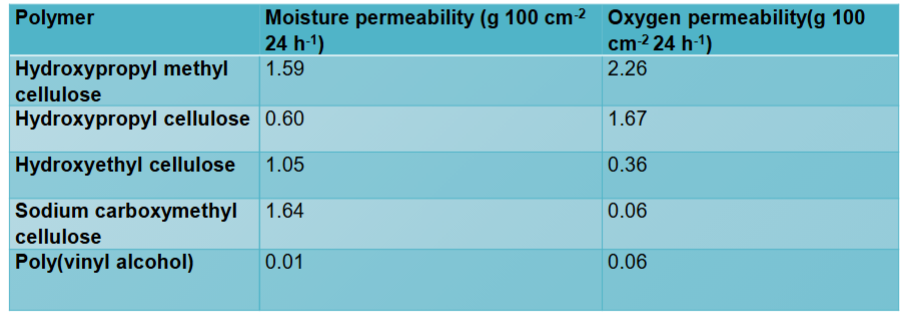
Polymer properties - mechanical properties
Determines quality of film coating formed
Film strength - resistant to mechanical stress
Film flexibility - resistance to cracking
Film adhesion - ensures integrity of film coating
Table showing examples of IR film coating polymers and why they’re used (1)
Solubility in aqueous medium
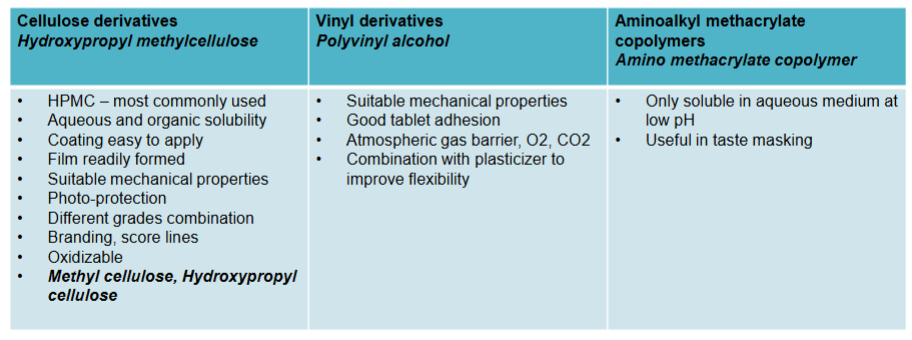
Table showing examples of MR film coating polymers and why they’re used (2)
Limited or no aqueous solubility

What is a plasticizer? - requirements, mechanisms and examples
6 – 7% of solid content
Impart flexibility on coating
Reduces tendency for film coat to crack
Improves film coat adhesion to substrate
Plasticizer requirements:
Compatible with polymer
Soluble in solvent system being used for polymer
Retained in film after formation
Mechanism:
Plasticizers penetrate into the polymer mass
Separate polymer chains
Reduce polymer-polymer contact
Reduce rigidity
Increase ductility
Examples: glycerin, polyethylene glycols, propylene glycol, citrate esters – triethyl citrate, phthalate esters
What is a colourant?
15%-30% of solid content
Improve product appearance
Aid product identification
Improve stability of coated products
Pigments - water insoluble
They:
Reduce permeability to moisture
Chemically stable towards light
Increase stability to moisture and light sensitive APIs
Increase solid content but not viscosity – ease of application and drying
Careful consideration in colour selection
Patient acceptance
Examples: iron oxide, titanium dioxide, aluminium lakes
What is a solvent? - advantages, disadvantages and examples
Dissolve or disperse coating materials
Organic solvents
Advantage:
Rapid drying times
Disadvantages:
Operator safety
Environmental hazard
Solvent residues
Cost
Aqueous coating formulations:
Water
Aqueous polymer dispersions - suspensions and lattices
When is use of solvent limited?
Coating process will not accommodate the use of water e.g. due to poor drying
Unacceptable adhesion with the use of water
Product being coated will have stability issues with water introduced
Polymer being used is water insoluble
Examples of organic solvents used:
Methanol
Dichloromethane
Acetone
Ideal properties of film coated tablets
Even coverage and colour of coating on surface of dosage form
Void of defects
Product appearance
Product functionality or stability
Compliant with compendial requirements of finished dosage form
What is sugar coating?
Applying multiple layers of sugar-based materials to the surface of a tablet
The coating is built up through several stages until the tablet has a smooth, often glossy finish
Conventional pan coating technology
Coating materials are readily soluble in water
Rapidly disintegrate in water
Immediate release of drug product
Modified-release – if MR polymer applied to coated tablet during sealing
Advantages of sugar coating
Improves product appearance
Taste masking
Ease of swallowing
Can protect drug from environmental factors
Disadvantages of sugar coating
Significant increase in tablet weight 50% -100%
Multi-stage process
Longer drying times
Less applicable to functional coating
Limited to the coating of tablets
Branding
What is compression coating (press coating)?
Involves surrounding an already formed tablet core with a layer of dry powder, which is then compressed around the core to form an outer layer
It does not require a liquid coating solution
Process done on same tabletting machine
Used to separate incompatible materials
Inert layer introduced to maintain product stability

Advantages of compression coating
Avoids exposure to water or organic solvents
Suitable for moisture-sensitive or solvent-sensitive drugs
Can separate incompatible ingredients
Can be used to produce delayed-release formulations
Disadvantages of compression coating
Requires specialised equipment
More complex than conventional tablet compression
Can increase tablet size
Requires accurate positioning of the tablet core