SA solid tumour 2 - oral & mammary tumours
 Call Kai
 Learn
 Practice Test
 Spaced Repetition
 Match
 Flashcards
 Knowt Play
1/50

There's no tags or description
Looks like no tags are added yet.
51 Terms
List the clinical signs of an oral tumour
(tumour more common in dogs cf to cats)
Mass / facial swelling
Oral bleeding
Dysphagia / pain
Halitosis
Epistaxis
Loose teeth / proliferative lesions noted @ dentals (always biopsy)
Cervical lymphadenopathy
What are the three most common oral tumours in a dog?
Malignant melanoma
SCC
Fibrosarcoma
(acanthomatous ameloblastoma most common benign)
(In order of frequency^)
How do you diagnose an oral tumour?
Assess under GA
Biopsy (incisional wedge)/ (FNA)
How can you stage an oral tumour?
Visual assessment usually underestimates quantity of 1° tumours as locally invasive
Rads = insensitive so use advanced imaging —> CT
Why should you assess in the LNs in a tumour case? How should you assess the LNs for metastatic tumours?
Palpable normal LN can contain tumour esp melanoma
Enlarged LN are not alwyas metastatic
For all metastatic tumours
FNA submandibular nodes
Image retropharyngeal nodes & sample if poss
If CT available consider lymphangiography
How do you assess for metastases?
Likelihood of distant metastases depends on tumour type
Rads —> 2 laterals & 1 DV (inflated)
+ Abd imaging for melanoma
(CT has greater sensitivity)
What is the tx of choice for an oral tumour?
Surgery
Maxillectomy / mandibulectomy
Margins dictated by histology
(For FSA & SCC follow w/ adjuvant radiotherapy for better results)
Palliative radiotherapy alone when surgical excision not poss
What margins do you use for
Acanthamous ameloblastoma
Squamous cell carcinoma
Fibrosarcoma
Acanthamous ameloblastoma = 1cm+
Squamous cell carcinoma = 2cm+
Fibrosarcoma = 3-5cm+
What are the complications of oral surgery for the treatment of oral tumours?
Recurrence
Dogs generally adapt very well, cat more variable (may need feeding tube)
Bleeding
Infection
Altered cosmetic appearance
Difficulty prehending food / messy eating
Salivation
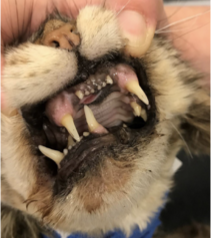
Mandibular drift esp in cats (see below)
due to lack of structural support
What dogs are more likely to get oral melanoma?
Generally smaller dog
Older (mean 11.4yo)
Golden retriever, cocker spaniel, min poodle, chow chow predisp
What are the features of an oral melanoma?
Very locally invasive
Highly metastatic (check both submand LNs, regardless of location in mouth)
How is melanoma diagnosed? What are some prognostic indicators?
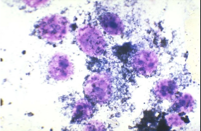
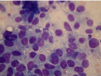
Based upon melanin containing mesenchymal cells
Some tumours do not contain melanin
IHC required for diag
Mitotic index useful for predicting outcome
Size & stage significant for survival
<2cm + no metastasis = longer survival time than >2cm or LN metastasis
How is an oral melanoma treated?
Surgery —> ass. w/ high rates of recurrence
Radiation therapy —> as primary or adjunctive therapy
What can be used as antimetastatic treatment for oral melanoma?
(chemo does not meaningfully extend survival)
Plasmid vaccine immunotherapy —> use in stage II & III dx
targets melano-protein —> tyrosinase
stimulates immune response that affects canine tyrosinase expressing cells —> melanocyts
Probably only helps minority but only minor local side effects (£££)
Does SCC have a higher or lower metastatic rate cf to melanoma?
Lower (but note tonsillar SCC has a >70% metastatic rate)
How do you treat oral SCC?
Local control = mainstay
Surgery
Radiotherapy
Medical therapy (when other therapies aren't possible)
Piroxicam
Piroxicam + Carboplatin
Meloxicam often used
What is the clinical presentation of a tonsillar SCC?
Dysphagia, coughing
Enlarged cervical LNs —> abcessation
Enlargement of 1 or both tonsils on clin exam
high metastatic rate
How is a tonsillar SCC treated?
Local control of tonsillar enlargement —> surgery or radiotherapy
Surgery or radiotherapy for LN metastasis
Carboplatin / mitoxantrone chemotherapy might be beneficial
What is the prognosis for tonsillar SCC?
Median survival time = 7 months
patients that receive most therapy live longest
control of local / regional dx most imporant
What are the features of an oral fibrosarcoma?
Large breed dogs especially Golden Ret & Labrador
Middle age dog —> median age approx 7.5yrs
Invasive
Low / moderate metastatic risk —> lung & occ. LNs

How do you treat a fibrosarcoma?
Local control = mainstay but challening
Surgery (most important) but relatively high recurrence rate
Additional radiotherapy often best
multimodal i.e. surgery + radiotherpy = higher median survival time & lower recurrence rate
Size = prognostic indicator
smaller tumours = better outcomes
How do histologically low-grade, biologically high-grade fibrosarcoma present?
Often cd maxilla
Aggressive, rapidly progressing oral tumour w/ benign histological appearance even after large biopsy
Very locally invasive
aggressive local management w/ surgery & radiotherapy tx
What are the features of epulides? Give some examples and their differences
Non-metastatic lesions arising from gingiva
Acanthomatous ameloblastoma (most common)
Agressive local behaviour & bone invasion
Peripheral ondotogenic fibroma
Slow growing, firm masses, usually non invasive
What are the features of canine oral osteosarcoma?
Aggressive
Not as rapidly metastatic as appendicular
Site & histological grade prognostic
survival —> mandib > maxill
maxil = die of recurrence
mandib = die of metastases
local recurrence high so complete excision vital
palliative radiotherapy if unresectable
List the uncommon oral tumours of the dog
Extramedullary oral plasmacytoma
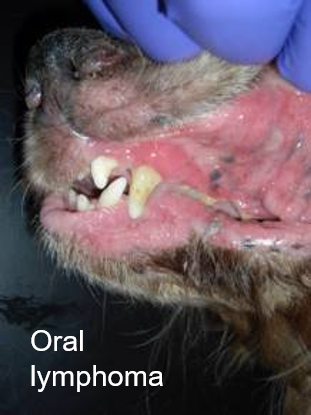
Oral lymphoma —> form of epitheliotrophic
requires multiagent chemo
Undifferentiated tumour of young dogs
rare —> grave prog

What is the most common feline oral tumour?
SCC
What incr the risk of feline oral SCC?
use of flea collars
exposure to smoking
canned food including canned tuna.
How do feline oral squamous SCC present?
Anorexia due to discomfort
Locally invasive
Low metastatic risk
Higher metastatic risk in cd positioned lesions
Anywhere in mouth but predilection base of tongue
bone invasive
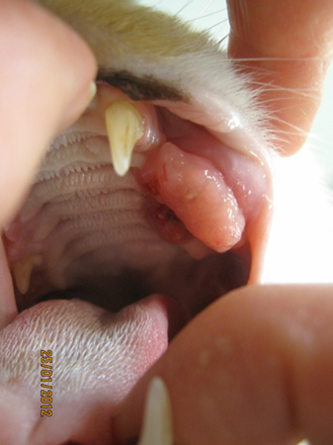
How does the outcome in feline oral squamous cell carcinoma differ?
Cats w/ surgically resectable dx can have good outcome but recurrence common
Best outcome in rostral mandib SCC
Soft tissue lesions affecting tongue have poor prog as resections difficult
How do you treat a feline oral SCC?
Surgery (depending on position)
Long term feeding tube often needed for several months
Radiotherapy occ helpful
What are the features of feline fibrosarcoma?
Middle aged or older
Very locally invasive
Tx = surgery
good outcomes poss w/ mandibulectomy; maxillaectomy more difficult

What oral lesion is being shown in this CT?
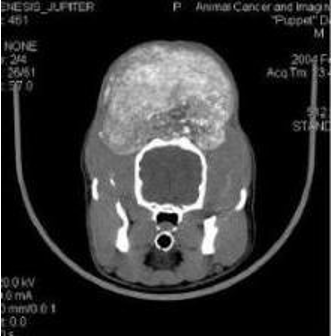
Multilobular osteochondrosarcoma —> dogs
Popcorn appearance radiographically
Usually a local problem
Resectability & grade predict survival
What oral lesion if being shown here?
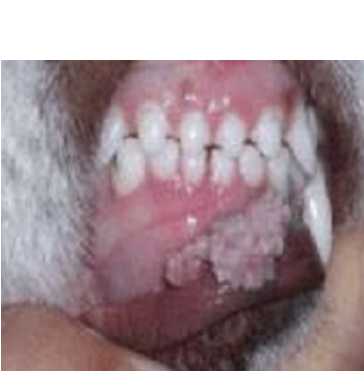
Viral papillomatosis —> dogs
Wart like lesions affecting oral soft tissues
Usually resolve in 4-8 wks
Occasionally persist in immunosuppressed animals
What breeds do eosinophilic granulomas affect?
Husky & CKCS
How is eosinophilic granuloma managed / treated in dogs
Surgery & corticosteroids
Where do eosinophilic granulomas usually affect dogs vs cats?
Dogs —> ventral & lateral aspect of tongue
Cats —> typically errosive lesions affecting upper lip near midline
What are the features of transmissible venereal tumours in dogs?
Prolif lesion affecting dogs who have been licking places they shouldn’t while on holiday in southern europe
Spontaneous regression & v. responsive to vincristine
What are the risk factors of mammary tumours?
Hormone exposure
(Balance early neutering risk against risk of urinary incontinence)
progestin, oestrogen use can incr risk
Obesity —> can incr oestrogen levels
being underweight @ puberty = reduced risk
Age —> older cats & dogs
usually always malig in cats
Breed
Poodles, Chihuahua, dachshund, Maltese, cocker spaniel and Yorkshire Terrier
Siamese cats
How do you diagnose a mammary tumour?
Palpation
clinical exam —> tumours >3cm have poorer outcome
fixed tumours
palpably enlarged LNs
Excisional biopsy by single or segmental masectomy
FNA can be used to exclude other ddx (e.g.- mastitis, lipoma or mast cell tumour, hyperplasia) not for diagnosis

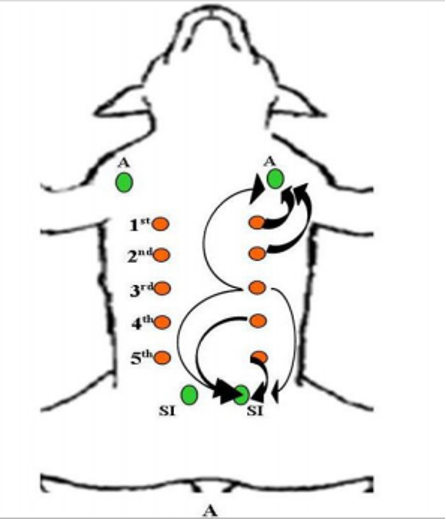
How can you locally stage a canine mammary tumour?
Assess local LN & typical drainage patterns:
1 and 2 will go to axilla
4,5 and sometimes 3 will go to inguinal node
How are mammary tumours distantly staged?
Thoracic rads / CT
Abdo U/S —> visceral metastases
can also metastasise to bone —> consider bone pain
How do we treat canine mammary tumours?
Low risk —> single masectomy
High risk —> consider regional masectomy
Intact bitches —> consider unilateral chain masectomy due to recurrence risk
What are the excision margine for canine mammary tumour margins?
Mobile lesions —> whole gland removal
Fixed lesions —> 2cm margine & removal of affected abdo fascia / wall
if neutering do this first if poss
List the post surgical prognostic factors of a mammary tumour
Tumour type
Malignancy
Less tissue heterogeneity ass. w/ poorer outcome
Sarcoma (esp osteosarcoma) poorer than carcinoma
Mitotic rate /Ki-67
Grade
Hormone receptor expression —> lack of expression correlate w/ poorer outcome
What are the features of a canine inflammatory carcinoma?
Extremely painful
Easily mistaken for mastitis
Generally all glands affected
FNA = inflam cells & tumour cells
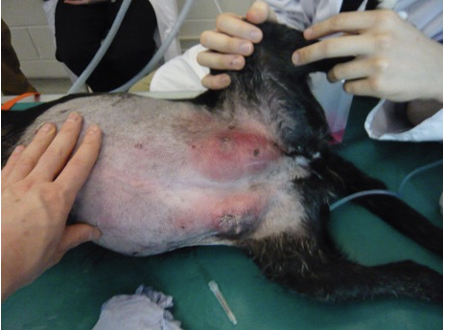
What is the prognosis of Canine inflammatory carcinoma
Very poor
Excision not typically feasible —> recurrence v. common
Palliative tx
Medical therapy might prolong survival for a few months
What is the big difference between canine and feline mammary tumours?
85-95% feline mammary tumours are malignant (cf to 50ish% in dog)
What is a significant differential for feline mammary tumours?
fibroepithelial hyperplasia (usually all glands are enlarged)
What are the clinical prognostic facotrs for feline mammary tumours?
Size
>2cm = significantly less survival time than <2cm
LN metastasis
lymphatic drainage less predictable than dogs
assess inguinal & axillary nodes bilaterally
Distant metastasis
Breed
DSH = better outcome
How are feline mammary tumours treated?
Chaine masectomy preferred to single / regional masectomy
Surgical resect inguinal and/or axillary LNs for high risk tumours
Should you perform an ovarihysterectomy @ time of mammary tumour excision?
Dog —> for benign tumours beneficial
Less clear for carcinoma
Benefit in cats has not been evaluated