MMA132: 4 Romanticism and Neo-Classicism in France
0.0(0)
Studied by 5 people Call Kai
 Learn
 Practice Test
 Spaced Repetition
 Match
 Flashcards
 Knowt Play
Card Sorting
1/104

Earn XP
Description and Tags
Last updated 5:17 AM on 3/15/23
Name | Mastery | Learn | Test | Matching | Spaced | Call with Kai | Chat |
|---|
No analytics yet
Send a link to your students to track their progress
105 Terms
1
New cards
was a widespread and influential movement in painting and the other visual arts that began in the 1760s, reached its height in the 1780s and ’90s, and lasted until the 1840s and ’50s.
Neoclassicism
2
New cards
In painting it generally took the form of an _____, using archaeologically correct settings and costumes.
emphasis on austere linear design in the depiction of classical themes and subject matter
3
New cards
attitude or intellectual orientation that characterized many works of literature, painting, music, architecture, criticism, and historiography in Western civilization over a period from the late 18th to the mid-19th century.
Romanticism
4
New cards
Romanticism can be seen as a ___ and late 18th-century Neoclassicism in particular. It was also to some extent a reaction against the Enlightenment and against 18th-century rationalism and physical materialism in general. _____
* rejection of the precepts of order, calm, harmony, balance, idealization, and rationality that typified Classicism in general
* Romanticism emphasized the individual, the subjective, the irrational, the imaginative, the personal, the spontaneous, the emotional, the visionary, and the transcendental
* Romanticism emphasized the individual, the subjective, the irrational, the imaginative, the personal, the spontaneous, the emotional, the visionary, and the transcendental
5
New cards
How Romantic art got its name? The word ____ had multiple meanings during its long history, but in the context of art, it’s a _____ that was prevalent at the dawn of the 19th century.
* “romance”
* reference to strong emotions associated with an art style
* reference to strong emotions associated with an art style
6
New cards
a period that glorified rational thinking, secularism and scientific progress.
Age of Enlightenment
7
New cards
The first operational steam engine, built in 1712, could be regarded as the beginning of the Industrial Revolution which later swept the Western hemisphere. Steam engines and cotton mills symbolized that Industrial Revolution. Industrialization transformed economies of Western Europe and North America, driving them from dependence on agriculture to manufacturing. However, at the turn of the 19th century, ___. Their reaction against the ongoing industrialization became a comprehensive movement – Romanticism. _____
* not everyone believed that science and reason could possibly explain everything.
* They looked beyond reason, and sought inspiration in intuition and imagination. Being emotionally engaged was the ultimate aim of their artwork
* They looked beyond reason, and sought inspiration in intuition and imagination. Being emotionally engaged was the ultimate aim of their artwork
8
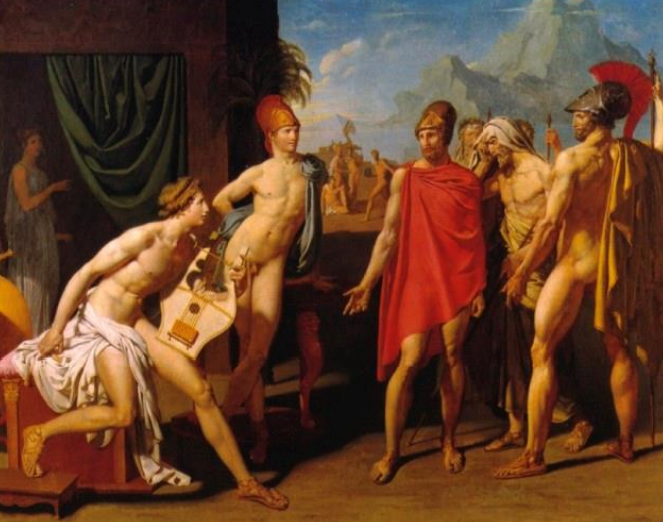
New cards
Began in Germany and England
Romanticism
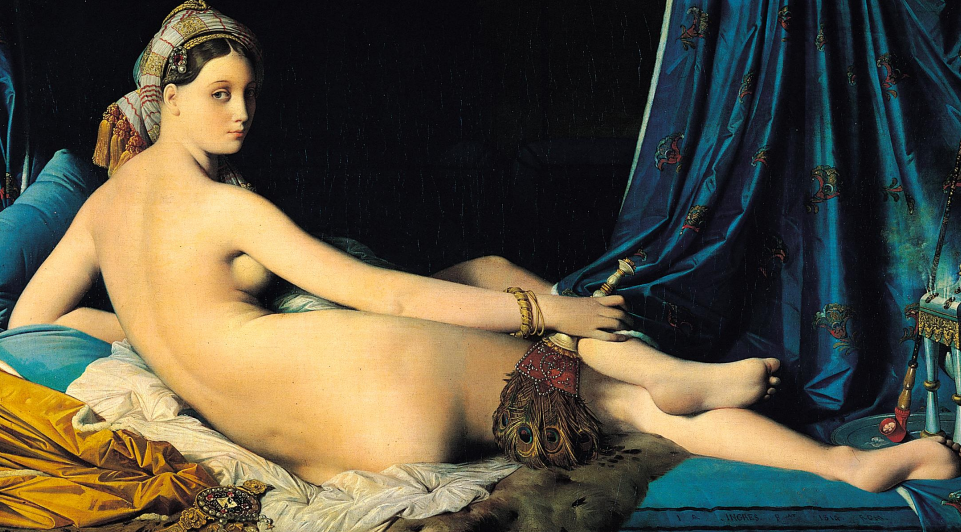
9
New cards
Entered Europe in 19th century
Romanticism
10
New cards
Deeply connected with politics and was the voice of changes that Europe went through
Romanticism
11
New cards
was a movement that began as a reaction to the constraints of Neoclassicism.
Romanticism
12
New cards
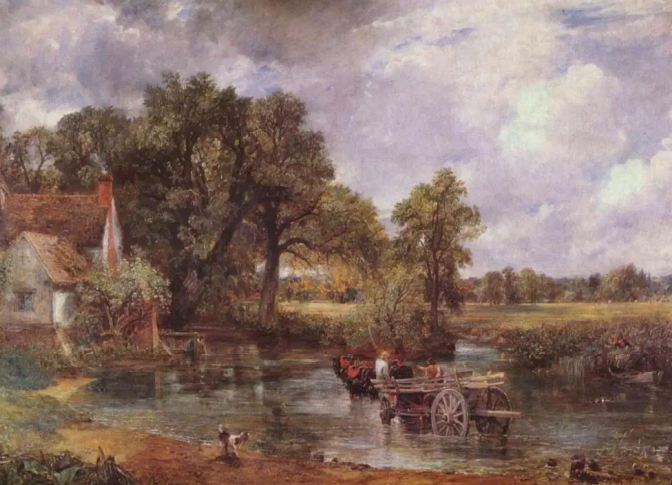
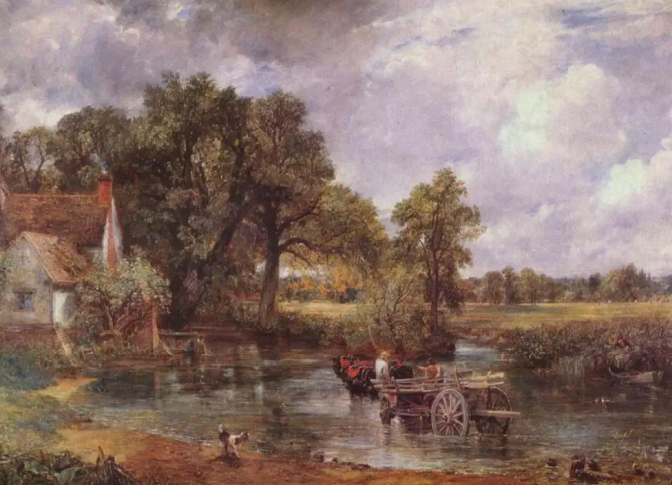
It swept across Europe and helped to inspire many nationalist movement.
Romanticism
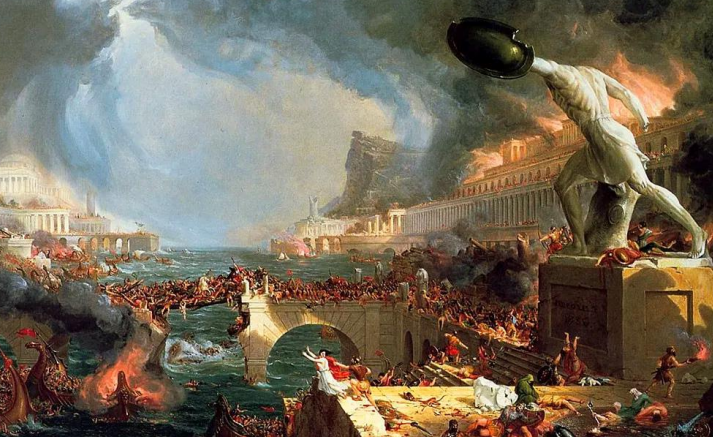
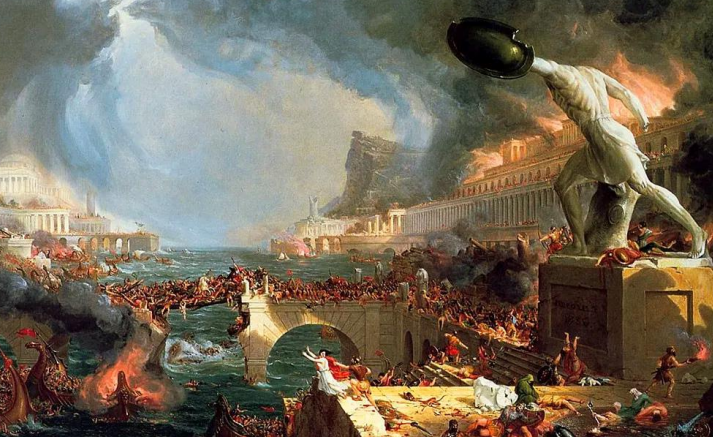
13
New cards
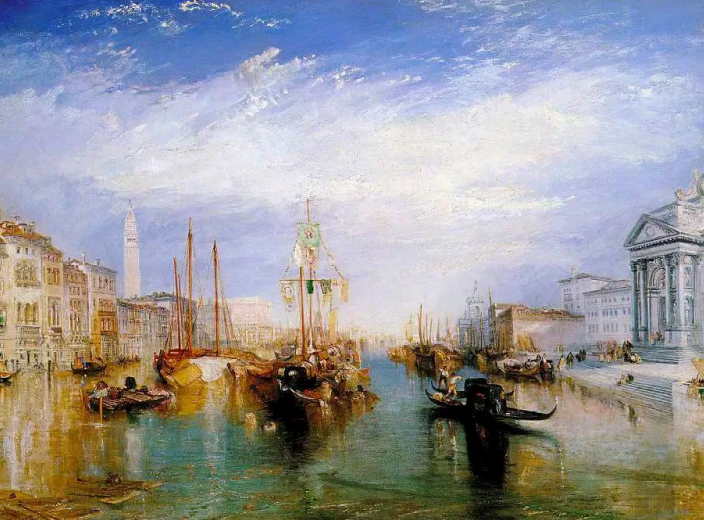
The artwork of ROMANTICISM is not linked by common artistic style but rather by the following characteristics:
* A desire to express personal emotions
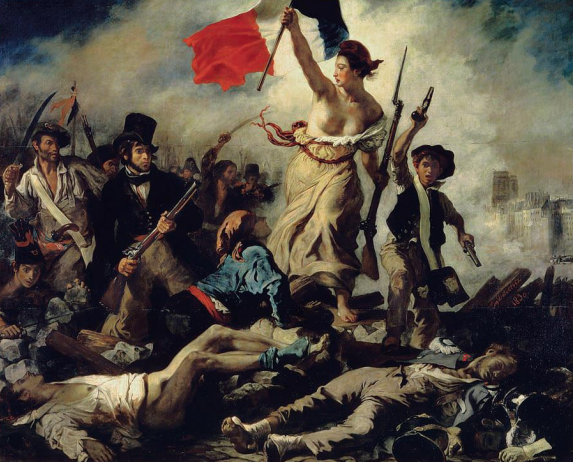
* A link to the ideas of Rousseau who rejected reason in favor of intuition
* A renewed link to the mysteries of religion and faith
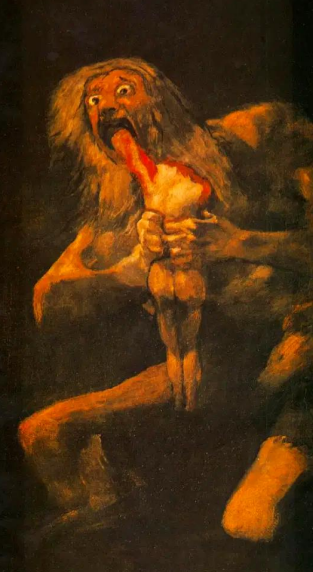
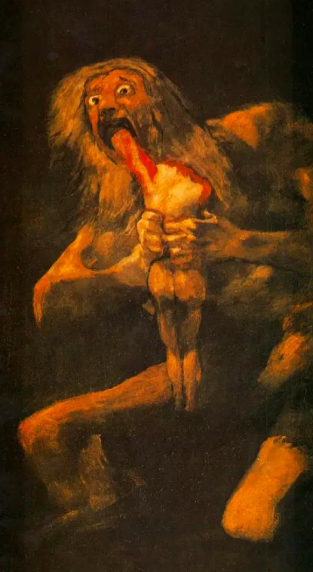
* Inspiration taken from medieval art, literature and the beauty of nature, including:
* Heroes and miraculous events of the Middle ages, especially of the Gothic period.
* Natural phenomena such as raging rivers, storms and misty mountains
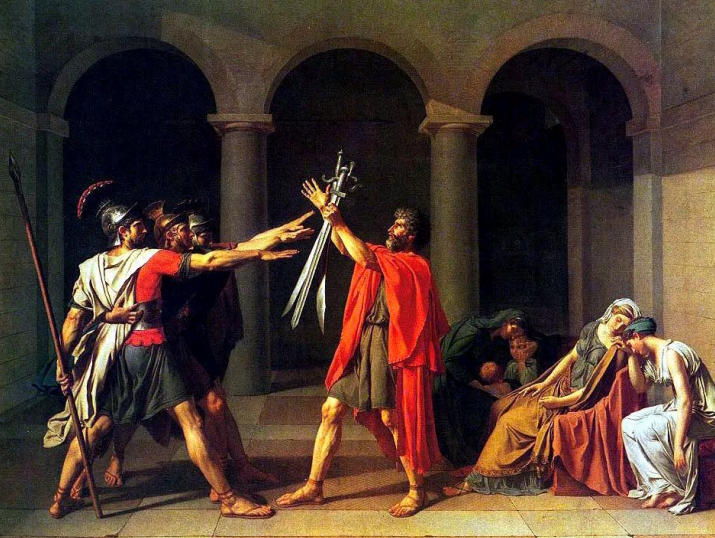
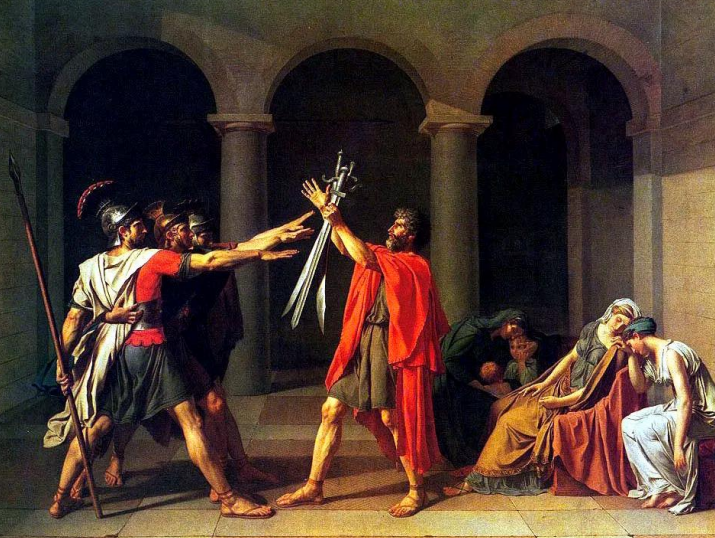
14
New cards
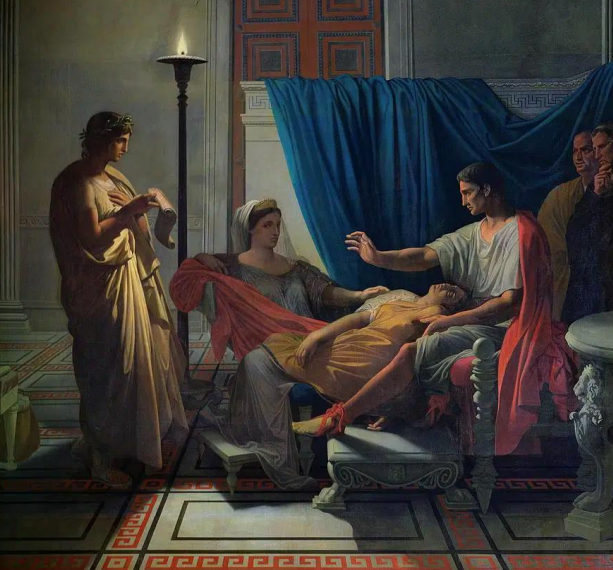
Themes depicted in Romantic Art
Far off lands
The distant past
Dreams
Night and moonlight
Rivers, lakes and forests
Nature and the seasons
The joy and pain of love
Fairy tales
The supernatural
Magic
The distant past
Dreams
Night and moonlight
Rivers, lakes and forests
Nature and the seasons
The joy and pain of love
Fairy tales
The supernatural
Magic
15
New cards
The leading figures in 19th century French art were:
* Jean Auguste Dominique Ingres
* Eugene Delacroix
* Eugene Delacroix
16
New cards
The champion of color
Eugene Delacroix
17
New cards
The champion of line
Jean Auguste Dominique Ingres
18
New cards
</>
Each represented the rival schools of Neoclassicism and Romanticism, as seen in this 19th century caricature depicting the two artists jousting in front of the Institut de France
19
New cards
A pupil of Jacques Louis David and was the leading exponent of Neoclassicism, and was renowned as the champion of crisp line and contour, as indicated by the fine tipped pen that he wields as his weapon
Jean Auguste Dominique Ingres
20
New cards
was the leading representative of Romanticism, and was known for his bravura use of color and painterly effects, indicated by the paint brush that he carries as his weapon
Eugene Delacroix
21
New cards
</>
The rivalry between these two giants of the 19 th century Academy replayed the 17th century academic debate between the Poussinistes (who favored drawing and design) and the Rubenistes (who favored color)
22
New cards
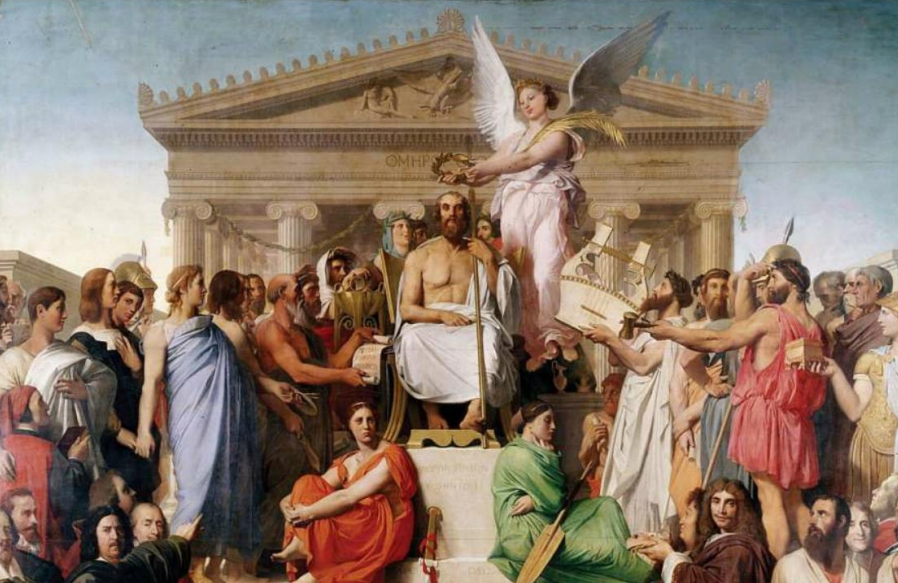
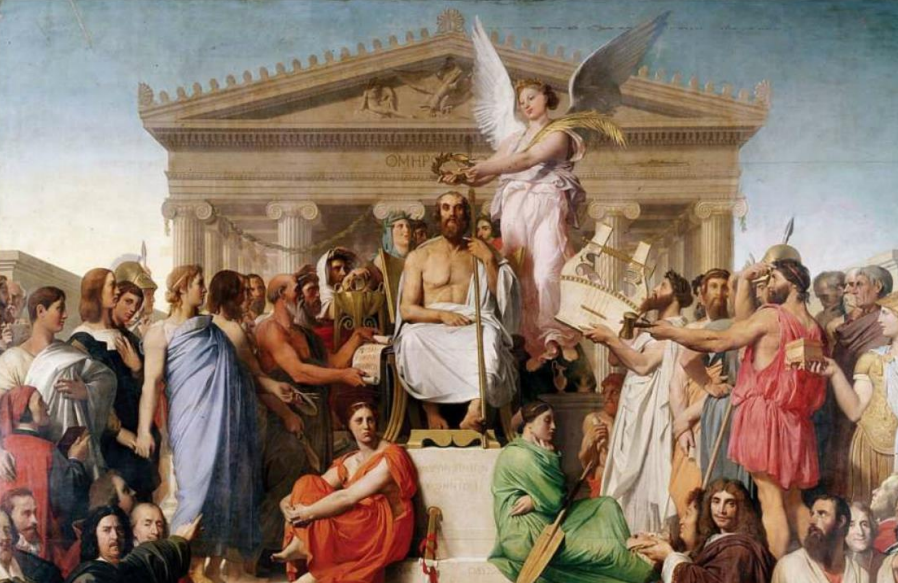
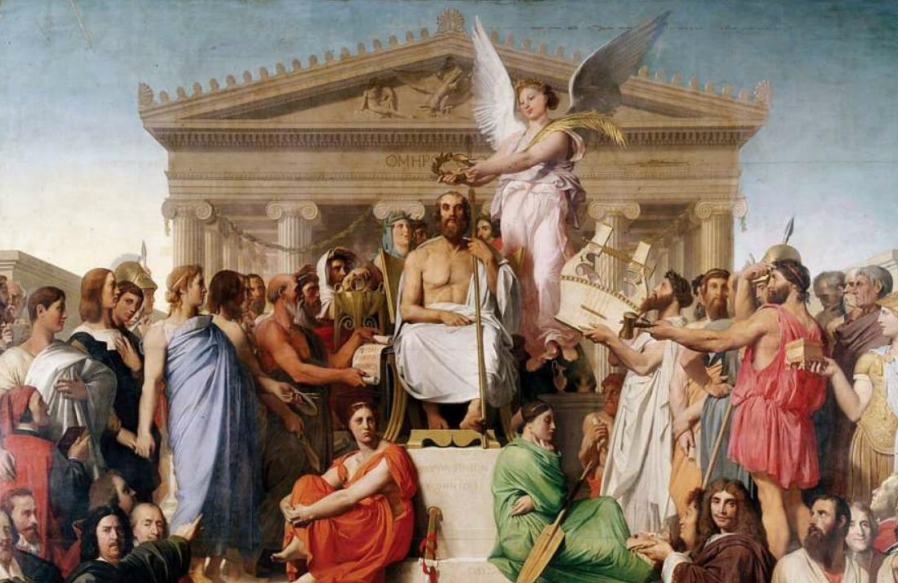
Identify the picture
**Apotheosis of Homer** by Jean Auguste Dominique Ingres
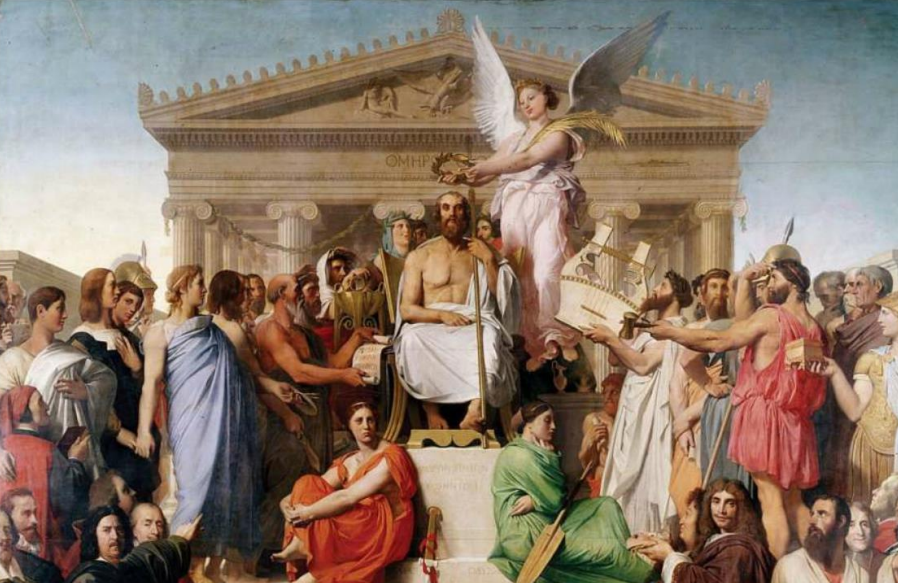
23
New cards
This painting by Ingres was submitted to the Salon of 1827, and was a kind of manifesto of Neoclassicism
**Apotheosis of Homer** by Jean Auguste Dominique Ingres
24
New cards
Based on Raphael’s School of Athens, the painting depicts the Greek poet Homer enthroned before a Greek Classical temple
**Apotheosis of Homer** by Jean Auguste Dominique Ingres
25
New cards
In Apotheosis of Homer, Allegorical figures representing his two great works, _____ are seated beneath his throne, symmetrically arranged like mirrored images of one another
The Odyssey and The Iliad
26
New cards
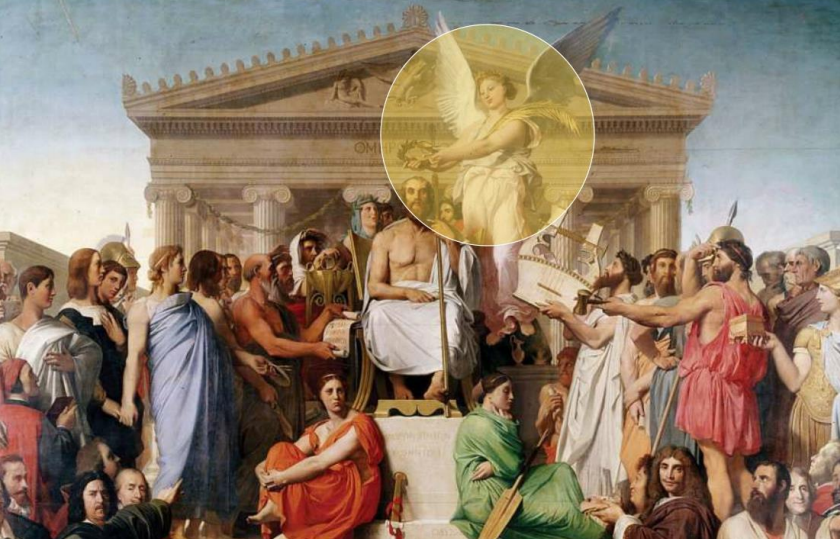
</>
The blind poet is crowned by a winged Nike, and he is surrounded by famous artists and writers from history, who acknowledge his great achievement
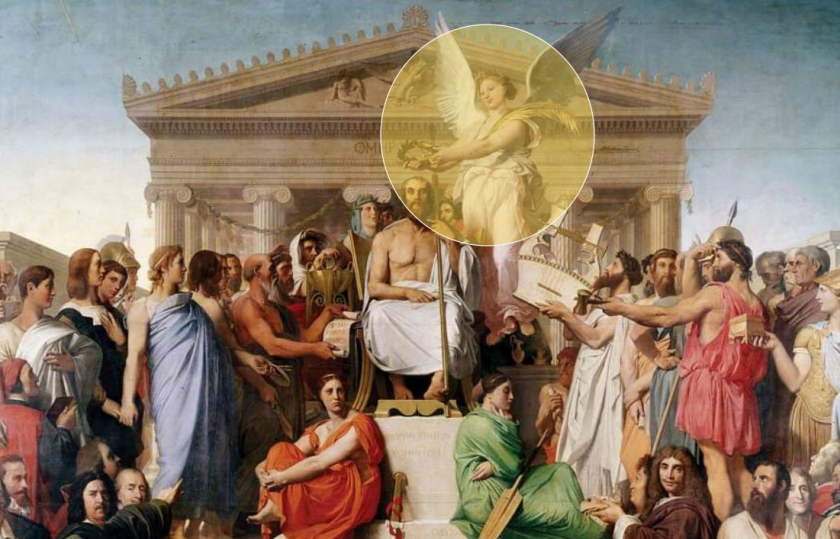
27
New cards
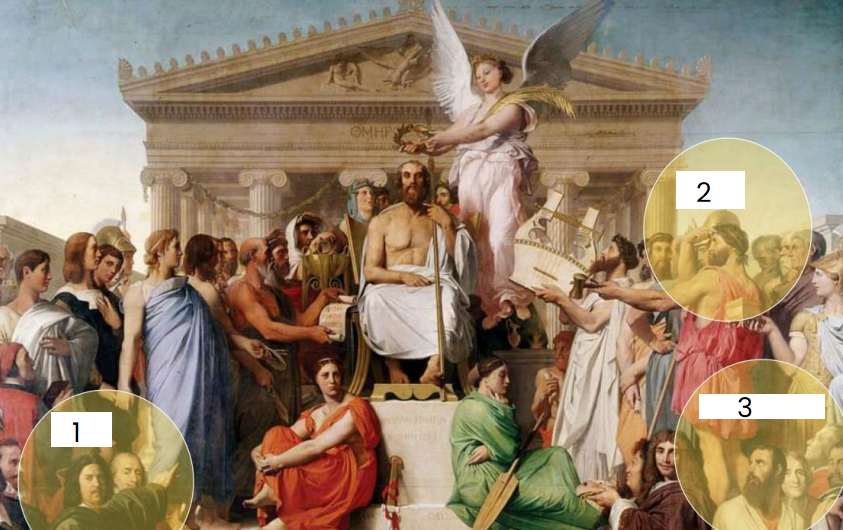
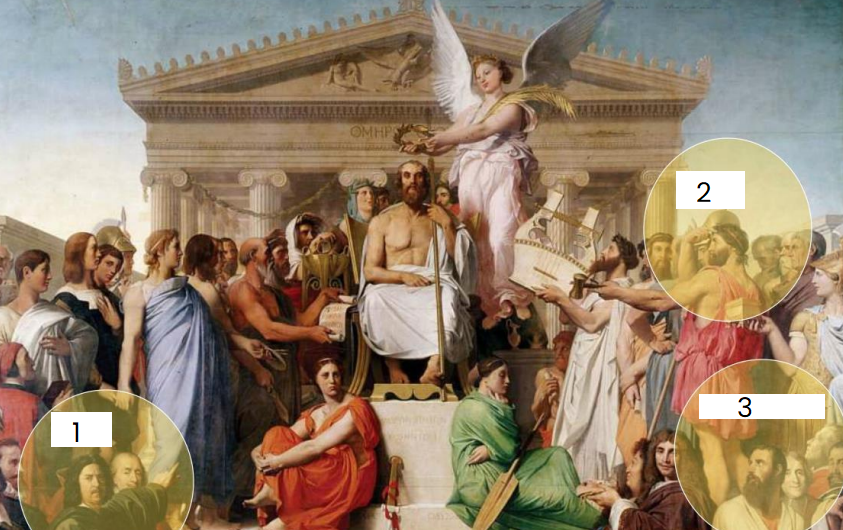
Name them.
1. Poussin
2. Phidias
3. Michelangelo
28
New cards
</>
Symmetrical, ordered, and balanced, the picture is a tribute to the rational values of the classical tradition
29
New cards
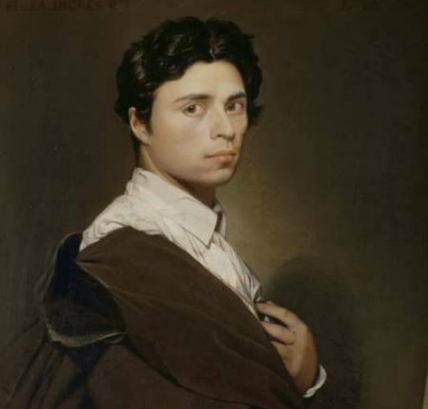
Identify the picture
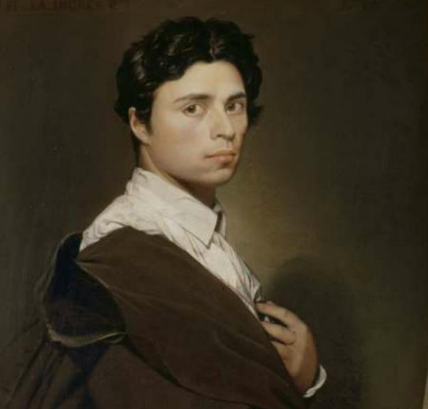
**Self Portrait at Age 24** by Jean Auguste Dominique Ingres
30
New cards
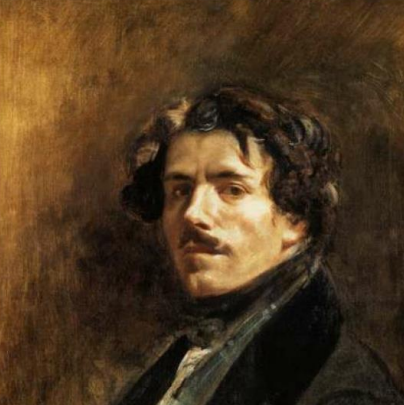
Identify the picture
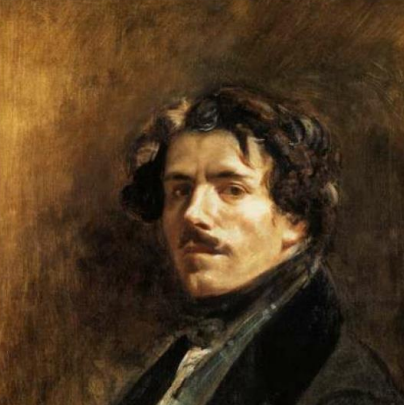
Self Portrait by Eugene Delacroix
31
New cards
Ingres’ chief rival in the 19th century French Academy was Eugene Delacroix, who rejected the values of Neoclassicism (an entry in his diary reads: _____)
“I dislike reasonable painting”
32
New cards
</>
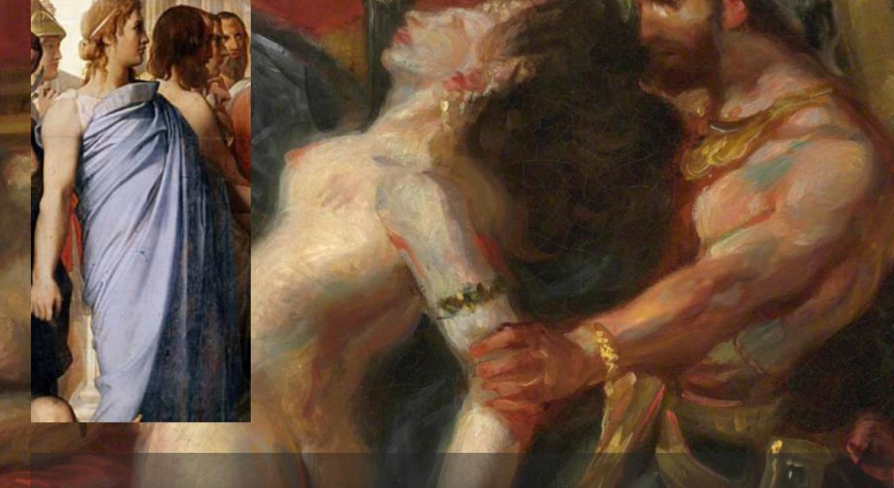
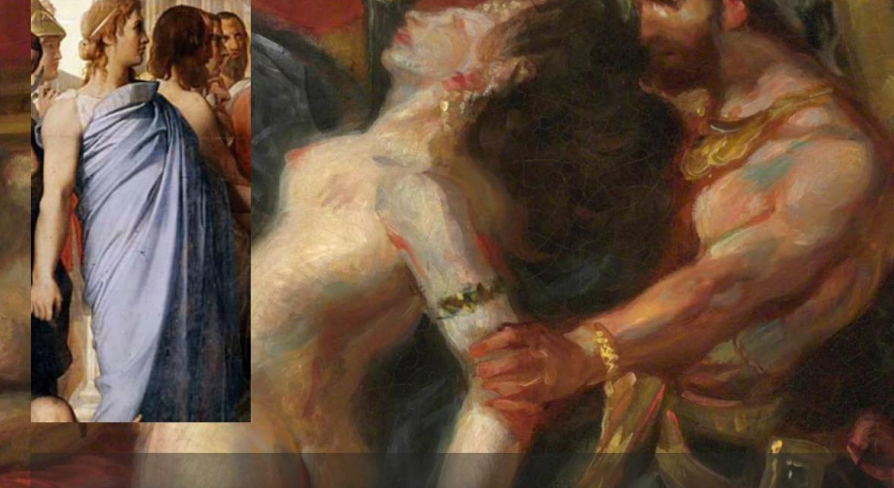
While Ingres’ style is slick, polished, and reserved (his teacher Jacques Louis David told his students: “never let your brushwork show”), Delacroix’s style is loose, spontaneous, and impetuous, expressing an unrestrained passion that contrasts with Ingres’ cool Neoclassical style
33
New cards
“I paint with my head”
Jean Auguste Dominique Ingres
34
New cards
“I paint with my heart”
Eugene Delacroix
35
New cards
He painted with precision and calculation
Jean Auguste Dominique Ingres
36
New cards
He painted with passion and spontaneity
Eugene Delacroix
37
New cards
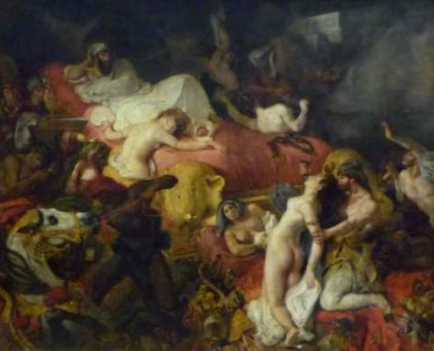
Identify the picture
**Death of Sardanapalus** by Eugene Delacroix
38
New cards
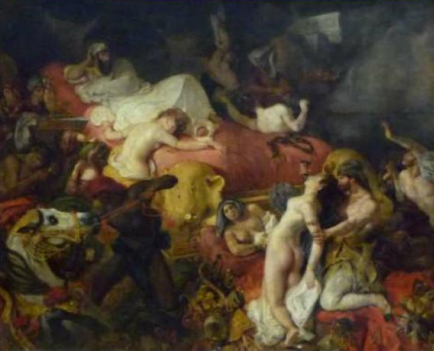
is a classic example of Romanticism
**Death of Sardanapalus** by Eugene Delacroix
39
New cards
</>
by Eugene Delacroix
\
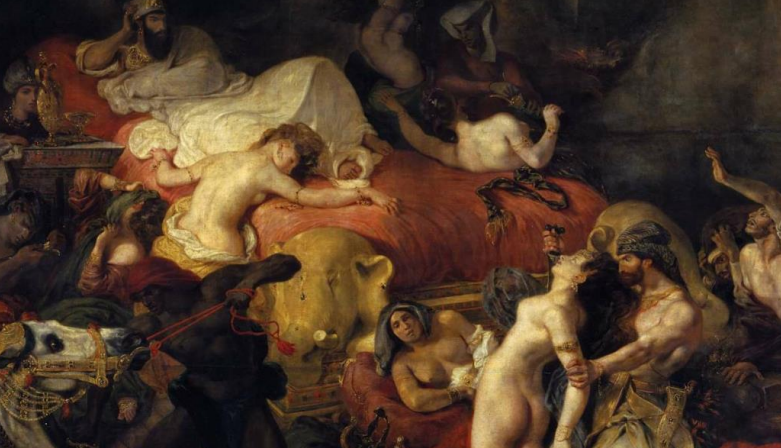
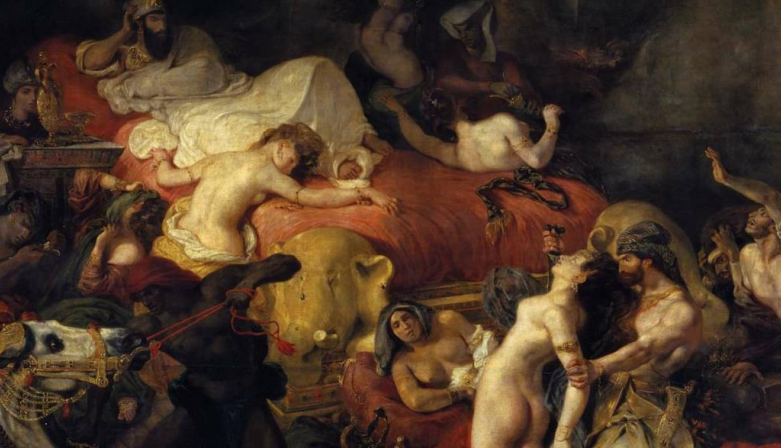
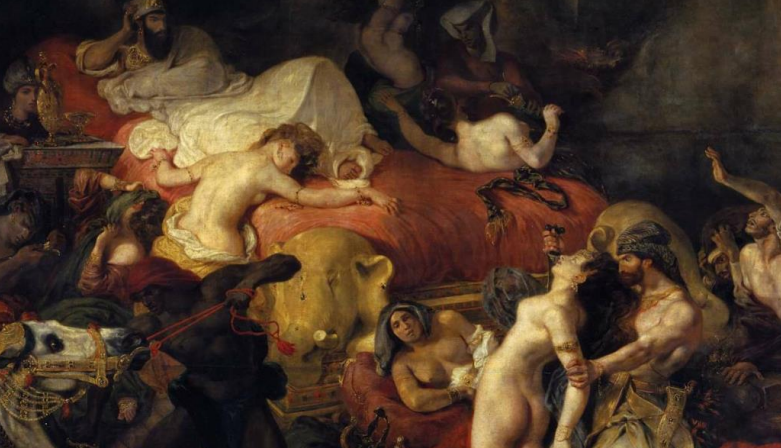
The painting is based on a story recounted by an ancient Greek historian about an Assyrian King whose city was under siege by an enemy army
\
Rather than suffer the humility of defeat, he orders his soldiers to slaughter his horses and his concubines, before setting himself on fire
\
The scene is one of chaotic violence, as naked bodies and horses struggle to escape their fate
\
The sadistic king reclines impassively on a massive bed, decorated at the corners by carved elephant heads
\
His decadent taste for luxuries is evident in the splendor of his surroundings, and the heavy jewelry worn by his concubines (in fact, the king himself wears rings on every toe!)
\
The painting is based on a story recounted by an ancient Greek historian about an Assyrian King whose city was under siege by an enemy army
\
Rather than suffer the humility of defeat, he orders his soldiers to slaughter his horses and his concubines, before setting himself on fire
\
The scene is one of chaotic violence, as naked bodies and horses struggle to escape their fate
\
The sadistic king reclines impassively on a massive bed, decorated at the corners by carved elephant heads
\
His decadent taste for luxuries is evident in the splendor of his surroundings, and the heavy jewelry worn by his concubines (in fact, the king himself wears rings on every toe!)
40
New cards
</>
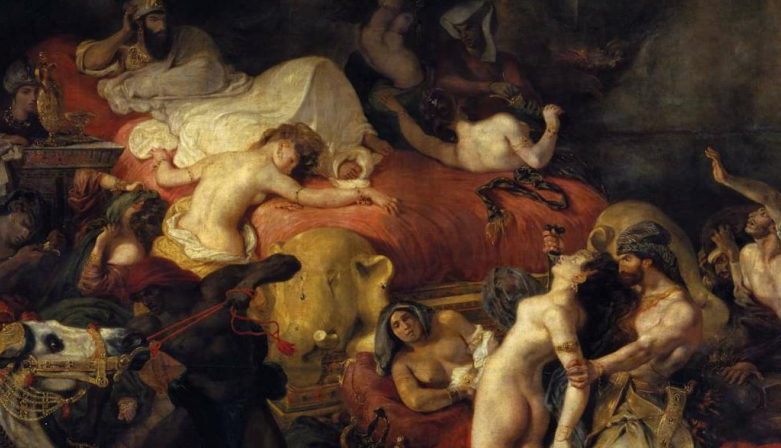
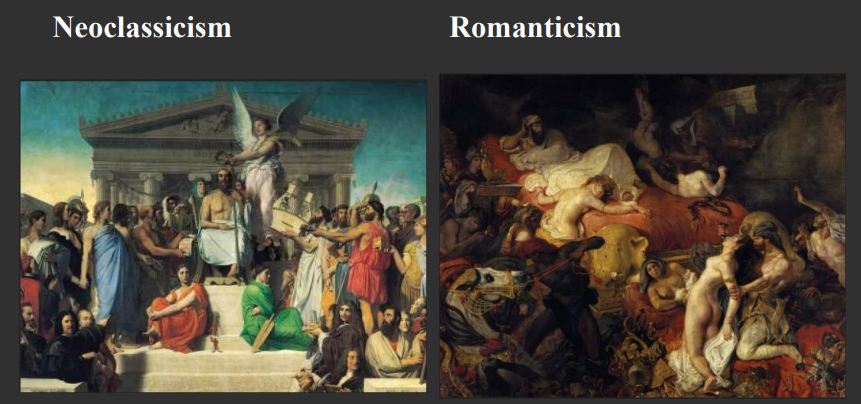
Eugene Delacroix Unlike Ingres’ Apotheosis of Homer (which was exhibited at the same Salon) Delacroix’s picture does not pay tribute to a noble hero.
\
Instead, it depicts a scene of sadistic violence and passion, betraying a morbid fascination with human depravity rather than noble virtue.
\
The style is also dramatically different
\
While __Ingres’ work is balanced and restrained__, with clear even lighting, cool colors, and crisp outlines.
\
Delacroix’s painting is chaotically arranged, with swirling bodies, and a strong diagonal that rushes headlong into space
\
\
\
Instead, it depicts a scene of sadistic violence and passion, betraying a morbid fascination with human depravity rather than noble virtue.
\
The style is also dramatically different
\
While __Ingres’ work is balanced and restrained__, with clear even lighting, cool colors, and crisp outlines.
\
Delacroix’s painting is chaotically arranged, with swirling bodies, and a strong diagonal that rushes headlong into space
\
\
41
New cards
</>
And in contrast to Ingres’ precisely rendered figures, Delacroix’s style is loose, sketchy, and impetuous – as if painted quickly, and with passion
42
New cards
</>
The colors, too, are rich, lush, and fiery, rather than cool and detached, providing a visual equivalent to the dark passions of the theme
43
New cards
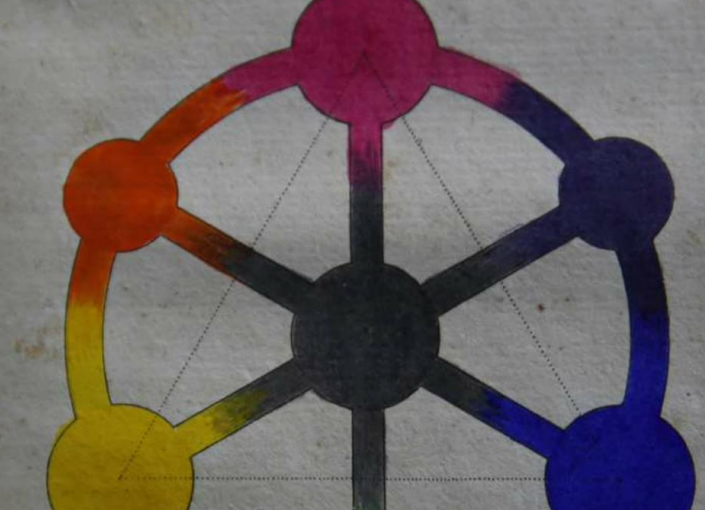
Delacroix’s use of color was influenced by _____, but it was also informed by new scientific theories about the properties of color, as seen in this color wheel from a book that belonged to the artist
Rubens, and by the Venetian masters of the Renaissance
44
New cards
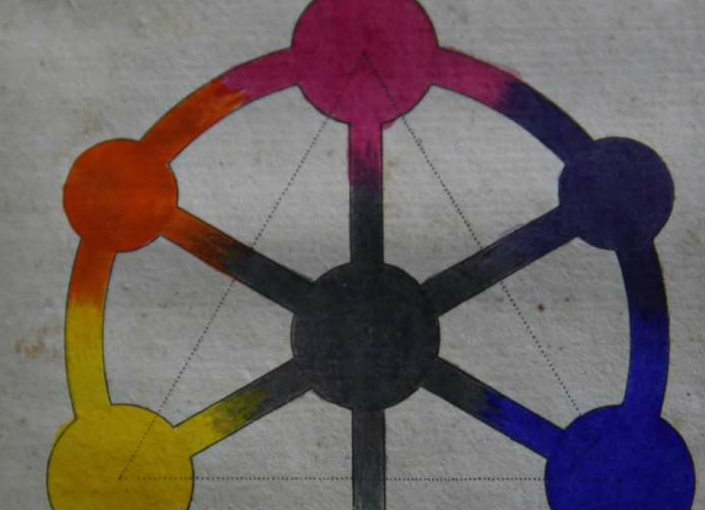
</>
The diagram shows primary and secondary colors, with their complimentary colors at the other end of the axis
45
New cards
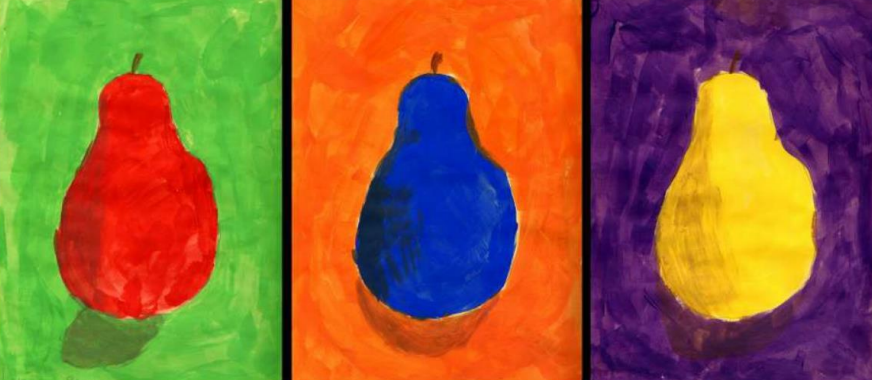
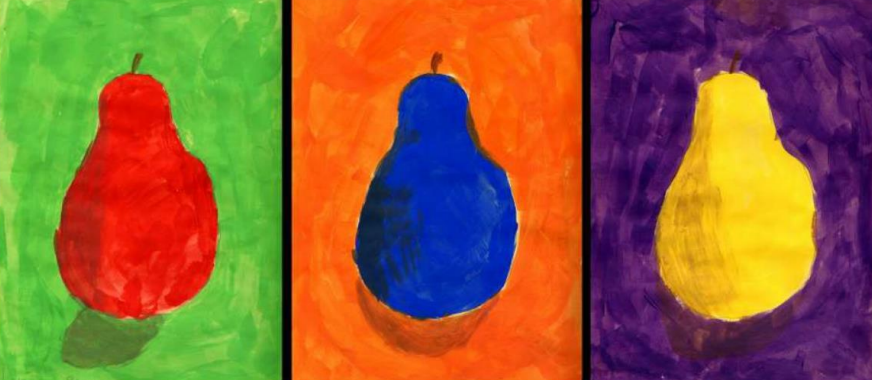
</>
Color theory teaches us that complementary colors intensify one another – a red against a green, or a blue against an orange, makes the colors pop with an intensity they would not have against a different background
46
New cards
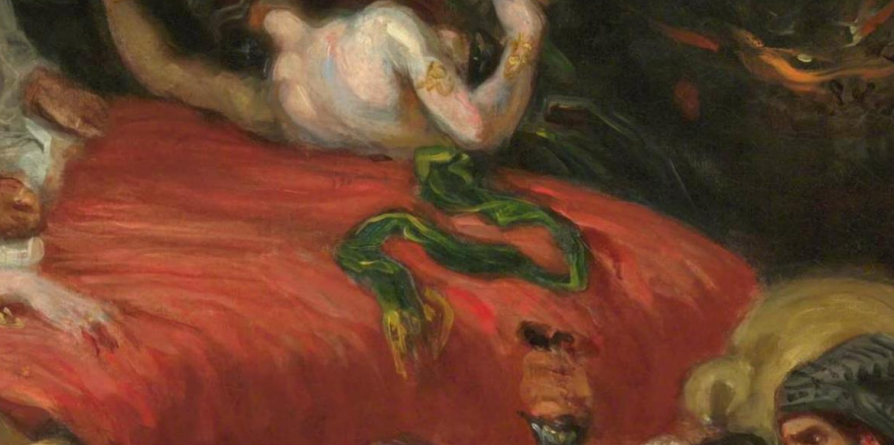
</>
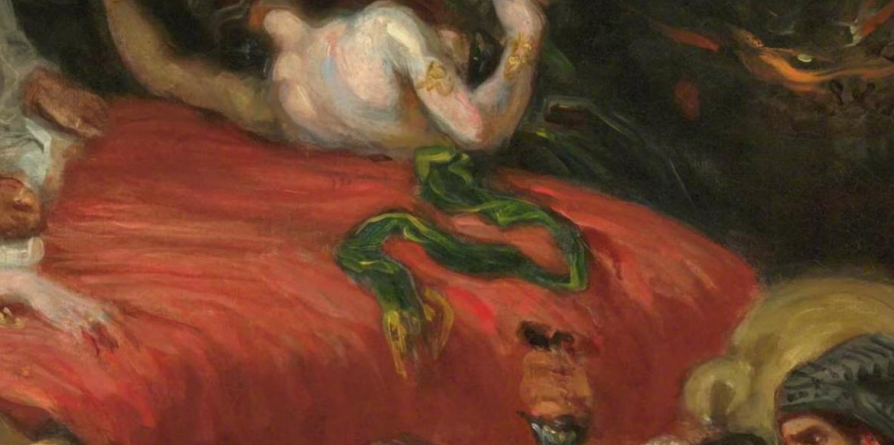
Delacroix used this understanding of color extensively in his paintings, as in this detail where we see a green sash draped haphazardly across the king’s bed
\
The complimentary colors intensify one another, making the colors literally “pop,” and adding to the overall drama of the picture the picture
\
The complimentary colors intensify one another, making the colors literally “pop,” and adding to the overall drama of the picture the picture
47
New cards
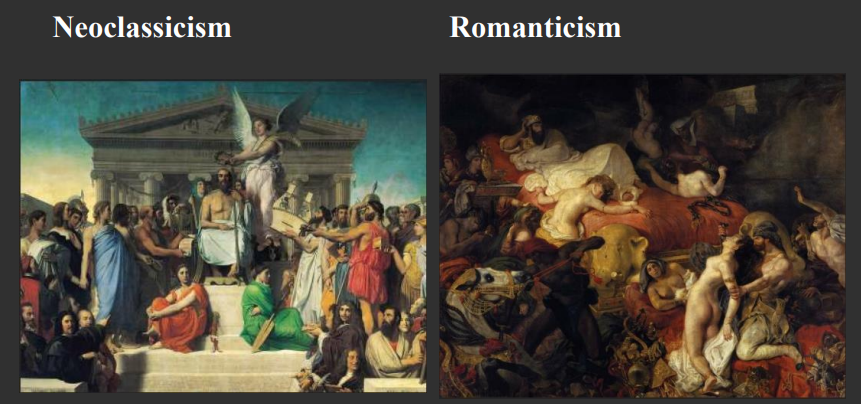
</>
The contrast between these two works sums up the competing values of Neoclassicism and Romanticism
48
New cards
Emphasis on reason and virtue
Neoclassicism
49
New cards
Emphasis on feelings, emotion – “human nature,” which is not always virtuous or noble
Romanticism
50
New cards
Style: painted with the “head”
✓ Smooth finish
✓ Balanced, ordered, harmonious
✓ Smooth finish
✓ Balanced, ordered, harmonious
Neoclassicism
51
New cards
Style: painted with the “heart”
✓ Loose, sketchy brushstroke
✓ Expressive color, dynamic composition, dramatic lighting
✓ Loose, sketchy brushstroke
✓ Expressive color, dynamic composition, dramatic lighting
Romanticism
52
New cards
Subject Matter
✓ Historical
✓ Exemplars of virtue
✓ Historical
✓ Exemplars of virtue
Neoclassicism
53
New cards
Subject Matter
✓ Themes from literature & the imagination
✓ Exotic people & places
✓ Horrific events
✓ Themes from literature & the imagination
✓ Exotic people & places
✓ Horrific events
Romanticism
54
New cards
He is profoundly respectful of the past, Ingres assumed the role of a guardian of academic orthodoxy against the ascendant Romantic style represented by his nemesis Eugène Delacroix. He described himself as a “conservator of good doctrine, and not an innovator.” Nevertheless, modern opinion has tended to regard Ingres and the other Neoclassicists of his era as embodying the Romantic spirit of his time, while his expressive distortions of form and space make him an important precursor of modern art.
Jean Auguste Dominique Ingres
55
New cards
Identify the picture
**Achilles Receiving the Envoys of Agamemnon** by Jean Auguste Dominique Ingres
56
New cards
Though firmly committed to Neoclassical values, is seen as expressign the Romanctic Spirit of the times.
**Achilles Receiving the Envoys of Agamemnon** by Jean Auguste Dominique Ingres
57
New cards
Identify the picture
**La Grande Odalisque** by Jean Auguste Dominique Ingres
58
New cards
Regarded as one of the greates modern paintings of the 19th century
**La Grande Odalisque** by Jean Auguste Dominique Ingres
59
New cards
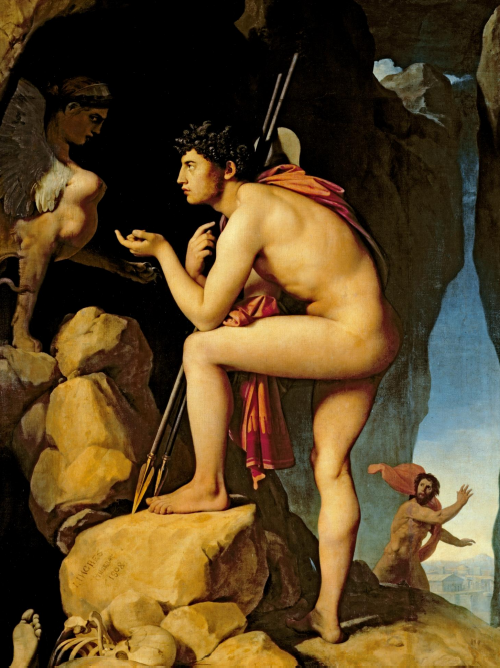
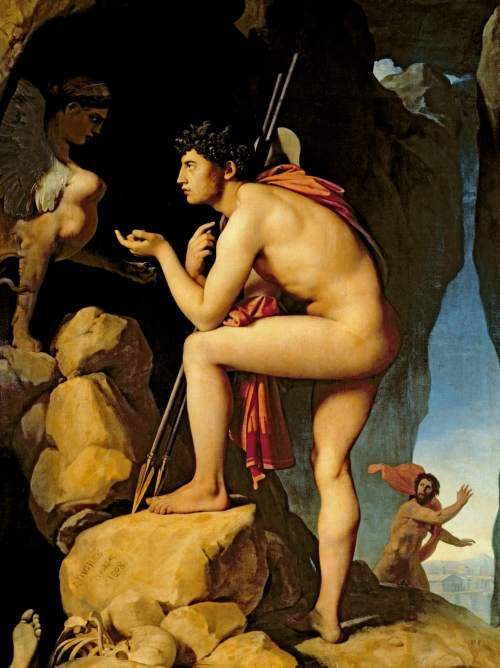
Identify the picture
**Oedipus Explaining the Enigma of the Sphinx** by Jean Auguste Dominique Ingres
60
New cards
He is the greatest French Romantic painter, whose use of colour was influential in the development of both Impressionist and Post-Impressionist painting. His inspiration came chiefly from historical or contemporary events or literature, and a visit to Morocco in 1832 provided him with further exotic subjects.
Eugene Delacroix
61
New cards
Identify the picture
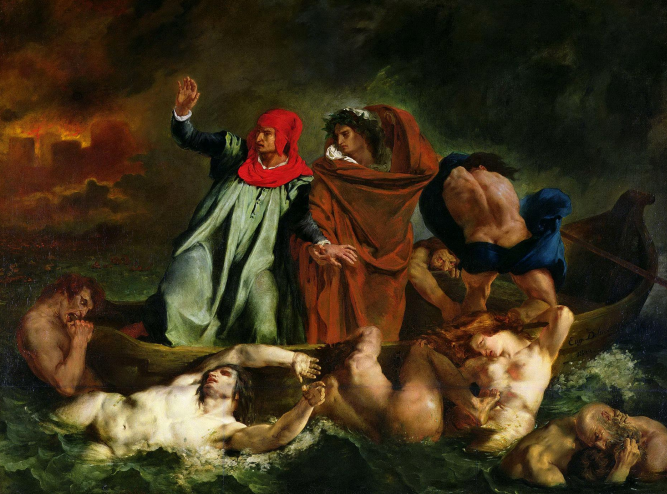
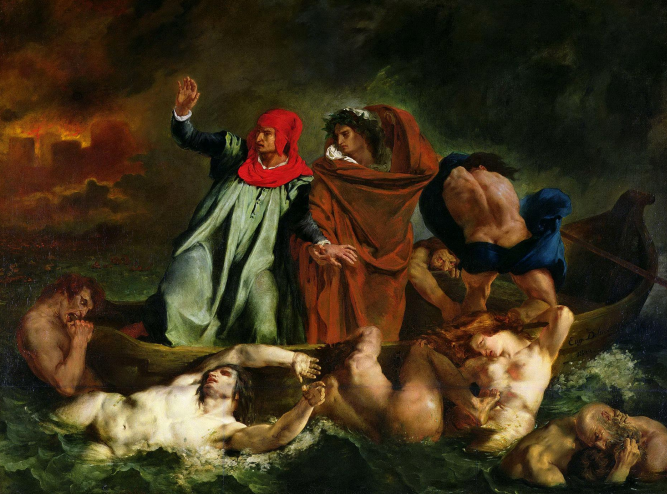
**The Barque of Dante**, sometimes known as **Dante and Virgil** **in Hell** by
Eugene Delacroix
Eugene Delacroix
62
New cards
The Barque of Dante, sometimes known as Dante and Virgil in Hell, is the first major painting by the French artist ___, and one of the works signalling a shift in the character of narrative painting from towards the _____.
* Eugène Delacroix
* Neo-Classicism
* Romantic movement
* Neo-Classicism
* Romantic movement
63
New cards
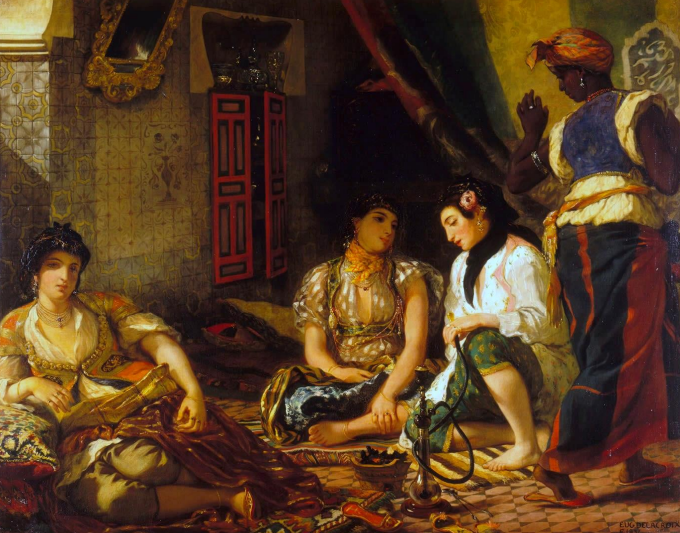
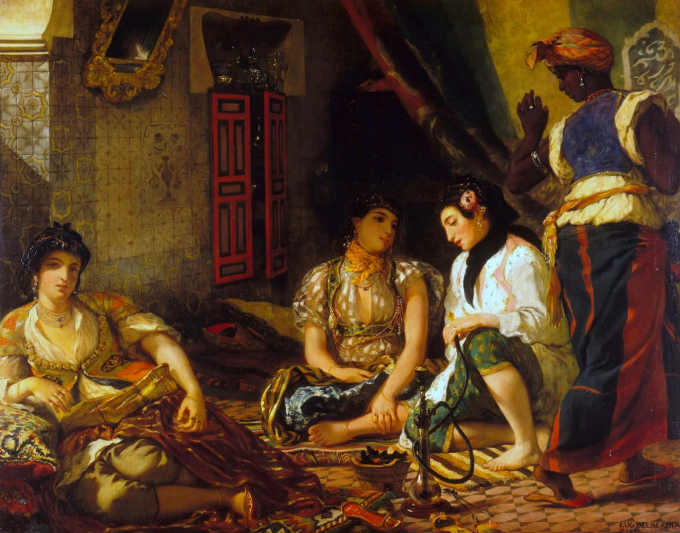
Identify the picture
**Women of Algiers in their Apartment** (French: *Femmes d’Alger dans leur appartement*) by Euguene Delacroix
64
New cards
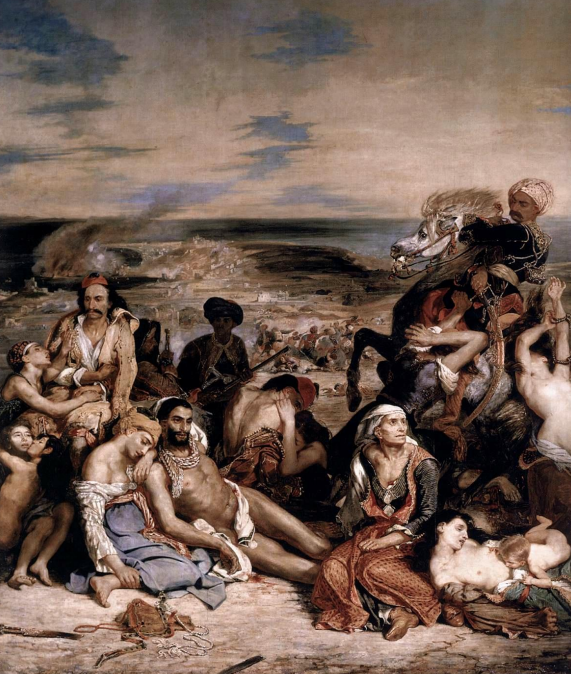
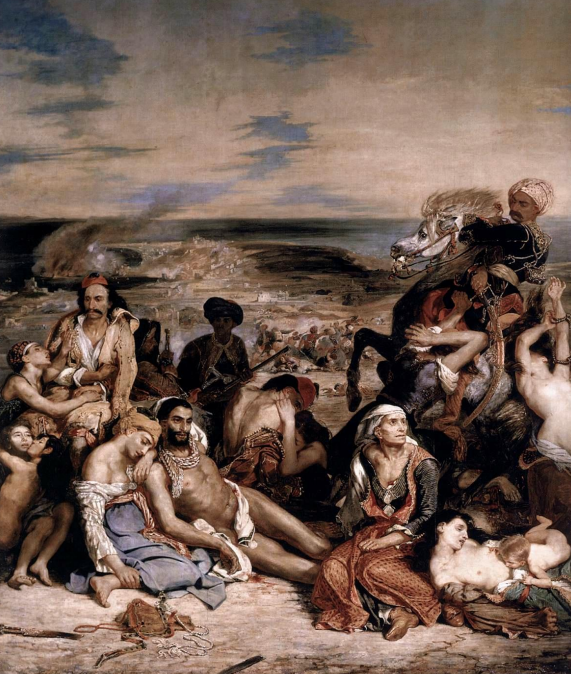
Identify the picture
**The Masscare at Chios** by Euguene Delacroix
65
New cards
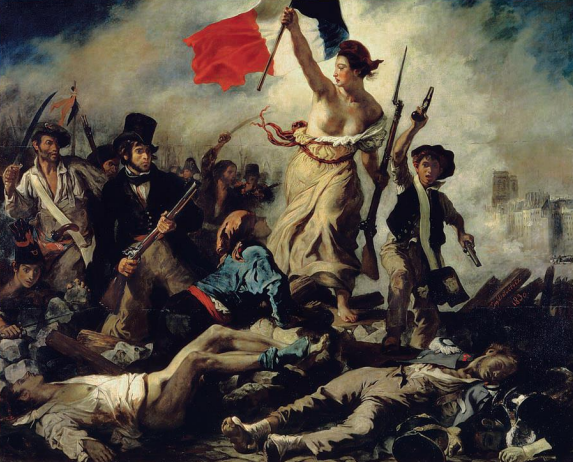
Identify the picture
**Liberty Leading the People** by Euguene Delacroix
66
New cards
Characteristics of Neoclassical Art
a concentration on Greek and Roman mythology history for subjects
a prioritization of the heroic male nude
somewhat dramatic lighting
a rather clean style
hard edges and bright primary colors in painting and smooth
highly polished marble in sculpture
a prioritization of the heroic male nude
somewhat dramatic lighting
a rather clean style
hard edges and bright primary colors in painting and smooth
highly polished marble in sculpture
67
New cards
Characteristics of Romantic Art
Romantic art focused on
* emotions
* feelings
* moods of all kinds including
* spirituality
* imagination
* mystery
* fervor
\
The subject matter varied widely including landscapes, religion, revolution, and peaceful beauty. The brushwork for romantic art became looser and less precise.
* emotions
* feelings
* moods of all kinds including
* spirituality
* imagination
* mystery
* fervor
\
The subject matter varied widely including landscapes, religion, revolution, and peaceful beauty. The brushwork for romantic art became looser and less precise.
68
New cards
How to identify Romantic art?
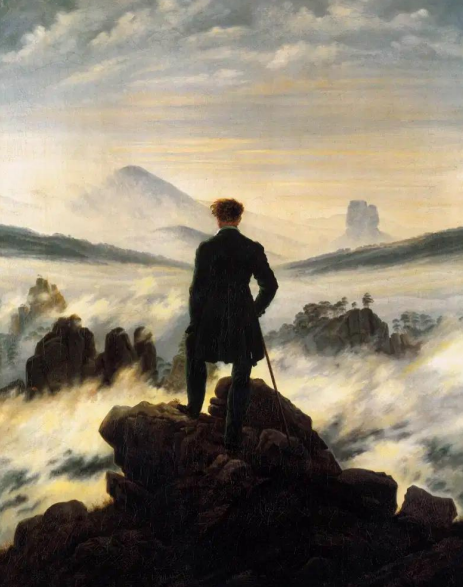
1. The skies are gloomy or cloudy as a sign of imminent danger and fear of the unknown, e.g. Wanderer above the Sea of Fog by Caspar David Friedrich.
2. A focus on nature – mystical landscapes with dark mysterious ambience; dark in both a literal and figurative sense, e.g. Der Heuwagen by John Constable.
3. Dramatic scenes of man or nature, occasionally with undertones of nature’s triumph over man, e.g. The Course of Empire Destruction 1836 by Cole Thomas.
4. The sky is prominent and overwhelming, often taking over around half of the painting, e.g. Venice Grand Canal by Joseph Mallord William Turner
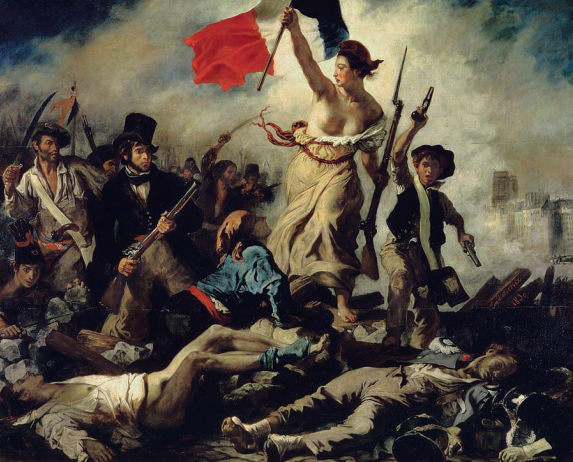
5. Dramatic scenes (similar to Baroque art but) painted in visible brushstrokes, as typical of the Romantic style, e.g. Liberty Leading the People by Eugène Delacroix
6. Horrific and gothic images, where faces express feelings such as intense pain, anguish, anger or fear, e.g. Saturn Devouring his Son by Francisco de Goya.
69
New cards
The skies are gloomy or cloudy as a sign of imminent danger and fear of the unknown
**Wanderer above the Sea of Fog** by Caspar David Friedrich
70
New cards
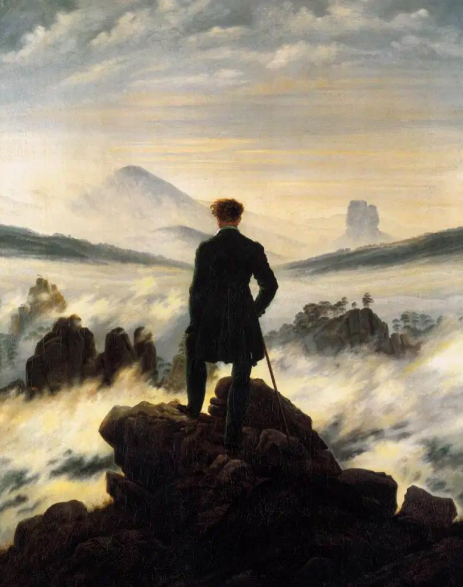
Identify the picture
**Wanderer above the Sea of Fog** by Caspar David Friedrich
71
New cards
A focus on nature – mystical landscapes with dark mysterious ambience; dark in both a literal and figurative sense
**Der Heuwagen** by John Constable
72
New cards
Identify the picture
**Der Heuwagen** by John Constable
73
New cards
Dramatic scenes of man or nature, occasionally with undertones of nature’s triumph over man
**The Course of Empire Destruction** by Cole Thomas
74
New cards
Identify the picture
**The Course of Empire Destruction** by Cole Thomas
75
New cards
The sky is prominent and overwhelming, often taking over around half of the painting
**Venice Grand Canal** by Joseph Mallord William Turner
76
New cards
Identify the picture
**Venice Grand Canal** by Joseph Mallord William Turner
77
New cards
Dramatic scenes (similar to Baroque art but) painted in visible brushstrokes, as typical of the Romantic style
**Liberty Leading the People** by Eugène Delacroix
78
New cards
Identify the picture
**Liberty Leading the People** by Eugène Delacroix
79
New cards
Horrific and gothic images, where faces express feelings such as intense pain, anguish, anger or fear
**Saturn Devouring his Son** by Francisco de Goya
80
New cards
Identify the picture
**Saturn Devouring his Son** by Francisco de Goya
81
New cards
How to identify Neo-classicism art?
1. Greek or Roman men armoured with swords and spears, e.g. The Oath of Horatii by Jacques Louis David
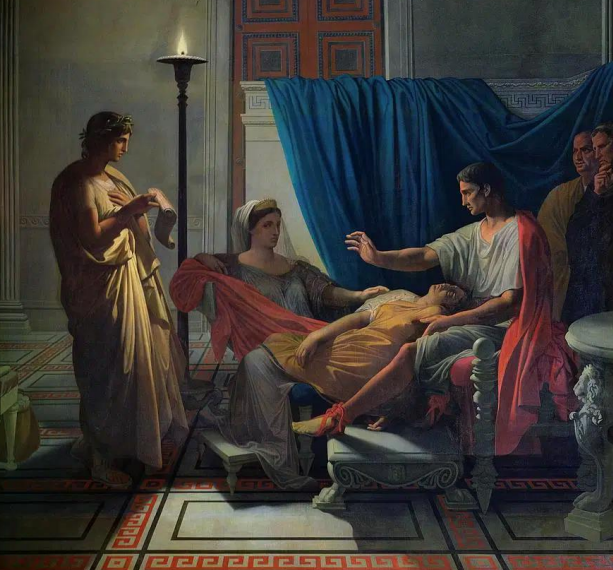
2. Classical subject matter: People in static calm poses, draped in flowing Greek robes, Roman togas and sandals, e.g. Virgil Reading the Aeneid to Augustus, Octavia, and Livia by Jean-Auguste-Dominique Ingres
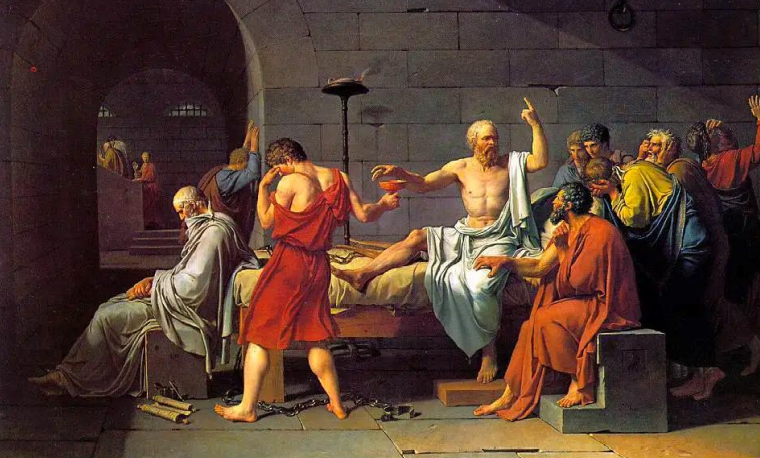
3. Clear and sharp outlines within a rectilinear composition featuring people looking polished and posing in a statuesque manner, as if they’re marble sculptures e.g. The Death of Socrates by Jacques-Louis David
82
New cards
Greek or Roman men armoured with swords and spears
**The Oath of Horatii** by Jacques Louis David
83
New cards
Identify the picture
**The Oath of Horatii** by Jacques Louis David
84
New cards
Classical subject matter: People in static calm poses, draped in flowing Greek robes, Roman togas and sandals
**Virgil Reading the Aeneid to Augustus, Octavia, and Livia** by Jean-Auguste-Dominique Ingres
85
New cards
Identify the picture
**Virgil Reading the Aeneid to Augustus, Octavia, and Livia** by Jean-Auguste-Dominique Ingres
86
New cards
Clear and sharp outlines within a rectilinear composition featuring people looking polished and posing in a statuesque manner, as if they’re marble sculptures
**The Death of Socrates** by Jacques-Louis David
87
New cards
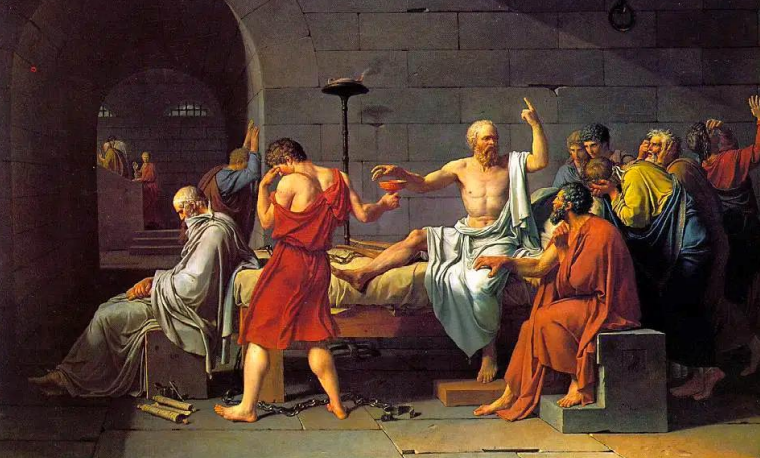
Identify the picture
**The Death of Socrates** by Jacques-Louis David
88
New cards
Romanticism **Subject matter**
various subject matters; if "historical" subjects, the Bible was the source
89
New cards
Romanticism **Themes**
sensuous themes or religious themes interest in nature
90
New cards
Romanticism **Theory of art**
art is to move, inspire
91
New cards
Romanticism **General style**
dynamic, restless, emotional, moody
92
New cards
Romanticism **Composition**
use of diagonal; dynamic
93
New cards
Romanticism **Space**
vast, unlimited; ambiguous
94
New cards
Romanticism **Figures**
expressive, individualistic
95
New cards
Romanticism **Color**
vivid, intense
96
New cards
Romanticism **Application of paint**
painterly
97
New cards
Neoclassicism **Subject Matter**
"history" paintings most important (especially subjects from Greek or Roman history or mythology)
98
New cards
Neoclassicism **Themes**
social, moral, ethical themes or classical or patriotic themes, urban themes
99
New cards
Neoclassicism **Theory of Art**
didactic: art is to teach
100
New cards
Neoclassicism **General Style**
clear, orderly, rational