Muscles Need to Know (Action, Origin, Insertion, Innervation)
 Call Kai
 Learn
 Practice Test
 Spaced Repetition
 Match
 Flashcards
 Knowt Play
1/83

There's no tags or description
Looks like no tags are added yet.
84 Terms
Buccinator (Action, Origin, Insertion)
A - compresses cheek
O - molar region of the maxilla and mandible
I - orbicularis oris
Inn - Facial nerve
Mentalis
A - wrinkles chin
O - mandible (below incisors)
I - skin of chin
Inn - Facial Nerve
Orbicularis oris
A - closes lips
O - maxilla and mandible
I - encircles mouth
Inn - Facial Nerve
Risorius
A - Pulls the angle of the mouth laterally (outward and slightly upward) for grins or laughter
O - parotid fascia
I - skin at corner of mouth
Inn - Facial Nerve
Zygomaticus major
A - raises the lateral corners of the mouth (smiling muscle)
O - zygomatic bone
I - skin and muscle at corner of mouth
Inn - Facial Nerve
Zygomaticus minor
A - raises the lateral corners of the mouth (smiling muscle)
O - zygomatic bone
I - skin and muscle at corner of mouth
Inn - Facial nerve
Orbicularis oculi
A - closes eyes
O - frontal and maxillary bones
I - tissue of the eyelid
Inn - Facial nerve
Occipitofrontalis (frontal belly)
A - raises eyebrows
O - epicranial aponeurosis
I - skin of eyebrows and root of nose
Inn - Facial nerve
Occipitofrontalis (occipital belly)
A - fixes aponeurosis and pulls scalp posteriorly
O - occipital and temporal bones
I - epicranial aponeurosis
Inn - Facial nerve
Temporoparietalis
A - Tightens the scalp and moves the scalp
O - Temporal fascia
I - Epicranial aponeurosis
Inn - Facial nerve
Temporalis
A - closes jaw
O - temporal fossa
I - coronoid process of mandible
Inn - trigeminal nerve
Masseter
A - prime mover of jaw closure
O - zygomatic arch and bone
I - mandible (angle and ramus)
Inn - Trigeminal nerve
Digastric (anterior belly)
A - open mouth and depress mandible
O - mandible and mastoid process of temporal bone
I - CT of hyoid bone
Inn - Trigeminal nerve
Sternocleidomastoid
A - head bending/tilting
O - manubrium of the sternum & clavicle
I - mastoid process of the temporal bone
Inn - Accessory nerve
External intercostals
A - pulls ribs towards one another to elevate rib cage
O - inferior border of rib above
I - superior border of rib below
Inn - intercostal nerve
Internal intercostals
A - pull ribs together and depress rib cage
O - superior border of rib below
I - inferior border of rib above
Inn - Intercostal nerve
Pectoralis major
A - adducts and medially rotates arm
O - sternal end of clavicle
I - greater tubercle humerus
Inn - Medial and Lateral pectoral nerves
Transversus abdominus
A - compresses abdominal contents
O - iliac crest of the ilium
I - pubic crest of the pubis
Inn - Intercostal nerves and L1
Rectus abdominus
A - flex and rotate lumbar region of vertebral column
O - pubic crest of pubis
I - xiphoid process of the sternum
Inn - Intercostal nerves
Latissimus dorsi
A - prime mover of arm extension, powerful arm adductor, medially rotates the arm
O - spines of vertebrae
I - intertubercular groove of humerus
Inn: Thoracodorsal nerve
Supraspinatus
A - initiates abduction of arm
O - scapula (supraspinous fossa)
I - humerus (greater tubercle)
Inn - Suprascapular nerve
Infraspinatus
A - rotates arm laterally
O - scapula (infraspinous fossa)
I - humerus (greater tubercle)
Inn - Suprascapular nerve
Subscapularis
A - rotates arm medially (prime mover)
O - scapula (subscapular fossa)
I - humerous (lesser tubercle)
Inn - Subscapular nerve
Levator scapulae
A - elevates and adducts scapula
O - transverse processes of vertebrae (C1-C4)
I - scapula (medial border)
Inn - Cervical spinal and dorsal scapular nerves
Deltoid
A - arm abduction (prime mover when all fibers contract simultaneously)
O - clavicle, acromion, spine of scapula
I - humerous (deltoid tuberosity)
Inn - Axillary nerve
Biceps brachii (short heads)
A - flexes and supinates the forearm
O - coracoid process of the scapula
I - radial tuberosity of radius
Inn - Musculocutaneous nerve
Biceps brachii (long heads)
A - flexes and supinates the forearm
O - supraglenoid tubercle of the scapula
I - radial tuberosity of radius
Inn - Musculocutaneous nerve
Triceps brachii (long heads)
A - powerful forearm extensor
O - infraglenoid tubercle of the scapula
I - olecranon of the ulna
Inn - Radial Nerve
Triceps brachii (medial heads)
A - powerful forearm extensor
O - humerus (posterior shaft)
I - olecranon of the ulna
Inn - Radial Nerve
Triceps brachii (lateral heads)
A - powerful forearm extensor
O - humerus (posterior shaft)
I - olecranon of the ulna
Inn - Radial Nerve
Flexor digitorum superficialis
A - Flexes the hand and middle phalanges of 2nd and 5th fingers
O - radius (shaft)
I - middle phalanges of 2nd to 5th fingers
Inn - Median Nerve
Flexor digitorum profundus
A - flexes the distal interphalangeal joints
O - ulna (coronoid process)
I - distal phalanges of 2nd to 5th fingers
Inn - Ulnar and Median nerve
Brachioradialis
A - synergist in flexing the forearm
O - humerus (lateral supracondylar ridge)
I - radial styloid process
Inn - Radial Nerve
Extensor carpi radialis longus
A - extends hand
O - humerus (lateral supracondylar ridge)
I - base of 2nd metacarpal
Inn - Radial Nerve
Extensor carpi ulnaris
A - extends and adducts the hand
O -posterior ulna
I - base of 5th metacarpal
Inn - Posterior interosseous nerve
Pronator teres
A - pronates forearm
O - humerus (medial epicondyle), ulna (coronoid process)
I - lateral radius midshaft
Inn - median nerve
Pronator Quadratus
A - pronates forearm
O - anterior ulna
I - anterior radius
Inn - Anterior Interosseous nerve
Gluteus maximus
A - major extensor of the thigh
O - sacrum or/and coccyx
I - gluteal tuberosity of femur
Inn - inferior gluteal nerve
Tensor fasciae latae
A - steadies the leg and trunk on the thigh by tightening the iliotibial tract
O - iliac crest, anterior superior iliac spine
I - iliotibial tract
Inn - Superior gluteal nerve
Gracilis
A - adducts thigh, flexes, and medially rotates leg
O - pubis (inferior ramus and body) & ischium (ishial ramus)
I - tibia (medial surface)
Inn - obturator nerve
Iliopsoas (Iliacus)
A - prime mover for flexing thigh or trunk on thigh
O - iliac fossa and crest, ala of sacrum
I - femur (lesser trochanter)
Inn - Femoral nerve
Iliopsoas (Psoas major)
A - prime mover for flexing thigh or trunk on thigh
O - transverses processes & discs of lumbar vertebrae and T12
I - femur (lesser trochanter)
Inn - Ventral rami
Biceps femoris (long head)
A - Extends thigh and flexes leg
O - ischial tuberosity
I - fibula (head) and tibia (lateral condyle)
Inn - Sciatic nerve
Biceps femoris (short head)
A - Extends the thigh and flexes the leg
O - femur (linea aspera)
I - fibula (head) and tibia (lateral condyle)
Inn - Fibular nerve
Rectus femoris
A - extends leg and flexes thigh at hip
O - ilium (ant. infe. iliac spine) and acetabulum (supe. margin)
I - patella and tibial tuberosity
Inn - Femoral nerve
Popliteus
A - flexes and rotates leg medially to unlock the extended knee when flexion begins
O - femur (lateral condyle) and lateral meniscus of the knee
I - proximal tibia
inn - tibial nerve
Tibialis anterior
A - primary mover of dorsiflexion
O - tibia (lateral condyle and shaft)
I - medial cuneiform and 1st metatarsal bone
Inn - Deep fibular nerve
Gastrocnemius (medial and lateral heads)
A - plantar flexes foot
O - medial and lateral condyles of femur
I - posterior calcaneus
Inn - Tibial Nerve
Flexor digitorum longus
A - plantar flexes and inverts foot, flexes toes
O - tibia (posterior)
I - distal phalanges of 2nd to 5th toes
Inn - Tibial Nerve
Flexor hallucis longus
A - plantar flexes and inverts foot; flexes great toe at all joints
O - fibula (midshaft)
I - distal phalanx of great toe
Inn - Tibial Nerve
Extensor digitorum longus
A - prime mover of toe extension
O - tibia (lateral condyle)
I - middle and distal phalanges (2nd to 5th toes)
Inn - Deep fibular Nerve
Extensor hallucis longus
A - extends great toe
O - fibula shaft and interosseous membrane
I - distal phalanx of great toe
Inn - Deep fibular Nerve
Flexor hallucis brevis
A - flexes great toe at metatarsophalangeal joint
O - lateral cuneiform and cuboid bones
I - proximal phalanx of great toe
Inn - Medial plantar nerve
Extensor digitorum brevis
A - helps extend toes at metatarsophalangeal joints
O - anterior calcaneus bone
I - base of proximal phalanx of great toe
Inn - deep fibular nerve
Knee ligaments
tibial (medial) & fibular (lateral) collateral ligaments
anterior & posterior cruciate ligaments
patellar ligament
medial meniscus
lateral meniscus
Shoulder ligaments
coracoacromial ligament
acromioclavicular ligament
coracoclavicular ligaments
glenohumeral ligaments
coracohumeral ligament
Hip ligaments
iliofemoral ligament
ischiofemoral ligament
pubofemoral ligament
Identify hamstrings
Biceps femoris (long and short head)
Semitendinosis
Semimembranosis
Sartorius

Identify quads
Rectus femoris
Vastus lateralis
Vastus medialis
Vastus intermedius

Identify rotator cuff
Supraspinatus
Infraspinatus
Subscapularis
Teres minor
Levator scapulae

Epicranial aponeurosis

Thoracolumbar fascia

Aponeurosis of external oblique

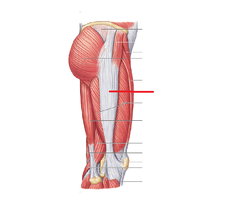
Iliotibial tract
Quadriceps tendon

Calcaneal tendon

flexion
Decreases the angle of a joint
extension
increases the angle of a joint
Adduction
Movement toward the midline of the body
Abduction
Movement away from the midline of the body
cirumduction
circular motion
Head Rotation (Left / Right)
Turning the head to the left or right around the longitudinal axis.
Internal (Medial) Rotation
Rotation of a limb bone around its longitudinal axis toward the midline.
External (Lateral) Rotation
Rotation of a limb bone around its longitudinal axis away from the midline.
Pronation
Rotation of the forearm placing the palm facing posteriorly or downward.
Supination
Rotation of the forearm placing the palm facing anteriorly or upward.
Eversion
Movement of the sole of the foot outward, away from the midline.
Inversion
Movement of the sole of the foot inward, toward the midline.
Dorsiflexion
Bending the foot at the ankle superiorly toward the shin.
Plantar flexion
Bending the foot at the ankle downward, pointing toes toward the floor.
Lateral Flexion
Bending of the vertebral column or trunk sideways to the left or right.
Protraction and Retraction
Protraction moves a body part anteriorly; retraction moves it posteriorly.
Opposition
Movement of the thumb to touch the tip of another finger on the same hand.
Elevation and Depression
Elevation moves a structure superiorly; depression moves it inferiorly.