Lecture 2: Quiet Revolution~ Female Labor Force Participation & Economic Development
 Call Kai
 Learn
Learn Practice Test
 Spaced Repetition
 Match
Match Flashcards
 Knowt Play
1/16

There's no tags or description
Looks like no tags are added yet.
Name | Mastery | Learn | Test | Matching | Spaced | Call with Kai | Chat |
|---|
No analytics yet
Send a link to your students to track their progress
17 Terms
TOPIC 1: Claudia Goldin’s Quiet Revolution
Purpose of the paper
Looks across the late 19th century to the modern day to analyze key factors that influenced women as economic agents.
5 phases of Female Labor Force Participation
1) Independent Female Worker (1870-1920)
2) Easing the Constraints (1930-1950)
3) Roots to Revolution (1950-1970)
4) Quiet Revolution (1970s-2000s)
Phase 1- The independent Female Workers- Key Characteristic~
1870-1920
Women could work if unmarried but faced marriage bars.
Domestic help, service, and manufacturing jobs were available, but wives faced stigma when working outside the home.
LFP: 15-22% driven by a decrease in fertility and an increase in education.
Phase 2- Easing the Constraints- Key Characteristic~
1930-1950
marriage bars eliminated
office jobs, clerical work, and part time jobs were available.
LFP (married): 10% to 25%, HS enrollment increased, increase in demand for women due to vacancy left in workforce by men fighting in WW2 (1939-45), introduction of washing machine and dryer freed up women’s time.
Phase 3- Roots to Revolution- Key Characteristic~
1950-1970
Many women thought they would enter the workforce temporarily but ended up staying in it.
“pink collar” jobs available: secretaries, nurses, teachers, social workers, librarians.
LFP: 25 to 46% driven by women’s human capital increasing (college enrollment up).
Phase 4-Quiet Revolution- Key Characteristics~
Occupational convergence: women became doctors, layers and managers.
employment expectation up!
LFP (mothers): 20% to 62% driven by college graduation and professional degree attainment.
TOPIC 2: Claudia Goldin’s U-Shaped Model of Female Labor Force Participation
Purpose of Paper
Goldin argues that if you look at the LFP of women across countries as a function of income (measured as GDP per capita), this relationship is U-shaped instead of linear.
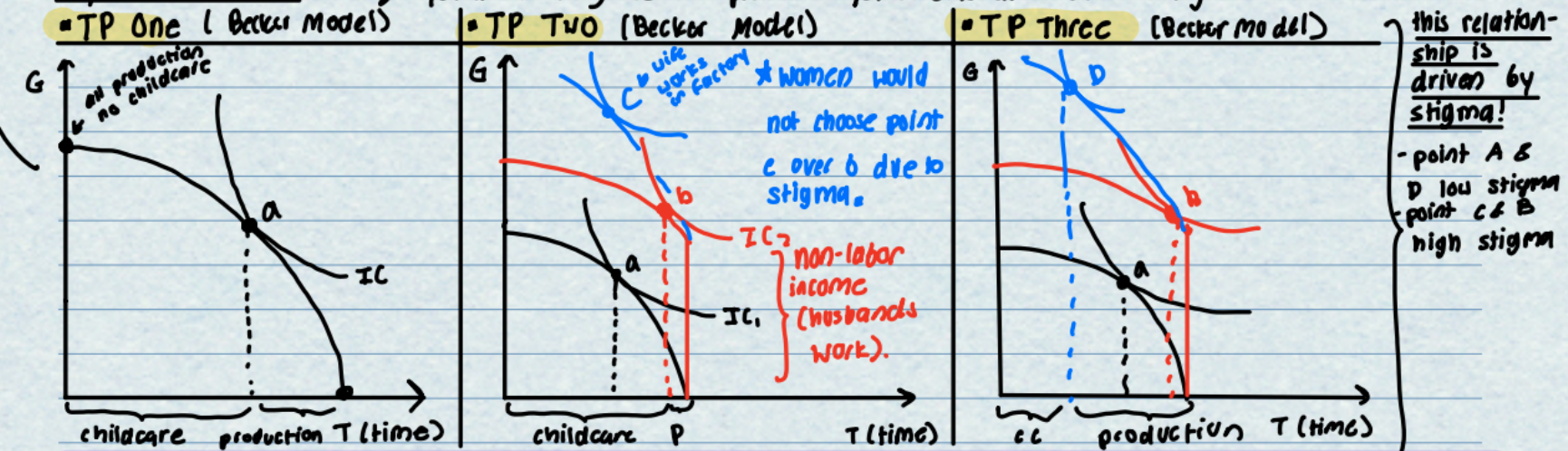
Assumptions of paper~ based on Becker Model Assumptions (4)
1) Competitive Labor Market- workers receive a wage that is exactly equal to the value of their marginal productivity. (W= P x MPL)
2) Frictionless Mobility- assumes frictionless mobility in and out of the workforce (skills do not deteriorate with long abbesses from work.
3) Childcare (C)- must be produced at home (no institutional childcare).
4) One Good (G)- produced at home (all periods), or produced by the firm (period 2 & 3).
Mathematical function for U-shaped model (with and without stigma)
u = (G, C)
Stigma (S) applies if women had blue-collar jobs (time period 2 and time period 3)
Stigma applies to the utility function in the following way: u = u(G, C)- ∂S, S=1 if blue-collar, S=0 otherwise.
Time periods within the U-Shaped model (description + graph)
Period 1- agriculture/ home production only.
Period 2- manufacturing firm is added (blue-collar).
Period 3- education & white-collar jobs added.

Income effect
Change in wife’s labor supply associated with a change in family income, holding wages constant.
∆ Hours of Work/ ∆ Y (income) I w̄ < 0
IE is typically negative.
Substitution Effect
Change in wife’s labor supply associated with a change in wage, holding income constant.
∆ Hours of Work/ ∆ W (wage) I Ȳ > 0
typically positive
Production Possibility Frontier (Beckers Model)
PPF- feasible combinations of ways time can be allocated. Y axis = G, X axis= T
Why is PPF Concave?
The longer you do one task the less productive you become at it (diminishing returns).
The U-shaped model conceptualized through the PPF