UNIT 4. MOVEMENT ACROSS CELL MEMBRANE
 Call Kai
 Learn
 Practice Test
 Spaced Repetition
 Match
 Flashcards
 Knowt Play
1/20

There's no tags or description
Looks like no tags are added yet.
21 Terms
Passive Transport
Active Transport
Endocytosis
Exocytosis
4 Major Types of Movements Across Cell Membrane
Passive Transport
4 Major Types of Movements Across Cell Membrane:
● No energy required
● Move due to gradient
● Movement is down the concentration gradient
● High concentration moves toward low concentration
Passive Transport
Facilitated Diffusion
Osmosis
3 Types of Passive Transport
Simple Diffusion
3 Types of Passive Transport:
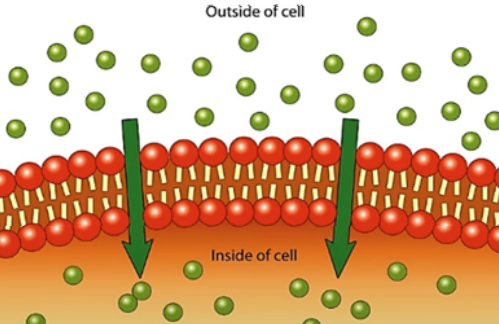
molecules move to equalize concentration
Movement of small, nonpolar molecules directly through the lipid bilayer
Example: Oxygen (O₂) entering cells, Carbon dioxide (CO₂) leaving cells
Facilitated Diffusion
3 Types of Passive Transport:
Movement of specific, polar or charged molecules down a concentration gradient
Pass through membranes via specific carrier protein
Selection is by size, shape, charge
Example: Glucose transport via GLUT transporters, ions via ion channels
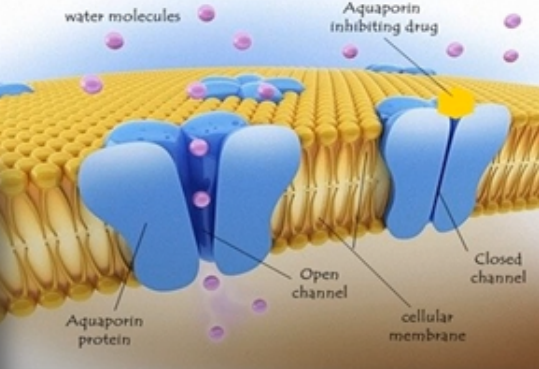
Channels
(are specific) help polar or charged molecules or ions enter or leave the cell
transport proteins
Channels usually are ______________
Aquaporin
a membrane protein channel that facilitate the movement of water
Osmosis
3 Types of Passive Transport:
- Special form of diffusion
- Fluid flows from the lower solute concentration to higher
- Requires selective permeable membrane
- Diffusion of water across a selectively permeable membrane
Hypotonic Solutions
Isotonic solution
Hypertonic solution
3 Types of Solutions:
Hypotonic Solution
3 Types of Solutions:
Solute concentration outside < inside
Water moves into the cell
cell may swell/lyse
important in turgor pressure in plant cells
Isotonic Solution
3 Types of Solutions:
Solute concentration outside = inside
Water moves equally in both directions
cell remains stable
Example: 0.9% NaCl (normal saline) for human cells
Hypertonic Solution
3 Types of Solutions:
Solute concentration outside > inside
Water moves out of the cell
cell shrinks/shrivels (crenation)
Example: 10% NaCl solution for human cells
Hypotonic = lysed
Isotonic = normal
Hypertonic = shriveled
Effects of Osmosis in Animal cell
Hypotonic = Turgid (normal)
Isotonic = Flaccid
Hypertonic = Plasmolyzed
Effects of Osmosis in Plant cell
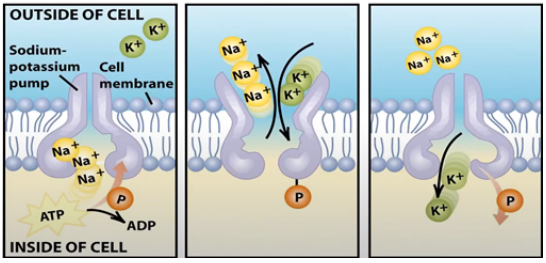
Active Transport
4 Major Types of Movements Across Cell Membrane:
Molecular movement
Requires energy (ATP)
against concentration gradient (low HC —> High HC)
Ex: Sodium-potassium pump (Na⁺/K⁺-ATPase) moves 3 Na⁺ out and 2 K⁺ in
Endocytosis
4 Major Types of Movements Across Cell Membrane:
Process of taking in large particles or liquids
invagination of the plasma membrane
Movement is into cell
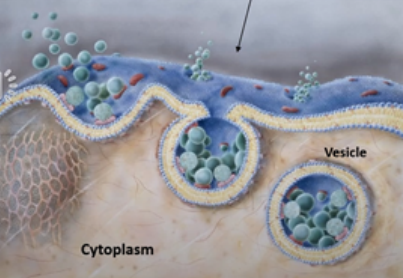
A. Pinocytosis
B. Phagocytosis
2 Types of Endocytosis:
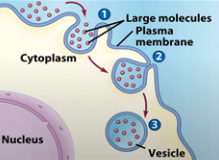
Pinocytosis
2 Types of Endocytosis:
'“cell drinking”
Engulfs liquids and dissolved solutes
Example: Nutrient uptake in intestinal cells
Phagocytosis
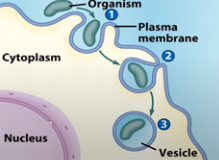
2 Types of Endocytosis:
“cell eating”
Engulfs large particles or microbes
Example: Macrophages ingesting bacteria
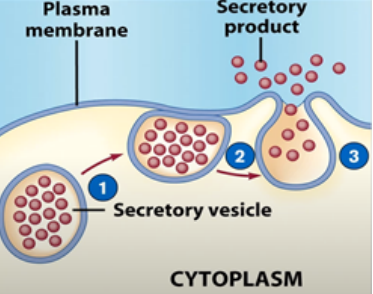
Exocytosis
4 Major Types of Movements Across Cell Membrane:
Reverse of endocytosis
Cell discharges material
Releases substances from the cell into the extracellular space
Vesicles fuse with the plasma membrane to expel contents
Example:
Neurotransmitter release at synapses
Hormone secretion (e.g., insulin from pancreatic β-cells)