History and Politics of Israel
 Call Kai
 Learn
 Practice Test
 Spaced Repetition
 Match
 Flashcards
 Knowt Play
1/54

There's no tags or description
Looks like no tags are added yet.
55 Terms
Primordial nationalism
Nationalism that relies on ancient/traditional narrative to instill a sense of national pride
Constructed nationalism
Nationalism based on tangible, physical creations like institutions and modern social constructs rather than ancient facts → includes things like currency, symbols, traditions, print, education, papers
Dreyfus Affair
Affair in the context of rivalry between Germany and FR. Rumors of a German spy among the French infantry through a forged letter. Alfred Dreyfus was tried several times with rigged trials and was eventually found guilty (by rigged trial) and sentenced to life in prison in a penal colony in French Guiana → the event itself was a catalyst because it encouraged Theodor Herzl (journalist at the time) to become inspired by the affair
Suphot beNegev
Translates directly to storms of the south→ massive waves of pogroms across Russia.
Context: Czar Alexander II expanded the rights of Jewish people in Russia. He was assassinated by a group of 7, one of which happened to be Jewish
Theodor Herzl
Father of modern zionism→ wrote for the Jewish need to create their own nationality if they’ve been told they don’t belong repeatedly
Theodor Herzl takes a full 180 and accepts this rhetoric for his own cause-> “they hate you but you have to accept it because you’re distinct”
Sends letters to many political officials across Europe to discuss Jewish problem in the 1st zionist congress-> much to his surprise, people actually follow this idea
Yehuda Pinsker
wrote auto-emancipation pamphlet-> Jews needed to stop thinking “when will we be liberated” and instead liberate themselves-> the answer= leave Russia and find home elsewhere
Pre-modern antisemitism:
Anti-semitism fueled largely/solely by religious practices and customs
Modern antisemitism:
Rose with rise of industrialization and nationalism-> not fueled by customs, but by the general personhood of the Jewish people
Urbanization meant more people, crime, and poverty
MacMahon-Hussein Correspondence:
Told Hussein that they would give him the Arabian peninsula if he staged jihad against Ottomans to defeat them-> Hussein was pissed at the Ottomans because the Ottomans pursued a Turkification policy and wanted to secure a unified sovereign kingdom across the middle east free from ottoman domination
Series of letters exchanged during WWI in recognizing Arab independence in a large region if Hussein launched the Arab Revolt against the Ottoman Empire
Arab Revolt
Jan. 1916: Sykes-Picot Agreement:
Sykes-Picot settled in secret
If the ottoman empire falls, they didn’t want to go to war with France on how to split the Middle East
Conflicts with what was promised to Sharif Hussein
Established the Sykes-Picot line
Balfour Declaration:
Letter from BR foreign secretary Arthur Balfour to British leader of jewish community on how BR would support the creation of a Jewish national home in Palestine if Zionist organizations help with BR’s cause
BR mandate of palestine
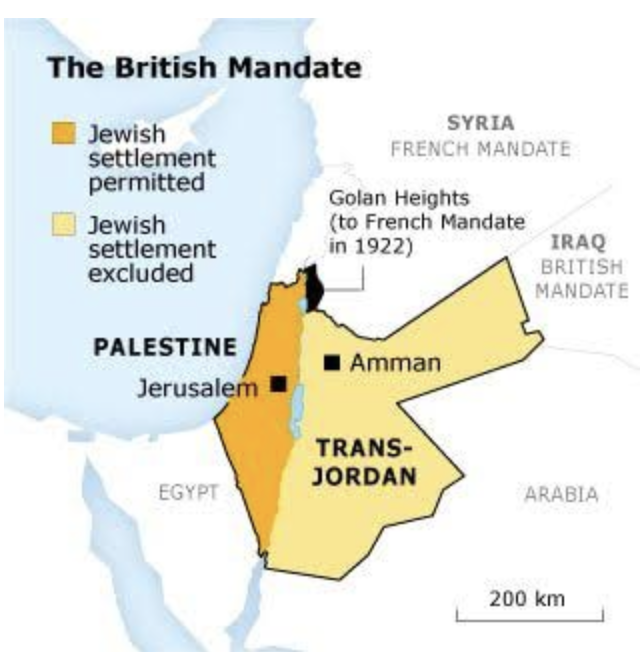
Pre-State Government Structure:
Government structure largely modeled off of BR’s parliamentary system
JNF created money for education and society to showcase that Israeli society is developing well-> JNF and Histadrut work together as a well-oiled machine in a cycle
Histadrut-> general federation of labor in Israel
Revitalized Hebrew as a language for national identity
Local Arab/Palestinian Population:
No sense of national identity in comparison to Jews
There were attempts: Faisal sent emissaries around to plan an uprising to claim cohesive national identity, which was shut down
Any type of national identity searched for by Arabs was shut down pretty quickly because of internal divisions
There was also the question of what exactly they were to protest for/against (ex: the mandate? For national identity?) People calling themselves Palestinians, Jordans, Syrians, etc.
Why was there such difference in the developments between the Jewish and Arab populations in the search for national identity?
By this point, the Jewish community was able to flesh out the foundations of its community and national identity for decades. When comparing national identities between Jewish and Palestinian communities, both had a lack of national identity. However, the reason why the Jewish community was able to prosper so well is because of the organization of the zionist movement and just that they had more time/spent more time organizing.
Basel Program
First manifesto created by the first zionist Congress, used as the first conception of a Jewish state→ strengthening Jewish agriculture, federation of all Jews into groups, strengthening jewish feeling, getting government grants for the zionist purpose
When was the world zionist organization founded
1897
El-Arish plan (1903)
the relegation of the Jewish people into the region of the northern Sinai→ the pro of this would be to get the foot in the door, the con would be that Jewish history is not settled there
Egypt also rejected this plan because it would be difficult to divert water from the Nile to irrigate this part of the Sinai
Uganda Plan (1903-1905)
Creation of a semiautonomous state in Uganda for the Jews
BR supported this plan because they felt that settling the jews there would increase the productivity of the British east africa protectorate (economically and thus offset very high costs up to that point like the newly built Uganda railway)
This time, looking for a Jewish homeland was more urgent than ever because of 1904 pogroms (especially the kishinev pogrom in Moldova)
Problem is that it would alienate the local population
Overview of the legislative system of Israel
Very pluralistic parliament→ several parliament members
120 MKs, 61 to get majority
No party has ever gotten a majority
For the first 30 years of Israel’s statehood, parliament was controlled by the Labor/Mapai party
1977→ the first year Mapai didn’t win the election→ went over to Likud
Each party needs at least 3.25% of votes/ballots
Each small party runs in the election in order to get votes from israeli voters→ after these votes are distributed among each of the many parties, the parties work together to form coalitions and see which parties will lead the resulting government
After each party forms a coalition, they need 61 of 120 seats → leaders can demand concessions for joining a certain coalition
PM is not elected separately
Even if a party holds the majority of the vote proportions, that doesn’t mean it will win because there can be an opposition bloc made up of lots of smaller parties banding together to oppose that majority-holding party
Israeli parliament distribution is also a proportional system→ percent of votes for each party determines the percent of the list that gets seats
Voters vote by party list, not by candidate
National vote share→ no districts
Dominant Party system: 1949-1977
Dominant party system→ for the first 8 elections, Mapai outdistanced rivals
Israeli elections are based on coalitions, party that wins a majority gets the first pick to form a coalition with other parties and thus form a government
Collapse of dominant system→ bipartisan system:
Collapse of Mapai was largely due to the attributes that made it succeed (centrality)
Many were unhappy with the institutions Mapai uplifted → histradut
Herut (predecessor of Likud) symbolized upward mobility, hawkish security, religious principles
Voter perspective also shifted to be more to the right and have resentment
1967 = big turning point because Israel had new captured territories (population saw security as a big voting issue for them now)
The taking of territory also meant that religious parties started to see these territories as biblically significant
1967 also ended Labor’s domination by the creation of a national unity government that included Likud on the eve of war
1973 lections→ Labor still had mininmal winning coaltion but dominating power disappeared
Since 1977, Labor has never been able to gain a dominant political position
Harari Compromise (1950)→ prevent one singular consittuion but rather have the constitution passed by several piecemeal legislation and resolution represnting different chapters of the constitution
Bipartisan/cluster system: 1996-2003
Several changes made the system bipolar: 2 major parties only separated by a few seats, smaller parties becoming satellites that support bigger parties, and the size of the two party blocs are almost equal
Heightened polarization
Coalition forming and unity governments→ each party led a cluster of small alliances of parties
Both domiant parties bring in their fringes of smaller parties to create a mass unity government
When both parties hold the same amount of votes, the only way to form a government is through national unity governments
1984: national unity governemnt after a deadlock of 40% onboth sides→ made coalitions of their own and brought in all of their fringes from left and right (Shimon and peres)
Also: 1988 and 2001 (Sharon)
1967 national unity government
Israel’s first national unity government (NUG)
Levi Eshkol (mapai) already had a majority but had to bring in other parties like Herut led by Menachim Begin because of increased security concerns with regional threats, troop build-ups, and closure of the strait of Tiran by Egypt
1992 direct election of PM
1996, 1999, 2001 special election for PM only
Idea was to strengthen main party and weaken the leverage of the smaller parties
However, what happened was that voters split the ticket→ elected PMs from large parties and voted for smaller parties in Knesset→ gave smaller parties more leverage and PM less power
What are fringe parties
Small, very extreme parties outside of the big, main, center party
Dealignment/multi-party system: 2003-2026
Different coalitions formed adhoc per election (Netanyahu talking to different politicians to form adhoc coalitions)
2003→ Likud won a very big victory under Sharon’s ledership
2005→ Major party split: Likud, Kadima, Labor, Blue-White→ Sharon left Likud to form Kadima party (centrist)
Labor also joined parts of Kadima, which made Labor shrink
Blue and White: formed 2 months before 2019 election, neck and neck with likud, then split in 2020
Blue and white was an alliance of parties that broke off after it became clear in 2020 that blue and white needed to have coalition with Likud to form a government
Center became more and more viable as a successful party→ were successful, but fell off very quickly (flavor of the week parties)
Increased center parties meant there was an increase in attention to socioeconomic issues, such as addressing price stability
Why centrist parties are like “flavor of the week” parties
Can’t join other larger parties/coalitions
Can’t create viable alternatives for a reality they don’t like
Gather disaffected people from both sides who don’t have much in common other than the fact that they’re dissatisfied
Why do national unity governments usually happen in the face of war/national security threats
Bringing in several parties together makes decision making more swift and quick instead of being hindered by a few veto votes
Also projects national unity
Mapai
Labor
Electoral advantage of oMapai allowed them to be so dominant in parliament→ middle of the party system (prevented coalitions from forming on teh left or right), was in the ideological middle (left-right socioecon, dove-hawk security, secularism-religion
How Israeli coalition politics work
After elections, president brings together all the party leaders to talk about which should be prime minister
President assigns a party leader who would have the best shot at getting 61 votes→ that party leader goes around trying to negotiate with other parties to form a coalition government
28 days + 14 day extension
If he fails, someone else is appointed
If they fail, it’s up for grabs for any MK
If that fails, new election round
Basically, what happens is that a minority party can have control over the government by forming its own coalition and getting outside support from smaller parties, whoever’s left out is the opposition
A coalition is a formal agreement with details on who gets what ministerial position, policy positions, etc.
Blocs are more informal and are just loose alliances of parties who back a specific person for PM
Blocs and coalitions in Israeli politics
A party can be in a bloc but not in a coalition→ this is becuase blocs are loose alliances on who should or shouldn’t be PM
Coalition is more detailed because the parties need to agree on a lot more details→ like budget, security, religion and state, and who controls ministry
Within these coalitions, it’s usually made up of the PM’s party and ideologically close parties, but also very small parties that may make the difference between 60 and 61 (because of this, smaller parties like religious parties get a lot more concessions than their size would suggest)
EX: Religious parties
A party in a bloc doesn’t have to be in a coalition and a coalition can take in parties from othe rblocs
Small parties get leverage because they can threaten to leave that coalition or quit because of the small margin there is to getting 61→ defections from that party can be serious too (2022 Bennett-Lapid government)
The process by which Israeli government falls/enters reelection
Histadrut
Known as the workers union of Israel→ was the mega union of every single subsection of unions based on profession
Largest labor federation of the country
Was very tied to Mapai party→ many workers were tied to the services that the Histadrut gave, thus many felt obligated to their loyalty for Mapai
Provided key services like healthcare, education, job security/help
Reached its peak in 1960s, fell off in 199-s
Confidence vs no-confidence votes
Opposition (parties not in the majority coalition) are able to use a no confidence vote as leverage by offering an alternative form of government that would get 61 votes
What does section 7a of Basic Law: the Knesset say
Candidate list of MK cannot run in Knesset if their campaign has any of the goals:
Negation of the state (denying the existence of the state of Israel as a Jewish and democratic state)
Racism
Support for armed struggle by a hostile state or terrorist organization against Israel