D1.2 Protein synthesis
 Call Kai
 Learn
Learn Practice Test
 Spaced Repetition
 Match
Match Flashcards
 Knowt Play
1/49

Earn XP
Name | Mastery | Learn | Test | Matching | Spaced | Call with Kai | Chat |
|---|
No analytics yet
Send a link to your students to track their progress
50 Terms
number of strands : 1 & 2
type of sugar: ribose & deoxyribose
base differences: uracil & thymine
What are the differences between RNA and DNA?
the synthesis of RNA, using DNA as a template
The enzyme RNA polymerase transcribes DNA to RNA.
Define Transcription
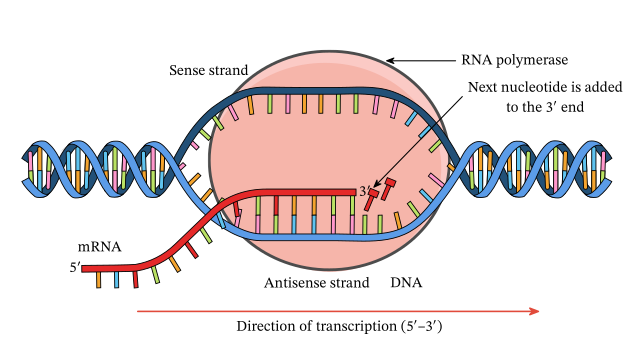
Occurs in nucleus of the cell
RNA Polyamersae attaches to the begging of a gene on DNA
RNA Polymerase seperates the two DNA strands
An mRNA molecule (produced on the template DNA strand) uses the enzyme to link RNA nucleotides into a single polynucleotide (condensation reaction)
RNA polymerase uses complementry base pairings to pair DNA + RNA nucleotides
RNA Polymerase reaches the end of the gene, the mRNA molecule is released
Transcription Steps:
DNA Base | RNA Base |
Adenine (A) | Uracil (U) |
Guanine (G) | Cytosine (C) |
Cytosine (C) | Guanine (G) |
Thymine (T) | Adenine (A) |
held together by hydrogen bonds
What are the complementry base pairs of DNA and RNA, what are they held together by?
strong covalent bonds between nucleotides
Why is DNA a stable molecule?
non-reproductive cells in organism
What are somatic cells?
as they don’t divide, single DNA strands can be used as a template for transcribing a base sequence, without the DNA base sequence changing, such sequences must be conserved throughout the life of a cell
What must be conserved in somatic cells?
Transcription
Translation
What two stages does protein synthesis consist of?
the synthesis of polypeptides (proteins) by ribosomes, using genetic code of mRNA
Define Translation
process where genetic information in a gene is used to synthesize a functional polypeptide
Define Gene Expression
gene must be transcribed to mRNA mRNA can be translated by a ribosome
If transcription doesn’t occur, neither can translation
Order in protein synthesis
by regulating transcription of genes
How can gene expression be switched on or off?
ribosomes require messenger RNA (mRNA) and transfer RNA (tRNA)
What is required for translation?
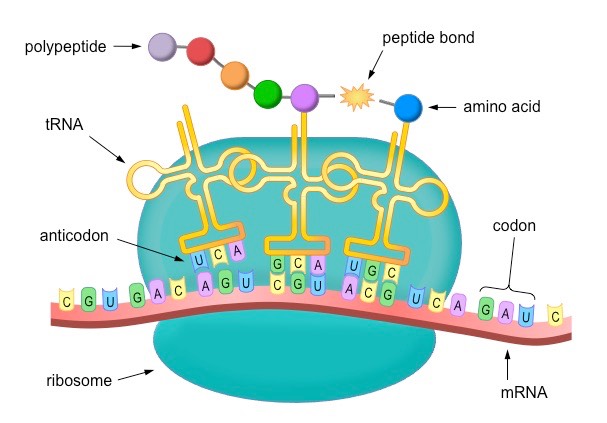
mRNA brings the genetic code to the ribosome/containas genetic form of codons
tRNA brings amino acids to the ribosome
Function of mRNA and tRNA
organells found in cells which translate genetic code of mRNA to a polypeptide
What are ribosomes?
small subunit
large subunit
What are ribosomes composed of?
sequence of three nucleotides that code for an amino acid
What are codons?
ribosomes use a sequence of codons on mRNA to determine the sequence of amino acids in a polypeptide
What determines the sequence of a polypeptide?
two tRNA molecules can bind simoulanously to the large subunit oif
mRNA binds to small subunit of ribosome to initiate translation
transfers amino acids from cytoplasm to the ribosome
tRNA have an anticodon which binds to mRNA codons
the binding of mRNA and the tRNA’s anticodeons in the ribosome by complamentry base pairing ensure the correct sequence of amino acids are synthesized
WHat are the steps of translation?
20 found in proteins
how many amino acids are found in living organisms?
by combining nucleotides into sequences of 3, producing in total 64
how does the genetic code code for them?
20
For how many different amino acids can these codons code for?
three
don’t code for amino acids and terminate translation
How many STOP codons are there? What do they do?
more than one codon may code for the same amino acid
Define degenerate
whoops! describe movement of ribosome
polypeptide chain grows
didnt do d1.2.10
change to the DNA sequence of an organism
Define Mutation
a single substitution mutation to a nucleotide in the alpha globin molecule in hemoglobin
What can cause sickle cell anemia?
invloves swapping one nucleotide for another
Define base substitutuion mutation
causes the shape of RBC to change into a sickle shape which may block small blood vessels
Why is sickle cell anemia bad?
regulator proteins which attach to the promoter region
WHat are transcription factors?
wether RNA polymerase can attach to the promoter region, controlling gebe expression
WHat do transcription factors control?
gene sequences that code for mRNA
expressed as functional polypeptides
What are coding sequences of DNA?
sections that don’t code for functional polypeptides
some sections have functions like:
controlling gene expression(can decide the transcription of genes)
genes for rRNA and tRNA
telomeres
What are non-coding sequences of DNA?
repeptative base sequences at the ends of chromosomes
WHat are telomeres?
come bac to d1.2.14
sections of DNA that don’t code for a protein and interrupt gene sequences
what are Introns?
sections of DNA and RNA that do code for proteins
what are Exons?
they’re removed from mRNA
What happens to introns after transcription?
scray tf
skip D1.2.15
Aminoacyl site
Peptidyl site
Exit site
What are th A, P, E site?
tRNA brings new amino acids to be added to the elongating polypeptide chain
Function of A site?
holds the tRNA
peptide bond forms between amino acids in A and P site which releases tRNA into E site
Function of P site?
after tRNA enters E site it’s released from the ribosome
Function of E site?
Initiation
Elongation
Termination
What are the three stages of Translation?
d1.2.17 look through it bb
must be modified
What must happen to polypeptides before they can function?
single popypeptide removed through endoplasmic reticulum to create pro-insulin
sent and packaged into secretory vesel
ALPHA & BETA chains join by dislulfide bonds to form functional insulin
insulin secreted into bloodstream
WHat must happen to pre-insulin so that it’s functional?
entire complement of proteins that is expressed by a cell or organism
What are Proteasomes?
broken down to amino acids through proteasomes
hydrolysis reaction
What happens to proteins that are no longer required by cell?
recylced to synthesized proteins that are required by cell
What happens with these amino acids?