Drugs and Society- Exam #2
 Call Kai
 Learn
 Practice Test
 Spaced Repetition
 Match
 Flashcards
 Knowt Play
1/114

There's no tags or description
Looks like no tags are added yet.
115 Terms
how drugs enter the body
Oral Administration
Ingesting a drug by mouth (later digesting it and absorbing it into the bloodstream through the gastrointestinal tract) is the oldest and easiest way of taking a drug.
Most of the absorption process is accomplished between 5 and 30 minutes after ingestion, but absorption may not be complete for as long as six–eight hours. Therefore, there is at least a little time after accidental overdoses or suicide attempts to induce vomiting or pump the stomach.
On the other hand, the gastrointestinal tract contains a number of natural barriers that may prevent certain drugs that we want absorbed into the bloodstream from doing so. One determining factor is the degree of alkalinity or acidity in the drug, as measured by its pH value. The interior of the stomach is highly acidic, and the fate of a particular drug depends upon how it reacts with that environment. Weakly acidic drugs such as aspirin are absorbed better in the stomach than highly alkaline drugs such as morphine, heroin, or cocaine. Insulin is destroyed by stomach acid, so it cannot be administered orally, whereas a neutral substance such as alcohol is readily absorbed at all points in the gastrointestinal tract.
If it survives the stomach, the drug needs to proceed from the small intestine into the bloodstream. The membrane separating the intestinal wall from blood capillaries is made up of two layers of fat molecules, making it necessary for substances to be lipid-soluble, or soluble in fats, to pass through. There are enzymes in the liver that destroy a drug by metabolizing (breaking down) its molecular structure prior to its excretion from the body. There is a further barrier separating the bloodstream (circulatory system) from brain tissue, called the blood–brain barrier, which determines a drug’s psychoactive effects. Any drug that cannot pass the blood–brain barrier will not have psychoactive effects.
All injections require a needle to pierce the skin, so there is a risk of infection if the needle is not sterile. The practice of injecting heroin or cocaine with shared needles, for example, promotes the spread of infectious hepatitis and HIV. On the other hand, if administered orally, drugs do not have to be any more sterile than the foods we eat or the water we drink.
how drugs enter the body
Injection
A solution to the problems of oral administration is to bypass the digestive process entirely and deliver the drug directly into the bloodstream. One option is to inject the drug through a hypodermic syringe and needle.
how drugs enter the body
Injection
intravenous
The fastest means of injection is an intravenous (i.v.) injection, since the drug is delivered into a vein without any intermediary tissue. An intravenous injection of heroin in the forearm, for example, arrives at the brain in less than 15 seconds. The effects of abused drugs delivered in this way, often called mainlining, are not only rapid but also extremely intense. In a medical setting, intravenous injections provide an extreme amount of control over dosage and the opportunity to administer multiple drugs at the same time. The principal disadvantage, however, is that the effects of an intravenous administration drug are irreversible. In the event of a mistake or unexpected reaction, there is no turning back unless some other drug is available that can counteract the first one. In addition, repeated injections through a particular vein may cause the vein to collapse or develop a blood clot.
how drugs enter the body
Injection
intramuscular (i.m.) injections,
With intramuscular (i.m.) injections, the drug is delivered into a large muscle (usually in the upper arm, thigh, or buttock) and is absorbed into the bloodstream through the capillaries serving the muscle. Intramuscular injections have slower absorption times than intravenous injections, but they can be administered more rapidly in emergency situations. Our exposure to intramuscular injections comes early in our lives when we receive the standard schedule of inoculations or get a flu shot.
how drugs enter the body
Injection
subcutaneous (s.c. or sub-Q
A third injection technique is the subcutaneous (s.c. or sub-Q) delivery, in which a needle is inserted into the tissue just underneath the skin. Because the skin has a less abundant blood supply relative to a muscle, a subcutaneous injection has the slowest absorption time of all the injection techniques. It is best suited for situations in which it is desirable to have a precise control over the dosage and a steady absorption into the bloodstream. The skin, however, may be easily irritated by this procedure. As a result, only relatively small amounts of a drug can be injected under the skin compared with the quantity that can be injected into a muscle or vein. When involved in drug abuse, subcutaneous injections are often referred to as skin-popping.
how drugs enter the body
Inhalation
Next to ingesting a drug by mouth, the simplest way of receiving its effects is to inhale it in some form of gaseous or vaporous state. The alveoli within the lungs can be imagined as a huge surface area with blood vessels lying immediately behind it. Our bodies are so dependent upon the oxygen in the air we breathe that we have evolved an extremely efficient system for getting oxygen to its destinations. As a consequence of this highly developed system, the psychoactive effect of an inhaled drug is even faster than a drug delivered through intravenous injection. Traveling from the lungs to the brain takes only five to eight seconds.
Drugs such as paint thinners, gasoline, and glues also can be inhaled because they evaporate easily and the vapors travel freely through the air. In medical settings, drugs that produce general anesthesia are administered through inhalation, since the concentration of the drug can be precisely controlled.
how drugs enter the body
Inhalation
burn it and breathe in the smoke-borne particles in the air.
One way of delivering a drug through inhalation is to burn it and breathe in the smoke-borne particles in the air. Drugs administered through smoking include nicotine from cigarettes, opium, tetrahydrocannabinol (THC) from marijuana, free-base cocaine, crack cocaine, and crystallized forms of methamphetamine.
how drugs enter the body
Inhalation
Drugs such as paint thinners, gasoline, and glues also can be inhaled because they evaporate easily and the vapors travel freely through the air.
Drugs such as paint thinners, gasoline, and glues also can be inhaled because they evaporate easily and the vapors travel freely through the air. In medical settings, drugs that produce general anesthesia are administered through inhalation, since the concentration of the drug can be precisely controlled.
how drugs enter the body
Absorption through the Skin or Membranes
A drug can enter the body through its transport across layers of the skin or through absorption into highly vascularized membranes of the nose, tongue, cheek, or rectum.
how drugs enter the body
Absorption through the Skin or Membranes
intranasal administration.
Sniffing or snorting a drug in dust or its powder form into the nose is referred to as intranasal administration. Once inside the nose, the drug adheres to thin mucous membranes and dissolves through the membranes into the bloodstream. The intranasal technique is commonly used in taking snuff tobacco or cocaine
how drugs enter the body
Absorption through the Skin or Membranes
sublingually,
Snuff tobacco, chewing tobacco, and cocaine-containing coca leaves can be chewed without swallowing or simply placed in the inner surface of the cheek and slowly absorbed through the membranes of the mouth. Nicotine chewing gums, available for those individuals who wish to quit tobacco smoking, work in a similar way. Nitroglycerin tablets for heart disease patients are typically administered sublingually, with the drug placed underneath the tongue and absorbed into the bloodstream. Medicines can also be placed as a suppository into the rectum, where the suppository gradually melts, and the medicine is absorbed through thin rectal membranes. This method is less reliable than an oral administration, but it may be necessary if the individual is vomiting or unconscious.
how drugs enter the body
Absorption through the Skin or Membranes
transdermal patch
Another absorption technique involves a transdermal patch, which allows a drug to slowly diffuse through the skin without breaking the skin surface. Transdermal patches have been used for long-term administration of nitroglycerin, estrogen, motion-sickness medication, and more recently, nicotine. Newly developed procedures to enhance the process of skin penetration include the promising technique of administering low-frequency ultrasound, which allows large molecules such as insulin to pass through the skin. Alternative methods include small silicon chip patches containing a grid of microscopic needles that painlessly pierce the skin and allow the passage of large molecules into the bloodstream. Future techniques include transmitting ultrasound waves to increase skin permeability or combining medications with special compounds that help the medication slip through skin pores
substance use disorder
The DSM-5: Defining Substance Use Disorders
For any treatment program to be effective, whether the problems are drug-related or not, a system of guidelines must be in place to establish an appropriate diagnosis. In the case of drug-related problems, health professionals in the United States use a set of specific behavioral circumstances that serve as criteria for a diagnosis, just as symptoms serve as criteria for a physical disease.
From the perspective of a health professional, the goal is to reduce the incidence of drug-related problems in an individual’s life through a therapeutic intervention. The emphasis in making a diagnosis is on the adverse impact of drug-taking behavior on his or her life, independent of any possible illegality that may be involved in the behavior itself.
The Diagnostic and Statistical Manual of Mental Disorders (referred to as the “DSM”), issued under the auspices of the American Psychiatric Association, has been the official standard for defining and diagnosing a wide range of psychological disorders, including those related to drug-taking behavior. The fifth edition of the manual (referred to as DSM-5) establishes a diagnosis of substance use disorder on the basis of 11 possible behavioral circumstances (or criteria). As we will see, a minimum number of criteria must be met for this diagnosis-
Impaired control, Social impairment, Risky use, Pharmacological effects.
substance use disorder
The DSM-5: Defining Substance Use Disorders
The 11 possible criteria for substance use disorder can be viewed in terms of four groupings of dysfunctional behavior:
Impaired control, Social impairment, Risky use, Pharmacological effects.
Impaired control: A substance may be taken in larger amounts or over a longer period of time than the individual originally intended (Criterion 1). There may be a persistent desire to cut down or regulate substance use or there may be multiple unsuccessful attempts to cut down or discontinue substance use (Criterion 2). A great deal of time may be spent obtaining the substance, using it, or recovering its effects (Criterion 3). There may be intense urges or cravings to engage in substance use or times in which the individual cannot think of anything else
substance use disorder
The DSM-5: Defining Substance Use Disorders
The 11 possible criteria for substance use disorder can be viewed in terms of four groupings of dysfunctional behavior:
Impaired control, Social impairment, Risky use, Pharmacological effects.
Social impairment: There may be a failure in fulfilling a major role obligation at work, at school, or at home as a consequence of substance use. Substance use may be continued despite the persistence or recurrence of social or interpersonal problems associated with use. An individual may withdraw from, reduce, or give up on important social, occupational, or recreational activities because of substance use
substance use disorder
The DSM-5: Defining Substance Use Disorders
The 11 possible criteria for substance use disorder can be viewed in terms of four groupings of dysfunctional behavior:
Impaired control, Social impairment, Risky use, Pharmacological effects.
Risky use: There may be multiple times when substance use has occurred in a physically hazardous situation. Substance use may continue despite the knowledge that it is likely to cause or exacerbate a physical or psychological problem. In other words, there is a failure to abstain from using the substance even though the individual recognizes the problems substance use is causing
substance use disorder
The DSM-5: Defining Substance Use Disorders
The 11 possible criteria for substance use disorder can be viewed in terms of four groupings of dysfunctional behavior:
Impaired control, Social impairment, Risky use, Pharmacological effects.
Pharmacological effects: Over time, there may be a development of tolerance to the effects of the substance being used. For those substances for which significant withdrawal symptoms have been documented in humans (e.g., alcohol, opioids, sedative-hypnotics, and antianxiety medications), withdrawal symptoms may be observed. However, in cases in which withdrawal symptoms are not documented to occur in humans, such as with hallucinogen use or inhalant use, is not considered in arriving at a diagnosis.
substance use disorder
The DSM-5: Defining Substance Use Disorders
The 11 possible criteria for substance use disorder can be viewed in terms of four groupings of dysfunctional behavior:
Impaired control, Social impairment, Risky use, Pharmacological effects.
According to the DSM-5, the severity of substance use disorder is defined in terms of the number of criteria that apply for a given individual. The presence of two or three criteria indicates a mild level of substance use disorder; the presence of four to five criteria indicates a moderate level; and the presence of six or more criteria indicates a severe condition.
substance use disorder
The DSM-5: Defining Substance Use Disorders
The 11 possible criteria for substance use disorder can be viewed in terms of four groupings of dysfunctional behavior: Impaired control, Social impairment, Risky use, Pharmacological effects.
Three major points should be made with respect to the terminology used in the DSM-5 system.
First, the phrase “substance use” is used throughout rather than “drug use” since it is acknowledged that confusion often exists in the public mind about the consumption of alcohol or tobacco products as representing a form of drug-taking behavior.
Second, separate diagnoses for substance abuse and substance dependence previously established in an earlier edition of the DSM (specifically DSM-IV-TR), with the latter indicating a greater severity of dysfunction, have been eliminated in DSM-5. It has been felt that the clinical treatment of drug-related problems can be more easily carried out with a singular diagnosis and the use of a scale of severity-of-symptoms as a rough approximation of the degree of dysfunctionality. The general guideline of fulfilling six or more criteria for substance use disorder (establishing a diagnosis of severe substance use disorder) can be considered equivalent to the older diagnosis of substance dependence.
Three, when a single drug is involved, the diagnosis of substance use disorder is identified in the context of that drug. As examples, the DSM-5 establishes separate diagnoses of opioid use disorder (when opioids are involved), stimulant use disorder, hallucinogen use disorder, cannabis use disorder, or alcohol use disorder. With the exception of those cases in which Criterion 11 is not considered (such as halluciinogen use or inhalant use), the same behavioral criteria in the DSM-5 are used, no matter what drug is involved
theoretical perspectives on drug use
Why do people take drugs? We all take drugs, of course, for genuine therapeutic reasons, to relieve ourselves of pain or symptoms that arise from a range of physical or psychological disorders. Yet why do people take drugs on a purely recreational basis? Is it for sheer pleasure, to escape from a life of boredom, to suppress feelings of sorrow and depression, to fit in with a group of friends, to relieve stress, or is there some propensity toward drug-taking behavior that is rooted in the neurochemistry of the brain? This section of the chapter will explore theoretical perspectives around why individuals use and abuse drugs.
theoretical perspectives on drug use
moral model
The oldest theory of drug abuse, and arguably the oldest theory to explain disapproved behavior in general, has its origin in demonology. Why would you do something bad? Answer: “Because the devil made me do it.” We have certainly moved away from believing that an evil spirit (or anything outside our experience) invokes bad behavior, but, strangely enough, a modern version of this belief continues to influence the way people might think about drug abuse. To some, a drug abuser is an individual who is morally deficient, who, because of personal inadequacies, overindulgence, a weakness of will, or other character flaw, has succumbed to a pattern of drug-taking behavior that has taken over his or her life and those around him or her. A nonreligious version of this point of view is the moral model of drug abuse. According to the moral model, drug-taking behavior is simply a matter of personal choice that we have made in our lives, and not a consequence of a biological defect, a psychological dysfunction, or sociological circumstances
theoretical perspectives on drug use
The biopsychosocial model
Biological Perspectives, Psychological Perspectives, Sociological Perspectives
The biopsychosocial model is another way of understanding substance abuse via the interplay of biological, psychological, and sociological factors. In this model, genetics, brain disease and other biological factors are recognized, as is the important role that the environment and psychological development play in the process of developing and maintaining an addiction. In this section, the three perspectives on drug-taking behavior (biological, psychological, and sociological) will form the basis for an examination of a variety of explanatory theories
theoretical perspectives on drug use
Biological Perspectives on Drug Abuse
When we theorize about the origins of drug abuse from a biological perspective, we are referring to specific physical mechanisms in specific individuals that influence the initial experience with drugs or an engagement in drug abuse over a period of time. Biological theories have focused primarily on genetic factors, physiological factors, and neurochemical systems in the brain.
theoretical perspectives on drug use
Biological Perspectives on Drug Abuse
Genetic Factors
As genetic research has advanced over the years, particularly since the completion of the mapping of the human genome in 2000, a great deal of attention has focused on the contribution that certain genetic traits make toward the abuse of a range of drugs. While environmental factors are also undoubtedly important, recent studies have shown that genetic factors play an equal or even greater role. Studies of different strains of mice and rats, for example, have found that some have a genetic propensity to become dependent upon cocaine, whereas other strains are more susceptible to the dependence-producing effects of opiates.
Most studies concerning genetic factors in humans have focused on alcoholic individuals, and a growing research literature indicates that alcoholism has a genetic component. Family studies have shown that children of alcoholics are four times more likely than other children to become alcoholics. Identical twins (those who have identical genetic compositions) are more likely to have a similar risk for alcoholism than fraternal twins, who share only half their genetic traits with each other. In addition, children who have at least one alcoholic biological parent and were adopted by nonalcoholic parents are three times more likely to have a problem with alcohol, even when they have been raised in a low-risk environment.
We have yet to identify the single gene or complete set of genes responsible for the emergence of alcoholism, much less the interaction of gene expression that increases the likelihood of alcoholic behavior. Like cancer and heart disease, alcoholism is considered to be genetically complex, distinguishing it from diseases such as cystic fibrosis, which results from the mutation of a single gene. In the case of alcoholism, genes are likely to be associated with liver enzymes that metabolize (break down) alcohol as well as specific patterns of brain chemistry. Even so, we are not speaking of genetic factors producing these effects in a deterministic manner. We are speaking of a predisposition toward alcohol misuse, which can increase the probability of alcoholism

theoretical perspectives on drug use
Biological Perspectives on Drug Abuse
Neurochemical Systems in the Brain
Amphetamines, cocaine, heroin, alcohol, and nicotine may be very different from a pharmacological standpoint, but the way people and animals react to them are remarkably similar. Use of these substances results in a pattern of compulsive behavior that is based on an intense drive to repeat the experience. We cannot determine whether animals are “craving” these substances, but we certainly recognize feelings of craving in humans. In general, the similarities among all of these drugs and across species are numerous enough to entertain the idea that there exists a common neurochemical system in the brain that links them all together.
There are two elements in understanding the intensely rewarding effect of certain psychoactive drugs. The first of these is the existence of brain chemicals called neurotransmitters, which allow neurons in the brain to communicate with each other. A specific neurotransmitter of interest with respect to drug abuse is dopamine. The second is the existence of an area in the brain called the nucleus accumbens.
The significance of the nucleus accumbens is that animals will work hard to produce an increase in its activity. As with animal experiments involving self-administration of drugs, researchers have been able to conduct studies in which the pressing of a lever causes electrical brain stimulation in a localized fashion. We cannot say how animals are feeling at the time, but their behavior indicates that they are intensely motivated toward “turning on” this region of their brains. Their compulsive efforts to receive this stimulation are unmistakable. Since self-administration behavior in animals closely parallels the pattern of human behavior that characterizes psychological dependence, studies of this kind can be used to understand the neural changes that occur as a consequence of drug abuse.
It is one thing to speculate about the effects of drug dependence on the brain, to assert that the transition from initially being a voluntary drug user to becoming a compulsive drug user is a matter of subtle but significant brain changes. It is quite another thing to show the effects themselves at a neurochemical level.
In other words, it is reasonable to assume a connection to the human experience: the craving, the intense “rush,” and compulsive drug-taking behavior associated with heroin, cocaine, amphetamines, or a host of other dependence-producing drugs. When laboratory animals are administered amphetamines, heroin, cocaine, alcohol, or nicotine, for example, there is a rapid increase in the level of dopamine activity in the nucleus accumbens. Hence, most drugs target the brain’s reward system by releasing a large amount of dopamine, activating feelings of euphoria, which reinforces continued drug use. Administration of any substance that interferes with dopamine activity in this region eliminates the desire of animals to work for the self-administration of these abused drugs. Considering the evidence now in hand, a persuasive argument can be made that dopamine-related processes in the nucleus accumbens underlie the reinforcing effects of many abused drugs. Research also shows an involvement of the nucleus accumbens in compulsive gambling and eating disorders as well.
Research on the influence of dopamine in drug dependence can help us understand why some individuals may be more susceptible than others to drug-taking behavior. In one study, for example, 23 drug-free men with no history of drug abuse were given doses of methylphenidate (brand name: Ritalin), a psychoactive stimulant when ingested by adults. Twelve of the men experienced a pleasant feeling, nine felt annoyed or distrustful, and two felt nothing at all. Measurements of dopamine receptors in the brains of these subjects showed a consistent pattern. The men with the least concentration of dopamine receptors were the ones experiencing pleasant effects. It is reasonable to hypothesize that those individuals with the fewest dopamine receptors might be the most vulnerable to drug abuse. The understanding we now have about the neurochemical processes underlying dependence has significant implications for drug-abuse treatment.
It is important to note that continued drug use causes the brain to adjust. The brain counteracts surges in dopamine and other neurotransmitters from drug use by producing less dopamine or decreasing the receptors that can receive signals. This makes it difficult for a drug abuser to experience feelings of pleasure naturally. This is why drug abusers often look and feel “flat” or “burned out.” This is also a contributor to drug tolerance, where individuals have to take more of a substance to get the same high. You will sometimes hear drug abusers talk about catching that first high. In addition to building tolerance, long-term addiction affects how the brain processes information, making it difficult for drug abusers to make sound decisions

theoretical perspectives on drug use
Biological Perspectives on Drug Abuse
Psychological
Physiological Factors
One physiological factor hypothesized to be involved in drug abuse has to do with metabolic processes in the body. In other words, people might differ in the extent to which chemicals in the body are broken down or changed in some way to allow us to function normally. For example, it has been proposed that chronic heroin abuse might be due to a metabolic defect in the bodies of heroin abusers. Just as Type 1 diabetics have an insufficient level of insulin that prevents them from processing glucose in a normal fashion, heroin abusers may have an inborn deficiency with respect to natural opiate-like chemicals produced by the brain itself, and, as a result, they feel compelled to seek out substances from the environment to make up for that deficiency. From this perspective, heroin abusers are “normalizing” their body by indulging in heroin abuse. A specific dysfunctional system in the body of a heroin abuser, however, is yet to be discovered. At present, the evidence of a metabolic defect is only circumstantial. In other words, heroin-dependent individuals appear to behave as if they have a metabolic imbalance with respect to opioids (opiate-related drugs) in general.
theoretical perspectives on drug use
Biological Perspectives on Drug Abuse
Psychological
Behavioral Theories
Behavioral theories emphasize the role of learning through the principle of reinforcement. According to the behavioral point of view, practically all of human behavior is learned. In other words, addiction to a drug or alcohol is a consequence of having modified one’s behaviors based on how those behaviors were rewarded.
The overarching principle of behavioral theory is that any behavior that is followed by a reward (reinforcement) is more likely to be repeated in the future. Repeated rewards will result in a continuing pattern of behavior that can be weakened only when these reinforcers are removed (a process called extinction) or other behaviors are now reinforced (a process called counterconditioning). Think about the range of reinforcers individuals get from getting high on marijuana. Rewards might include the “high” feeling, socializing with friends that are also getting high, fitting in, feeling relaxed and free of anxiety, and having a good time.
Individuals using a drug with a high reinforcement potential typically report that they care more about obtaining and using the drug than just about anything else in their life. In this case, reinforcers related to drug-taking behavior exceed or overcome competing reinforcers, such as the benefits derived from a job, financial security, or satisfying relationships with friends and family.
While behavior theorists make the distinction between positive reinforcement (gained through the attainment of a pleasurable circumstance—for example, feeling high, having fun with friends) and negative reinforcement (gained through the reduction of a painful or uncomfortable circumstance—for example, reducing anxiety or depression), the principle of reinforcement remains the same. The reinforcement of heroin abuse can focus either on the reexperiencing of the euphoric feelings associated with heroin (positive reinforcement) or on the relief from uncomfortable feelings associated with heroin withdrawal (negative reinforcement).
Which aspect of reinforcement is emphasized among drug abusers in general can determine the pattern of drug-taking behavior. Those guided by the positive reinforcement of the drug experience are often referred to as euphoria seekers, and those guided by the negative reinforcement of withdrawal relief are referred to as maintainers. Euphoria seekers typically display a compulsive pattern of drug-taking behavior.
In the case of heroin abuse, maintainers tend to consume just enough heroin to avoid the withdrawal symptoms that would occur if their pattern of heroin abuse were to cease. They try to stay within the conventionality of their social community as they “nurse” their habit along. Euphoria seekers, however, are inclined to be so heavily into the pleasurable aspects of heroin that their lives spiral out of control. They descend into a lifestyle dominated by the drug. Social conventionality is no longer possible. There are case studies of heroin abusers (called “chippers”), who have successfully maintained occasional heroin use over an extended period of time, but clearly their lives are extremely precarious.
Social reinforcement for substance abuse can be just as difficult to combat as the physiological reinforcement. Think about an adolescent struggling with substance misuse who decides to stop using substances. How might this youth’s peers respond when he reports that he no longer drinks, smokes, or does pills? Peers who engage in substance use are likely to reinforce use by peers and punish abstention by giving clean youth a hard time. Individuals who are justice-involved often grow up in environments where family, friends, and community members misuse substances. The ability to refrain from use, even with legal consequences, becomes a significant challenge as reinforcers for substance abuse are all around.
theoretical perspectives on drug use
Biological Perspectives on Drug Abuse
Psychological
Behavioral Theories #2 -Conditoning
A visual image of white powder, resembling lines of cocaine, along with a razor blade, tends to elicit powerful feelings of craving among individuals with earlier experiences of cocaine abuse.
Behavioral theorists also assert that specific cues or situations have the capability of stimulating powerful drug cravings brought on by memories of past pleasurable (reinforcing) experiences. Through a process of Pavlovian conditioning (discussed earlier in this chapter in the context of behavioral tolerance), drug users associate drug use with certain visual cues, specific friends and situations, or even a song. Cigarette smokers, for example, commonly report that it is difficult to abstain from smoking when drinking alcohol, talking on the phone, or driving a car if these circumstances have been closely associated with smoking behavior. Some marijuana users report cravings after seeing paraphernalia used in smoking marijuana, such as a bong or pipe, while heroin injectors may crave heroin after viewing a hypodermic needle.
Conditioned cues are very difficult to break and can present major obstacles to overcome on the path to drug-abuse recovery. Drug-abuse treatment efforts are often cut short by the appearance of cues that have played an important part in previous drug-taking behavior. Counseling professionals believe that it is essential that individuals break both their pharmacological and their psychological (behavioral) dependence
theoretical perspectives on drug use
Biological Perspectives on Drug Abuse
Psychological
Cognitive theories
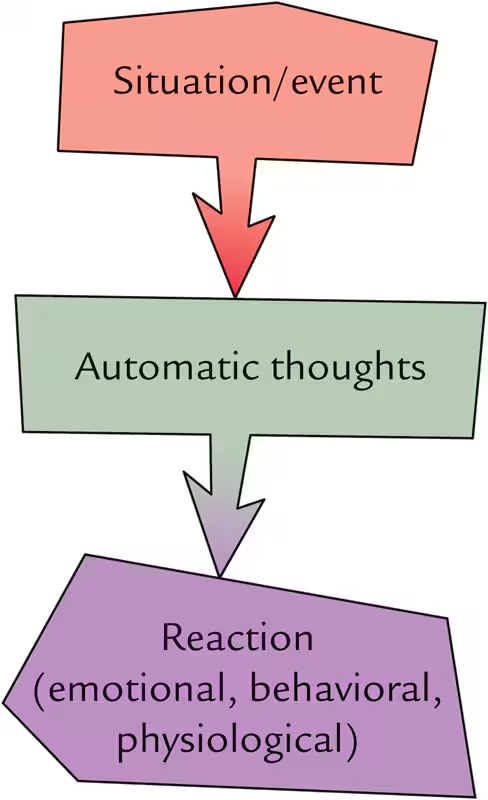
According to cognitive theories, thoughts and beliefs drive behaviors. In other words, a person’s feelings (both emotions and physical sensations) and behavior are the result of that person’s perception of a situation. Figure 8.3 shows how the model works. Here, Judith S. Beck, a leading cognitive therapist, identifies a situation or event, which triggers automatic thoughts (or thoughts that occur spontaneously, immediately after one encounters the situation) which then leads to a reaction or response to the situation, including a feeling and action. The feeling and action stem from how one interprets the situation.
Hence, the cognitive model assumes that it is the thoughts that drive how one ultimately responds to a situation. Cognitive strategies for substance abusers involve cognitive restructuring, or the process of identifying risky or irrational thoughts, and challenging and changing these thoughts, to help change behaviors. Typical risky thoughts for drug abusers are that “my drug use isn’t hurting anyone,” “marijuana comes from the earth,” or “this will be the last time.” The goal with cognitive restructuring is to identify the specific risky thoughts that accompany a person’s using behavior and help them to change that pattern of thinking.
The other important component to cognitive theory is the role of beliefs. Beliefs are the ideas people have about themselves and the world. Under a cognitive model, beliefs form based on one’s experiences from early childhood and beyond, and one’s beliefs inform their automatic thinking, or immediate interpretation of situations.32 Beliefs are important in a cognitive model as they are the foundation from which individuals behave. In the above situation, if it is a young man’s belief that “I will never amount to anything,” then whenever a high-risk situation is encountered, he is likely to revert to using drugs. Conversely, if his belief is that “drugs destroy lives,” he is more likely to respond by avoiding his old drug dealer.
Albert Ellis, who developed Rational Emotive Behavior Therapy (REBT), has focused extensively on the role of thoughts
theoretical perspectives on drug use
Biological Perspectives on Drug Abuse
Psychological
Cognitive theories
Take the example of a person just out of rehab who returns to his neighborhood and sees his old drug dealer. The following sequence may occur:
Situation: I just got out of rehab yesterday, I’m walking to the store and I see my old drug dealer.
Automatic thoughts: “Oh man, I need to stay clean”; “this guy is no good”; “I gotta get out of this situation.”
Reaction: He feels nervous (emotional), shaky (physiological), and crosses the street (behavioral response).
Let’s look at the same guy, in the same situation, and see how a change in the interpretation of the situation impacts the outcome:
Situation: I just got out of rehab yesterday, I’m walking to the store and I see my old drug dealer.
Automatic thoughts: “Yes! I need a score”, “finally, some relief,” “no big deal... no one will find out.”
Reaction: He feels anxious to get high and excited (emotional), restless (physiological), and approaches the drug dealer (behavioral reaction).

theoretical perspectives on drug use
Biological Perspectives on Drug Abuse
Psychological
Personality Theories
Non-psychoanalytic personality theories - impulsive, sensation seeking, risk-taking
Personality disorders
Psychological explanations of drug abuse can also emphasize a constellation of personality traits that distinguish drug abusers from non-abusers. This theory argues that some individuals have an “addictive personality,” or specific factors or traits that lead to substance abuse. One of the first empirical studies to examine the concept “addictive personality” found there was no single trait that led to addiction, rather a set of personality factors associated with individuals who abused alcohol or drugs. Factors included (1) impulsivity and the need for immediate gratification, (2) sensation seeking, (3) valuing nonconformity over following social norms, (4) high experience of stress with lack of coping skills, and (5) accepting defiant behavior in others and social isolation.
Today, many of these traits are associated with the diagnosis of antisocial personality disorder. Individuals with antisocial personality disorder are typically impulsive, sensation seeking, and immature, and they tend to engage in law violating behaviors. Individuals displaying these traits may be more prone to abuse drugs because of their increased need for stimulation, excitement, and immediate gratification, and their apathy toward following societal norms. Sensation-seeking people are essentially risk takers, and drug use epitomizes risk-taking behavior, particularly in adolescence.
Individuals that struggle with stress, anxiety and depression, and lack the coping skills to manage it, and people
theoretical perspectives on drug use
Sociological Perspectives on Drug Abuse
For sociologists, environmental and societal factors play an especially important role in drug use and abuse. The focus of sociological theories is quite different from the focus of theories associated with either a biological or psychological perspective. The emphasis is not on the individual alone, but the individual embedded in social situations, social relationships, and social structures.40
During the Vietnam War, for example, a large proportion of American troops used and abused heroin, which was available in Vietnam at extraordinarily high levels of purity. It is reasonable to assume that easy access to heroin in the context of being in a strange and dangerous environment encouraged them to turn to heroin for escape and relief (see Chapter 9). However, only one in eight soldiers continued to use heroin after returning home to a “normal” life. Evidently, the social context of their drug-taking behavior was a crucial factor in allowing them to make this shift.41
Sociological perspectives on drug use and abuse will be represented by five major theories: (1) anomie or strain theory, (2) social control or bonding theory, (3) differential association theory, (4) subcultural recruitment and socialization theory, and (5) labeling theory.
theoretical perspectives on drug use
Sociological Perspectives on Drug Abuse
Anomie/Strain Theory
In 1893, sociologist Emile Durkheim used the term anomie to describe the feelings of frustration and alienation that exist among individuals who see themselves as not being able to meet the demands of society. Durkheim studied the effects of anomie as they pertained to suicide, while sociologist Robert Merton in 1968 applied the concept to other forms of deviant behavior, such as drug use. Merton believed that every society includes a set of cultural goals and means to achieve them (norms). In most cases, members of society can reach these cultural goals, or at least have some hope of reaching them, by following certain socially defined means. In the United States and other economically developed nations of the world, the primary cultural goal is economic success, and individuals aspire to reach this goal through the acceptable social norm of hard work. When someone is unable to obtain economic success, the result is a feeling of frustration and anomie. This sense of anomie or strain (hence the terms “anomie theory” or “strain theory”) is highest among disadvantaged segments of the population, who experience high rates of crime and drug use in their everyday lives.
Merton classified five possible adaptations or responses to anomie when someone is unable to achieve cultural goals through acceptable means. The five adaptations (conformity, innovation, ritualism, retreatism, and rebellion) will be reviewed in the context of drug use and abuse.
theoretical perspectives on drug use
Sociological Perspectives on Drug Abuse
Anomie/Strain Theory
Conformity
Innovation
Ritualism
Retreatism
Rebellion
In the first adaptation, conformity, individuals accept both culturally defined goals and the prescribed means for achieving them. They may find it necessary to scale down their aspirations, work hard, and save money, while continuing to follow legitimate paths. In this sense, conformity is not deviant behavior but rather an adjustment in their lives. It is also the most common mode of response when contending with anomie. This type of adaptation would lead to a decision not to use or abuse drugs that are outside the mainstream of our culture. It would not, however, discourage the use of alcohol or nicotine if drinking and tobacco smoking were acceptable drug-taking behaviors.
In the second adaptation, innovation, individuals retain the dominant cultural goal of monetary success but choose to reject legitimate avenues of goal attainment. Unlike conformity, innovation involves illegal behavior. Aspiring to be a drug dealer in order to achieve economic success is an example of innovation.
In the third adaptation, ritualism, individuals reject the goal of economic success (considering it unattainable) but continue to accept the means of working in legitimate areas of life. An example is the burnt-out factory worker who uses illicit drugs to get through the day without “making waves” and then goes home to get drunk or “stoned.”
In the fourth adaptation, retreatism, individuals reject both
It is conceivable that someone’s personal adaptation to feelings of anomie could be a combination of any of the above possibilities.
A survey of more than 9,000 high school students in 1990 found that feelings of anomie or strain were important predictors of drug use. Students who have a negative response to questions such as, “When you are older, do you expect to own more possessions than your parents do now?” or to the statement, “My life is in my hands, and I am in control of it” were more likely to engage in drug-taking behavior.
Anomie theory, however, does tend to oversimplify a complex problem. We know that people who have attained economic success have, at the same time, become dependent on drugs and alcohol. Rock stars and celebrities of all kinds, for example, have become dependent on drugs such as cocaine, heroin, alcohol, and prescription medication. In fact, celebrity status in our society encourages such involvement. Moreover, anomie theory fails to explain why one person chooses to be a ritualist, for instance, whereas another becomes an innovator. Finally, anomie theory disregards the potential impact of interpersonal relationships, such as peer group association, differential access to drugs, and the degree of attachment to one’s community and family.
theoretical perspectives on drug use
Sociological Perspectives on Drug Abuse
Social Control/Bond Theory
A second major sociological perspective on drug use and abuse is social control theory. According to social control theorists, all human beings are, by nature, rule breakers. The bonds that people have to society and its moral code are what keep them from breaking the law and remaining socially controlled (hence the terms “social control theory” or “social bond theory”). When an individual is strongly bonded to his or her family, religious affiliation, school, or community, that individual is less likely to engage in delinquent behavior. When these bonds become weakened, deviant behavior, such as drug use, results.
Social control theorists identify four social bonds that promote conformity: attachment, commitment, involvement, and belief.46 Attachment refers to one’s closeness to significant others, such as parents, peers, and teachers. Individuals will conform to social norms and refrain from drug use because they seek the approval of these significant individuals. Commitment refers to an individual’s investment and pursuit in reaching conventional goals, such as the attainment of a good education and a satisfying job. Involvement refers to the extent to which one is associated with conventional activities within a school, community, or religious affiliation. Belief refers to how well an individual has internalized the moral values of society, such as honesty, perseverance, and respect for authority. Attention to social bonds is important in the design of effective prevention
theoretical perspectives on drug use
Sociological Perspectives on Drug Abuse
Differential Association Theory
The third major sociological perspective is differential association theory. Originally proposed by sociologist Edwin Sutherland in 1939 as a general theory of deviance, differential association theory has served in recent years as a theoretical foundation for some of the most important research on illicit drug use. The basic premise of the theory is that deviant behavior such as drug use is learned in interactions and communications with other individuals. This learning takes place within relatively intimate groups, such as family and friends. Significant others (parents and friends) often communicate prodrug or antidrug messages. When one’s attitudes and beliefs favoring drug use exceed one’s attitudes and beliefs against it, the likelihood of drug use increases. In other words, if an adolescent has a greater number of friends who encourage and use drugs than friends who discourage and do not use drugs, he or she is more likely to engage in that behavior.
From a differential association perspective, the process of learning to use drugs also involves learning the techniques to use drugs and learning how to enjoy the experience. First-time marijuana users, for example, must learn how to roll a “joint” and how to hold the marijuana smoke in their lungs for a period of time to obtain the drug’s full effects. First-time heroin users must learn how to “cook” or prepare the heroin for intravenous injections by placing the drug in a spoon with water, then heating
theoretical perspectives on drug use
Sociological Perspectives on Drug Abuse
Subcultural Recruitment and Socialization Theory
A second major sociological perspective on drug use and abuse is social control theory. According to social control theorists, all human beings are, by nature, rule breakers. The bonds that people have to society and its moral code are what keep them from breaking the law and remaining socially controlled (hence the terms “social control theory” or “social bond theory”). When an individual is strongly bonded to his or her family, religious affiliation, school, or community, that individual is less likely to engage in delinquent behavior. When these bonds become weakened, deviant behavior, such as drug use, results.
Social control theorists identify four social bonds that promote conformity: attachment, commitment, involvement, and belief.46 Attachment refers to one’s closeness to significant others, such as parents, peers, and teachers. Individuals will conform to social norms and refrain from drug use because they seek the approval of these significant individuals. Commitment refers to an individual’s investment and pursuit in reaching conventional goals, such as the attainment of a good education and a satisfying job. Involvement refers to the extent to which one is associated with conventional activities within a school, community, or religious affiliation. Belief refers to how well an individual has internalized the moral values of society, such as honesty, perseverance, and respect for authority. Attention to social bonds is important in the design of effective prevention
Empirical tests of predictions made by social control theory with regard to drug use are mixed. Several studies have found that variables such as parental attachment and school attachment are related to lower rates of drug use among youths, whereas other studies have found that relationships with peers act as a more important predictor of drug use than attachment to one’s family or school. In fact, the primary weakness of social control theory is that it underestimates the importance of the role of delinquent friends, while overestimating the importance of involvement in conventional social activities. Studies have consistently found that patterns of adolescent alcohol and drug use are strongly related to drug abusers having friends who also engage in this behavior. Yet, there is no explanatory role for peers in social control theory. The next theory, however, places great importance on the nature of peer relationships.
theoretical perspectives on drug use
Sociological Perspectives on Drug Abuse
Differential Association Theory
The third major sociological perspective is differential association theory. Originally proposed by sociologist Edwin Sutherland in 1939 as a general theory of deviance, differential association theory has served in recent years as a theoretical foundation for some of the most important research on illicit drug use. The basic premise of the theory is that deviant behavior such as drug use is learned in interactions and communications with other individuals. This learning takes place within relatively intimate groups, such as family and friends. Significant others (parents and friends) often communicate prodrug or antidrug messages. When one’s attitudes and beliefs favoring drug use exceed one’s attitudes and beliefs against it, the likelihood of drug use increases. In other words, if an adolescent has a greater number of friends who encourage and use drugs than friends who discourage and do not use drugs, he or she is more likely to engage in that behavior.
From a differential association perspective, the process of learning to use drugs also involves learning the techniques to use drugs and learning how to enjoy the experience. First-time marijuana users, for example, must learn how to roll a “joint” and how to hold the marijuana smoke in their lungs for a period of time to obtain the drug’s full effects (see Chapter 11). First-time heroin users must learn how to “cook” or prepare the heroin for intravenous injections by placing the drug in a spoon with water, then heating
theoretical perspectives on drug use
Sociological Perspectives on Drug Abuse
Subcultural Recruitment and Socialization Theory
The fourth major sociological perspective draws on the assumptions of differential reinforcement theory but focuses more directly on the dynamic relationships that drug abusers have with respect to each other. According to proponents of subcultural recruitment and socialization theory, such as Erich Goode and Bruce Johnson, a selective interaction exists in which individuals are drawn to drug users because they recognize a compatibility of social values.
The social bonding of individuals in the subculture increases as a direct function of drug-taking behavior becoming more and more a central focus of their social interactions. The dominant influence of peers, however, applies primarily to adolescent drug abuse. In later stages of drug abuse, when the drugs of choice change from a concentration on beer, wine, cigarettes, liquor, and marijuana to drugs such as cocaine and heroin, drug abusers tend to break away from a tightly focused subcultural group and move toward a set of less intimate relationships. At this point, there is typically a close relationship with only one drug-abusing friend, an individual who shares the same social attitudes, behaviors, and problems
theoretical perspectives on drug use
Sociological Perspectives on Drug Abuse
Labeling Theory
Primary deviance vs secondary deviance
The fifth major sociological perspective is labeling theory. Labeling theorists argue that virtually everyone has experimented with drugs at some time in his or her life. This experimentation is referred to as primary deviance, nonconformity that is temporary, exploratory, and easily concealed. Primary deviant acts, such as drug experimentation, often go unnoticed, and individuals who commit these acts do not generally regard themselves as deviants and are not labeled as such by others. Once the drug use is discovered and made public by others, however, the situation changes. At this point, drug users are labeled as deviant, and they are often seen in a new light by others as a “stoner” or “dope head.” It becomes difficult for users to shed this new status.
Eventually, users begin to internalize the newly acquired label and continue to use drugs because others expect them to do so. In other words, the individual changes his or her self-perception to fit the expectations of others. Behavior now continues as secondary deviance, in the form of a persistent pattern of nonconformity by the individual who has been labeled as deviant. Drug users who do not wish to be labeled as deviant may choose to keep their drug use covert or, in time, may become a member of a drug subculture.
According to labeling theorists, social class distinctions play a major role in determining whether an individual might be labeled in a negative manner. A businessman who drinks three vodka martinis at lunch, for example, is much less likely to be labeled as deviant than a factory worker who drinks three beers at lunch. As discussed in, policy decisions regarding which drugs to outlaw and which to legitimize have often been associated with an underlying fear of a minority group whose drug use has become labeled as socially devian
integrating Theoretical Perspectives on Drug Abuse
Success in drug-abuse treatment rests upon the recognition that there are multiple pathways to drug abuse. For each individual, a specific combination of biological, psychological, and sociological factors needs to be considered in assessing the origins of drug abuse and, in doing so, developing the best treatment for that individual. This integrated, combinational approach to treatment reflects the biopsychosocial model of drug-taking behavior in general.

how drugs enter the body
How Drugs Enter and Exit the Body
There are four basic ways to administer drugs into the body: oral administration, injection, inhalation, and absorption through the skin or membranes. Each of these presents constraints on which kinds of drugs will be effectively delivered into the bloodstream.
Most drugs are eliminated from the body with urinary excretion. Drugs are broken down for elimination by the action of enzymes in the liver. An index of how long this process takes is called the elimination half-life.
substance use disorder
Physical and Psychological Dependence
Drug dependence can be viewed in terms of a physical dependence model, in which the compulsive drug-taking behavior is tied to an avoidance of withdrawal symptoms, or a psychological dependence model, in which the drug-taking behavior is tied to a genuine craving for the drug and highly reinforcing effects of the drug on the user’s body and mind.
For health professionals, the Diagnostic and Statistical Manual of Mental Disorders, Fifth Edition (referred to as DSM-5) is currently the standard for defining and diagnosing a wide range of psychological problems. Specific conditions related to drug abuse are referred to as substance use disorders, based upon a set of behavioral circumstances (diagnostic criteria). A severity-of-symptoms scale identifies a mild, moderate, or severe level of substance use disorder, based upon the number of criteria met.
theoretical perspectives on drug use
Biological Perspectives
Biological Perspectives on Drug Abuse
Biological perspectives on drug abuse refer to specific physical mechanisms in individuals that influence the initial experience with drugs or an engagement with drug abuse over a period of time. Theories from this perspective have focused on genetic factors, physiological factors, and neurochemical systems in the brain.
Research on genetic factors has concentrated primarily on explanations for alcohol abuse and alcoholism. The consensus in this literature is that there is a genetic predisposition toward alcoholism.
Physiological factors include metabolic deficiencies that set the stage for individuals to seek out drugs to “normalize” their bodies. A metabolic-defect concept has been applied to the study of heroin abuse.
Research on the role of neurochemical systems in drug abuse has concentrated on the functioning of dopamine in the nucleus accumbens. Drug-taking behavior has been hypothesized to be a compensation for an inadequate number of dopamine receptors necessary to experience pleasurable feelings without drugs.
Theoretical Perspectives on Drug Abuse
Moral Model
Explanations of drug use have shifted from the moral model (drug abusers are bad), to the disease model (drug abusers are sick), to the biopsychosocial model (there are a number of factors that contribute to drug abuse).
theoretical perspectives on drug use
Psychological Perspectives on Drug Abuse
Psychological perspectives on drug abuse draw on behavioral, cognitive, motivation, and personality theories.
Behavioral theories emphasize the pivotal role of reinforcement in the learning of drug-taking behaviors. Behavioral theorists have studied the influence of positively reinforcing experiences inherent in the drug experience itself as opposed to negatively reinforcing experience of gaining relief from uncomfortable withdrawal symptoms.
Cognitive theories focus on the thoughts and beliefs that lead to drug-using behaviors. According to this theory, individuals encounter high-risk situations, which trigger automatic thoughts, leading to feelings, physical sensations, and, ultimately, actions. Problems with drug abuse are attributable to what and how a person thinks, which stems from that person’s belief system (or how they see themselves and the world around them).
Motivation theories include the Transtheoretical model (or stages of change model) which depicts six stages a person experiences through the course of changing a behavior, including substance use. From this model, a therapeutic technique called motivational interviewing was developed. This approach in treatment is designed to move individuals up the stages of change, so that they are motivated to address problems with drugs or alcohol.
Personality theories consider the personality traits
theoretical perspectives on drug use
Sociological Perspectives on Drug Abuse
Sociological perspectives emphasize the important role of environmental and social factors in drug use and abuse. Theories generated from a sociological perspective include anomie/strain theory, social control/bond theory, differential association theory, subcultural recruitment and socialization theory, and labeling theory.
Anomie/strain theorists assert that drug use and abuse result from feelings of frustration and alienation existing in individuals who see themselves as not being able to meet the demands of society. Adaptations to feelings of anomie include conformity, innovation, ritualism, retreatism, and rebellion.
Social control/bonding theory identifies attachment, commitment, involvement, and belief as four social bonds that promote conformity and the disinclination to be a drug user.
The basic premise of differential association theory is that drug use is learned in interactions and communications with significant others such as parents and friends.
In subcultural recruitment and socialization theory, the focus is on the dynamic relationships among drug abusers as a cohesive group. In adolescent patterns of drug abuse, peer influence is the dominant factor in maintaining the subculture; in later stages, drug abusers tend to break away from a tightly focused subcultural group and move toward a set of less intimate relationships.
Labeling theory emphasizes the process through which individuals continue to use drugs because others expect them to do so. Drug users who are labeled as deviant may “find comfort” in being a member of a drug subculture.
theoretical perspectives on drug use
Integrated Theoretical Perspectives on Drug Abuse
The perspective that there are multiple pathways to drug abuse and for each individual, a specific combination of biological, psychological, and sociological factors needs to be considered in assessing the origins of drug abuse and, in doing so, developing the best treatment for that individual.
how drugs enter the body
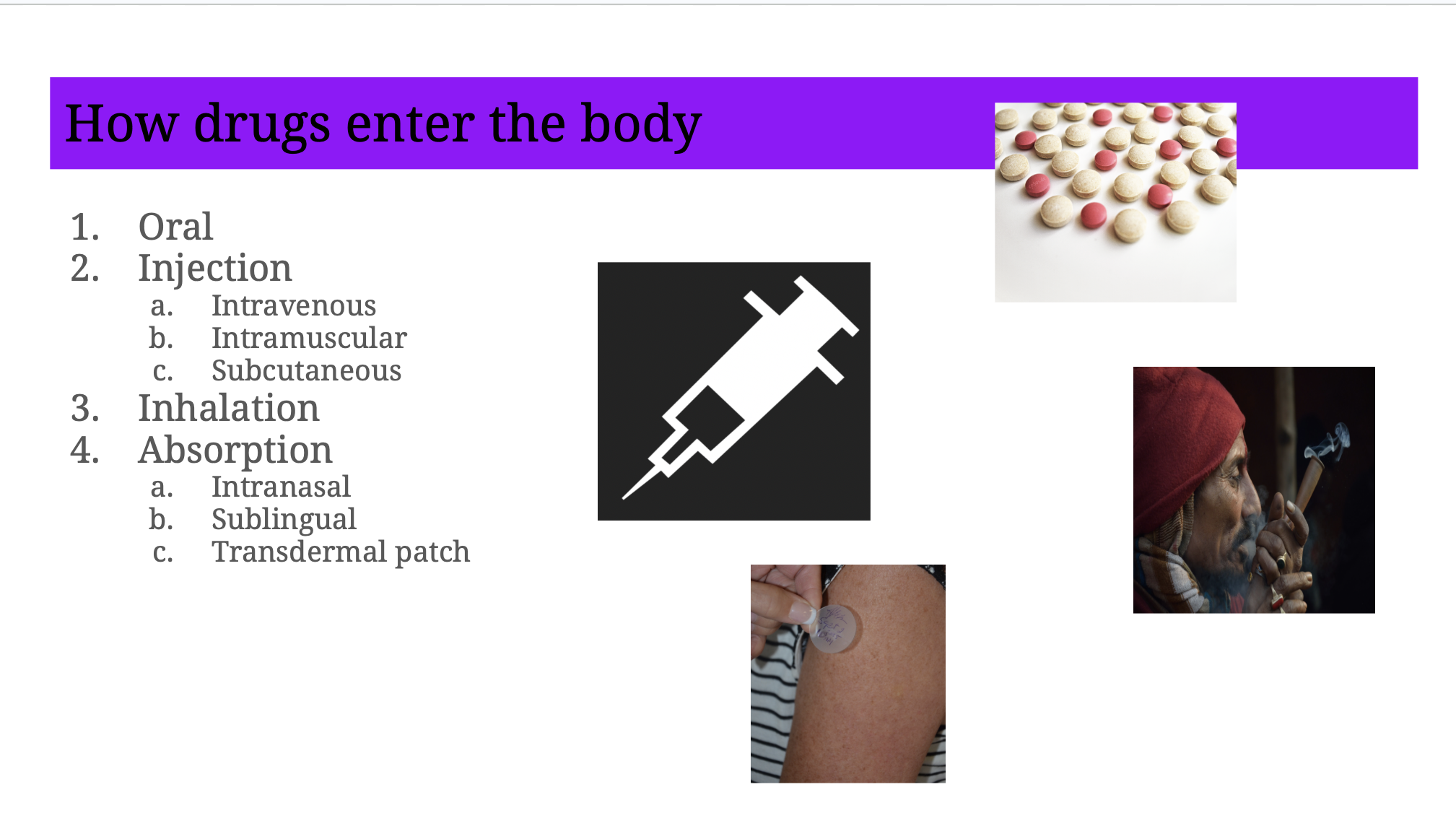
How drugs enter the body
Oral
Injection
Intravenous
Intramuscular
Subcutaneous
Inhalation
Absorption
Intranasal
Sublingual
Transdermal patch
substance use disorder
Substance Use Disorder from DSM 5
Identifies an individual with varying degrees of behavioral difficulties that are related to some form of drug taking behavior
Criteria to meet the diagnosis:
Impaired control - substance taken longer than needed, people go out of their way to get the substance, persistent desire to cut down but unsuccessful, intense urges or cravings
Social impairment - failure to fulfill work or school obligations, continued use despite recurrent problems, people may withdraw from activities because of substance abuse
Risky use - when use creates physically hazardous situations, can cause medical problems, failure to abstain even though the individual recognizes the problems it is causing
Pharmacological effects - development of tolerance to the drug(s), withdrawal symptoms may be observed
theoretical perspectives on drug use
Moral Model
This is the older perspective that claims drug taking behavior is a personal choice, overindulgence and a weakness, or character flaws and not a consequence of anything else (genetics, mental impairment or dysfunction, social structures)
The older models or perspectives on drug use were slightly more religious based and claimed that the evil spirits caused people to “make you do it”
Some still believe that people who engage in drug taking behavior are morally deficient, is weak, is a risk taker and/or is over-indulgent - this belief is reinforced within our current criminal justice system with the punishments for drug taking behaviors
theoretical perspectives on drug use
Biological Perspectives- Genetic factors, Brain Structure and Function
These perspectives are focused on genetics, physiological factors, neurochemical systems in the brain, and brain structure and function.
Genetic factors = a genetic link has been found for alcoholism - studies show that children of alcoholics are 4x more likely to become an alcoholic than children of non-alcoholics
A single gene has not been identified but most likely is a genetically complex configuration in individuals that can be responsible for alcoholism
Genetic studies have also shown that there are links between dependence on cocaine and opiates
Family and twin studies support this: people with a parent or sibling with addiction are more likely to develop one themselves; identical twins at greater risk
Specific genes affect drug metabolism and dopamine receptor sensitivity, and traits like impulse control and sensation-seeking
Brain Structure and Function = reward system activation
Most addictive drugs (like opioids, cocaine, alcohol, nicotine) stimulate the brain’s reward circuit, particularly the dopamine system (dopamine produces feelings of pleasure or euphoria)
Over time, the brain reduces its own dopamine production, making it harder to feel pleasure from normal activities, and some drugs can contribute to this
Changes in brain areas:
Prefrontal Cortex: Impaired in addiction, affecting judgment, impulse control, and decision-making
Hippocampus: Involved in emotional memory - drug cues (like a smell or place) can trigger cravings and relapse or negative emotional states during withdrawal
Amygdala - processes emotional responses and stress
theoretical perspectives on drug use
Biological Perspectives cont..
Physiological factors, Dopamine, Acetylcholine, Serotonin, Endorphins, Norepinephrine, Glutamate
Physiological factors = metabolic processes in the body - people differ in the extent in which chemicals in the body are broken down or changed that allow us to function
Neurotransmitters allow brain cells to communicate with each other and a deficiency or abundance can cause people to become dependant on drugs. Most common neurotransmitters:
Dopamine - affects mood, motor control and euphoria; deficiency in this can make people more susceptible to drug abuse because their bodies are “making up” for the loss and they might experience the most pleasurable effects from drugs, can produce feelings of cravings that continue to encourage drug use
Acetylcholine - affects heart rate, learning, memory and can influence drug use by associating pleasure with it
Serotonin - sensory perception, sleep, mood, body temp - differing levels can impact mood disorders, depression and possibly increase effects of hallucinogenic drugs
Endorphins - natural painkillers produced by the brain and can resemble drugs that do the same thing
Norepinephrine - influences sleep, memory and is associated with regulation of mood
Glutamate - basis for effects of hallucinogenic drugs and involved in drug craving and drug abuse relapse
theoretical perspectives on drug use
Psychological Perspectives
Psychoanalytic theories - all based in the subconscious, childhood experiences, development
Id, ego, superego
Oral fixations
Drug highs and feelings of power and superiority
Unconscious death wish
Behavioral theories - effect of reinforcement on learned responses to one’s environment
Learning models
Risk/rewards - euphoria seekers vs maintainers
Conditioning
Cognitive theories - explanations of behavior based upon the notion of that a person’s feelings and behaviors is the result of that person’s perception of the situation
Non-psychoanalytic personality theories - impulsive, sensation seeking, risk-taking
Personality disorders
Mood disorders
Psychotic disorders
Anxiety disorders
Trauma Disorders
Obsessive compulsive disorders
theoretical perspectives on drug use
Sociological Perspectives
Focuses on the social context to drug taking
Strain theory
Conformity
Innovation
Ritualism
Retreatism
Rebellion
Social Integration Theory
Differential Association Theory
Subculture and Socialization Theory
Labeling theory
Primary deviance vs secondary deviance
medical uses for opiate based drugs
Medical Uses
Opiate based drugs are used for pain relief, treatment of acute diarrhea, cough suppressant
Analgesic = “without pain”, suppresses the cough reflex center in the brain
Epidurals
Therapeutic and local anesthetic agents
Blocks the sensations in the nerve fibers and messages through the spinal cord
Prescription pain meds are generally Schedule II drugs - FDA approved in 1995 - slow absorption over a 12 hour period, reducing pain without a sudden feeling of euphoria
Oxycodone (oxycontin)
Hydrocodone with acetaminophen (vicodin)
Oxycodone with acetaminophen (percocet)
When oxy’s are crushed and swallowed or inhaled as a powder, the effect can be similar to heroin
Even when used as prescribed, some patients have suffered severe withdrawal symptoms similar to heroin withdrawal
FDA warning states that oxy’s are potentially addictive and chewing, snorting or injecting could be lethal
medical uses for opiate based drugs
Medical Uses of Opioid Drugs
While the focus in this chapter has been on opioid drugs in the context of opioid abuse, it important to look at the beneficial effects as well as the adverse side effects that these drugs can have in a medical setting
medical uses for opiate based drugs
Beneficial Effects
Excluding heroin, which is a Schedule I controlled substance in the United States and therefore unavailable for medical use, opioid drugs are useful as prescription medications (Schedule II controlled substances) for three primary therapeutic purposes: the relief of pain, the treatment of acute diarrhea, and the suppression of coughing.
The first and foremost medical use of opioids today is for the treatment of pain. For a patient suffering severe pain following surgical procedures or from burns, the traditional drug of choice has been morphine. Recently, synthetic opioids are used.
The second application capitalizes on the effect of opioids in slowing down peristaltic contractions in the intestines that occur as part of the digestive process. As noted earlier, one problem associated with the chronic abuse of heroin, as well as of other opioids, is constipation. However, for individuals with dysentery, a bacterial infection of the lower intestinal tract causing pain and severe diarrhea, this negative side effect becomes desirable. Therefore, the control of diarrhea by an opioid is literally lifesaving, since acute dehydration (loss of water from the body) can be fatal. Fortunately, the opioid medication loperamide (brand name: Imodium), which is available on an over-the-counter basis, effectively controls diarrhea symptoms by its action on the gastrointestinal system. Because it cannot cross the blood–brain barrier, loperamide does not produce any psychoactive effects.
The third application focuses on the capacity of these drugs to suppress the cough reflex center in the medulla. In cases in which an antitussive (cough-suppressing) drug is necessary, codeine is frequently prescribed, either by itself or combined with other medications such as aspirin or acetaminophen (brand name: Tylenol, among others). As an alternative treatment for coughing, dextromethorphan is available in over-the-counter syrups and lozenges, as well as in combination with antihistamines. Unfortunately, the abuse of dextromethorphan among young people, who are consuming it on a recreational basis, has become a relatively new cause for concern and one of the continuing challenges of present-day substance abuse.
medical uses for opiate based drugs
Prescription Opioid Medication Side Effects
Despite the overall beneficial effects of prescription opioid medications, there are serious adverse side effects. For example, respiration will be depressed for four to five hours following even a therapeutic dose of morphine, so caution is advised when the patient suffers from asthma, emphysema, or pulmonary heart disease. In addition, opioid medications decrease the secretion of hydrochloric acid in the stomach and reduce the pushing of food through the intestines, a condition that can lead to intestinal spasms. Finally, although opioids have a sleep-inducing effect in high doses, it is not recommended that they be used as a general sedative–hypnotic treatment, unless sleep is being prevented by pain or coughing
medical uses for opiate based drugs
Prescription Opioid Medication Abuse
The nonmedical use of prescription opioid medications (in other words, the recreational use of opioid medications) has been acknowledged as a national epidemic for several years. In 2015, approximately 92 million noninstitutionalized adults in the United States (more than one-third of the population) had used prescription opioids, 11 million had misused them, and 1.9 million had a substance use disorder with regard to prescription opioids. Misuse and use disorders were most commonly reported in adults who were uninsured, were unemployed, had low income, or had behavioral health problems. In terms of public health, approximately one-half of all opioid-related overdose deaths involved a prescription opioid.32
Clearly, opioids are needed by millions of people who seek legitimate relief from pain. Yet, the abuse of opioids present significant personal and social problems for millions of others. This situation poses a unique challenge for law enforcement authorities and public health officials.
medical uses for opiate based drugs
Patterns of OxyContin Abuse
The principal medications of concern are well known: oxycodone with acetaminophen (brand name: Percocet), the continuous-release form of oxycodone (brand name: OxyContin), hydrocodone, and hydrocodone with acetaminophen (brand name: Vicodin). Prior to 2013, all opioid medications were Schedule II controlled substances, with sole exception of Vicodin, which was classified as a Schedule III controlled substance. In 2013, the FDA recommended a reclassification of Vicodin from a Schedule III to a Schedule II controlled substance, a move that had been recommended by the DEA for several years. Substance abuse is common with respect to all the prescription opioid medications, but the focus here will be on patterns of OxyContin abuse, since it has received in recent years the most public attention and concern.
Introduced in 1995, OxyContin was promoted initially as being relatively safe from potential abuse and more acceptable to the general public because it lacked the social stigma associated with morphine. In its original FDA-approved continuous-release formulation, OxyContin would be taken orally and absorbed slowly over a period of 12 hours, killing pain without inducing a sudden feeling of euphoria. For several years, however, OxyContin tablets could be easily crushed and then either inhaled as a powder or injected after diluting the powder into a solution, producing a pharmacological effect similar to that of heroin. Even without altering the tablets in any way, some patients suffered severe withdrawal symptoms, similar to those experienced during heroin withdrawal, when they abruptly stopped taking high-dosage levels of the OxyContin.
In 2010, under intense pressure from public health authorities, Purdue Pharma, manufacturer of OxyContin, introduced a new formulation containing an added chemical called Remoxy that changed the tablet into a gummy, less easily abusable substance when crushed or dissolved. Unfortunately, some abusers have turned to microwaving the new formulation and sniffing the burned remains, a far more inconvenient but nonetheless viable option. For a time, others turned to the extended-release form of another opioid medication, oxymorphone (brand name: Opana ER), which could be crushed and dissolved like the original form of OxyContin. In 2012, a new formulation of Opana ER was launched with a modification similar to that implemented with OxyContin, though it has become apparent that even the new formulation is not immune to abuse. In 2017, the FDA requested that Endo Pharmaceuticals remove Opana ER from the market. In its news release, the FDA stated that “After careful consideration, the agency is seeking removal based on its concern that the benefits of the drug may no longer outweight its risks.” It was the first time the FDA had called for a removal of a licit opioid medication for this reason.
The demographic features of OxyContin abusers, unlike that of heroin abusers, cut a across age, socioeconomic status, geographic location, and gender. Communities, however, that are particularly hard-hit by this form of substance abuse are in nonurban areas (Portrait) where treatment facilities are often less readily available, pharmacy security is less rigorous, and there are fewer safeguards against illegitimate access to prescription opioid medications in general
medical uses for opiate based drugs
Prescription Opioid Medication Abuse and Drug Diversion
Two primary sources of drug diversion, defined as the means by which prescription medications become available for nonmedical use, have been identified. The first source includes patients who visit multiple doctors (“doctor-shoppers”) and obtain multiple prescriptions by convincing doctors that there is a genuine reason for opioid treatment.Other individuals visit legal storefront stress and pain clinics (often called “pill mills”) where they speak with a physician, are typically required to take a psychological test, and undergo a perfunctory physical examination, after which they leave with a prescription for a controlled substance regardless of their medical condition. Since no controlled substances are stored on the premises, no DEA license is required for these clinics to operate. Frequently, however, these clinics are raided in a “buy-bust” law enforcement operation although it is difficult to close them down permanently. Some individuals using medications for nonmedical purposes are not patients at all, but instead the medications are obtained directly from a friend or relative.
The second source is the health-care provider, typically a private-practice physician (sometimes unlicensed) or pharmacist who has issued or dispensed prescription medications in a fraudulent manner. The DEA Drug Diversion Task Force and local law enforcement agencies are continually engaged in the prosecution of physicians and pharmacists who have abused their prescription privileges.
In some cases, the consequences have been deadly. In New York, for example, a 230-count indictment was issued in 2018 to a physician with a history of reckless overprescribing in opioid drugs as well as other drugs. The indictment included two charges of manslaughter, nine counts of reckless endangerment, and more than 200 counts of criminal sale of a prescription for a controlled substance. The manslaughter charges involved two men who had died from an opioid overdose in 2013 and 2014, respectively. A third overdose death in 2016 was the basis for one of the charges of reckless endangerment. Large numbers of opioid prescriptions had been issued, with some patients turning around and selling the pills as part of their own drug-trafficking operations.
In another case, reported by the DEA Drug Diversion Task Force, a physician in Tennessee received a 23-year prison sentence after being convicted of improperly writing prescriptions for opioid medications as well as other controlled substances without sufficient medical necessity. He had charged patients $80 to $100 in cash for each visit, without performing a physical examination, even after receiving information that patients were abusing their drugs or selling them to others. Agreements had been made with patients that they would bring all or part of the drugs back to him, presumably for his personal use. He was also found guilty of willingly failing to file income tax forms for multiple years when he had a gross income exceeding $1 million.
medical uses for opiate based drugs
Portrait Billy Thomas and Ricky Franklin—The Two Sides of OxyContin
Billy Thomas’ pain had become so excruciating that he was on the verge of suicide. A former salesman of plumbing supplies in North Plainfield, New Jersey, Thomas had endured pulsating back pain for six years. Seven surgeries, endless doctor’s appointments, thousands of pills, acupuncture, and other alternative treatments had all proved unsuccessful. When Thomas began taking OxyContin, however, a relatively normal lifestyle returned. His perceived pain level (on a scale of 1 to 10, with 10 being the most horrible pain imaginable) was an acceptable 2 or 3—a dramatic improvement from his continual ratings of 8 or 9 before the advent of OxyContin. The drug had literally saved his life.
For every Billy Thomas, however, there has been a Ricky Franklin. Prescribed OxyContin following hip-replacement surgery, Franklin found that the drug was difficult to give up even after his recovery was complete. In 1999, this resident of rural Maine was convicted of selling guns to finance the purchase of a steady supply of OxyContin. In May 2001, while on parole for the firearms theft conviction, Franklin was charged with walking into a Rite Aid pharmacy with a gun and pushing a note across the counter that read: “Give me all your OxyContin or I will shoot you.” The gun turned out to be an unloaded BB gun. Franklin was sentenced in federal court in 2002 to 46 months in prison and 3 years of supervised release.
Franklin has not been alone in his descent into criminal activity as a result of compulsive OxyContin abuse. Arrests have been made in all parts of the United States (the drug has been called the “rural heroin”) for crimes ranging from simple theft to murder and drug trafficking, all related to the illicit abuse of this drug. At the same time, demands to remove OxyContin from the market until a completely full-proof abuse-reducing formulation is developed would return people like Billy Thomas and millions of other Americans to a life of abject misery. Theproblem is that it is difficult to predict which path a patient will follow. As a neurologist and pain management specialist has expressed it, “A practicing physician has to be mindful that someone, even if they don’t come with ‘addict’ written all over them, may be one … The physician has to establish a relationship with the patient they’re taking care of on a long-term basis.” It is unclear whether it will ever be possible to have completely positive outcomes from the development of pain medication, without the negative consequences of substance abuse.
medical uses for opiate based drugs
Prescription Opioid Medication Abuse and Drug Diversion
A third case, described at the opening of Chapter 4, involved a 78-year-old physician in Alabama who received in 2018 a much lighter sentence (probation and a hefty fine) following a conviction of drug distribution, health-care fraud, and money laundering.
A third case, described at the opening of Chapter 4, involved a 78-year-old physician in Alabama who received in 2018 a much lighter sentence (probation and a hefty fine) following a conviction of drug distribution, health-care fraud, and money laundering. Multiple prescriptions for fentanyl patches had been written without any medical justification. The physician was also engaging in money laundering of funds gained from illegal drug distribution. Fortunately, no deaths had resulted from his actions, and due to his age, an extended prison sentence was waived.35
While drug diversion continues to be challenging for the enforcement of drug laws, better communication and coordinated record-keeping systems have helped to reduce the problem, particularly with respect to opioid prescription abuse. A system of statewide prescription drug monitoring programs (PDMPs) in which electronic databases track controlled substance prescriptions has shown great promise. Implementation of a system of this kind in Florida, for example, resulted in a decrease in the number of opioid prescriptions from 2010 to 2015 that was greater than the decrease reported nationwide over the same period of time. As of 2018, nearly all U.S. states have established statewide PDMPs for providers of prescription medications. In addition, nearly all U.S. states participate in a nationwide PDMP and data-sharing program, sponsored by the National Association of Boards of Pharmacy, for dispensers of prescription medical.
It should be noted that the providers and dispensers of prescription opioid medications are not the only ones under scrutiny as intense national attention continues to be directed toward the role of prescription opioid medications in the present-day opioid-abuse crisis. In 2007, three senior executives of Purdue Pharma, the pharmaceutical company that makes OxyContin, pleaded guilty to criminal charges that, from 1995 to 2001, they had misled federal regulators, physicians, and patients about the potential for OxyContin to be an abused drug. The company agreed to $600 million in fines and other payments; the executives themselves were convicted on misdemeanor charges and fined $34 million for their wrongdoing. In 2018, Attorney Generals of six U.S. states filed lawsuits against Purdue Pharma for misleading marketing tactics with regard to OxyContin.
medical uses for opiate based drugs
Abuse of Other Opioid Pain Medications
Vicodin and Percocet are based on opioids (hydrocodone and oxycodone, respectively) that have been available for a longer period of time than OxyContin and unfortunately have a longer record of abuse and dependence. An additional problem with these medications has been the addition of acetaminophen (up to 1,000 mg in the case of one form of Percocet). This combination is particularly dangerous because excessive dosages of acetaminophen increase the risk of liver toxicity and death. In order to reduce the incidence of adverse effects, the FDA ordered in 2011 a limit of 325 milligram of acetaminophen when combined with a prescription pain medication. Two opioid medications, Zohydro ER and Hysingla ER, now contain no acetaminophen
medical uses for opiate based drugs
Drug Enforcement . . . in Focus
National Prescription Drug Take-Back Day and Rogue Pharmacies
In 2010, the DEA initiated National Prescription Drug Take-Back Day in an effort to provide a more environmentally responsible and secure way to dispose of expired or unwanted medications that are highly susceptible to diversion, misuse, and abuse. At that time, individuals across the country turned in over 121 tons of medications at more than 4,000 take-back locations. In 2017, eight years later, Take-Back Day yielded a record-setting total of 456 tons of medications collected at more than 5,000 U.S. locations.
On another front, the three most-used Internet search engines in the United States adopted policies in 2010 prohibiting Internet pharmacies from advertising on the sidebars of search result pages unless they have been identified as Verified Internet Pharmacy Practice Sites by the National Association of Boards of Pharmacy and operate in compliance with U.S. pharmacy laws and practice standards. These policies are intended to reduce the number of “rogue pharmacies” that operate as unlicensed Web-based operations, often from locations in foreign countries that do not require valid prescriptions to dispense medications.
medical uses for opiate based drugs
Medical Uses
Opiate based drugs are used for pain relief, treatment of acute diarrhea, cough suppressant
Analgesic = “without pain”, suppresses the cough reflex center in the brain
Epidurals
Therapeutic and local anesthetic agents
Blocks the sensations in the nerve fibers and messages through the spinal cord
Prescription pain meds are generally Schedule II drugs - FDA approved in 1995 - slow absorption over a 12 hour period, reducing pain without a sudden feeling of euphoria
Oxycodone (oxycontin)
Hydrocodone with acetaminophen (vicodin)
Oxycodone with acetaminophen (percocet)
When oxy’s are crushed and swallowed or inhaled as a powder, the effect can be similar to heroin
Even when used as prescribed, some patients have suffered severe withdrawal symptoms similar to heroin withdrawal
FDA warning states that oxy’s are potentially addictive and chewing, snorting or injecting could be lethal
medical uses for opiate based drugs
Prescription Opioid Medication Use and Misuse
In medical settings, opioid drugs have been extremely helpful in the treatment of pain, the treatment of dysentery, and the suppression of coughing.
Side effects of opioid medications include respiratory depression, intestinal spasms, and sedation.
medical uses for opiate based drugs
Prescription Opioid Medication Abuse
There has been great concern since the late 1990s that opioid pain medications have been diverted to nonmedical purposes and are subject to abuse. Three medications of this type are OxyContin, Vicodin, and Percocet. There are numerous instances of pharmacy robberies, with the intent of securing supplies of opioid pain medication, particularly OxyContin. A continuing challenge for law enforcement has been the monitoring and prosecution of instances of prescription medication diversion, particularly with regard to opioid medications, through fraudulent actions of prescription-issuing health-care providers.
methadone maintenance criticisms
Methadone maintenance
= legally and carefully controlled narcotic administered slowly to reduce the cravings for heroin
Criticisms:
Still using an opiate
Substituting one type of dependence for another
Goal should be abstinence
Blocks yearning for heroin but not the craving to get high
methadone maintenance criticisms
Opioid Maintenance
Prior to the introduction of buprenorphine-based or naltrexone-based medications, the other medically assisted treatment for opioid abuse was the long-term administration of the synthetic opioid, methadone.
Since the mid-1960s, one strategy has been to have a detoxified heroin abuser participate have daily oral administrations of methadone, essentially substituted for the injected heroin or other opioids that had been central to patient’s pattern of opioid abuse. This treatment approach, called methadone maintenance, was initiated in New York City in the 1970s through the joint efforts of Vincent Dole, a specialist in metabolic disorders, and Marie Nyswander, a psychiatrist whose interest had focused on narcotic dependence. Their idea was that if a legally and carefully controlled opioid drug was available to heroin abusers on a regular basis, the craving for heroin would be eliminated, their drug-taking lifestyle would no longer be needed, and they could turn to more appropriate social behaviors such as steady employment and a more stable family life. The general philosophy behind this approach to heroin-abuse treatment was that heroin abuse was essentially a chronic metabolic disorder requiring a long-term maintenance drug for the body to “normalize” the drug abuser, in the same way as a diabetic patient would need a maintenance supply of insulin.
There are several advantages of the methadone maintenance approach in heroin-abuse treatment. Since it is a legal, inexpensive narrcotic drug (when dispensed through authorized drug treatment centers), criminal activity involved in the purchase of heroin on the street can be avoided. Methadone is slower acting and more slowly metabolized, so that, unlike heroin, its effects last approximately 24 hours and it can be easily absorbed through an oral administration. Because it is an opioid drug, methadone binds to the same endorphin-sensitive receptors in the brain as does heroin and prevents feelings of heroin craving. The rush of a heroin high is avoided, thanks to its relatively slow rate of absorption by brain tissue.
Typically, clients in the program come to the treatment center daily for an oral dose of methadone, dispensed in orange juice, and the dose is gradually increased to a maintenance level over a period of four to six weeks. The chances of an abuser turning away from illicit drug use are increased if the higher doses of methadone are made conditional on a “clean” (drug-free) urinalysis.26
As a social experiment, methadone maintenance programs have met with a mixture of success and failure. On the one hand, evaluations of this program have found that 71 percent of former heroin abusers who have stayed in methadone maintenance for a year or more have stopped intravenous drug taking, thus reducing the risk of AIDS. In a major study, drug-associated problems declined from about 80 percent to between 17 and 28 percent, criminal behavior dropped from more than 20 percent to less than 10 percent, and 40 percent, suggesting that alcohol may be substituting for opioids during the course of treatment, and one study found that as many as 43 percent of those who had successfully given up heroin had become dependent on alcohol. Furthermore, methadone is sometimes diverted away from the clinics and onto the streets for illicit use. The availability of street methadone remains a matter of great concern.28
The primary concern with methadone maintenance is the need to receive daily doses in designated maintenance locations, which can be logistically inconvenient. To reduce this difficulty to some extent, the opioid LAAM (levo-alpha-acetylmethadol), marketed under the brand name Orlaam, is available as an alternative medication for maintenance purposes. LAAM has a substantially longer duration, relative to methadone, so that treatment clients need to receive the drug only three times a week instead of every day
methadone maintenance criticisms
Treatment for Heroin Abuse
Treatment for heroin abuse includes short-term detoxification and long-term interventions that address the continuing craving for the drug and physical dependence factors in the body. Medically assisted treatments currently available are based on buprenorphine (Subutex, Suboxone, Sublocade) and naltrexone (Vivitrol).
Methadone maintenance programs focus primarily on the physiological needs of the heroin abuser, whereas therapeutic communities and support groups focus on his or her long-term reintegration into society.
cocaine effects
Cocaine effects/risks
Chronic stuffy or runny noses, bloody noses, deviated septum
Dilated pupils, heightened alertness, sensory sensitivity, reduced appetite
Fast breathing, dry mouth
Euphoria, confidence, restlessness, anxiety, paranoia, irritability
Constricts blood vessels but raises heart rate, blood pressure so this increases risk of sudden cardiac arrest
Sweating, paleness of skin
Withdrawal can lead to severe fatigue, intense depression, cravings, sleep disturbances, dramatic mood swings
cocaine effects
Acute Effects of Cocaine
The effects of cocaine on the user vary in degree with the route of administration, the purity of the dose, and the user’s expectations about the experience, but certain features remain the same. The most prominent reaction is a powerful burst of energy. If the cocaine is injected intravenously or smoked, the extremely intense effect (often referred to as a “rush” or “high”) is felt within a matter of seconds, and lasts only 5 or 10 minutes. If the drug is snorted through the nose, the effect is less intense than when injected or smoked but lasts somewhat longer, approximately 15–30 minutes.
Users also experience a general sense of well-being, although in some instances cocaine may precipitate a panic attack.As levels of cocaine diminish, the mood changes dramatically. The user becomes irritable, despondent, and depressed. These aftereffects are uncomfortable enough to produce a powerful craving for another dose.
The depression induced in the aftermath of a cocaine high can lead to thoughts of suicide. In 1985, during one of the peak years of cocaine abuse in the United States, as many as one out of five suicide victims in New York City showed evidence of cocaine in their blood at autopsy. The prevalence of cocaine use was greatest among victims who were in their twenties and thirties, and for African Americans and Latinos.14 In a 1989 survey of teenage callers to the 1-800-COCAINE hotline, at the height of cocaine abuse, one out of seven reported a previous suicide attempt.

cocaine effects
sexual arousal
Cocaine’s effect on sexual arousal is often cited as having been the basis for its purported allure as an aphrodisiac. On the one hand, interviews of cocaine users frequently include reports of spontaneous and prolonged erections in males and multiple orgasms in females during initial doses of the drug. On the other hand, cocaine’s reputation for increasing sexual performance (recall Freud’s reference in his letter to Martha) may bias users toward a strong expectation that there will be a sexually stimulating reaction, when in reality the effect is a much weaker one. The fact is that chronic cocaine use results in decreased sexual performance and a loss of sexual desire, as the drug essentially takes the place of sex.16
Cocaine produces a sudden change in a number of systems in the body. Heart rate and respiration are increased, while appetite is diminished. Blood vessels constrict, pupils in the eyes dilate, and blood pressure rises. The cocaine user may start to sweat and appear suddenly pale. These effects can lead to a cerebral hemorrhage or congestive heart failure.Cardiac arrhythmia results from cocaine’s tendency to bind to heart tissue itself.17
Given the extreme excitatory effects of cocaine on bodily organs, it is not surprising that behavioral skills, particularly those requiring fine motor control, would be adversely affected. In a study of drivers showing reckless behavior on the road, those found to have been under the influence of cocaine were wildly overconfident in their abilities, taking turns too fast or weaving through traffic. One highway patrol officer called this behavior “diagonal driving. They were just as involved in changing lanes as in going forward.” Yet it has been determined that they are capable of passing standard sobriety tests (such as walking a straight line) that have been designed to detect alcohol intoxication.
cocaine effects
Chronic Effects of Cocaine
Repeated and continued use of cocaine produces undesirable mood changes that can be alleviated only when the person is under the acute effects of the drug. Chronic cocaine abusers are often irritable, depressed, and paranoid. As was true in Fleischl’s experience with cocaine, long-term abuse can produce the disturbing hallucinatory experience of formication. The sensation of “cocaine bugs” crawling on or under the skin can become so severe that abusers may scratch the skin into open sores or even pierce themselves with a knife to cut out the imaginary creatures. These hallucinations, together with feelings of anxiety and paranoia, make up a serious mental disorder referred to as cocaine psychosis.
When snorted, cocaine causes bronchial muscles to relax and nasal blood vessels to constrict; the opposite effects occur when the drug wears off. As the bronchial muscles contract and nasal blood vessels relax, chronic abusers endure continuously stuffy or runny noses and bleeding of nasal membranes. In advanced cases of this problem, the septum of the nose can develop lesions or become perforated with small holes, both of which present serious problems for breathing.
cocaine effects
How Cocaine Works in the Brain
Cocaine greatly enhances the activity of dopamine, and, to a lesser extent, norepinephrine in the brain (see Chapter 8). In the case of both neurotransmitters, the actual effect is to stimulate receptors longer and to a greater degree. Unlike the amphetamines (discussed later in this chapter), the structure of cocaine does not appear to resemble the structure of either dopamine or norepinephrine, so why cocaine should have this effect on receptors is not at all clear. Nonetheless, what has been determined is that the acute effect of euphoria experienced through cocaine is directly related to an increase in dopamine activity in the region of the brain that controls pleasure and reinforcement in general: the nucleus accumbens.The current scientific thinking is that this alteration in neurochemistry has a profound effect on an individual’s decision-making skills and an individual’s potential for developing a dependence on cocaine (or some other drug of abuse).
Chronic cocaine abuse, however, leads to the loss of about 20 percent of the dopamine receptors in this region of the brain over time. The depletion of dopamine receptors among long-term cocaine abusers has been observed up to four months after the last cocaine exposure, even though the cocaine abuser no longer has cocaine in his or her system. As a result, there is a tendency toward a decline in the experience of pleasure from any source. In fact, cocaine abusers frequently report that their craving for cocaine no longer has cocaine in his or her system. As a result, there is a tendency toward a decline in the experience of pleasure from any source. In fact, cocaine abusers frequently report that their craving for cocaine no longer stems from the pleasure they felt when taking it initially. Their lives may be in shambles and the acute effects of euphoria from cocaine may no longer be strong, but they still crave the drug more than ever. In other words, there is now a disconnection between “liking” and “wanting.”
One feature of cocaine is quite unlike that of other psychoactive drugs. Although cocaine abusers over repeated cocaine exposures develop a pattern of drug tolerance to its euphoric effect, they develop a pattern of sensitization (a heightened responsiveness) with respect to motor behavior and brain excitation. This phenomenon, referred to as the kindling effect, makes cocaine particularly dangerous because cocaine has the potential for setting off brain seizures. Repeated exposure to cocaine can lower the threshold for seizures, through a sensitization of neurons in the brain over time. As a result of the kindling effect, deaths from cocaine overdose may occur from relatively low dose levels
cocaine effects
Acute and Chronic Effects of Cocaine
Cocaine produces a powerful burst of energy and sense of well-being. In general, cocaine causes an elevation in the sympathetic autonomic nervous system.
Long-term cocaine use can produce hallucinations and deep depression, as well as physical deterioration of the nasal membranes if cocaine is administered intranasally.
cocaine effects
Medical Uses of Cocaine and How Cocaine Works in the Brain
The only accepted medical application for cocaine is its use as a local anesthetic.
Cocaine causes faster breathing and heart rate as well as elevated blood pressure and hyperthermia. Within the CNS, cocaine increases the activity of dopamine and, to a lesser extent, norepinephrine in the brain.
Like cocaine, amphetamines cause faster breathing and heart rate as well as elevated blood pressure and hyperthermia. Unlike cocaine, however, the effects are more long-lasting. Amphetamines increase dopamine and norepinephrine activity in the brain.
withdrawal from stimulant drugs
Treatment for cocaine/amphetamines
Intense withdrawal and users feel as if they are having a heart attack, intense depression and disturbances in sleep
Detoxification and abstinence under medical supervision
In-patient and out-patient programs
Cognitive -behavioral therapy
Withdrawal from amphetamines can take 6-16 weeks and brings a very high relapse rate due to this long time period
withdrawal from stimulant drugs
abuse professionals view the process of coming off cocaine as one of the most anguished and depressing of experiences.Some abusers feel like they are having a heart attack. They will do almost anything to keep from crashing.
Despite its difficulties, the varieties of treatment for cocaine abuse all have certain features in common. The initial phase is detoxification and total abstinence. The cocaine abuser aims to achieve total withdrawal with the least possibility of physical injury and minimal psychological discomfort. During the first 24–48 hours, the chances are high that there will be profound depression, severe headaches, irritability, and disturbances in sleep.
In severe cases involving a pattern of compulsive use, the cocaine abuser needs to be admitted for inpatient treatment in a hospital facility. The most intensive interventions, medical supervision with psychological counseling, can be made in this kind of environment. The early stages of withdrawal are clearly the most difficult, and the recovering abuser can benefit from the around-the-clock attention that only a hospital staff can give.
benefit from the around-the-clock attention that only a hospital staff can give.
withdrawal from stimulant drugs
Treatment for Methamphetamine Abuse
The course of methamphetamine withdrawal—and of amphetamine withdrawal in general—is very similar to the course of events described earlier for cocaine. First, there is the “crash” when the abuser feels intense depression, hunger, agitation, and anxiety within one to four hours after the drug-taking behavior has stopped. Withdrawal from amphetamines, during total abstinence from the drug, takes between 6 and 16 weeks, during which the intense craving for amphetamine slowly subsides.
As in cocaine-abuse treatment, there are inpatient and outpatient programs for methamphetamine abuse, depending on the circumstances and motivation of the abuser. Self-help groups such as Cocaine Anonymous can be useful as well, since the symptoms of amphetamine withdrawal and cocaine withdrawal are nearly identical. Methamphetamine abusers represent approximately 1 in 12 individuals in treatment for substance abuse, but relatively few methamphetamine abusers attempt treatment, much less succeed in recovery. The reason is that they perceive themselves as remaining in control over their drug use, despite evidence to the contrary. The attitude of denial makes it difficult for methamphetamine abusers to seek treatment.
Overall, methamphetamine abusers find it extremely difficult to become drug-free, and their relapse rate is one of the highest for any category of illicit or licit drug abuse.
effects of marijuana
Is chronic marijuana smoking harmful over a period of time? What is the extent of tolerance and dependence? Are there long-term consequences for the health of organ systems in the body? Will marijuana lessen one’s potential as a productive human being in society? Will marijuana abuse lead to the abuse of other drugs? These are questions to be considered next.
effects of marijuana
Tolerance
It is frequently reported that experienced marijuana smokers tend to become intoxicated more quickly and to a greater extent than inexperienced smokers, when exposed to marijuana joints with equivalent THC concentrations. For many years, this observation suggested that repeated administrations of marijuana produced sensitization, or reverse tolerance (a greater sensitivity), rather than tolerance (a lesser sensitivity). If this were true, then we would have been faced with the troubling conclusion that marijuana operates in a totally opposite way to any other psychoactive drug considered so far. As it turns out, when animals or humans are studied in the laboratory, marijuana smoking shows tolerance effects that are consistent and clear-cut.
Why, then, the difference with the experience of humans outside the laboratory? One important factor is the way in which we measure the quantity of THC consumed. Reaching an effective high from marijuana requires some degree of practice. For example, novice marijuana smokers may not have mastered the breathing technique necessary to allow the minimal level of THC to enter the lungs. They may have to smoke a relatively large number of marijuana joints initially before they achieve a high. Later, when they have acquired the technique, they may need fewer joints to accomplish the same effect. In these circumstances, a calculation of the number of joints consumed does not reflect the amount of THC ingested. If you were to control the THC content entering the body, as is done in laboratory studies, you would find the predictable results of tolerance over repeated administrations.
Another factor complicating tolerance studies is the slow elimination rate of marijuana. Regular marijuana smokers are likely to have a residual amount of THC still in the system. This buildup of THC would elevate the total quantity of THC consumed with every joint and induce a quicker high. Once again, the impression of sensitization is false; we are actually observing the enhanced effects of an accumulation of THC in the body. Once dosage levels are controlled, the results indicate a consistent pattern of tolerance rather than sensitization. In general, tolerance effects following repeated administrations of THC are greater as the dosage level of THC increases
effects of marijuana
Withdrawal and Dependence
On the basis of early studies conducted in the 1970s, it appeared that evidence of physical dependence (that is, the observation of withdrawal symptoms) following chronic administration of marijuana was limited to circumstances in which the level of THC ingestion was extreme. In one study, human volunteers were administered large doses of THC every 4 hours for 10–20 days. Within 12 hours after the last administration, subjects reported physical symptoms that included hot flashes, irritability, restlessness, and insomnia. In contrast, in another study in which subjects smoked one marijuana cigarette daily for 28 days, a condition closer to the typical exposure to marijuana, no withdrawal symptoms were observed.
More recent studies, however, have shown that withdrawal effects can occur even with more moderate levels of THC consumed over shorter periods of time. Abstinence from smoking marijuana cigarettes with approximately 2–3 percent THC levels or equivalent oral doses of THC, administered four times a day over a four-day period, resulted in feelings of irritability, stomach pain, anxiety, and loss of appetite. These symptoms began within 48 hours and lasted at least 2 days. Therefore, it is quite possible that daily marijuana use among chronic marijuana smokers is maintained, at least in part, because of its alleviation of withdrawal symptoms. Nonetheless, the symptoms involved here are substantially milder than those associated with the chronic use of heroin or alcohol.
There is also evidence of significant marijuana craving, indicating a degree of psychological dependence in some marijuana smokers, but it is difficult to measure the extent of these feelings or to determine whether these effects are due to circumstances in which marijuana is used in conjunction with other drugs. As was pointed out earlier, any definitive judgment as to the possibility of psychological dependence or the extent to which psychological dependence may occur in the average marijuana smoker has to rest upon research studies involving THC concentrations that are typical of currently available marijuana
effects of marijuana
Cardiovascular Effects
THC produces significant increases in heart rate, but there is no conclusive evidence of adverse effects in the cardiovascular functioning in young, healthy people. The reason why the emphasis is on a specific age group is that most of the studies looking at possible long-term cardiovascular effects have involved marijuana smokers under the age of 35; little or no information has been compiled about older populations. For those people with preexisting disorders such as heart disease, high blood pressure, or arteriosclerosis (hardening of the arteries), it is known that the acute effects of marijuana on heart rate and blood pressure can worsen their condition.
effects of marijuana
Respiratory Effects
The technique of marijuana smoking involves the deep and maintained inhalation into the lungs of unfiltered smoke on a repetitive basis, probably the worst scenario for incurring chronic pulmonary problems. In addition, a marijuana joint (when compared with a tobacco cigarette) typically contains about the same levels of tars, 50 percent more hydrocarbons, and an unknown amount of possible contaminants. Joints are often smoked more completely because the smoker tries to waste as little marijuana as possible.
Given all these factors, marijuana smoking presents several risks. One of the immediate consequences affects the process of breathing. When marijuana is inhaled initially, the passageways for air entering and leaving the lungs widen, but after chronic exposure, an opposite reaction occurs. As a result, symptoms of asthma and other respiratory difficulties are increased. Molecular abnormalities in the respiratory tracts of heavy marijuana smokers have been identified that resemble the changes in the respiratory tracts of cigarette smokers. However, marijuana smoking does not increase the risk of developing emphysema, a chronic lung disease that is closely associated with tobacco smoking.
Evaluations of the effects of marijuana smoking over an extended period of time have been relatively sparse. However, one study has indicated that occasional and low- cumulative marijuana use, even over a period of more than 20 years (1985–2006), does not produce adverse effects on lung capacity as indicated by standard pulmonary breathing tests. On the other hand, most people who smoke marijuana also smoke tobacco, and the adverse effects of tobacco smoking on lung function are well known. There is a threefold increase in the risk of pulmonary disease among heavy marijuana use combined with tobacco use, suggesting that marijuana and tobacco might have a synergistic impact on lung function. It has been difficult for researchers to find a sufficient number of heavy marijuana smokers who are not also tobacco smokers to make a definitive conclusion about the pulmonary effects of heavy marijuana use alone.
Overall, while the effects of a single inhalation of marijuana smoke present greater problems than a single inhalation of tobacco smoke, we need to remember that the patterns of consumption are far from comparable. All things considered, on a statistical basis, you can think of one joint as being equivalent to five cigarettes in terms of the amount of carbon monoxide intake and four cigarettes in terms of tar intake. The use of a water pipe reduces the harm somewhat, but the risks are still present.
effects of marijuana
Risks of Lung Cancer
Does smoking marijuana produce a higher incidence of lung cancer? Once again, it has been difficult to isolate the risk of lung cancer due to marijuana use as opposed to concurrent tobacco use. An additional challenge in making a marijuana-lung cancer link is that the peak years in which lung cancer cases are typically diagnosed are decades later than the years in which marijuana smoking begins and is most frequent. It is only recently that these difficulties have been overcome. In a 40-year follow-up study of young Swedish males aged 18–20 years old identified as heavy marijuana smokers in 1969–1970, researchers have found more than a twofold increase in the incidence of lung cancer, separating out the effects of tobacco use over that period of time. The study defined heavy marijuana use as self-reports of having smoked marijuana more than 50 times over one’s lifetime.
Important questions, however, remain to be answered on the issue of linking marijuana use to lung cancer. First of all, it is not known from this study to what extent marijuana smoking continued past late adolescence and early adulthood and what role that might have played in the final outcome. Were the men diagnosed with lung cancer 40 years later, the ones who smoked marijuana most of their adult life? Adolescence and early adulthood is a time of significant lung development and it is possible that marijuana smoking coincided with a “critical period” of susceptibility to the carcinogens in marijuana smoke, but we cannot determine the relationship at this time. Second, adolescents and young adults are currently smoking higher potency marijuana than was the case 40 years ago. It is possible that decades from now we might find a linkage to lung cancer at more occasional or moderate levels of marijuana use of this factor. On the other hand, the lower incidence of current tobacco smoking among adolescents and young adults, relative to the much higher incidence 40 years ago, might reduce the possibility of synergistic effects of combining marijuana and tobacco
effects of marijuana
Effects on the Immune System
When THC is administered to animals, the immune system is suppressed, resulting in a reduction in the body’s defense reactions to infection and disease. In humans, the evidence is inconclusive. Some studies indicate that THC has a suppressive effect; others indicate that no immunological changes occur at all. Because marijuana smoking has not been found to be associated with a higher incidence of any major chronic disease, we can tentatively conclude that marijuana smoking does not have a major impact on the immune system. Yet, long-term epidemiological studies, in which marijuana-exposed and control populations are compared with regard to the frequency of various diseases, have not been conducted on a large-scale basis. It has been shown that cannabinoids cause a mobilization of immune-suppressor cells that may potentially have a significant effect in weakening the immune system; it is not clear whether this effect is later seen in a higher incidence of immune system-related diseases
effects of marijuana
Effects on Sexual Functioning and Reproduction
The reproductive systems of both men and women are adversely affected by marijuana smoking. In men, marijuana reduces the level of testosterone, reduces sperm count in the semen, and increases the percentage of abnormally formed sperm. In women, marijuana use results in a reduction in the level of luteinizing hormone (LH), a hormone necessary for the fertilized egg to be implanted in the uterus. As little as one marijuana joint smoked immediately following ovulation is evidently sufficient for this LH suppression to occur. Despite these hormonal changes in both males and females, however, little or no effect on fertility has been observed.
The research is sparse on the question, but there does not appear to be evidence of birth defects in the offspring of women who have smoked marijuana during their pregnancy. Studies indicate, however, a lower birth weight and shorter length among newborns, as well as a reduction in the mother’s milk. It may be unfair to associate these effects specifically with marijuana smoking because other drugs, including alcohol and nicotine, are often being consumed during the same period. Even so, the best advice remains that women should avoid marijuana during pregnancy.
effects of marijuana
Long-Term Cognitive Effects and the Amotivational Syndrome
In the 1960s, when marijuana smoking became a mainstream concern among many in the establishment, though chronic exposure to marijuana frequently has been suspected of producing significant brain damage or long-term impairment in neural functioning, there is little or no evidence in support of this idea. It also has been suspected that marijuana may produce more subtle neurological changes that would affect one’s personality, motivation to succeed, or outlook on life. In 1968, William McGlothin, a psychologist, and Louis West, a psychiatrist, proposed that chronic marijuana smoking among young people was responsible for a generalized sense of apathy in their lives and an indifference to any long-term plans or conventional goals. These changes were called the amotivational syndrome. In their words, Regular marijuana use may contribute to the development of more passive, inward-turning personality characteristics. For numerous middle-class students, the subtly progressive change from conforming, achievement-oriented behavior to a state of relaxed and careless drifting has followed their use of significant amounts of marijuana ... . Such individuals exhibit greater introversion, become totally involved with the present at the expense of future goals, and demonstrate a strong tendency toward regressive, childlike magical thinking.
effects of marijuana
amotivational syndrome
Essentially, McGothlin and West, and probably a sizable proportion of the American public in the late 1960s, were saying, “These people don’t seem to care any more about things that we think are important, and marijuana must be to blame for it!”
The issue of the amotivational syndrome revolves around two basic questions that need to be examined separately. The first question deals with whether such a syndrome exists in the first place, and the second deals with whether chronic abuse of marijuana is a causal factor.
As to the existence of the syndrome, the evidence does suggest that students who smoke marijuana are at a disadvantage academically. Studies of high school students indicate that those who smoke marijuana on a regular basis (weekly or more frequently) earn lower grades in school, are less likely to continue on to college, are more likely to drop out, and miss more classes than those who do not smoke it.In a survey of high school students graduating in the early 1980s, those who smoked marijuana on a daily basis reported several problems in their lives that are related to motivation: a loss of energy (43 percent), negative effects on relationships (39 percent), interference with work and the ability to think clearly (37 percent), less interest in other activities (37 percent), and inferior performance in school or on the job (34 percent).35 While this survey was conducted more than 30 years ago, it is likely that these percentages would be roughly the same today.
effects of marijuana
Long-Term Cognitive Effects and the Amotivational Syndrome
academic performance
These changes in academic performance and other aspects of cognitive activity are genuine, but we cannot easily establish a direct causal link between marijuana and such global problems, other than to acknowledge that the presence of THC in a student’s system during school hours would be reflected later in a decline in overall academic performance. More broadly speaking, we cannot exclude the possibility that marijuana smoking may be, in the words of one expert in the field, “just one behavior in a constellation of related problem behaviors and personality and familial factors” that hamper an adolescent’s ability to do well in school and in life. We also cannot exclude the possibility that an involvement with marijuana may closely correlate with involvement in a deviant subculture, a group of friends and associates who feel alienated from traditional values such as school achievement and a promising future. Either of these factors, in combination with the regular ingestion of marijuana, can account for the motivational changes that are observed. The point is that we cannot conclude that such lifestyle changes are purely pharmacological.
Nonetheless, it is clear that acute marijuana intoxication produces significant cognitive deficits, as evidenced by reduced scores on tasks of attentiveness and memory. The question remains whether these problems are increased or perhaps may become irreversible as a result of long-term marijuana use. Large and well-controlled studies have shown that cognitive deficits in heavy marijuana smokers, relative to nonusers, are observed after 12–72 hours of abstinence. In other words, the specific signs of cognitive impairment among long-term marijuana smokers may linger for as long as three days after active marijuana smoking. In one study, however, testing after 28 days of abstinence revealed equivalent performance scores between nonusers and users of marijuana, even though the latter group had smoked a median of about 15,000 times over a period of 10–33 years. No correlation was seen between the test scores after 28 days of abstinence and the number of episodes of marijuana use over an individual’s lifetime. Therefore, it appears that problems related to attention and memory among heavy marijuana smokers can be reversed by stopping marijuana use. It is a hopeful sign in the context of drug-abuse treatment. On the other hand, recent studies indicate that specific brain abnormalities associated with long-term heavy marijuana use have a negative impact on successful information-processing abilities, particularly among young smokers and marijuana with high THC levels.These neuroanatomical changes may not be reversible.
effects of marijuana
Acute Effects of Marijuana
Because marijuana is almost always consumed through smoking, the acute effects are rapid, but because it is absorbed into fatty tissue, its elimination is slow. It may require days or weeks in the case of extensive exposure to marijuana for THC to leave the body completely.
Acute physiological effects include cardiac acceleration and a reddening of the eyes. Acute psychological effects, with typical dosages, include euphoria, giddiness, a perception of time elongation, and an increased hunger and sexual desire. There are impairments in attention and memory, which interfere with complex visual–motor skills such as driving an automobile.
The acute effects of marijuana are now known to be due to the binding of THC at special receptors in the brain.
effects of marijuana
Chronic Effects of Marijuana
Chronic marijuana use produces tolerance effects; there is no physical dependence when doses are moderate and only a mild psychological dependence.
Carcinogenic effects are suspected because marijuana smoke contains many of the same harmful components that tobacco smoke does, and in the case of marijuana smoking inhalation is deeper and more prolonged.
effects of marijuana
Acute effects
Rapid absorption when inhaled into the lungs - peak levels reached within 10 minutes and then decline quickly after
Blood pressure changes, heart rate rises, dilated blood vessels, bloodshot eyes, dry mouth
As THC increases, more sleep inducing effects take place
Significant deficits in behaviors, cannot carry out tasks with attention and memory, speech can be fragmented, complex motor tasks performed poorly
Studies show that THC in bloodstream has 3-7X more accidents than alcohol
Evidence of psychological dependence shown with cravings
People with heart conditions, high BP can worsen with use of marijuana
Mild depression, panic reactions, mild paranoia, distorted body image, delusions, confusion are all possible with higher levels of THC
Joints smoked more completely than regular cigarettes
1 joint = 4.5 cigarettes
Overdose would be 20-40,000X ED before death could occur
THC is an immune system suppressant
Regular HS smokers earned lower grades, missed more classes, more likely to drop out - decline in the ability to carry out tasks that involve attention and memory
“Greening out” - unpleasant reaction to consuming too much THC and triggers a sudden physical and psychological overload - dizziness, lightheadedness, the room spinning, severe nausea, vomiting, cold sweats, and a racing heart, intense anxiety, paranoia, panic attacks, confusion, and depersonalization (feeling detached from your body or reality)
effects of marijuana
Chronic effects
Chronic use leads to tolerance, mild psychological dependence, and lingering cognitive and motor impairments after the user no longer feels high
Over time, heavy daily use is associated with significant declines in sensory–motor performance, impairments in attention and memory that can still be seen 24 hours after last use
The marijuana smoke also contains many of the same harmful components as tobacco smoke, and because inhalation is deeper and more prolonged, cancer-causing effects are suspected
Amotivational syndrome - lack of energy, lack of ability to think clearly, no long term planning, no motivation
how drugs enter the body
-Notes
-4 Basic ways drugs enter the body. -Slandered was oral, shot into out body, cocaine, swallow, pills, Taking something oral is usually mild and don’t have to put a shock into yourself. Absorption rate is slower. Want an effect soon when taking drugs. Sometimes taking something oral is not enough. Cough cold medicine and ailments. Oldest.
-Ingestion- Introvensus and vain. -Goes right into out bold stream and feel it immediately. Opiate from example. Sedate you not aware of the surgery. Heart rate and blood pressure, Not same type of system when shooting up heroin. Introvense goes directly into the body.
-Inhalation- Vitamins or allergy shoots, pain or soreness. -Flu vaccine different. -Ephanaprain. -Putting in a Epupen. -Open up airways and help you heal.
Pull you skin up. Maybe nervous about the muscle. Allergy shoots, just longer transmission.
Injection is a good way to medications and drugs in.
Inhalation- Most lowkey, just breathing medication into your noise. Inhaled. Maybe have oxgen mask on. Or medication that sedates you. Nitros oxcide. Inhalled into our lungs. Slower absorpation rates. Feel drowsy pretty quickly.
-Abosoration- Absorded through skin. Cheweble benedrill. Nasal spray. Flu mist.
-Shot no question its in your system.
-Subligial goes into your mouth. Paper in your tongue.
Patches-Nicotine patches. Administer hormones. Patches absorbed in skin. -Creams. Absorpation- Does not cause pain.
substance use disorder
-Notes
-DSM-5- Not something as similar as using everyday. Criteria needs to be meet.
-Formal diagnosis- Leave the door open. -Earlier the better. -Delaying time and use.
-Impaired Control- Aware they might have an issue, but not ready to address it. -planning week and days around the drug. -Just one shot. -No I’m not going to smoke, but then routines impact us. -Trying to stop, but they just can’t. -Cravings and planning. -Know its an issue, but can’t stop. -Not to the point where dependence is a huge problem. -Aware there is an issue. Still able to go to work or school. -Not withdrawl, using a lot, but there bodies are pretty stable without it.
-Social Impairment- Jobs and social activities. So sick can’t get up or go to school, or don’t go to class. -Tired of hearing negatives, because they don’t want to deal with judgement. Easier to isolate and do it yourself. Interferes with your life.
-Risky Use- Doctor maybe liver function test is off. -Doctor is warning you, what’s causing that. -Causing you a medical issue. -Viens might collapse- This is impacting your health. -When you are aware that its impacting your health, but still counting to use it. -Burn a hole in your brain- Talking to you about the dangers, but still continuing to snort cocaine.
-Pharmacological effects- Off of it we are miserable, so it becomes a problem. Stableness in your system. -All go together.
-Usally takes a long time for someone to get help. -Or people go begging for help. -A lot addicts who want help but can’t. -Herion addicts-Who are sobbing while putting in their vein, but want help. -Sometimes takes a long time for people to realize. -Sometimes rock buttom keeps going. -Like multiple overdoes.
theoretical perspectives on drug use
Moral Model- Notes
Old school. -If you choose to take a drug or drink its your problem. Its your morals. -Religions, withcrafts. -Taking responsibility. -Talking about addiction. -Becomes out of our control. -Stop using it and you will be fine. There are biological issues to that. -Not good. Know a lot more now.