CMPE 312: Midterm Topic 2
 Call Kai
 Learn
 Practice Test
 Spaced Repetition
 Match
 Flashcards
 Knowt Play
1/18

There's no tags or description
Looks like no tags are added yet.
19 Terms
Continuous-Time Signal
A continuous-time signal is defined for all values of time \(t\): x(t)
Discrete-Time Signal
A discrete-time signal is defined only at discrete instants of time: x[n]
A discrete-time signal can be obtained by sampling a continuous-time signal:
x[n]=x(nT_s)

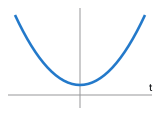
Even Signals
A signal is even if:
x(-t)=x(t)
Symmetric about the vertical axis.
The left side mirrors the right side.
ex: x(t)=t² because (-t)²=t²
Odd Signal
A signal is odd if:
x(-t)=-x(t)
Antisymmetric about the time origin.
The signal changes sign when time is reversed.
Ex: x(t)=t³ because (-t)³ = -t³

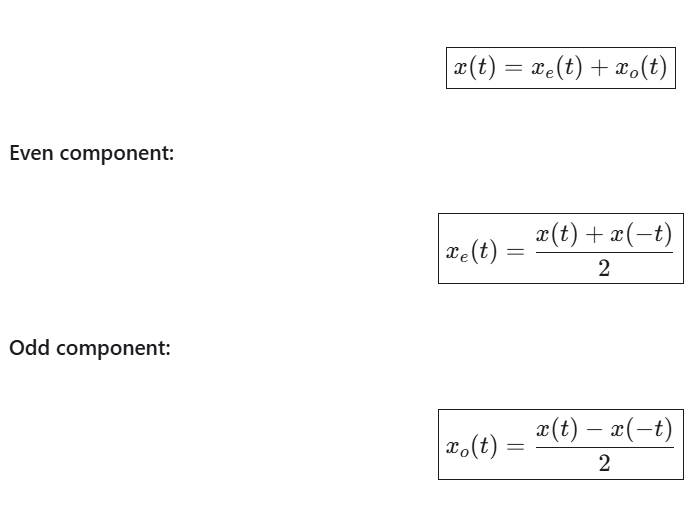
Problem: expressing a signal as the sum of Even and Odd Components

Periodic Signals
A periodic signal repeats itself after a fixed time interval T.
x(t) = x(t+T)

Aperiodic Signal
An aperiodic signal does not repeat itself at regular intervals.
There is no positive period \(T\) that satisfies the periodicity condition.
Examples:
Periodic: sine wave, cosine wave, repeating square wave.
Aperiodic: a single rectangular pulse or a decaying exponential.
The 4 elementary signals
1. exponential signal
2. sinusoidal signal
3. unit-step function
4. unit-impulse function
Exponential Signal
x(t) = Be^at
Where:
B = amplitude constant
a = real parameter
a<0 means decaying exponential
a>0 means growing exponential


Sinusoidal Signal

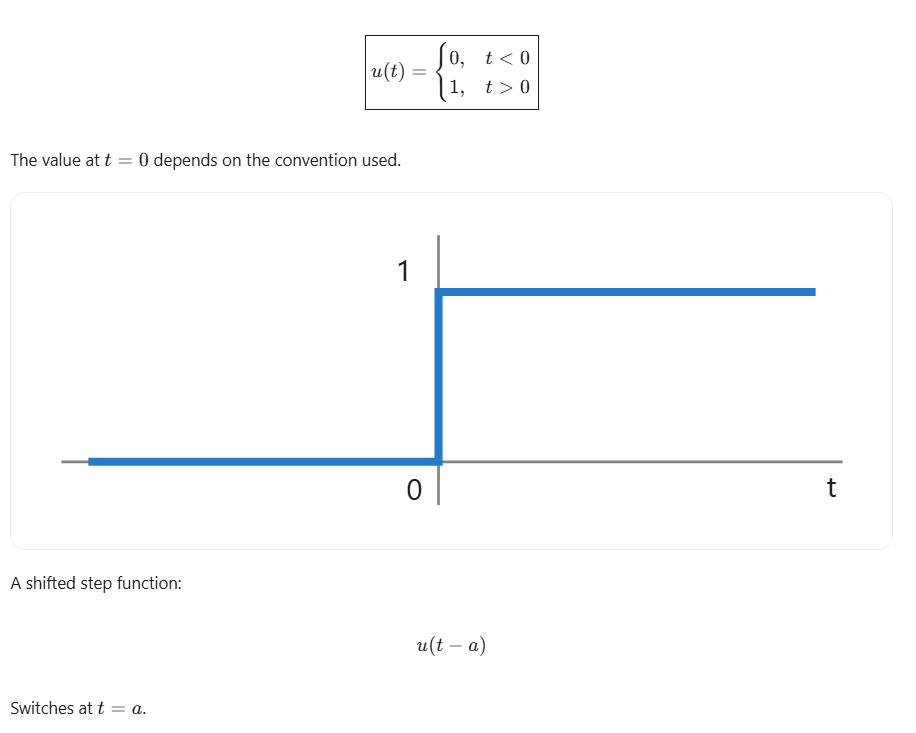
Unit-step function
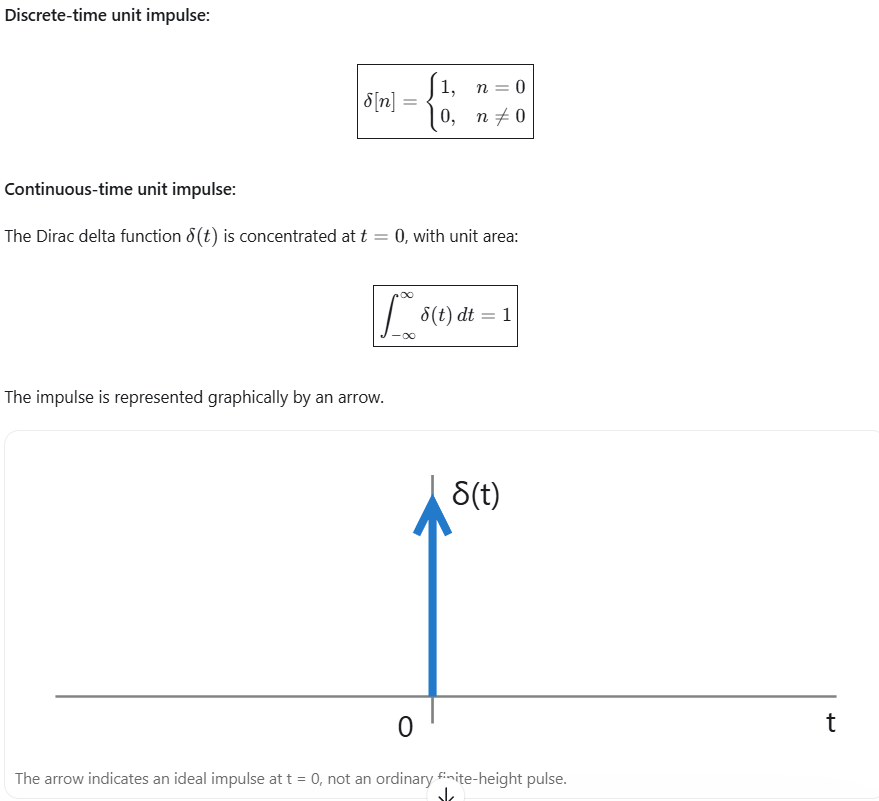
Unit-Impulse Function
Basic Operations on Signals

Time scaling
y(t) = a(at)
a > 1: signal is compressed
0 < a < 1: signal is expanded
ex: x(2t) → compressed by 2
x(t/2) = expanded by 2
Time shifting
y(t) = x(t-t_0)
t_0 > 0: shift right
t_0 < 0: shift left
ex: x(t - 3) → right by 3
x(t + 2_ → lefr by 2
Reflection
y9t) = x(-t)
Reflection reverses the signal about the vertical axis (t=0).
Combining Time Shifting and Scaling
y(t) = x(at - b)
First, perform time shifting: \(v(t)=x(t-b)\).
Then, perform time scaling: \(y(t)=v(at)=x(at-b)\).

Formula Cheat Sheet
