Cestode and Trematode lab
 Call Kai
 Learn
Learn Practice Test
 Spaced Repetition
 Match
Match Flashcards
 Knowt Play
1/87

There's no tags or description
Looks like no tags are added yet.
Name | Mastery | Learn | Test | Matching | Spaced | Call with Kai | Chat |
|---|
No analytics yet
Send a link to your students to track their progress
88 Terms
Diphyllobothrium latum
Fish tapeworm
Taenia saginata
Beef tapeworm
Taenia solium
Pork Tapeworm
Taenia pisiformis
Common dog/rabbit tapeworm
Echinococcus granulosa
Dog tapeworm
Echinococcus multilocularis
Dog/Fox tapeworm
Dipylidium canium
Double Pored/Flea tapeworm
Vampirolepis (Hymenolepis) nana
Dwarf Tapeworm
Hymenolepis diminuta
Dwarf Tapeworm
Diphyllobothrium latum lifecycle
Unembryonated eggs passed in feces
Eggs embryonate in water
Coracidia hatch from eggs; ingested by crustaceans
Grow to procercoid larvae
Infected crusaceans eaten by small fish; develop into pierocercoid larva
predator fish eats smaller fish
Human ingests raw or undercooked infected fish
What is the diagnostic stage of Diphyllobothrium latum?
Egg stage
What stage is the infective stage for Diphyllobothrium latum?
Pierocercoid larva
Taenid (Beef/Pork/Dog Tapeworms) Lifecycle
Eggs or gravid proglottids in feces or environment
Cattle/Pigs ingest contaminated vegetation
Oncospores hatch, penetrate intestinal wall, circulate to muscle
Oncospheres develop into cysticerci in muscle
Human ingests raw or undercooked infected meat
Scolex attach to intestine
Adults migrate to small intestine
What is the diagnostic stage for Beef/Pork/Dog tapeworms
Egg or Gravid Proglottid stage
What is the infective stage for Beef/Pork/Dog tapeworms
When the Oncospheres develop into cysticerci in muscle

What egg is this?
Diphyllobothrium latum egg

What egg is this?
Taeniid eggs
Echinococcus granulosus life cycle in Definitive host
adult in small intestine
Embryonated eggs in feces
Oncosphere hatches: penetrates intestinal wall
Hydatid cyst in various organs
Protoscolex from cyst
scolex attaches to intestine
Echinococcus multilocularis (alveolar) life cycle
Adult in small intestine
Embryonated egg in feces
Oncosphere hatches, penetrates intestinal wall
Alveolar hydatid cyst in visceral organs
Protoscolex from cyst
Scolex attaches to intestine
Echinococcus granulosus life cycle in humans
adult in small intestine
Embryonated eggs ingested
Oncospheres released in small intestine
Hydatid cysts in various organs
Echinococcus multilocularis (alveolar) life cycle in humans
Adult in small intestine
Embryonated egg ingested
oncospheres released in small intestine
alveolar hydatid cysts in liver; may disseminate to other organs
Dipylidium canium life cycle
Gravid proglottids passed intact in feces
Proglottids disintegrate and release egg packets
Flea larvae ingest egg packets. Oncospheres hatch; develop into cysticercoids
Flea larvae mature; harbor inefective cysticercoids
Definitive host ingests infected fleas (dogs/cats)
scolex
incidental transmission to humans
Infective stage of Echinococcus granulosus (cystic)
Embryonated egg in feces
Diagnostic stage of Echinococcus granulosos (cystic)
Hydatid cyst in various organs
Infective stage of Echinococcus multilocularis (alveolar)
Embryonated egg in feces
Diagnostic stage of Echinococcus multilocularis (alveolar)
Alveolar hydatid cyst in visceral organs (usually liver)
Infective stage of Dipylidium canium
When definitive host consumes fleas with cysticercoids
Diagnostic stage of Dipylidium canium
Gravid proglottids passed in feces and the release of egg packets
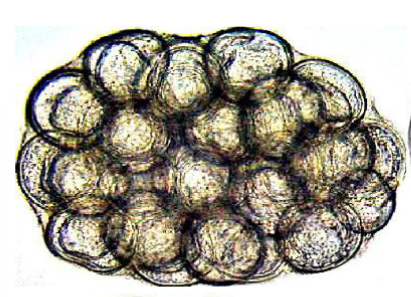
What eggs are these?
Dipylidium canium egg
Vampirolepis (Hymenolepis) nana lifecycle
embryonated egg in feces
Egg ingested by insect
cysticercoid develops in insect
Humans/rodents ingest cysticercoid infected arthropods
Embryonated egg ingested by humans from contaminated food, water, or hands
oncosphere hatches, cysticercoid develops in intestinal villus
scolex
adult in illium
eggs released through genital atrium of gravid proglottids
Gravid proglottids disintegrate, releasing eggs passed in stool
Autoinfection occurs if eggs remain in intestine
Infective stage of Vampirolepis (Hymenolepis) nana
Embryonated egg in feces
Diagnostic stage of Vampirolepis (Hymenolepis) nana
Embryonated egg in feces (same as infective)

What eggs are these?
Vampirolepis (Hymenolepis) nana
Scolex
Cestode head
Found on Anterior side
Contains structures for attachment and locomotion
Rostellum
Protruding cone line structure on Scolex
Equipped with hooks for attachment
Bothrium
Shallow facets/grooves in the head of the tapeworm
Help with attachment
Proglottid
The individual “reproductive packet” on a tapeworm
Contains both male and female anatomy
Strobila
The portion of the body behind the Scolex
Contains the proglottids
Monozoic
A primitive taxa lacking strobila
Body is a single unit
Polyzoic
When the body is comprised of a chain of proglottids (strobila)
Suckers
Cup shaped muscular structured used for attachment
Tegument
External body surface
What two systems are absent from Cestodes?
Digestive and Vascular
What is used to absorb food in Cestodes?
Tegument
Monoecius
Where both male and female reproductive systems exist
Protandrous
Where male reproductive organs are developed prior to female reproductive organs
Operculum
Lid like cover on some egg species
Oncosphere
First motile stage of larva
Hexacanth
Oncosphere with 3 pairs of hook structures
Cysticercoid
Second larval stage in some cestodes (H. diminuta, V. nana, D. canium)
Hydatid cyst
Vesicular structure formed in host tissue in which new scolices are formed (E. granulosus and E. multilocularis)
Coracidium
Ciliated hexacanth of D. latum
Procercoid
Second stage of D. latum in 1st intermediate host
Plerocericoid
D. latum stage reached in second intermediate host
Cysticerus
Second stage larvae in some cestodes (Taenia sp.)
Blood Flukes
Schistosoma mansoni
Schistosoma haematobium
Schistosoma japonicum
Common liver fluke
Fasciola hepatica/gigantica
Giant intestinal Fluke
Fasciolopsis buski
Oriental Lung Fluke
Paragonimus westermani/kellicotti
Chinese/Oriental Liver Fluke
Clonorchis sinensis
Schistosoma sps. Life Cycle
Eggs shed from infected humans (in feces and urine)
Eggs hatch and release miracidia
Miracidia penetrate snail tissue
Sporocysts develop in snail
Free swimming cercariae released into water
Cercariae penetrate skin
Cercariae lose tails, becoming schistomulae
Circulation
Migration to blood portal in liver where maturation occurs
Paired adult worms migrate to either mesenteric venules of bowl OR venous plexus of bladder
What is the infective stage for Schistosoma spp.
Free-swimming cercariae
What is the diagnostic stage for Schistosoma spp.
Eggs shed from infected humans

What egg is this?
Schistosoma haematobium eggs

What egg is this?
Schistosoma japonicum egg

What egg is this?
Schistosoma mansoni egg
Fasciola hepatica/gigantica life cycle
Unembryonated eggs passed in feces
Eggs become embryonated in water
Miracidia hatch, seek out snails
Miracidia penetrate snail; develop from sporocysts into cercariae
Free-swimming cercariae encyst aquatic vegitation
Metacercariae ingested by definitive host
Immature flukes encyst in duodenum; migrate through liver parenchyma to billiary ducts
Adult flukes mature in hepatic billiary ducts
Infective stage of Fasciola hepatica/gigantica
Metacercariae on vegetation
Diagnostic stage of Fasciola hepatica/gigantica
Unembryonated eggs passed in feces

What egg is this?
Fasciola hepatica/gigantica egg
Fasciolopsis buski life cycle
unembryonated eggs passed in feces
Eggs embryonate in water
Miracidia hatch, penetrate snail
Develop from sporocysts into cercariae
Free-swimming cercariae
Metacercariae on water plant ingested by humans or pigs
encyst in duodenum
adults in small intestine
What is the infective stage of Fasciolopsis buski
Metacercariae on water plant
What is the diagnostic stage of Fasciolopsis buski
unembryonated eggs in feces
Paragonimus westermani/kellicotti life cycle
unembryonated eggs
become embryonated in water
Miracidia hatch; penetrate snail
Sporocysts debelop into cercariae
Cercariae invade crustaceans; encyst into metacercariae
Humans ingest inadequately cooked or pickled crustaceans with metacercariae
Metacercariae encyst in duodenum
Adults in cystic cavities in lungs
Diagnostic stage of Paragonimus westermani/kellicotti
Unembryonated eggs
Infective stage of Paragonimus westermani/kellicotti
Metacercariae in crustaceans
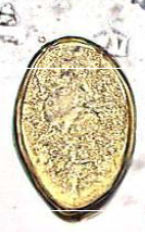
What egg is this?
Paragonimus westermani egg
Clonorchis sinensis life cycle
embryonated eggs passed in feces
Eggs ingested by snail
Develop from miracidia to cercariae
Free-swimming cercariae encyst in skin or flesh of fresh water fish
Infected fish eated by human
Encyst in duodenum
Adults in biliary duct
Diagnostic stage of Clonorchis sinensis
Embryonated eggs in feces
Infective stage of Clonorchis sinensisi
Infected fish is consumed
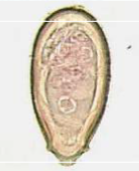
What egg is this?
Clonorchis sinensis egg
Endoparasite
A parasite that lives within another organism
Cercaria (Cercariae)
Trematode larva
Develops from a sporocyst or a redia
Daughter Sporocyst
Larval stage in certain trematodes
Reproduces asexually
Dioecious
Containing both male and female reproductive organs
Distome
Largest trematode group
Anterior and Oral sucker on ventral portion of body
Monostome
Only has the oral sucker, located on anterior
Gastrome