FINAL EXAM bio
 Call Kai
 Learn
 Practice Test
 Spaced Repetition
 Match
 Flashcards
 Knowt Play
1/65

There's no tags or description
Looks like no tags are added yet.
66 Terms
sexual reproduction
combines genetic material from two parents. half the genetic material being from the mom, and half from the dad
gametes
eggs and sperm
meiotic cell division
cell division that results in daughters with half the number of chromosomes and the parent cell
how many rounds of DNA synthesis in meiosis
1
how many rounds of cell divison in meiosis
2
how many daughter cells does meiosis produe
4
are the daughter cells from meiosis genetically identical or genetically unique?
unique
the 2 cell divisions in meiosis are called
meiosis I and meiosis II
are both meiosis I and meiosis II sucessive?
yuh
paternal pairs of chromosomes are called
homologous chromosomes
meiosis I begins with this stage
prophase I
prophase I of meiosis
1. chromosomes first apear as long thin threads
2. chromosomes condense
3. homologous chromosomes pair
(since DNA replication has already taken place each chromosome has become 2 sister chromatids held together at the centromere)

synapsis
The aligned and precise pairing of homologous chromosomes in prophase I of meiosis.
opportunity for the maternal and parternal chromosomes to exchange genetic info
bivalent
when homologous chromosomes come together but they both have 2 chromatids so they make a 4 stranded structure with 2 pairs of chromatids aligned along their length

nonsister chromatids
basically homologus chromosomes are like similar but not the same
Chromatids of different members of a pair of homologous chromosomes; although they carry the same complement of genes, they may carry different allele variants.
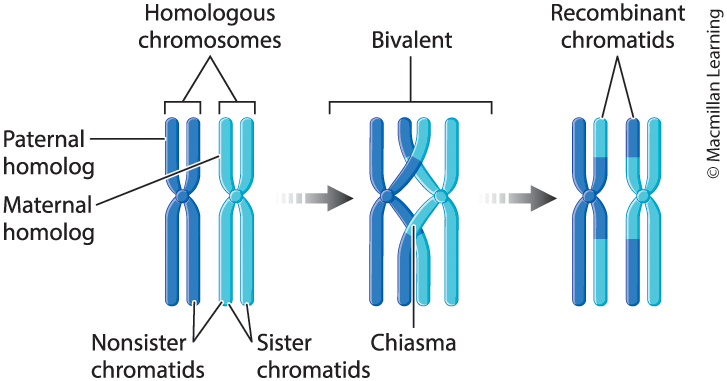
Crossing over between DNA molecules results in
exchange of DNA
chaisma
when nonsister chromatids break and then join in such a way that meternal and paternal genetic material is exchanged

The positions of the chiasmata along the chromosome are specialized/random
random
T or F: usually, no nucleotides are gained or lost as homologous chromosomes exchange
TRUE
recombinant chromatids
those that carry partly paternal and partly maternal segments.
The number of chiasmata that form during meiosis depends on
the species
typical range of chiasmata in humans
50-60
Most bivalents have at least (this many) chiasma
one, where they are paired is almost always a chiasma, even on sex chromosomes
in addition to exchanging genetic material, what else do chiasmata do?
hold the bivalents together while they’re properly oriented in the cell of the cell during metaphase
when is the number of chromosomes reduced in meiosis
the first meiotic division
At the end of prophase I
the chromosomes are fully condensed and have formed chiasmata, the nuclear envelope has begun to disappear, and the meiotic spindle is forming.
prometaphase I
the nuclear envelope breaks down and the meiotic spindles attach to kinetochores on chromosomes
metaphase I
bivalents move into position to be separated
Each bivalent lines up so that its two centromeres lie on opposite sides of this plane, pointing toward opposite poles of the cell
the orientation of the bivalents is random, for some the maternal homolog might be attached to one pole and the parternal homolog is attached to the spindle from the other pole

anaphase I
two homologous chromosomes of each bivalent separate as they are pulled in opposite directions
the centromeres do not split and the two chromatids that make up each chromosome remain together. (because spindle microtubules from one pole of the cell attach to both kinetochores of a given chromosome)
in anaphase I are the chromatids pulled apart
no
how many chromosomes are at each pole at the end of meiosis i
23
reductional division
A descriptor of meiosis I because this division reduces the number of chromosomes by half.
telophase i
chromosomes uncoil slightly and a nuclear envelope reappears
The chromosomes do not completely decondense, however, so telophase I blends into the first stage of the second meiotic division.
THERE IS NO DNA MADE BETWEEN THE 2 MEIOTIC DIVISIONS
The second meiotic division resembles
mitosis.
prophase ii
the nuclei in prophase II have the haploid number of chromosomes
In prophase II, the chromosomes recondense to their maximum extent.
Toward the end the nuclear envelope begins to disappear , and the spindle begins to be set up
meiosis ii
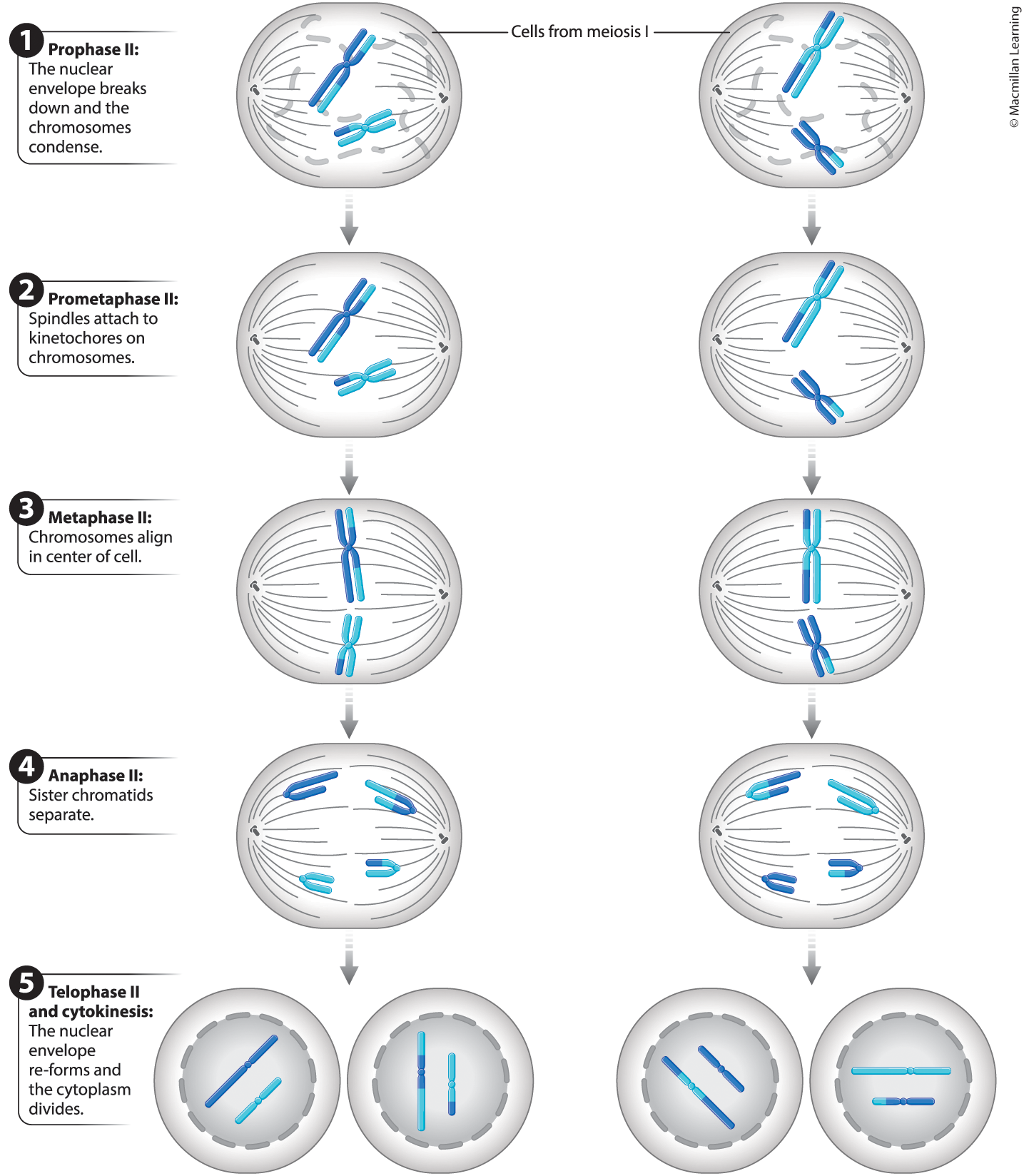
prometaphase ii
spindles attach to kinetochores
metaphase ii
the chromosomes line up so that their centromeres lie on an imaginary plane cutting across the spindle
anaphase ii
the centromere of each chromosome splits. The separated chromatids, now each regarded as a full-fledged chromosome, are pulled toward opposite poles of the spindle
resembles mitosis
telophase ii
chromosomes uncoil and become decondensed
nuclear envelope re-forms
The nucleus of each cell now has the haploid number of chromosomes
equational division.
A descriptor of meiosis II because cells entering meiosis II have the same number of chromosomes as the cells that result from the process.
The similarity of meiosis II and mitosis suggests that
meiosis likely evolved from mitosis
T or F: meiosis is thought to have evolved in the common ancestor of all eukaryotes and has been subsequently lost in some groups.
True
Division of the cytoplasm often differs between
the sexes
In female mammals the cytoplasm in divided like this
Most of the cytoplasm is retained in one meiotic product, a very large cell called the oocyte. This large cell can develop into the functional egg
the other miotic products only recieve a small amount of cytoplasm and are called polar bodies
in male mammals meotic divison
the cytoplasm divides about equally in both meiotic divisions, and each of the resulting meiotic products goes on to form a functional sperm (4 sperm)
During the development of sperm, most of the cytoplasm is eliminated
what is left is essentially a nucleus in the sperm head equipped with a long whiplike flagellum to help propel it toward the egg.
creation of gametes, male vs female

polar bodies
A small cell produced by the asymmetric first meiotic division of a primary oocyte.
chromosome theory of inheritance
The concept that chromosomes contain genes and the movement of chromosomes during cell division explains inheritance. Specifically, the behavior of chromosomes during meiosis is the cellular basis for Mendelian inheritance
why are errors resulting in extra chromosomes infrequently observed even though they’re quite common
because most of them are lethal
Nondisjunction in meiosis results in
Nondisjunction in meiosis results in
nondisjunction
the failure of a pair of chromosomes to separate during anaphase of cell division
when nondisjuntion occurs in Meiosis i
2 gametes have an extra chromosome and 2 gametes are missing a chromosome

when nondisjunction occurs in meiosis ii
2 normal gametes are made
1 gamete with an extra chromosome is made
and 1 gamete with a missing chromosomes is made
which nondisjunction is more harmful: one in meiosis i or in meiosis ii
meiosis i because all of the resulting gametes will either be missing a chromosome or have an extra
down syndrome
A condition resulting from the presence of an extra copy of chromosome 21; also called trisomy 21.
because affected individuals have three copies of chromosome 21

side affects of down syndrome
intellectually disabled to varying degrees
characteristic facial appearance
higher risk of dementia
short because of delayed maturation of the skeletal system,
short because of delayed maturation of the skeletal system,
trisomy 13 and trisomy 18
much rarer than Down syndrome, and the effects are more severe. In both cases, the effects on development are so profound that newborns with these conditions usually do not survive the first year of life.
extra sex chromosomes of xxx, xyy
These individuals are in the typical range of physical development and mental capability, and usually their extra sex chromosome remains undiscovered until their chromosomes are examined for some other reason.
why no effect if XYY
The Y chromosome contains the gene that stimulates the embryo to take the male developmental pathway and few other genes, so individuals do not have many extra genes, as is the case in Down syndrome.
why no effect if XXX
in the cells of female mammals, all X chromosomes except one are inactivated and gene expression is largely repressed.
This process is called X-inactivation
Because of X-inactivation, a 47, XXX female has one active X chromosome per cell, the same number as in a 46, XX female.
sex-chromosome anomalies that do have detectable effects
XXY, X
XXY chromosome anomalie
klinefelter syndrome
are male bc y chromosome but the testes fail to enlarge at puberty, the voice remains high pitched, pubic and facial hair remain sparse, and there is some enlargement of the breasts.
affected males do not produce sperm and are sterile
klinefelter syndrome
A set of conditions that results when an individual has 47 chromosomes, including two X chromosomes and one Y chromosome.
X chromosome anomaly (one X chromosome)
results in turner syndrome
Affected females are short and often have a distinctive webbing of the skin between the neck and shoulders.
There is no sexual maturation.
The external sex organs remain immature
the breasts fail to develop, and pubic hair fails to grow.
Internally, the ovaries are small or absent, and
menstruation does not occur (sterile)
In fertilized eggs with extra or missing chromosomes, the embryos usually
fail to complete development.
in some time during pregnancy — in some cases very early, in other cases relatively late — the chromosomally unbalanced embryo or fetus undergoes spontaneous abortion.