3030 - Sine waves and complex sounds
 Call Kai
 Learn
Learn Practice Test
 Spaced Repetition
 Match
Match Flashcards
 Knowt Play
1/48

There's no tags or description
Looks like no tags are added yet.
Name | Mastery | Learn | Test | Matching | Spaced | Call with Kai | Chat |
|---|
No analytics yet
Send a link to your students to track their progress
49 Terms
Periodic vibration
pattern of vibration repeats regularly over time
Aperiodic vibration
No regular pattern of vibration
Properties of a sine wave
1. Starting phase
2. Amplitude
3. Frequency
Starting phase
Point in displacement cycle when object begins to vibrate
Instantaneous phase
Point in displacement cycle at time of measurement
Units: angle (degrees/radian)
Amplitude
height of the wave, related to displacement of particle
Peak amplitude

Peak-to-peak amplitude

Wavelength is the distance between two successive ________ or __________
condensations, rarefactions
0, 180, 360 degrees represents
equilibrium
0-360 degrees is a
complete cycle
90 and 270 represent
maximum displacement

Fourier Analysis
A mathematical procedure by which any signal can be separated into component sine waves at different frequencies. Combining these sine waves will reproduce the original signal.
Complex sound
combination of all puretones
Complex waveform
contains energy at a number of different frequencies, amplitudes, and phase relationships (e.g. speech)
Simple harmonic motion
contains energy at one frequency (e.g. pure tone)
in-phase waves
add together and results in a higher amplitude

out of phase waves
amplitude will not be as high as sounds that are in-phase

completely out of phase waves
if it is a pure tone, the waves will cancel one another out; it would be silent
spectrum
graph with frequency along the x-axis and amplitude along the y-axis
line spectrum
displays frequency content of periodic sounds
continuous spectrum
displays frequency content of aperiodic sounds
Line spectrum of a periodic complex sound

Continuous spectrum of an aperiodic complex sound

Line spectrum of a pure tone

Transient aperiodic sound (waveform and spectrum)
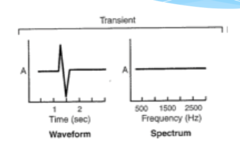
Continuous aperiodic sound (waveform and spectrum)

Perception
tone that reflects different in frequency
A fundamental frequency of 100 Hz has a first harmonic of 200 Hz. What is the fourth harmonic of the fundamental?
400 Hz
Waveform
graphical representation with a time domain
Spectrum
graphical representation with a frequency domain
Amplitude spectrum
amplitude as a function of frequency
phase spectrum
phase as a function of frequency
Line spectrum
graphical representation that indicates a discrete number of sinusoids
Continuous spectrum
graphical representation that contains all frequencies within certain limits
Phase spectrum

nth harmonic (if fundamental frequency is 100 Hz)
n*100 Hz
Octave
is a scale of frequency; DOUBLING of frequency in Hz
How many octaves spans from 100 to 800?
3 octaves
100-200 Hz
200-400 Hz
400-800 Hz
Sawtooth wave
sum of odd and even harmonics
-6 db/octave slope

Square wave
sum of odd harmonics
-6 db/octave slope

Triangular wave
sum of odd harmonics
-12 db/octave slope

Noise
aperiodic complex wave that has instantaneous amplitudes that vary in a RANDOM manner

White noise
noise consisting of all audible frequencies in equal amounts

Broad band noise
aperiodic complex wave that contains all frequencies within certain BROAD limits
Narrow band noise
aperiodic complex wave that contains alll frequencies within NARROW limits
All the frequencies contained within white noise have the same _______ intensity or pressure
average
Amplitude spectrum of white noise characteristics
Continuous and flat
Phase spectrum of noise characteristics
Random