Chapter 6 : Development of Ball Skills
 Call Kai
 Learn
 Practice Test
 Spaced Repetition
 Match
 Flashcards
 Knowt Play
1/52

There's no tags or description
Looks like no tags are added yet.
53 Terms
Ballistic Skills are skills in which a
person applies force to a small object to project it
Building Blocks to play in sports
Most studied ballistic skills?
overhand-throw
Types of throwing
◦ Underhand (One or two handed)
◦ Sidearm
◦ Overarm (One or two handed)
One-hand overarm throw is the
most common in sports and games
Baseball, track/field events
Javelin throw
What are the 3 phases of throwing?
Preparatory Phase : All movements directed away from the intended line of projection
Execution Phase : Consists of all movements performed in the direction of the throw
Follow-through Phase : All movements following the release of the ball
Characteristics of Early Overarm Throwing
◦ Early throwers will show minimal movement
◦ Mostly arm action in children < 3 years old
◦ Elbow is pointed up
◦ Elbow extension
◦ No step or trunk action; trunk flexion

Movements are ________ to transfer momentum?
sequential
Characteristics of Proficient Overarm Throwing
◦ Preparatory windup (Weight shifts to back foot and trunk rotates back; arm swings)
◦ Thrower uses opposite leg, long step, and differentiated trunk rotation
◦ Upper arm and forearm lag behind trunk and upper arm during forward swing
◦ Follow through

Observing Overarm Throwing from the FRONT/BACK
◦ Trunk-to-upper arm angle
◦ Elbow angle
◦ Lateral trunk bend
Observing Overarm Throwing from the SIDE
◦ Step
◦ Trunk Rotation
◦ Upper and forearm lag
Developmental Changes in Overarm Throwing (TRUNK ACTION)
◦ 1. None, and no forward or backward movements
◦ 2. Block rotation
◦ 3. Differentiated rotation
Developmental Changes in Overarm Throwing (BACKSWING, HUMERUS, and FOREARM ACTION)
◦ 1. None
◦ 2. Shoulder flexion
◦ 3. Upward circular backswing
◦ 4. Downward, circular backswing
Developmental Changes in Overarm Throwing (HUMERUS ACTION)
◦ 1. Humerus oblique
◦ 2. Humerus aligned but independent
◦ 3. Humerus lagging
Developmental Changes in Overarm Throwing (FOOT ACTION)
◦ 1. No step
◦ 2. Homolateral step
◦ 3. Short contralateral step
◦ 4. Long contralateral step
Developmental Changes in Overarm Throwing (FOREARM ACTION DURING FORWARD SWING)
◦ 1. No forearm lag
◦ 2. Forearm lag
◦ 3. Delayed forearm lag
What is a ballistic strike of an object from the foot ?
Kicking
soccer, kickball
Individual must have developed ___________ and ___________ to kick
sufficient perceptual abilities and eye coordination
Kicking a moving ball is ________ for young children
challenging
What are the 3 phases of Kicking
◦ Preparation Phase: The approach or position of the body prior to the ball (object) contact
◦ Force Production Phase: Contact is made with the ball
◦ Follow through Phase: The position of the body after contact of the ball is made
Characteristics of Early Kicking
Like throwing, there is a single action rather than a sequence
◦ Arms held stationary at the sides
◦ No trunk rotation
◦ Kicking leg simply pushes the ball forward
◦ No step from the non-kicking foot


Characteristics of Proficient Kicking
Preparatory windup is used
◦ Arms are in opposition to legs and react to trunk and leg movements
◦ Trunk rotates forward; kicker will lean back at contact with ball
◦ Movement is sequential: kicking thigh rotates forward; then lower leg
extends
◦ Kicking leg will swing through full range of motion

Observing Kicking from the FRONT
Whether toes or instep of foot is used to kick
Observing Kicking from the SIDE
◦ Placement of non-kicking foot
◦ Range of motion and contact of the kicking leg
◦ Range of trunk motion
◦ Arm opposition
Developmental Changes in Kicking
◦ Kicking has not been studied extensively
◦ However, it can be suggested that kicking is not a skill that children will automatically do, rather they need to be taught
◦ Children will modify kicking movements based on distance to be kicked
Punting is a form of
kicking where an object is dropped from an individual’s hand before impact with the foot
Soccer, football
Difficult
Timing: Ball drop and leg swing
Characteristics of Early Punting
◦ Ball is tossed up in the air rather than dropped
◦ Arms drop to the sides
◦ Rigidly extend kicking leg knee or bend kicking leg knee
◦ Foot is at right angle and the ball contacts the toes rather than instep

Characteristics of Proficient Punting
◦ Arms are extended forward to drop ball before final stride
◦ Arms then drop to sides and move into opposition to legs
◦ Punter leaps onto supporting leg, swings putting leg vigorously up to make
contact with the ball; body leaves the ground with hop of supporting leg
◦ Punting leg is kept straight; toes are pointed at the time contact

Developmental Changes in Punting ARM ACTION : BALL-RELEASE PHASE
◦ 1. Upward toss
◦ 2. Late drop from chest height
◦ 3. Late drop from waist height
◦ 4. Early drop from chest weight
Developmental Changes in Punting ARM ACTION : BALL-CONTACT PHASE
◦ 1. Arm drop
◦ 2. Arm abduction
◦ 3. Arm opposition
Developmental Changes in Punting LEG ACTION: BALL-CONTACT PHASE
◦ 1. No step or short step, ankle flexed
◦ 2. Long step, ankle extended
◦ 3. Leap and hop
Observing Punting from the SIDE
◦ Height at which ball is dropped
◦ Arm position
◦ Foot position
Movement in which performer uses a designated body part or implement to project an object is called
Striking
Striking with an implement is
bat, racket
Striking without an implement
hand, arm
Underarm strike example
underhand volleyball serve
sidearm strike example
baseball swing with a bat
Overarm Strike example
overhand volleyball serve
involves perceptual motor ability and timing
Striking Phases
◦ Preparation Phase : Use of arms and body for a back swing to prepare for object
◦ Contact Phase : Arm or implement contacts the object
Characteristics of Early Sidearm Striking
◦ Form of striking where the arm remains at or below shoulder level.
◦ Similar arm motion as in overhand throw
◦ Chopping motion (elbow extension)
◦ Little leg and trunk movement
◦ Individual faces the oncoming

Characteristics of Proficient Sidearm Striking
◦ Sideways preparatory stance and long step
◦ Horizontal swing through large range of motion (arm extended before contact)
◦ Differentiated trunk rotation
◦ Stepping into the hit
◦ Sequence of movements: backswing and forward step, pelvic rotation, spinal rotation and swing, arm extension, contact, follow through

Observing Sidearm Striking from the FRONT
Direction of step, plane of swing, and arm extension
Observing Sidearm Striking from the SIDE
step, trunk rotation, and extent of swing
Developmental Changes in Sidearm Striking
◦ Striker stands sideways instead of forward
◦ Trunk rotation (none, blocked, then differentiated)
◦ Plane of swing progresses from vertical to horizontal
◦ Grip changes from power grip to “shake-hands” grip
◦ Elbows are held away from body and extended before contact
A type of striking where the arm travels above shoulder level. An example is a person swinging a racket in a tennis serve. This is what?
Overarm Striking
With Implement: volleyball serve
Without : Tennis Serve
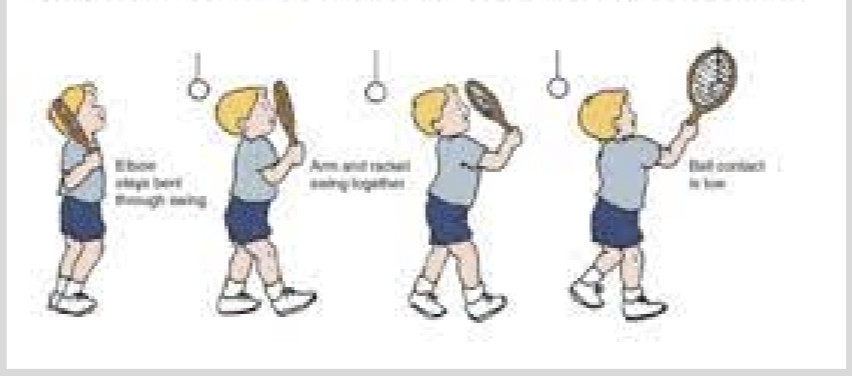
Characteristics of Early Overarm
Striking
◦ Looks like early throwing
◦ Swing with collapsed elbow and the arm and racket swing forward in unison
◦ Limited trunk rotation
◦ Little or no lag with swing forward
Characteristics of Proficient Overarm Striking
◦ Elbow is held between 90 and 119 degrees at start of forward movement
◦ Racket lags behind arm in forward swing
◦ Lower and upper trunk are rotated more than 90 degrees
◦ Movement is sequential
Observing Overarm Striking from the BACK
location of arm and lags
Observing Overarm Striking from the SIDE
Direction of step, plane of swing, and arm extension
Developmental Changes in Overarm Striking : PREPARATORY PHASE (TRUNK ACTION)
◦ 1. No trunk rotation
◦ 2. Minimal trunk rotation
◦ 3. Total trunk rotation
Developmental Changes in Overarm Striking : BALL CONTACT PHASE (SPINAL AND PELVIC ROM)
◦ 1. Rotation of less than 45°
◦ 2. Rotation of 45° to 89°
◦ 3. Rotation of 90° or more
Developmental Changes in Overarm Striking : BALL-CONTACT PHASE (ELBOW ACTION)
◦ 1. Very small or very large angle
◦ 2. Intermediate angle (21°– 89°)
◦ 3. Ideal angle (90°– 119°)
Developmental Changes in Overarm Striking : PELVIC ROM
◦ 1. Rotation of less than 45
◦ 2. Rotation of 45-89
◦ 3. Rotation of 90 or more
Developmental Changes in Overarm Striking : RACKET ACTION
◦ 1. No racket lag
◦ 2. Racket lag
◦ 3. Delayed racket lag