lec 16 - T cell activation and killing
 Call Kai
 Learn
 Practice Test
 Spaced Repetition
 Match
 Flashcards
 Knowt Play
1/39

There's no tags or description
Looks like no tags are added yet.
40 Terms
Recall what is the primary APC that presents to / activates T cells?
dendritic cells!
Recall where do naive T cells wait to be activated?
in the T cell zone of secondary lymphoid organs

T/F: Naive T cells spend their lifespan circulating through MULTIPLE secondary lymphoid organs until they find their antigen.
true!
Secondary lymphoid organ AKA _ _ _
SLO
Naive T cells enter the SLO —> engage in low affinity, transient interactions with dendritic cells looking for their antigen —> what do they do if they don’t find it?
detach and leave the SLO if they don’t find it —> move onto the next SLO
Naive T cells enter the SLO —> engage in low affinity, transient interactions with dendritic cells looking for their antigen —> what do they do if they do find it?
the low affinity interaction is STABILIZED by finding their specific peptide in the MHC
and so begins the process of antigen recognition!
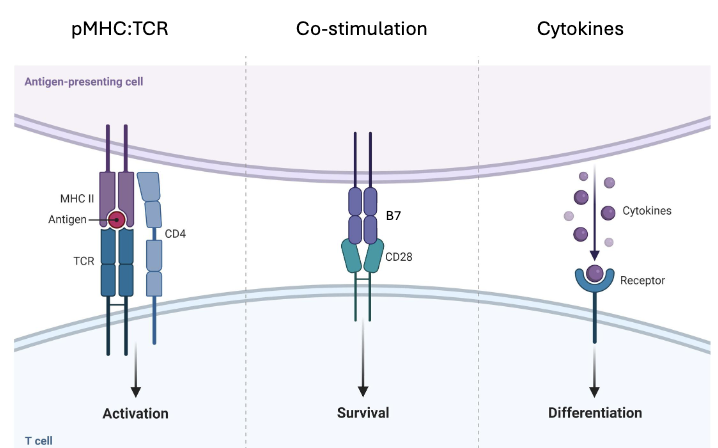
What are the 3 signals required for activation?
Antigen-specific interaction (TCR: pMHC)
Co-stimulation (CD28:B7)
Cytokine signalling (these cytokines can come from the T-cell, APC, or other cells).

Even if all 3 signals aren’t met, can the T cell be activated?
nopeee! all 3 must be met to be activated
What is the “immune synapse”?
the interface between immune cells!

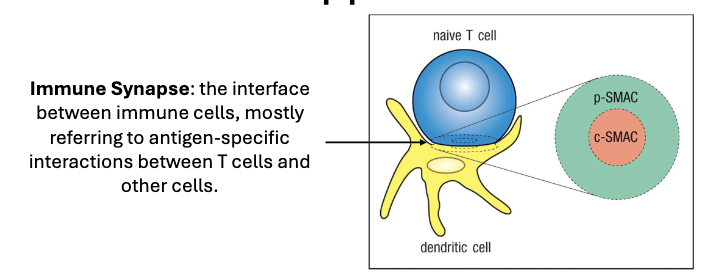
The structure of the immune synapse supports T cell interaction. How so?
there is c-SMAC and p-SMAC involved in the synapse to help the interaction!
c-SMAC = central supramolecular activation cluster (don’t memorize SMAC) = molecules involved in TCR signalling and T cell activation
p-SMAC = peripheral SMAC = adhesion molecules involved in keeping the cells in contact
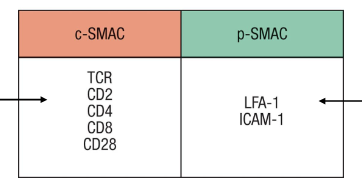
What does c-SMAC stand for? What are the molecules involved?
c-SMAC = central supramolecular activation cluster (don’t memorize SMAC) = molecules involved in TCR signalling and T cell activation

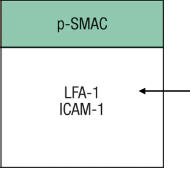
What does p-SMAC stand for? What are the molecules involved?
p-SMAC = peripheral SMAC = adhesion molecules involved in keeping the cells in contact
Rem. TCRs can either be alpha-beta constant domains or delta-gamma constant domains. Does the alpha-beta TCR signal? Why or why not?
no the alpha-beta TCR does not! Cuz It has no intracellular signalling domain!
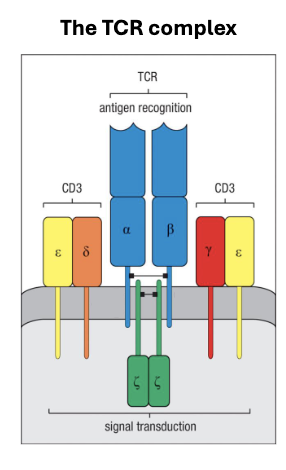
But we know the TCR complex binding to pMHC causes signal transduction into the T cell. So how does it happen?
the TCR forms a complex with CD3 proteins. THESE are what cause signalling transduction.
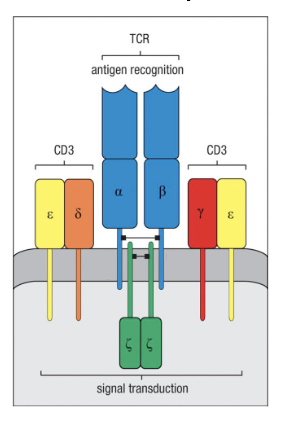
So summarize the roles:
TCR defines antigen specificity
CD4 is the co-receptor necessary for binding MHC-2
CD8 is the co-receptor necessary for binding MHC-1
CD3 performs signal …?
So summarize the roles:
TCR defines antigen specificity
CD4 is the co-receptor necessary for binding MHC-2
CD8 is the co-receptor necessary for binding MHC-1
CD3 performs signal transduction upon TCR binding pMHC
Ok so we finished talking about signal 1. Recap it s’il vous plait.
The TCR itself isn’t what signals. Rather it’s the CD3 co-receptor that causes signal transduction into the T cell.
Now onto signal 2: co-stimulation. We know naive T cells express co-stimulatory ligands like CD28. What do activated APCs express ?
Activated APCs also express co-stimulatory receptors like B7.

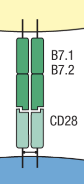
T/F: CD28:B7 is the only example of a cognate co-stimulatory ligand pair.
no!!! there are many!!! CD28:B7 is just one example
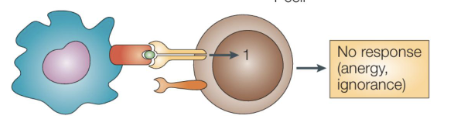
If only signal 1 is present (instead of both signal 1 AND 2), then the T cell is pushed towards non-reaction AKA _________.
If only signal 1 is present (instead of both signal 1 AND 2), then the T cell is pushed towards non-reaction AKA tolerance.

If only signal 2 is present (instead of both signal 1 AND 2), then the T cell acts like it ain’t see the …
like it ain’t see the co-stimulation signal 2.
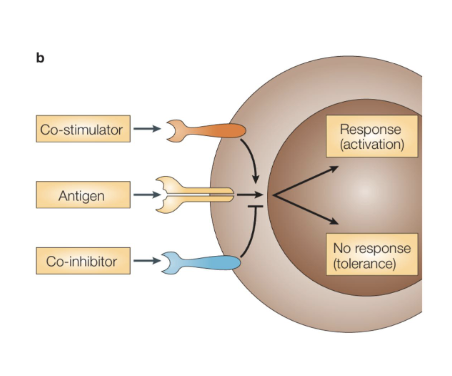
Both co-stimulatory and co-inhibitory molecules exist. Whether a T cell is activated depends on the balance of activating and inhibiting signals.
…
Ok finally let’s talk about signal 3: cytokines! What are the 2 general functions of a cytokine?
to induce proliferation and differentiation (e.g., IG-2)
to induce polarization into one of the 4 immune effector modules

At baseline, a naive T cell only expresses a low-affinity IL-__ receptor (lacking the alpha-chain).
At baseline, a naive T cell only expresses a low-affinity IL-2 receptor (lacking the alpha-chain).
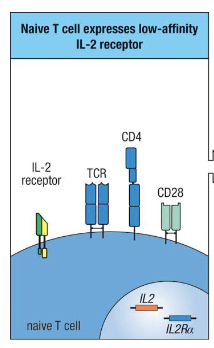
But once signal 1 and 2 activate the T cell, the T cell will start to transcribe the genes for IL-2 and its ______ chain (IL2R-alpha).
But once signal 1 and 2 activate the T cell, the T cell will start to transcribe the genes for IL-2 and its alpha chain (IL2R-alpha).

Adding IL2R-alpha assembles the ….
Adding IL2R-alpha assembles the high-affinity IL-2 receptor.


The T cell secretes IL-2 which binds back to its own high-affinity receptors —> triggers rapid cell division. This means the single naive T cell is now repeated into a bunch of identical clones that are all …
…that are all specific for the same antigen!
This proliferation and differentiation into mature effector CD8+ T cells is called ____________ _________________?
CLONAL EXPANSION
Once activated and differentiated, the T cells are licensed to act. For CD8+ T cells, “licensed to ?”.
Once activated and differentiated, the T cells are licensed to act. For Cd8+ T cells, “licensed to kill”.
T/F: Once licensed, effector T cells need both signals again.
false! Once licensed, effector T cells only need Signal 1 (TCR:pMHC).


Summary of the 3 signals:
…
Recall that CD8+ T cells are cytotoxic aka serial killers. Why?
cuz these T cells recognize the pMHC and directly kills the presenting cell (releasing cytotoxic granules to induce apoptosis).
one CD8+ T cell can kill multiple targets serially.
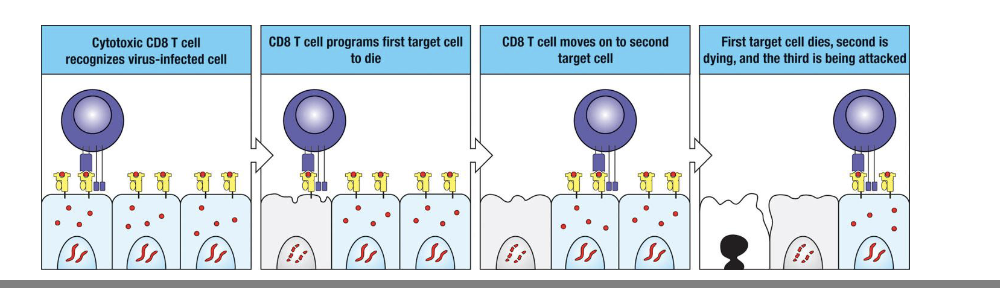
Because CD8+ T cells kill our own cells, they help battle cancerous cells and virally infected cells.
If they are inadvertently activated against SELF proteins, they kill our own cells, causing ____immunity.
Because CD8+ T cells kill our own cells, they help battle cancerous cells and virally infected cells.
If they are inadvertently activated against SELF proteins, they kill our own cells, causing autoimmunity.
CD8+ T cells kill via apoptosis in target cells. This is the same effector mechanism as what innate immune cell?
as NK cells!
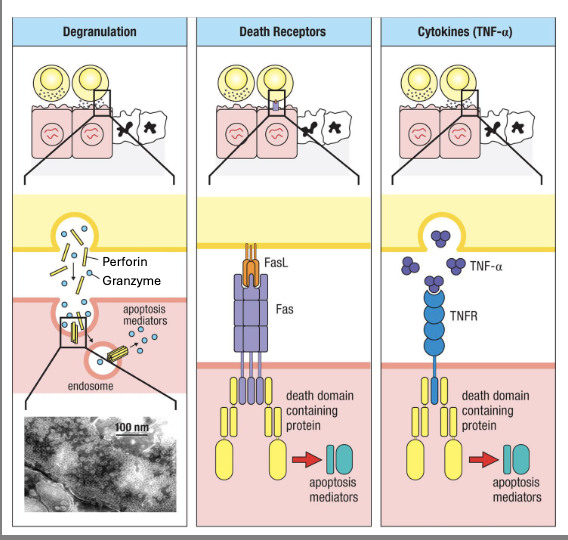
Walk me thru the detailed 3 processes of inducing apoptosis:
CD8+ T cell releases cytotoxic granules into target cell. It contains perforin and granzymes.
Perforin creates a pore in the membrane that allow granzymes through.
Granzymes activate triggers caspase cascade —> apoptosis
Activated CD8+ T cells express FasL (a ligand) on their surface, which binds to the Fas death receptor on the target cell membr.
Fas recruits death-domain containing proteins (FADD etc) —> triggers intracellular signalling —> apoptosis
CD8+ T cell secretes TNF-alpha —> binds to TNFR (receptors) on target cell surface —> triggers intracellular signalling —> apoptosis


When the CD8+ T cell recognizes pMHC on its target cell, what will the T cell do to better fit the synapse?
the T cell will reorganize its cytoskeleton and cytoplasmic machinery to directly face the synapse.
Lytic granules from the T cell will secrete directly into the c-SMAC. The surrounding p-SMAC acts as a tight gasket to ensure cytotoxic molecules don’t leak out onto adjacent cells.
In the pic you can see after 3 mins, the cytotoxic granules traverse from the back of the T cell to the synapse.
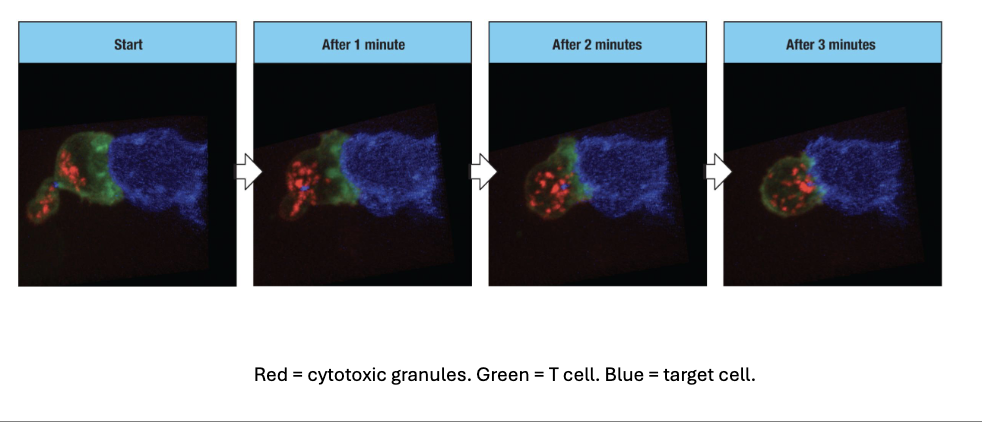
Thanks to the contained synapse, target cells undergo clean apoptosis while sparing adjacent uninfected neighbours.
….

Ok so what happens to the T cells once the pathogen is cleared ? Memory wise i mean.
cuz isn’t maintaining millions of active effector T cells too energy-intensive?
yuppp too energy consumption. thus up to 95% of effector T cells undergo apoptosis post-infection. the surviving 5% persist as long-term memory T cells.


Wait why don’t CD8+ T cells just kill the dendritic cells that activate them IN the lymph node?
cuz naive T cells aren’t yet licensed to kill! they must first upregulate killing molecule granzymes etc to kill upon the 2nd time of encountering them…
Why is it good that naive T cells aren’t yet licensed to kill?
cuz this ensures the DC can survive long enough in the lymph node to prime and activate the T cell.
What is “DC editing”?
the targeted killing of antigen-bearing dendritic cells by activated, licensed effector CD8+ cytotoxic T lymphocytes (CTLs)