NUR3190 Cardiovascular Diseases
 Call Kai
 Learn
 Practice Test
 Spaced Repetition
 Match
 Flashcards
 Knowt Play
1/130

There's no tags or description
Looks like no tags are added yet.
Name | Mastery | Learn | Test | Matching | Spaced | Call with Kai | Chat |
|---|
No analytics yet
Send a link to your students to track their progress
131 Terms
What are the three (3) systems within the heart?
(1) Mechanical System, (2) Circulatory System, and (3) Electrical system.
What is the function of the mechanical system within the heart?
Wall movement (contractility).
What are two (2) functions of the circulatory system outside the heart?
(1) Blood flow, (2) Arterial health.
What are two (2) functions of the electrical system within the heart?
(1) Conduction, (2) Heart rhythm.
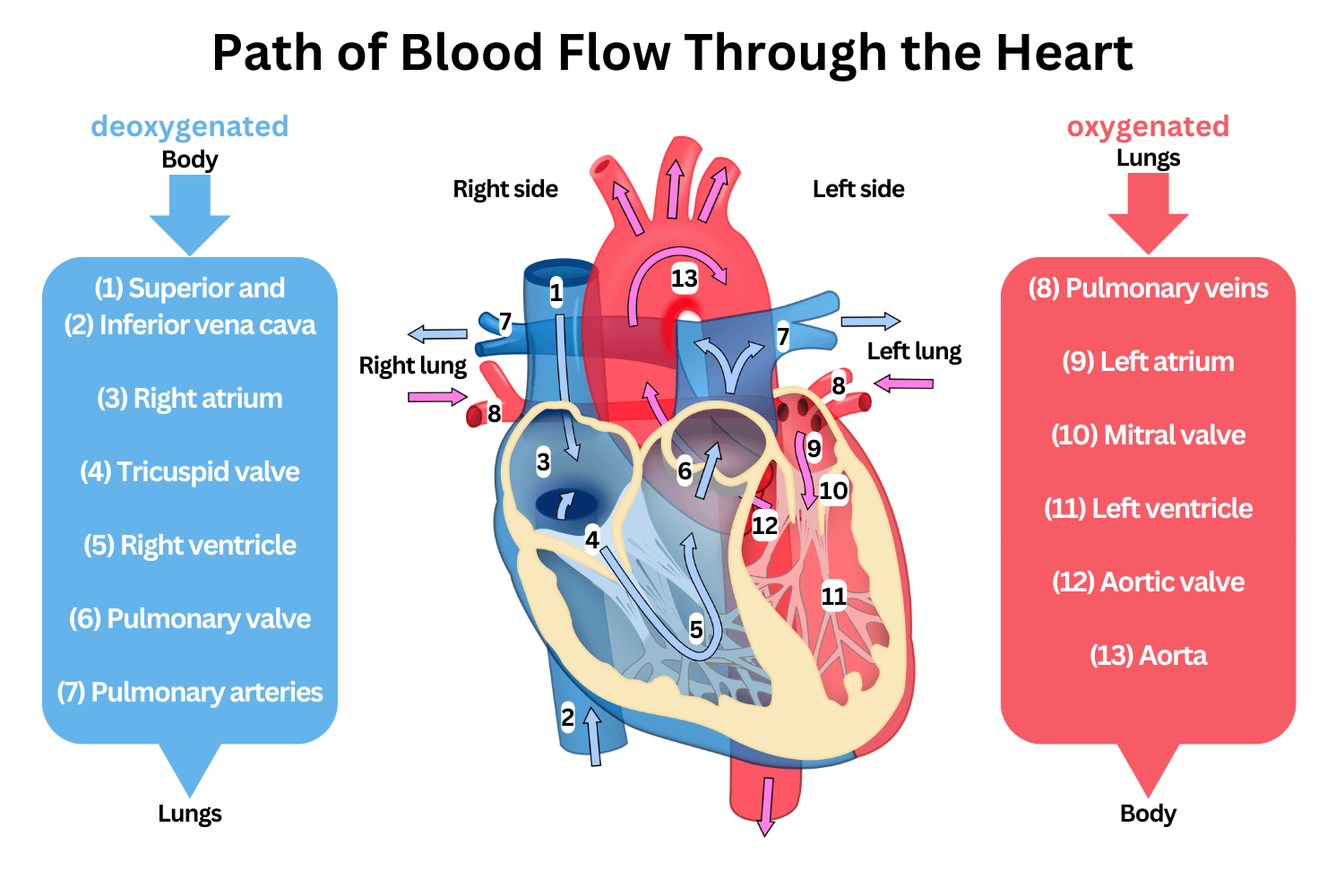
Understand the Circulatory path of blood in and out of the heart.
Understand the Circulatory path of blood in and out of the heart.
True or False?
Arteries carry oxygenated blood to tissues/organs and veins carry deoxygenated blood to the heart for oxygenation.
True.
True or False?
Arteries are high pressure whereas veins are low pressure with valves.
True.
Why do venous clots form?
Stasis/pooling of blood from venous insufficiency or inactivity.
Why do arterial clots form (4)?
Intima irritation, inflammation, atherosclerosis, and smoking.
Understand thrombus vs thromboembolus.
Thrombus: a blood clot that forms and stays in place.
Thromboembolism: when a traveling clot obstructs a vessel.
What are three (3) complications of a thromboembolus?
(1) PE, (2) Ischemic stroke, and (3) MI.
What are varicose veins?
Leaky/faulty valves (blood flows backwards causing the veins to distend).
What are five (5) risk factors for varicose veins?
(1) Age, (2) Gender, (3) Obesity, (4) Pregnancy, and (5) DVT.
True or False?
Varicose veins are not usually life-threatening.
True.
What is an aneurysm?
Localized dilation or out-pouching (weakening) of an artery, vessel wall, or cardiac chamber such as the aorta.
True or False?
Aneurysms are risk factors for clotting.
True.
What is Buerger's disease?
Highly inflammatory, autoimmune clotting disorder.
True or False?
Buerger's disease is characterized by Thrombi (micro-clots) that disrupt blood flow and oxygenation causing tissue death that may require amputation.
True.
What is Raynaud's phenomenon?
Vasospams causing numbness, cold, and pale digits.
What is Arteriosclerosis?
Arteriosclerosis is a general, broad term for any hardening, thickening, and loss of elasticity in the walls of arteries.
What is Atherosclerosis?
Atherosclerosis is a specific type of arteriosclerosis caused by the buildup of fats, cholesterol, inflammation, and other substances (called plaque) on and inside the artery walls.
What are two (2) diseases caused by atherosclerosis?
(1) Coronary artery disease, (2) Peripheral vascular disease
What are four (4) symptoms of hyperlipidemia?
(1) HTN, (2) Blood clots, (3) PVD, and (4) Heart diseases such as Agina, MI, CAD, etc.
Criteria for Dyslipidemia:
What is the normal range for cholesterol?
150-200 mg/dL; The higher - the better!
What is the normal range for LDL; what do they do?
< 100 mg/dL; carries cholesterol to the tissues.
What is the normal range for HDL; what do they do?
45-60 mg/dL; Removes cholesterol from the blood to the liver.
What is the normal range for VLDL; what do they do?
2-30 mg/dL; Produced in the liver, delivers triglycerides to the body.
What is the normal range for Triglycerides?
< 150 mg/dL.
What is the normal range for Total Cholesterol?
< 200 mg/dL.
What are three (3) major categories of Lipoproteins?
(1) HDL, (2) LDL, and (3) VLDL.
True or False?
Lifestyle modifications before medications.
True.
What are five (5) non-pharmacological methods for
cholesterol reduction?
(1) Reduce saturated fats and cholesterol in diet, (2) Reduce total fat intake to 30% or less of caloric intake, (3) Reduce cholesterol intake to 300 mg/day or less, (4) Exercise, and (5) Stop smoking.
True or False?
Continue lifestyle modifications during medication.
True.
What are seven (7) classes of antihyperlipidemics?
(1) HMG CoA Reductase Inhibitors (Statins), (2) Fibrates, (3) Bile-Acid Sequestrants, (4) Cholesterol Absorption Inhibitor, (5) Adenosine Triphosphate-Citrate Lyase (ACL) Inhibitors, (6) PCSK9 Monoclonal Antibody Inhibitors, and (7) Short-Interfering RNA (siRNA).
What are three (3) examples of HMG CoA Reductase Inhibitors (Statins)?
(1) Atorvastatin (Lipitor), (2) Simvastatin, and (3) Lovastatin.
True or False?
Statins are the first-line Tx for hyperlipidemia?
True.
What is the action of Statins?
Decrease cholesterol.
What are two (2) side effects/adverse reactions of Statins?
(1) Hepatotoxicity, (2) Myopathy (Rhabdomyolysis).
What are four (4) nursing considerations of Statins?
(1) No pregnancy or lactation, (2) Evening dosing, (3) Treat with food due to GI upset, and (4) Monitor CK for reported muscle aches.
True or False?
Abrupt discontinuation of Statins may lead to rebound effect. If abrupt discontinuation of Statins is required, administer LOTS of fluids.
True.
What are two (2) examples of Fibrates?
(1) Gemfibrozil, (2) Fenofibrate.
What is the action of Fibrates?
Decreases cholesterol.
When are fibrates administered?
30 minutes AC (before meals) BID (2 times a day).
What are five (5) side effects/adverse reactions of Fibrates?
(1) GI upset, (2) Myopathy, (3) Hepatotoxicity, (4) Gallstones, and (5) Higher risk for pancreatitis.
What are three (3) nursing considerations of Fibrates?
(1) Gallbladder (RUQ) pain, (2) Monitor CK for reported muscle aches, and (3) Serum liver function testing.
What are two (2) examples of Bile-Acid Sequestrants?
(1) Colesevelam (Welchol), (2) Colestipol.
What are two (2) actions of Bile-Acid Sequestrants?
(1) Decrease cholesterol, (2) MAY INCREASE TRIGLYCERIDES.
What are three (3) side effects/adverse reactions of Bile-Acid Sequestrants?
(1) Severe constipation, (2) May lower A1C in diabetics, and (3) GI upset.
What are three (3) nursing considerations of Bile-Acid Sequestrants?
(1) Increase fiber in diet and fluids, (2) Monitor BS, and (3) Take with meals/water.
What is one (1) example of Cholesterol Absorption Inhibitors?
(1) Ezetimibe (Zetia).
What are two (2) actions of Cholesterol Absorption Inhibitors?
(1) Inhibits reabsorption of cholesterol secreted in bile and absorption of cholesterol from food, (2) Triggers the liver to increase LDL receptors.
What are five (5) side effects/adverse reactions of Cholesterol Absorption Inhibitors?
(1) Hepatotoxicity, (2) Myopathy, (3) HA(headache?), (4) Sore throat, and (5) Rhinorrhea.
What are four (4) nursing considerations of Cholesterol Absorption Inhibitors?
(1) No pregnancy or lactation, (2) Evening dosing, (3) Treat with food due to GI upset, and (4) Monitor CK for reported muscle aches.
What is one (1) example of Adenosine Triphosphate-Citrate Lyase (ACL) Inhibitors?
(1) Bempedoic Acid (Nexletol).
True or False?
Adenosine Triphosphate-Citrate Lyase (ACL) Inhibitors are used for patients who are intolerant to Statins.
True.
What are two (2) actions of Adenosine Triphosphate-Citrate Lyase (ACL) Inhibitors?
(1) Prevent cholesterol synthesis in the liver, (2) Decrease cholesterol.
What are five (5) side effects/adverse reactions of Adenosine Triphosphate-Citrate Lyase (ACL) Inhibitors?
(1) Hepatotoxicity, (2) Nephrotoxicity, (3) Myopathy, (4) Tendon rupture, and (5) Gout.
What are three (3) nursing considerations for Adenosine Triphosphate-Citrate Lyase (ACL) Inhibitors?
(1) Monitor labs such as uric acid, (2) Joint pain, and (3) Check interactions.
What are two (2) examples of PCSK9 Monoclonal Antibody Inhibitors?
(1) Alirocumab (Praluent), (2) Evolocumab.
What is the action of PCSK9 Monoclonal Antibody Inhibitors?
Decrease cholesterol.
What are three (3) side effects/adverse reactions of PCSK9 Monoclonal Antibody Inhibitors?
(1) Hypersensitivity rash, (2) Angioedema, and (3) Evolocumab: Pre-Filled Syringe (Latex Sensitivity)
What are two (2) nursing considerations for PCSK9 Monoclonal Antibody Inhibitors?
(1) Check allergies, (2) Give SQ.
What is one (1) example of Short-Interfering RNA (siRNA)?
(1) Inclisiran (Leqvio).
What is the action of Short-Interfering RNA (siRNA)?
Decrease cholesterol.
What are four (4) side effects/adverse reactions of Short-Interfering RNA (siRNA)?
(1) Injection site reactions, (2) Severe rash, (3) Muscle pain, and (4) Immune response.
True or False?
Short-Interfering RNA (siRNA) injections must be done in a clinical setting.
True.
What are two (2) nursing considerations of Short-Interfering RNA (siRNA)?
(1) SQ injection Q3 mos. apart x2 loading dose, then Q6mos, (2) Given by MD in clinical setting.
What is Coronary Artery Disease (CAD)?
Tissue/muscle is not getting blood and oxygen past a blockage or spasming vessel (artery).
What are three (3) signs/symptoms of CAD?
(1) Pain (Angina), (2) Tissue damage (ischemia), and (3) Tissue death (MI).
What are four (4) general Tx for CAD?
(1) Prevent narrowing of arteries, (2) Vasodilation to restore bloodflow, (3) Decrease workload of heart, and (4) Decrease oxygen demand of tissues.
Differentiate the three (3) layers of the heart wall:
(1) Epicardium (Outside), (2) Myocardium (Middle), and (3) Endocardium (Inside).
What is classic (stable) angina?
Occurs with predictable stress or exertion. Pause, stretch, rest, recover.
What is unstable (preinfarction) angina?
Occurs frequently with progressive severity unrelated to activity; unpredictable regarding stress/exertion and intensity.
(??) What is variant (Prinzmetal's, vasospastic) angina?
Occurs during rest. (vasospasms?)
How do we diagnose angina/CAD and differentiate it from other non-cardiac pain?
(1) Physical assessment and interview, (2) ECG, (3) CK-MB, (4) Troponin, and (5) Invasive Testing (stress test, cardiac catheterization, etc).
What are seven (7) nonpharmacological Tx for patients with CAD and Angina?
(1) Avoiding heavy meals, (2) Smoking cessation, (3) Avoiding extreme weather changes, (4) Avoiding strenuous exercise, (5) Avoiding emotional upset, (6) Proper nutrition and moderate exercise, and (7) Adequate rest, relaxation techniques.
True or False?
Ischemia (Angina): ST Depression
Death of Tissue (MI): ST Elevation
True.
What is one (1) example of Nitrates to treat Angina?
(1) Nitroglycerin (NTG).
What are six (6) forms of NTG?
(1) Sublingual tablet, (2) Ointment, (3) Patch, (4) Spray, (5) Isosorbide mononitrate (oral), and (6) Isosorbide dinitrate (sublingual).
What is the action of NTG?
(1) Vasodilation, (2) Increases bloodflow, and (3) Decreases oxygen demand.
What are three (3) side effects/adverse reactions of NTG?
(1) Headache, (2) Flushing, and (3) Dizziness.
What is one (1) RARE side effect/adverse reaction of NTG?
Methemoglobinemia (cyanosis, hypoxia).
What are two (2) nursing considerations for NTG?
(1) Do NOT take with ED agents (PDE-5 inhibitors/Slidenafil (Viagra)); Causes SEVERE Hypotension, (2) Patches/Paste: Nitrate-free period each day.
True or False?
Regarding NTG, use tablet and spray for emergent (RESCUE) circumstances. IF pain after 5 minutes, call 911, take second tablet/spray. IF pain after 5 minutes, take third tablet/spray.
True.
What are two (2) types of Beta Blockers?
(1) Cardioselective, (2) Nonselective
What are two (2) Nonselective Beta Blockers?
(1) Propranolol, (2) Carvedilol
What is the action of Nonselective Beta Blockers?
Inhibit beta1 and beta2 receptors.
What are three (3) Cardio-Selective Beta Blockers?
(1) Atenolol, (2) Bisoprolol, and (3) Metoprolol.
What is the action of Cardio-Selective Beta Blockers?
Inhibit beta1 receptors.
What are three (3) actions of Beta Blockers to Tx angina?
(1) Decrease workload of heart, (2) Decrease oxygen demand of tissues, and (3) Vasodilation by slowing heart rate.
What are four (4) side effects/adverse reactions of Beta Blockers (BABE)?
B: Bronchospasm
A: Atrioventricular (AV) block
B: Bradycardia
E: Exacerbation of HF, Erectile dysfunction
What is an additional Anti-Anginal drug?
Ranolazine.
What are three (3) actions of Ranolazine?
(1) Decrease workload of heart, (2) Decrease oxygen demand of tissues, and (3) Vasodilation by slowing heart rate.
What are six (6) side effects/adverse reactions of Ranolazine?
(1) Hepatotoxicity, (2) Nephrotoxicity, (3) Hypoglycemia, (4) Pancytopenia, (5) Bradycardia, and (6) QT Prolongation.
What are two (2) nursing considerations of Ranolazine?
(1) No grapefruit juice (causes toxicity), (2) Extended-release tab (DO NOT CHEW).
What are four (4) Calcium Channel Blockers to Tx Angina?
(1) Nifedipine, (2) Verapamil, (3) Diltiazem, and (4) Amlodipine (Norvasc).
What are five (5) actions of Calcium Channel Blockers?
(1) Block calcium channels, (2) Vasodilation, (3) Decreases contractility, (4) Decreases HR, and (5) Decreases workload.
What are three (3) side effects/adverse reactions of Calcium Channel Blockers?
(1) Bradycardia, (2) Hypotension, and (3) Orthostatic Hypotension.
What are two (2) nursing considerations of Calcium Channel Blockers?
(1) Monitor ECG, (2) NO grapefruit juice.