food credit 1+ 1
 Call Kai
 Learn
 Practice Test
 Spaced Repetition
 Match
 Flashcards
 Knowt Play
1/54

There's no tags or description
Looks like no tags are added yet.
55 Terms
Define therm: official veterinarian & auxillary
under the responsibility on the official veterinarian, under the supervision of the official veterinarian
official vet: a vet appointed by the competent authorieties as staff or otherwise. they must be qualified to perform official controls and other official activities following regulation No 2017/625
auxillary: person representing the competent authorities who have ewceiveed trainign according to the establishment requirements to perform official controls of products of animal origin ontended for human consamption. they can perform offoc control tasks or other activities
respons of vet: the official vet assigns performanceof an action to an official auxillary
supervis vet: in a trained person is performing actions while the official vet os preseent to look after those actions, the official vat is responsible for those actionswhat
what r\are the requirements for financing of official controls?
what types of costs need to be taken into account when calculating the amount of fees for official controls
Regulation 2017/625 requires member states to ensure that they have wnough financial resources to perform official controls. The compitent authorities will collect fees or charges for the official controls, either via general taxation or by collecting fees or charges
the fees and changes are determined on the basis of salary and cost of stuff innvolved in official controls, including cost of facilities, equipment, consumables tools, training, travels …. and the cost of sampling and lab analysis, testing and diagnosis charged by official laboratories.
what is food premises registration? who needs to register , explain the procedure for food buisness establishments
what is regulation No 2017/625 anout? what are official controls and who does carry them
what are competent authrities? describe obligations of the competent authorities
what are the health and identification marks? Describe thee technical requirements of the health and identification mark and the practical arrangements for their application



1.What is food premises registration? Who needs to register? Explain the procedures for registration of food business establishments
Food businesses (FBOs) must register and be approved by the competent authority under Regulation No 852/2004 so official hygiene controls can be maintained.
Key Registration Rules
Mandatory Listing: Authorities must maintain an updated list of all registered food businesses.
Deadline: Operators must submit the registration form at least 28 days before starting food operations.
Operators must register every establishment under their control and notify the local authority of all premises used to store, sell, prepare, or distribute food.
Who Must Register?
The food business operators have to ask the local authority for registration and of each establishment being under their contro
Supermarkets, restaurants, cafes, and ice cream vans.
Establishments handling food of animal origin, + primary production and connected activities.
Small-Scale Producers: of primary animal products directly to final consumers or local retail operations.
Primary Production
Required Application Details
Business name, registered seat, + company registration number.
Natural Persons / Entrepreneurs: name, surname, company ID number, and place of business.
Hygiene Responsible:
First name, surname, and contact details of the person in charge of operational hygiene.
Activity Details: The specific type and scope of the food activities being registered.
The FBOs must inform the local authority of the following: The premises used for storing, selling, preparing and distribution of the food. About establishments performing only primary production, operations and activities which are associated the primary production or operations and activities which are only marginal, localized and restricted activity of retail establishment
The establishments which needs to register are: Food premises (supermarkets, restaurants, cafes, ice cream cans and others). Food establishments which handle food of animal origin with the primary production or with operations and activities which is in connection with the primary production. Other producers which supply final consumers, local establishments and retail operations a small quantity of primary products of animal origin must also register.
This form must be submitted to the food authority at least 28 days before commencing food operations. If it is approved, the FBO will get registration number from the LA. This allows them to have updated list and they can visit them when needed. This list should also be available for other competent authorities.
What is the Administrative Assistance and Cooperation (AAC) system and how does it operate?
The Administrative Assistance and Cooperation (AAC) system enables EU and national authorities to share information to detect, investigate, and punish violations of agri-food chain legislation.
Member States must work together - on-the-spot official controls and quickly share information from law enforcement, prosecutors, and courts about non-compliance cases involving health risks or fraud.
AAC system has a Rapid Alert System for Food and Feed (RASFF)
How does it operate? 2 parts
1. Dedicated to every request for AAC, - requests that do not involve health risks (to humans or animals) or suspected violations of EU food laws.
2. Food Fraud Network - intentional violation of the EU food and feed legislation
Types of non-compliance in the request: Mislabeling, documents that are not updated, replacement/dilution, unapproved treatments, IPR infringement.
AAC works with the Food Fraud (FF) network - 4 key criterias to be put in the case of food fraud or non-compliance
Breaking EU food chain laws listed in Article 1(2) of Regulation (EU) 2017/625.
lie to Customer →hiding true quality of a product
Direct or indirect economic gain for the perpetrator
Deliberate intent, backed by strong evidence that the violation was not an accident.
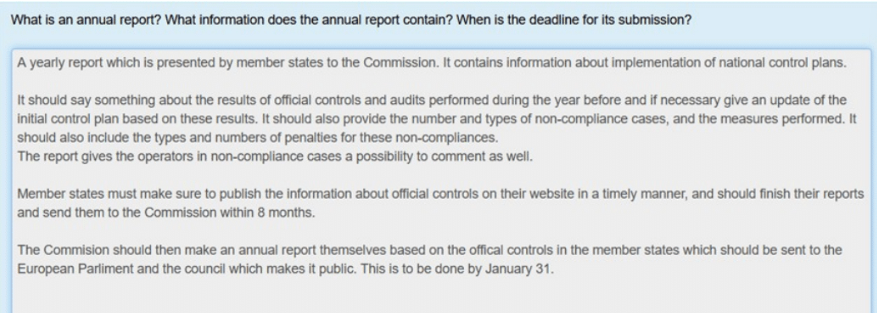
3.What is an annual report? What information does the annual report contain? When is the deadline for its submission?
- yearly report which should be given by member states to the Commission. → include information on the implementation of the multi-annual national control plans (this provides a basis for how the commission inspections are carried out in the member states)
report should give results from the official controls and audits done within year and if anything should be update in the control plan as effected by these results.
include → type and number of cases of non-compliance. + information of that official control that found the non-compliance (like what measures were performed). Can also include what type of penality was chosen and the number fo these penalties.
include the possibility for where the FBO found of non-compliance can comment this
finished + send reports within 31. August (within 8 months)
Based on national control plans (MANCPs), the Commission must publish a public annual report by January 31 summarizing official controls, results, and recommendations for the previous year. This report must be sent to the European Parliament and the Council, and made fully available to the public.
What are the general rules and main principles for performing official control
Regulation 2017/625 -the rules for official controls, which are done by competent authorities or authorized persons.
Core Control Logistics
Frequency & Notice: regularly and frequently. →unannounced, except for audits or specific decisions where advance warning to the FBO is required.
Evidence Check: must look all relevant documentation, traceability data, and operational records to evaluate compliance.
The 5 Essential Control Methods
Verification: Checking whether all regulatory requirements are actively being met.
Inspection: Examining feed, food, and animal health/welfare—including comprehensive antemortem and postmortem animal inspections.
Monitoring:
Observing and measuring long-term metrics like antibiotic (Ab) use, drinking water safety, food of animal origin, growth indicators, and heavy metal contamination.
Audits: Systems-level evaluations to verify if existing safety programs—such as control plans and HACCP frameworks—are effective.
Sampling & Analysis: Testing raw, processing, or distribution samples of food and feed to scientifically verify law compliance.
The rules of the official controls are decided/laid down by the Regulation (EU) 2017/625
Official controls meand activities that are performed either by the competent authority itself or by delegated bodies or persons.
Official controls are carried out frequently on a regular basis. The control must be carried out without a warning but in cases of audits or decisions the FBO should be warned in addition to the control
During the official control it should be used control methods and techniques for the purpose of:
Verification: examine if the requirements are being fulfilled
Inspection: Make sure that the examination of both feed, food and animal health and welfare are in accordance to the requirements of the rules and laws. This inspection include both post mortem and antemortem inspection of the animals.
Monitoring: Get an overview of the observations and measurement when it comes to the use of Ab, drinking water, food of animal origin, growth and also when it comes to the contamination and amount of heavy metals.
Audits: Examination to determine whether the arrangement are affectively and suitable to achieve the objectives. This is associated with the evaluation systems, like control and safety system and HACCP.
Sampling for analysis: Taking samples of the feed or food relevant to the production, processing and distribution of feed or food. This is to make sure that animal health rules and feed or food laws are in compliance by checking the analysis.
Documents, traceability records and other records which may be relevant to assessments of compliance with the rules must be examined.
How are fees or charges calculated? What are the main methods for calculating fees or charges? In which sectors are fees mandatory?
Food premises registration mandatory requirement - Regulation (EC) No 852/2004 - enables authorities to maintain oversight and execute official hygiene controls.
Core Rules & Deadlines
Operators must give all sites used to store, sell, prepare, or distribute food.
Live Registry: Local authorities need maintain up-to-date master list of all registered Food Business Operators (FBOs).
Multi-Site: A separate registration must be submitted for every individual establishment under an operator's control.
Who Must Register?
Shops, supermarkets, market stalls, restaurants, cafes, ice cream vans, delivery vehicles, and train buffet carts.
Animal Origin Handlers: Facilities dealing with animal products, including transport operations and primary production.
Small Producers: Primary producers supplying small amounts of animal products directly to local retailers or final consumers.
Minor Operations: Establishments handling primary production, associated activities, or marginal, highly localized retail functions.
Required Application Details
Legal Corporations: Corporate name, registered seat, and company registration number.
Sole Traders / Entrepreneurs: First name, surname, business ID number, and place of enterprise.
Hygiene Manager: First name, surname, and direct contact details of the person accountable for operational hygiene at the site.
Scope of Business: The specific type and exact scale of food operations being conducted.
What are health and identification marks? Describe the technical requirements of the health and identification marks and the practical arrangements for their application?
Applied exclusively to large mammal carcasses by an official veterinarian (or an official assistant under the vet's direct supervision) to certify the meat is fit for human consumption.
Prerequisites: Requires passing both ante-mortem and post-mortem inspections.
Format: An oval-shaped stamp.
Placement: Applied to the external surface of the carcass. Every individual piece must bear the mark if the carcass is cut.
Required Info: Country name, slaughterhouse approval number, slaughterhouse location, and the inspector's ID.
🏷 Identification Mark
Applied directly by the Food Business Operator (FBO) to processed food products of animal origin to confirm legal compliance.
Placement: Applied to the packaging outside of the food wrapping.
Required Content:
Product name and complete ingredient list (with quantities).
Net quantity and minimum durability date (expiry).
Manufacturer/packager name, address, and place of origin.
Special storage conditions and clear instructions for use.
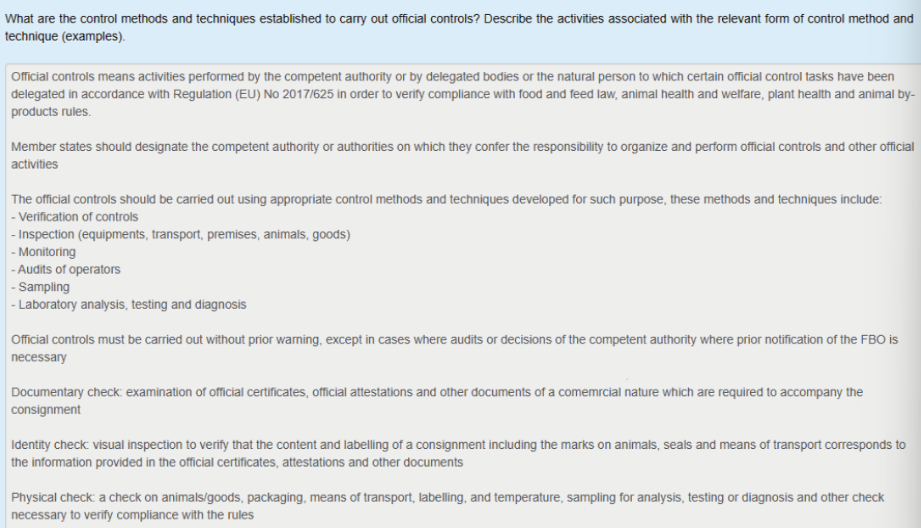
What is Regulation (EU) No 2017/625 about? What are official controls and who does carry them out
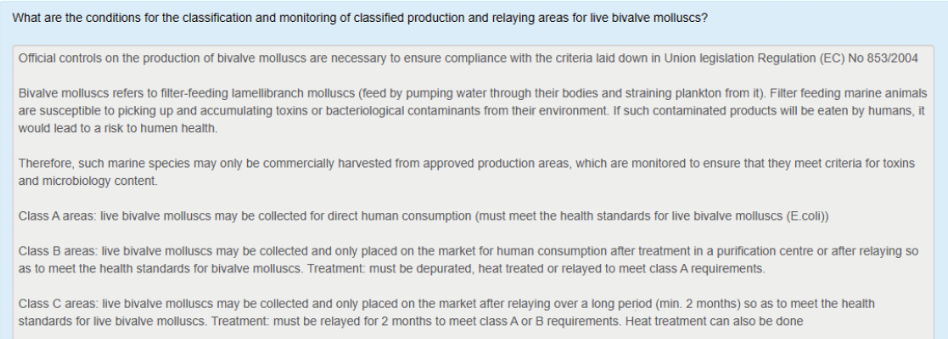
What are the conditions for the classification and monitoring of classified production and relaying areas for live bivalve molluscs?
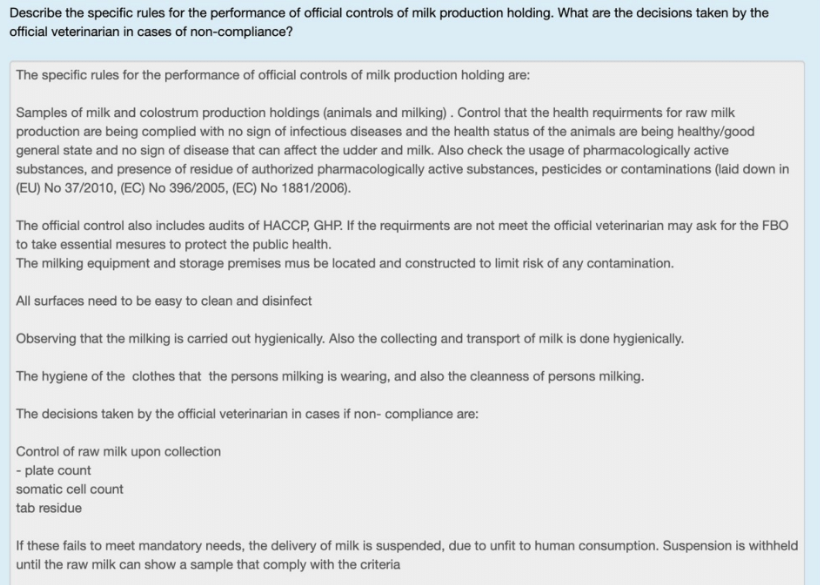
Describe the specific rules for the performance of official controls of milk production holding. What are the decisions taken by the official veterinarian in cases of non-compliance
Official controls on milk and colostrum holdings ensure raw milk is safe by verifying animal health, farm hygiene, and strict regulatory compliance.
Core Control & Audit Areas
Animal Health Checks: Verifying that dairy animals are in a healthy general state, free of infectious diseases, and show no signs of udder illness that could contaminate milk.
Chemical & Drug Screening: Monitoring for unauthorized substances, pesticides, contaminants, and residues of veterinary medicines.
Premises & Equipment: Auditing that milking equipment and storage facilities are built to prevent contamination, with surfaces that are easy to clean and disinfect.
Hygiene Observation: Assessing the cleanliness of staff, their work clothing, and the hygienic execution of milking, collection, and transport.
System Audits: Reviewing farm-level Good Hygiene Practices (GHP) and HACCP compliance.
Enforcement & Vet Decisions for Non-Compliance
Testing Metrics: Raw milk is tested at collection for plate counts, somatic cell counts, and antibiotic residues.
Immediate Suspension: If milk fails to meet mandatory safety criteria, the official veterinarian suspends all milk deliveries, declaring the product unfit for human consumption.
Reinstatement: The suspension remains active until the operator proves compliance with official safety criteria through a clean follow-up sample.
What is food premises approval? who needs to approval? Explain the procedure for approval of food business establishments
Food Business Operators (FBOs) supplying or selling products of animal origin must be approved by the competent authority under Regulations (EC) No 852/2004 and 853/2004, which requires a mandatory on-site visit by the authority before approval is granted.
Establishments Requiring Approval
Slaughterhouses and meat cutting plants.
Game-handling establishments.
Collection centers for animal products.
Facilities manufacturing meat preparations (such as minced meat).
Approval Procedure & Application Requirements
Local Notification: Operators must apply to the local authority for each individual establishment under their control.
Corporate Details: Business name and company registration number for legal entities.
Sole Traders: First name, surname, company ID number, and place of enterprise for natural person-entrepreneurs.
Site Location: Exact address where the food business activity takes place.
Operational Scope: The specific type of food business activity being performed.
Accountable Personnel: Full name and address of the persons responsible for the operations.
Technical Dossier: Structural, technical, material, and staffing documents proving facility readiness.
Outcome: Successfully approved establishments receive a unique, official approval number.
What are competent authorities? Describe obligations of the competent authorities
Competent Authorities (CAs) are central or national bodies responsible for organizing official food safety controls within an EU Member State.
Core Obligations of a Competent Authority
Laboratory Capacity: Must have direct access to fully compliant testing laboratories staffed by a sufficient number of qualified, experienced personnel.
Infrastructure: Must provide and maintain proper facilities that allow staff to perform official controls safely, efficiently, and effectively.
Legal Authority: Must possess the explicit legal powers required to execute official controls and enforce regulatory measures.
Emergency Preparedness: Must establish operational control plans and ready-to-use contingency plans for emergency situations.
Quality & Consistency: Must implement formal procedures to guarantee the effectiveness, impartiality, quality, and consistency of all control activities.
What is a multi-annual national control plan? What information does the multi-annual national control plan contain? When is the deadline for its submission?
A Multi-Annual National Control Plan (MANCP) is a mandatory master blueprint that each EU Member State must establish and regularly update to detail the structure, organization, and long-term planning of its official control systems.
Core Architecture & Contents
Past Performance: Includes complete results from official controls and audits executed during previous years.
Agency Framework: Designates specific local and central competent authorities, outlining their tasks and available resources.
Management Hierarchy: Maps the organization of official controls at national, regional, and local levels—including site-specific establishment inspections.
Sector Controls: Defines the distinct inspection systems applied across different agricultural and food sectors.
Staffing & Operations: Outlines staff training programs and standardized, documented operational procedures.
Emergency Preparedness: Details the organization of contingency plans for food-borne illnesses, animal diseases, feed contamination, and public health risks.
System Integration: Coordinates the framework for mutual assistance and inter-agency cooperation.
Submission Deadline
Strict Timeline: Member States must finalize and submit their updated MANCP to the European Commission by August 31st each year.
What is the Integrated Management System for Official Controls (IMSOC) and how does it operate?
IMSOC (Information Management System for Official Controls) is an integrated EU computer system designed for rapid, real-time data exchange between Member States to block safety violations at the border.
System Integration
All-in-One Network: Merges all existing food safety systems into a single hub, including TRACES, BOVEX, Europhyt, and iRASFF.
How it Operates (Example Workflow)
Detection: The TRACES component identifies a health risk at an EU border.
Instant Sharing: IMSOC instantly routes this alert to necessary networks like the iRASFF alert system and the AAC.
Enforcement: Border customs authorities immediately receive the data and intercept the non-compliant shipment before it enters any Member State.
Regulation (EC) No 178/2002 as amended (scope, general principles of food law, EFSA, procedures relating to food safety, food safety requirements
Scope
Framework for food/feed law within the EU
Imposes obligations on Member States & on food/feed business operators
Applies -stages of production, processing & distribution of food/feed but not primary production for private domestic use
General principles of food law are:
Protection of human life/health + consumers’ interests with regards to the protection of animal health/welfare, plant health and the environment
EU-wide free movement of safe and wholesome human food
Consideration of existing or planned international technical and sanitary standards for food
European Food Safety Authority (EFSA):
Provides advice & scientific/technical support in all areas on food safety
Independent source of info on all matters in this field
Ensures public kept informed
Participation open to Member States of EU & other countries applying EU food safety law
Procedures relating to food safety
Relates to direct/indirect impact on food safety & elimination of risk to human health
Rapid alert system (identifies emerging risks) – effective tool to exchange info relating to existence of a serious direct/indirect risk to human health
Looks at risk analysis – risk assessment, risk management, risk communication
Food safety requirements
Food not placed on market if unsafe (injury to health/unfit for consumption)
. Regulation (EC) No 882/2004 as amended (subject matter & scope, main elements of this Regulation
if follow the rules
general rules. performance of official controls to verify compliance aiming at: (more of a goal)
Preventing, eliminating or reducing risk to humans/animals to acceptable levels (directly/indirectly through enviro)
fair food trade & protecting consumer interests (incl. food labelling & other info)
‘official control’ - any form of control that the competent authority or EU performs for verification of compliance with feed/food law, animal health & animal welfare rules
Carried out regularly & in accordance with risk-based approach
Without prior warning to business concerned (except in audits)
At all stages of production, processing & distribution
On feed/food produced & sold in EU
On feed/food for export & import
Requirements for competent authority 10
Staff & Training
Hire enough skilled workers
Keep staff trained
Quality Control & Outsourcing
Check their own work: Run regular internal and external audits to make sure inspectors are doing their jobs right.
Oversee outside helpers: If the agency hires an independent outside group ("control body") to do inspections, make sure that group meets strict legal standards.
Transparency & Paperwork
Be open about enforcement: information about how laws being enforced.
Write and share inspection reports: Write a report after every inspection and give a copy to the food business.
Use written step-by-step guides: instructions for how to do inspections, actually use them, and keep them updated.
Teamwork & Law Enforcement
Work well with other agencies: government departments and safety authorities.
Manage business permissions: Have clear systems in place for registering and approving food buildings.
Punish rule-breakers:
the second Official controls of third country imports of feed/food
Checks - at Border Inspection Posts (BIP)
documentary, identity checks and physical checks
labelling and composition
Checks on compliance with feed and food law
third are fundadmd
4Administrative assistance and cooperation with other Member States and with the Commission
Competent authorities of different Member States (MS) may work together and with the commission
Results of enforcement controls indicate that action needed in more than one country
Each MS required to designate ‘liaison body
This can be used as first point of communication for transmission and reception of requests for assistance
5control plans and annual reports to Commission
Each country prepare a ‘multi-annual’ national control plan
Covers arrangements for enforcement of feed/food law, animal health/welfare rules and plant health controls
Plan must be updated regularly
Community controls in MS and in third world countries
Audits of the national control plans and annual reports
EU Hygiene Package
Covers:
Food hygiene
Hygiene for food of animal origin
Official controls on products of animal origin intended for human consumption
HP is the collection of legislation consisting 3 Regulations + 2 Directives:
Regulation (EC) No 852/2004 on the hygiene of foodstuffs as amended – general food hygiene rules (H1)
Regulation (EC) No 853/2004 laying down specific rules for food of animal origin as amended – Special hygiene rules for food of animal origin (H2)
Regulation (EC) No 854/2004 laying down specific hygiene rules for the organisation of official controls on products of animal origin intended for human consumption as amended – Additional control rules on food of animal origin (H3)
Directive 2002/99/EC laying down animal health rules governing the prod, processing, distribution and introduction of products of animal origin for human consumption – Animal health rules related to food of animal origin intended for human consumption (H4)
Directive 2004/41/EC repealing certain Directives concerning food hygiene and health conditions for the production and placing on the market of certain products of animal origin intended for human consumption (H5)
Principles of HP:
Food businesses are legally responsible for the safety of the food they sell.
Safety starts at the source and must be maintained at every step, from the farm all the way to the consumer's plate.
Companies must use HACCP principles, which is a official system for spotting and stopping food dangers before they happen.
Basic hygiene rules apply to everyone, food business must follow standard cleaning and safety setups.
Some businesses must register officially with the government or local authorities before they are allowed to open.
Official rulebooks must be created to give businesses clear guidelines on how to keep things clean and follow the safety rules.
. Regulation (EC) No 852/2004 as amended - Registration of food business establishments (who needs to register, registration procedure, small quantities of primary products)
Who needs to register?
1. Food premises: shops, supermarkets, restaurants, cafes, etc)
2. Food Establishments for Feedstuffs of Animal Origin
Primary production → raw sourcing of animal goods—including raising livestock, milking, fishing, hunting, and harvesting from the wild.
Operations associated- primary prod. ie transport operations -Transport, storage and handling primary products - Transport of them to a market, slaughterhouse or bw farms -raw wild game +fishery directly from caught or hunted→ first processing or storage facility.
Primary producers directly supplying small amounts of primary products from poultry/lagomorphs slaughtered on the farm
Storage of products not requiring temperature-controlled storage conditions
Transport/delivery of foodstuffs of animal origin to other establishments
Registration procedure →Ask local authority for registration
Application for registration contains:
Official business details: The name of the company, its head office address, and its official registration/ID numbers.
Owner/Operator details: The name and address of the business owner or entrepreneur.
The Hygiene Officer: The name, contact info, and location of the person in charge of food safety at each location.
Business description: Exactly what kind of food activity you do and how big the operation is (e.g., a small bakery vs. a large meat factory).
What the government authority does with it:
Records the application: They officially log your paperwork.
Issues a number: They give your business a unique official registration number.
Publishes the list: They put all registered businesses on a public website for that EU Member State (MS).
Why this matters for inspections:
Keeps a master list: Registration lets local authorities know exactly where all food businesses are so they can inspect them.
Sets the inspection schedule: High-risk businesses (like raw meat processors) will be visited much more often than low-risk ones (like a shop selling packaged snacks).
Registration allows local authorities to keep an up-to-date list of all premises which they can visit when needed
Frequency of visits will depend on degree of risk involved
Small quantities of primary producers
supplied directly by operator producing them to the final consumer or to a local retail establishment
Appropriate to protect public health through national law
Especially due to the close relationship between the producer and consumer
. Regulation (EC) No 853/2004 as amended - Approval of food business establishments (who needs to approval, approval procedure)
Who needs to approval?
1. Slaughterhouses
2. Meat cutting plants
3. Establishments manufacturing meat preparations, minced meat, mechanically separated meat and meat products
4. Game-handling establishments
5. Raw milk collection centres
6. Establishments manufacturing milk products
7. Collection of eggs from primary producers
8. Establishments manufacturing egg products
9. Establishment handling fishery products
10. Establishments preparing frog's legs and snails
11. Establishments manufacturing rendered animal fats
12. Establishments treating bladders, stomachs and intestines
13. Establishments manufacturing gelatine
14. Establishments manufacturing collagen
15. honey
16. Establishments requiring temperature-controlled storage conditions
18. Retail establishments that perform activities and operations for the purpose of delivery of foodstuffs of animal origin to other establishments (This delivery is not only marginal, localised and restricted activity of retail establishment in question)
19. Other establishments
Approval procedure
Upon application for approval from a food business operator,→ authority visit
Establishment shall not operate unless the competent authority has:
a) Granted approval to operate following on-site visit
b) Provided establishment with conditional approval
c) Approval based on an application of a natural person-entrepreneur or legal person if it meets the structural, technical, material, staffing and other conditions for the requested type and scope of activities laid down
Authority assigns approval number
Decision shall take effect as of the day of delivery of the decision on approval
Competent authority keeps list of establishments, facilities and activities that have been approved
Food business operators shall ensure that an establishment ceases to operate if:
a) Competent authority withdraws approval
b) Fails to prolong or grant full approval (if under conditional approval)
. Regulation (EC) No 854/2004 as amended (subject matter and scope, auditing and inspection tasks of the competent authority and the official veterinarians replaced by 2017/625
→ official controls - products animal origin intended for human consumption to verify compliance with Regulation (EC) No 852/2004 + No 853/2004
The official controls carried out in accordance with this regulation include:
Audits of business operators’ activities & inspections, including checks on food business operators’ own controls
Audits -hygiene practices + hazard analysis + critical control point (HACCP)-based procedures
Audits and inspections- slaughterhouses, game handling establishments and certain cutting plants
Official controls - production of meat
Official controls - live bivalve molluscs and fishery products
Official controls -f raw milk
Audits of good hygiene practices shall verify food businesses are always following proper cleanliness rules.
Checks on food-chain information
Design and maintenance of premises and equipment
Pre-operational, operational and post-operational hygiene
Personal hygiene
Training in hygiene and in work procedures
Pest control
Water quality
Temperature control
Controls on food entering and leaving establishment
Any accompanying documentation
When carrying out auditing tasks, the competent authority (official veterinarian) shall:
whether staff at all stages of production comply with the relevant requirements of the Regulations
Verify the food business operator's relevant records
Take samples for laboratory analysis when necessary
Document elements taken into account and the findings of the audit
Council Directive 2002/99/EC as amended (scope, general animal health requirements, derogations, veterinary certificates
- general health rules - all stages of production, processing and distribution within the EU
- introduction from third world countries + products from them for human consumption
-Makes for stricter application of animal health rules and a broader scope
General animal health requirements
stop the spread of animal diseases: Member States (MS) -make sure that making, processing, and shipping animal products does not spread sicknesses to other animals.
wiping out these diseases:
Products from quarantine zones are banned:
Animals must be healthy and meet EU standards: All products- must come animals health and safety laws set by the EU.
Exceptions (Derogations)
EU countries allow animal products made + sold - restricted zone—as long as the specific farm itself is not infected or suspected of illness,
Complete separation: products handled, shipped, and stored separate healthy food, or handled different times.
Approved travel: authority approve how transported out of restricted zone.
Clear tracking: The items waiting for safety treatment must be clearly labeled and identified.
must undergo a special treatment (like cooking or pasteurization) - kills the disease risk.
This treatment only happen at a specialized facility - officially approved
The products - undergo treated - clearly identified - special identification mark (Council Directive 2002/99/EC) or an alternative identification mark (Commission Decision 2007/118/EC)
Veterinary certificates
General principles:
When shipping animal products, they must have an official health certificate that follows these three strict rules:
Official signature and stamp: inspector shipping location → sign and stamp the paperwork.
The right language: The certificate must be written in the language of the country receiving the goods or where it enters the EU border (or include a certified translation).
Original copy only: The physical, original certificate must travel with the shipment when entering the EU.
Commission Regulation (EC) No 2073/2005 as amended (subject matter and scope, microbiological criterion, food safety criteria, process hygiene criteria
Microbiological criteria -measure safety of foodstuffs based on absence, presence or number of m/o per unit of mass/vol/area/batch
Criteria for bacteria (salmonella, listeria, etc)
Food operators -responsibility for ensuring criteria are met at a specific point of the food chain determined in the regulation
National authorities verify - rules complied with
New microbiological criteria →test whether good hygiene practices and HACCP principles are properly applied
New criteria cover:
a) Food safety: criteria for foodborne bacteria, toxins and metabolites
b) Process hygiene: criteria during the production process
When the results of testing against the criteria are unsatisfactory, food business operators find the cause of the unsatisfactory results with the corrective actions defined in their HACCP-based procedures
unsatisfactory → product withdrawn
Products placed on the market which do not fulfil the food safety criteria may be submitted to further processing by a treatment eliminating the hazard in question
Commission Regulation (EC) No 2075/2005 as amended (scope, sampling of carcases, Trichinella examination, import health requirements /health certificates
examination - presence of Trichinella- slaughtered pigs, wild boar and horses (except pigs originating from Trichinella-free farms)
Sampling of carcasses
pig ampled slaughterhouses as part of PM examination (same wild + horses)
Sample examined in lab pointed → authority using one of these methods of detection:
1. Chapter I of Annex I →Magnetic stirrer→ pooled sample digestion
2. Chapter II of Annex I
Mechanically assisted pooled sample digestion method/ sedimentation tech
Mechanically assisted pooled sample digestion method/ on filter isolation tech
Automatic digestion method for pooled samples of up to 35g
Trichinella examination and application of health mark
carcass/parts not leave before Trichinella exam negative
Other parts - contain striated muscle tissue may not leave exam negative
Animal waste and by-products not intended for human consumption and not containing striated muscle may leave before results are available
Import health requirements
Meat of animals that may be carriers of Trichinella, containing striated muscle or from a third country can only be imported if examined in that country
Such exam is carried out in accordance with this regulation
imported without examined if - comes from hird country recognised by the EU as free from Trichinella
can- undergone freezing treatment under supervision competent authority in the third country
Health cert accompanying imports shall have a statement by the official vet stating ‘the meat has been examined in the third country of origin in accordance with this regulation’
. Directive 2000/13/EC as amended (purpose, compulsory
indication of the labelling of food of animal origin, identification marking) 1169/2011
ffood labaling law
consumer gets all essential info regarding composition of product, manufacturer, methods of storage and prep, durability, etc
Producers and manufacturers are free to provide any additional info they wish provided it doesn’t mislead consumer
Must be waterproof
Must have ID mark
Info on food label:
Name product is sold
List ingredients
Quantity of certain ingredients
Net quantity (in the case of pre-packaged foodstuffs)
Date of minimum durability
Any special storage conditions
Name and address of the manufacturer or packager (or of a seller established within the EU)
Place of origin
Instructions for use
Alcoholic strength by volume (when more 1.2% vol of alcohol)
live-bivalve products, following info:
Species
Date of packaging
date minimum durability may be replaced by entry ‘these animals must be alive when sold’
If products are made with raw milk: ‘made with raw milk’ must be on label
If products are made with gelatine or collagen: ‘gelatine fit for human consumption’ and must indicate date of min durability
Commission Decision No 2006/677/EC (purpose and scope, nature of audit process, implementation of audit process, definitions relating to
the audit process) 2017/625
guidance + implementation of audit systems
1.Audits of competent authorities should be:
Organized from start to finish (Systematic): Every audit must follow a clear, step-by-step system—from planning and doing the check, to following up on mistakes and managing the overall process.
Open and clearly documented (Transparent): Everything must be written down with clear rules, including how the audit is planned, what standards are being judged, and how the final report gets approved.
Completely unbiased (Independent): The people doing the audit must be totally free from outside pressure—whether from businesses, money, bosses, or politicians—so the final results are 100% honest and fair.
2.Implementation of audit process
Guiding principles:
Confirm they follow the plan: Verify agency follows its own rules
Check the plan works in practice: Make sure written procedures aren't just sitting on paper, but carried out effectively in the real world.
Judge if the plan is good enough: Evaluate whether the agency's rules and setups are actually strong enough to achieve the food safety goals of Regulation (EC) No 882/2004
Audit reporting - clear conclusions
Follow-up audit results with corrective and preventive actions
Resources (MS should ensure that competent authority have sufficient powers and resources to establish, implement and maintain an effective audit system)
Definitions
Audit criteria: set requirements used as a reference against which audit evidence is compared
Audit plan: description of the activities and arrangements for an audit
Audit programme: set of one or more audits planned for a specific time frame and directed towards a specific purpose
Audit team: one or more auditors conducting an audit supported if needed by technical experts
Auditee: the killer
Auditor: detective
Technical expert: person who provides specific knowledge/expertise to the audit team
Audit body: body that carries out the audit process (may be internal/external)
Audit process: set of activities (Systematic Approach)
Audit system: combination of one or more audit bodies carrying out an audit process within or across competent authorities
Corrective action: action to eliminate the cause of a detected non-conformity or other undesirable situation
Preventive action: action to eliminate the cause of a potential non-conformity or other undesirable situation
Production chain: whole production chain incorporating all "stages of production, processing and distribution"
Rapid Alert System for Food and Feed (RASFF). Legal basis. Scope. RASFF notifications
The Rapid Alert System for Food and Feed (RASFF) real-time network connecting Member States, the Commission, and the EFSA Authority -exchange info + rapid responses serious food or feed health threats. GROUP CHAT
System Management & Reporting Triggers
Network Management: The European Commission manages the network and instantly transmits received alerts to all members.
Mandatory MS Notifications: Member States (MS) must immediately notify the Commission of:
Official measures restricting or withdrawing products from the market.
Voluntary operator agreements aimed at limiting high-risk products.
Consignment rejections at EU border posts due to health risks.
Global Alerts: If an import cargo is blocked at an EU border, the Commission immediately warns all other EU border posts and the third country of origin.
The 4 Types of RASFF Notifications
All notifications are publicly queryable via the online RASFF Portal database and fall into two main categories:
1. Market Notifications (Risk found on the active market)
Alert Notifications: Triggered when a product presenting a serious health risk is actively on the market, requiring immediate, rapid containment action from other MS.
Information Notifications: Used when a risk is identified on the market, but other members do not need to take immediate action (e.g., the product hasn't reached their market or is already removed).
2. Border Rejections (Risk intercepted at the perimeter)
Border Rejection Notifications: Triggered when a non-compliant food or feed consignment fails testing and is blocked at the external EU border.
Third-Country Dispatches: Triggered when a contaminated product under a rapid alert has already been shipped out to a country outside the EU.
Definitions of official food control. General obligations. Competent authorities
Official control - any form of control that the competent authority or EU performs for verification of compliance with feed and food law, animal health and animal welfare rules
Official controls must be carried out:
1. regularly and in accordance with risk-based approach +Without prior warning (except in audits)
2. On an ad hoc basis inrutin and when needed
3. At any stages of production, processing and distribution of food, animals and animal products
· On feed/food produced and sold in EU
· On feed/food for export and import
Official controls shall be applied:
To exports outside the EU
To the placing on the market in the EU
To introductions from third countries into the EU
Competent authority = central authority of a MS competent organisation of official controls to carry out veterinary checks or any other authority to which that competence has been conferred
Also includes the corresponding authority of a third country
CA ensure:
Effective Controls: Inspections on animals, animal feed, and food must actually work and be done right at every stage, from the farm to the store shelf.
No Conflicts of Interest: The inspectors must be completely neutral and fair. They cannot have any personal or financial ties to the businesses they are checking.
Good Labs & Smart Staff: They must have access to proper testing laboratories and a sufficient number of highly trained, experienced workers to do the job right.
Up-to-Date Equipment: Their facilities, tools, and testing equipment must be kept in good working order.
Legal Power: Inspectors must have the official, legal authority to do their jobs and take action (like issuing fines or shutting places down) if rules are broken.
Emergency Plans: They must have solid safety plans ready to go instantly if a major food or feed emergency happens.
Business Cooperation: Food and feed businesses are legally required to let inspectors in, undergo checks, and help the inspectors do their work.
Control staff. →Official veterinarian.
Approved veterinarian.
Official auxiliary. Professional qualification
Control Body: An outside, independent -hired by government - specific food safety inspections on their behalf.
Competent Authority make sure- inspectors meet 3 core standards:
Proper Training:
Up-to-Date Knowledge:
Teamwork Skills:
How Inspections Work
Inspectors must use the right tools and techniques for the job.
everyday routine checks also deeper investigations →physical inspections, audits, and lab-testing food samples.
Training make sure staff take correct decisions - regard implementation HACCP principles
food safety inspectors from all EU Member States (MS). This ensures every country enforces the exact same safety standards.
Training courses may be open to third countries, particularly developing
Official Veterinarian: qualified vet → officially hired and appointed by the government→ enforce food and animal health laws.
undergo training - at least 200h before starting work independently →work under the supervision of existing official veterinarians
maintain up-to-date knowledge through regular continuing education activities
Approved Veterinarian: A private or outside vet - given special permission by government → carry out specific official inspections on farms ("holdings") on the government's behalf.
official veterinarian carry out inspection:
slaughterhouses, game handling establishments and cutting plants placing fresh meat on the market
production live bivalve molluscs, pectinidae & marine gastropods
production of fishery products
milk production and colostrum holdings
Official auxiliary: person qualified, to act in such a capacity, appointed by the competent authority and working under the authority and responsibility of an official veterinarian
must have least 500h of theoretical training & 400h of practical
practical training in slaughterhouses and cutting plants under official vet supervision
maintain up-to-date knowledge through regular continuing education activities
trained assistant hired by government help a vet carry out official food and animal inspections—essentially acting like a veterinary technician, such as a meat inspector at a slaughterhouse.
Control activities, methods and techniques. Control plans. Annual reports. Financing of official control
The official controls - done using appropriate techniques:
Routine surveillance checks (careful observation of one or more feed or food businesses, feed or food business operators or their activities)
More intensive controls such as:
Verifications - checking, by examination and the consideration of objective evidence, whether specified requirements have been fulfilled
Inspections - examination of any aspect of feed, food, animal health and animal welfare in order to verify that such aspects comply with the legal requirements of feed and food law and animal health and animal welfare rules
Monitoring - conducting a planned sequence of observations with a view to obtaining an overview of the state of compliance with feed or food law, animal health and animal welfare rules
Audits – independent exam determine- activities and related results comply with planned arrangements and whether these are implemented effectively and are suitable to achieve objectives
Sampling - taking feed or food or any other substance relevant to the production, processing and distribution of feed or food or to the health of animals, in order to verify through analysis compliance with feed or food law or animal health rules
Testing of samples
National control plans should be regularly updated - new developments:
New legislation
New diseases or other health risks
Significant changes to the structure, management or operation of the competent national authorities
Results of MS official controls & Commission controls
Scientific findings
Annual report – by MS to the Commission with info on implementation of the multi-annual control plans
results - official controls + audits during previous year + update of control plan in response to these results
non-compliance identified and the actions to ensure the effective operation of multi-annual national control plans, including enforcement action and its results
MS finalise their reports and transmit them to the Commission within 6 months of the end of year
make available to public
MS -financial resources are available to provide the necessary staff and other resources for official control
Criteria to be taken into consideration for calculation of fees
Salaries of the staff involved in the official controls
Costs for the staff involved in the official controls, including facilities, tools, equipment, training, travel and associated costs
Laboratory analysis and sampling costs
Sampling and analysis of samples (purpose, basic principles, supplementary expert opinion). Official laboratories
Basic principles that must be addressed in food sampling
match what shoppers actually buy, and if the sample is split into smaller portions, every portion must still accurately reflect the whole batch.
Sampling process - not alter - in any way that - affect analysis
Storage and transportation- not alter it in any significant way – whether through contamination, loss, deterioration or other means
The quantity- enable the required analysis to be made
Nature of the samples that are appropriate will depend on the purpose for which the analysis is undertaken
Quantity vary according to product & analysis to be carried out
Scope of the investigation of food samples:
– Sensory - Physico-chemical examination
– Microbiological examination
– Contaminants
– Food additives
– Residues
– Allergens
– Labelling
– Other specific examinations
Supplementary expert opinion/| they can ask 2 oppinion if feel wronged
Competent authorities
Competent authorities may only designate labs that operate and are accredited in accordance with the following European standards:
EN ISO/IEC 17025 on ‘General requirements for the competence of testing and calibration laboratories
EN 45002 on ‘General criteria for the assessment of testing laboratories
EN 45003 on ‘Calibration and testing laboratory accreditation system – General requirements for operation and recognition taking into account criteria
official labs - test food for compliance with the relevant legislation and guidelines
Labs should be accredited for individual tests used
Labs involved in analysis of official samples should work in accordance with internationally approved procedures and use methods of analysis that have been validated
Official labs should have equipment enabling the correct determination of standards fixed by the EU and national law
The EU's network of laboratories includes:
EU Reference Laboratories (EU-RLs) designated by the Commission
National Reference Laboratories (NRLs) designated by each EU-countries
- Official control laboratories under the responsibility of EU-countries
5.Official control of fresh meat (food chain information, ante-mortem inspection, post-mortem inspections, laboratory testing)
Food chain information (FCI)
FCI document must be completed and supplied to the slaughterhouses and game handling establishments by:
Person responsible of the animals to be slaughtered
Official/approved veterinarian- AM inspection before slaughter
Hunter: trained person responsible for the initial examination of the body and viscera of the hunted wild game
The official veterinarian has to:
Check Farm Records: review health and treatment records from farm before slaughter.
Guide Physical Inspections: Inspectors use the results from these farm to decide what to look for during AM + PM
Review Vet Certificates and Notes: Inspectors must also factor in any official travel documents and health statements written by vets or trained inspectors who checked the animals back on the farm ("primary production").
Ante-mortem inspection
Official vet must carry out AM inspection of all animals before slaughter
Carried out at the holding where the animals are kept
If not carried out at the holding, it must be carried out at the slaughterhouse
Must take place within 24 hours of arrival of the animals at the slaughterhouse and less than 24 hours before slaughter
Vet is to verify that animals accepted for slaughter for human consumption are properly identified
Must determine whether, as regards the animal inspected, there is any sign:
Welfare has been compromised
Any condition which might adversely affect human/animal health, especially zoonotic diseases and diseases on List of the Office International des Epizooties (World organisation for animal health/OIE)
After AM → complete + sign a health certificate
Certificate must declare the animals healthy, free of symptoms of infectious, transmissible or contagious disease and without the risk of residues of veterinary medicinal products in excess of the levels allowed or residues of forbidden substances
animals transported to slaughterhouse must have a valid health certificate. (Validity of health certificate is 3 days)
If not slaughtered within 3 days, re-examined
If show clinical symptoms -not be slaughtered for human consumption
killing of animals showing clinical symptoms happen at end of slaughter process, if precautions are taken to avoid the risk of spreading pathogenic organisms and to clean/disinfect facilities after killing
Post-mortem inspection
Carcasses and accompanying offal are to be subjected without delay after slaughter to PM inspection:
All external surfaces are to be viewed
Minimal handling of the carcass and offal or special technical facilities may be required
Particular attention to be paid to the detection of zoonotic diseases and diseases on OIE List
Additional examinations, such as palpation and incision of parts of the carcass and laboratory tests, are to take place, considered necessary:
To reach a definitive diagnosis,
To detect the presence of
Animal disease,
Residues or contaminants in excess of the levels laid down under EU legislation
Non-compliance with microbiological criteria
Other factors that might require the meat to be declared unfit for human consumption
Official Control of live bivalve molluscs and fishery products (filter feeders, classification of production and relaying areas, monitoring, not filter feeders, health standards, checks & inspection of fishery products)
Filter-Feeders
Filter-feeding marine -fed by pumping water through their bodies + straining plankton east trap bak + contaninants
Bivalve molluscs (oysters, mussels, clams, cockles and scallops).
Echinoderms either filter, substrate eaters or carnivores (starfish, sea cucumbers or urchins)
Tunicates (sea squirts)
harvested approved production areas - monitored to ensure. CA fix location
Class A areas – collected for direct human consumption (already the health standards for live bivalve molluscs and E. coli)
Class B areas - placed on market after treatment in purification center
Class C areas – placed on market only after relaying for long period of time (< 2 months)
Monitoring of Classified Relaying and Production Areas
There’s no malpractice regarding origin, current location and destination of live BV molluscs
The microbiological quality of these molluscs in relation to production and relaying areas (check faecal contam)
Presence of toxin-producing plankton in production and relaying waters and biotoxins in molluscs
Presence of chemical contaminants (e.g. heavy metals ) in molluscs
Non-filter feeders
· Pectinidae family – BV molluscs incl the scallop closely related to the clam and oyster
· Official controls of Pectinidae and live marine gastropods that are not filter feeders and harvested outside of production areas are to be carried out in fish auctions, dispatch centres and processing establishments
· These controls verify compliance with health standards for live BV molluscs
a) Must have organoleptic properties assoc with freshness and viability (e.g. clean shells, normal response to percussion)
b) Not contain marine biotoxins that exceed permitted limits.
· Official controls on the production and placing of fishery products on the market incl:
a) Regular checks on hygiene of landings
b) Regular inspections of vessels and land establishments to see
· Conditions for approval are fulfilled
· Fishery products are handled correctly
· Compliance of hygiene and temp requirements
· Cleanliness of establishments incl vessels, facilities, equipment and staff
c) Checks of storage and transport conditions
Official controls of fishery products must be carried out at all stages of production, processing and distribution. These include:
a) Organoleptic examinations – compliance with freshness criteria in accordance with EU leg
b) Freshness indicators – determine total levels of total volatile basic nitrogen (TVB-N) and Trimetheylamine nitrogen (TMA-N)
c) Histamine – levels comply with EU leg
d) Residues and contaminants – levels comply with EU leg
e) Microbial checks - compliance of relevant rules and criteria laid down by EU leg
f) Parasites – comply with EU leg. Can check by visual inspec.
Poison fishery products – ensure products from poisonous fish or those containing biotoxins harmful to human health are not placed on the market
Official control of raw milk and dairy products (milk collection holdings, raw milk upon collection, food safety criteria, processed dairy products)
Official controls also include audits of good hygiene practices (GHP) and HACCP.
Control of milk producing holdings
Animals are subject to official controls to check
has good health and no sign of disease that would affect milk
drus→(respect of withdrawal period and no admin of unauthorised substances)
checks done by vet
Holdings undergo official controls regularly and without prior notice to verify hygiene requirements are being complied with:
Milking equipment and premises of storage, handling and cooling are located and build so as to minimize risk of contamination
Storage - protect against vermin
Surface areas -come into contact with milk -easy to clean + disinfect.
Milking, collection and transport must be carried out hygienically and cold temperatures must be maintained.
People milking and or handling raw milk must wear appropriate, clean clothes and have a high level of personal hygiene.
Official control may also include monitoring for controls the FBO performs
If hygiene levels are inadequate the CA must tell the operator the steps to take to fix the situation
Control of Raw milk upon collection
CA organises official controls to ensure compliance with standards raw milk
a) Plate count (≤100,000/ml cowls milk)
b) Somatic cell count (≤400,000/ml cow’s milk)
c)Antibiotic residues (levels in Reg (EU) No 37/2010)
Representative no. of samples of raw milk collected from the holdings should be taken by random sampling
If raw milk fails to meet the mandatory food safety criteria, the CA may suspend delivery of milk and ask farmer to fix the issue (suspended until FBO proves it now meets the criteria)
a) Temp – not >6 °C
b) Heat treatment and ultra high heat treatment
d) Wrapping and packaging
e) Labelling
f) Identification marking
Official control of eggs, gelatine, collagen (raw materials, processed products, health and hygienic requirements, marketing standards)
eggs on market must ensure:
kept clean, dry, free of external odours and protected from shocks and direct sunshine.
stored and transported - constant temp
delivered to consumer within 21 days of laying (max time limit)
Eggs meet highest standards of cleanliness, freshness and quality
originate from flocks tested negative salmonella. Each consignment must be accompanied by a certificate stating the test was carried out
The CA must organise official controls of the FBO to check
Facilities and equipment used for egg production (houses and hens should be checked for cleanliness)
“ “ for egg collection (surfaces inside poultry house keep egg clean and dry)
Egg equipment for storage (containers, crates and vehicles)
suitable temp, dry, clean etc)
Personal hygiene and handling (staff -good health and training on health risks and eggs are handled hygienically)
Record keeping (FBO must keep account of samples taken and measures put in place to control hazards, e.g. checks on hens or eggs, info on disease occurrence and veterinary products used incl withdrawal, etc)
Animal Collagen and Gelatine
· Animal collagen: Protein based product derived from animal bones, hides, skins and tendons
· Gelatine: Natural, soluble protein obtained by partial hydrolysis of collagen.
Raw materials used for collagen/gelatine production intended for use in food:
Bones
Hides and skins of farmed Ruminants and wild game
Pig and poultry skins
- Must derive from animal carcases slaughtered in slaughterhouse and found fit for human consumption, or wild game found fit for human consumption
The CA must carry out audits on collection centres, tanneries and carry out audits on GHP and HACCP-based principles
The Ca must organise official controls to check
Storage of raw materials (rooms or premises are clean, hygienic, at correct temp, etc)
Production process of collagen (finished product is fit for human consumption)
Labelling (Date of min durability, ID mark and “collagen/gelatine fit for human consumption”)
. Official control of products of animal origin entering the EU from the third countries (Council Directive 97/78/EC as amended / veterinary checks, border inspection posts, certificates
applies to imports from third countries such as:
a) Food products of animal origin
b) Animal feed
c) Plant products which increase risk of spreading infectious or contagious animal diseases
d) By-products not intended for human consumption
All products from third countries are subject to veterinary checks before introduction into the EU. These are carried out at a border inspection post by an OV of the CA.
a) Documentary check of veterinary certificates and other documents accompanying consignment
b) Identity check by visual inspection to ensure products correspond with info on documents
c) Physical check (sensory eval, simple physical or chemical tests) on the product to ensure it meets requirements of EU leg (packaging, temp, sampling, etc)
After completion of checks the OV issues a certificate to say the consignment complies with regulations
If the OV or CA suspects - not complied with, it must remain under supervision of the CA until the results of further checks are received.
If something that may cause a serious threat to animal/human health is suspected the CA may suspend or set special conditions for imports coming from part or all of the country concerned.
Reg (EC) No 882/2004 – if the product doesn’t meet the conditions of EU leg, measures must be applied incl. the possibility of destruction, returning or treatment of products in question.
FBOs and CAs worldwide can use the Trade Control and Expert System (TRACES) to trace animal and animal product movement. It is a web-based trans-Europe veterinary network.
. Official controls of food premises (verification of FBOs compliance with the requirements of Regulation (EC) No 852/2004 + No 853/2004 as amended).
Official controls include audits of GPH and HACCP-based procedures
Audits of GHP verify FBOs apply procedures properly and consistently. Checks include:
a) checks on food chain info
b) design and maintenance of premises and equipment
c) pre-operational, op and post-op hygiene
d) personal hygiene
e) work hygiene and procedures
f) pest control
g) water quality
h) temp control
i) controls on food entering and leaving the establishment
j) Any accompanying documentation
Audits of HACCP based procedures shall verify FBOs apply procedures:
Continuously and properly
Guarantee products of animal origin comply with
o Community legislation on Microbiological criteria
o Community leg on residues, contaminants and prohibited substances
o Doesn’t contain physical hazards (E.g. foreign bodies)
11. Official controls of audits of Good Hygiene Practice (GHP) and Hazard Analysis and Critical Control Points (HACCP) system
Food operators must:
a) Offer assistance needed to make sure official controls carried out by the CA can be done efficiently
b) Give access to all buildings, premises and other infrastructure
c) Make any documents and records required by regulation or considered necessary available
Audits of GHP ensure FBOs apply procedures properly and consistently. Checks include:
a) checks on food chain info
b) design and maintenance of premises and equipment
c) pre-operational, op and post-op hygiene
d) personal hygiene
e) work hygiene and procedures
f) pest control
g) water quality
h) temp control
i) controls on food entering and leaving the establishment
j) Any accompanying documentation
Audits of HACCP based procedures shall verify FBOs apply procedures:
Continuously and properly
Guarantee products of animal origin comply with
Community legislation on Microbiological criteria
Community leg on residues, contaminants and prohibited substances
Doesn’t contain physical hazards (E.g. foreign bodies)
When carrying out auditing the CA (official vet) makes sure:
Staff and staff activities comply with relevant regulations at all times
verify the FBOs relevant records
take samples for lab analysis
document findings
1. Decision following the official controls of products of animal origin. Enforcement measures. Action in case of non compliance. Sanctions
Regulation (EC) No 882/2004 of European parliament and of the Council of 29th April 2004
On controls performed to ensure compliance with feed and food law, animal health and animal welfare rules
Decision taken by competent authority (CA) due to official controls
Enforcement measures
food business breaks the rules, the food safety authority will step in to make them fix it, and the business has to pay for all the costs. - consideration nature + operators past
Make business put proper cleaning or safety steps in place so the food is safe and follows the law.
Stop food sales and trade
Remove or destroy food
Use the food for something else: (example, animal feed instead).
Pause or cancel license: Temporarily freeze or permanently take away the business's official approval to operate.
any other steps:
Safety Authority → Give the Business
written notice: An official letter explaining what action they are taking and the reasons why.
Appeal information: Details on how the business can formally challenge or appeal the decision.
Sanctions
Each EU country create own punishments for breaking laws, make sure punishments happen, ensure are fair + tough enough stop people from breaking the rules.
take measures ensure are implemented.
Sanctions must be effective, proportionate and dissuasive
Effective: It actually solves the problem and enforces the law.
Proportionate: The punishment fits the crime (bigger mistakes get bigger fines).
Dissuasive: It is strict enough to scare businesses away from breaking the rules again.
2. Decisions following official control of fresh meat (food chain info, live animals, animal welfare, meat)
Food Chain Information (FCI) paperwork—shows animal's health + history— filled + sent to slaughterhouse by person who cared for, checked, or hunted the animal.
Keeper/person person responsible for animals to be slaughtered
Official/approved vet carrying out AM inspection of animal before slaughter
Hunter – trained person responsible for initial exam of body and viscera in wild game
Official vet shall
Check relevant info from records of original holdings of animals for slaughter
Take into account these documents during AM and PM
Look at all official documents accompanying animas and declarations of vet or trained person inspection wild game on the spot.
Decisions concerning food chain info
Official vet - not slaughtered unless slaughterhouse - given relevant food chain info
can undergo slaughter if info not available (but info given before carcass approved -stored separately until then)
Decision concerning live animals
OV confirm animals human consumption are correctly identified. If animal can’t be IDed - killed separately + unfit for human consumption.
Decisions concerning animal welfare
OV must ensure food business operators (FBOs) take immediate action if rules about protection of animals during transport is broken.
Includes corrective measure and preventative measures.
Decisions concerning meat
Meat must be declared:
a) fit human consumption
PM - no abnormality & no other reason to prevent meat entering the food chain
OV → health mark
b) unfit human consumption
PM reveal abnormalities - other reasons prevent meat entering
Reasons include things like inedible by-products
No health mark may be applied
3. Decisions following official control of live bivalve molluscs and fishery products (decisions after monitoring, decisions after controls)
Decisions after monitoring
If results of sampling show health standards for molluscs do not comply with regulation or a risk to human health the CA must close or reclassify the production area.
CA may reopen or reclassify this area if health standards once again comply with EU legislation.
Decisions after controls
Fishery products often declared unfit for human consump if:
Checks on organoleptic, chemical or physical properties, MO or parasites do not comply with EU leg
The contain contaminants/residues exceeding limits in EU leg
a) Poisonous fish
b) Fishery products containing too much biotoxins
c) Bivalve molluscs, marine gastropods etc with biotoxins exceeding limits in Reg (EC) No 853/2004.
· CA feels they are a risk to human/animal health or are unfit for human consumption.
4. Decisions following the official control of raw milk and dairy products, eggs, gelatine and collagen
Raw milk
If doesn’t meet food safety criteria the CA may:
suspend the delivery of milk
farmer take necessary measures
suspend it until the FBO proves the milk complies again to the criteria
Gelatine/collagen – failure to meet legal requirements
CA audits collection centres and tanneries
Does audits of good hygiene practices (GHP) and (HACCP) in manufacturer
Organises official controls in order to check
a) Storage of raw materials (hygiene conditions, cleanliness, temperature etc)
b) Production process for collagen and gelatine (compliance with MO and contaminant criteria)
c) Labelling of collagen and gelatine (ID mark, date of min durability, “collagen or gelatine fit for human consumption

5. Health marking (health mark, special health mark, special identification mark or other identification mark)
Health Marking
for human consumption
Only animal after AM and PM inspection, - no grounds for declaring it unfit for human consumption
OV must supervise marking and marks used
Health Mark
Ink or hot branding - external surface of carcass
cut into halves, quarters,→ mark all pieces.
Oval mark at least 6.5 cm X 4.5 cm, with letters 0.8cm high and figures 1 cm high. Must indicate:
a) Name country establishment is located in (2 letter code e.g. UK,)
b) Approval number of slaughterhouse (eg 2468)
c) Location of slaughterhouse within the EY (the abbreviation eg EC)
d) May also include indication of OV who carried out health inspection.
Special Health Mark
meat underwent emergency slaughter.
placed on market only in member state the slaughter takes place in
form + indications of mark decided by law of each member state.
Special Health Identification Mark (SPIM)
Products of animal origin treated in approved establishment
For meat from a territory or part of a territory
Council Directive 2002/99/EC laying down animal health rules governing production, processing, distribution and introduction of products of animal origin for human consumption.
Stamp must be oval, at least 6.5 cm x 4.5 cm bearing a diagonal cross and the following info:
a) The country the establishment is in (2 letter code eg UK)
b) Approval no. of slaughter house within the EU
c) Identification of OV who carried out inspection
Alternative Identification mark
used instead of SPIM – must have the following dimensions:
o Square with outer diam of not <30 mm
o Relevant country code = 8mm
o Approval no of establishment = 11mm

6. Decisions following the official control of products of animal origin entering the EU from third countries (Action in the case of suspicion, action following official control, special treatment, redispatch of consignment, notifications)
Action following official controls from third countries
The CA can place under official detention food from third countries that doesn’t follow food law:
destroyed, re-dispatched or subject to special treatment
Monitor - recall/withdraw food - been placed on the market
Verify food no adverse effects on human health (directly or through environment) while these measures are being carried out.
If unsafe, → detention pending its destruction to protect human health
CA notify Commission or Member States of its findings and of the identification of the products, and of its decisions and info on the final destination of the consignment to customs.
CA gives operator - written notification of its decision,+ reasoning- can appeal
Special treatment
Treatment or processing - including decontamination but not including dilution.
Processing suitable manner other than human or animal consumption.
treatment in establishment under CAs control, or control another Member State in accordance with national rules.
Re-dispatch of Consignments only if:
The destination has been agreed with the FBO responsible for the consignment
FBO informed CA of the third country of origin or destination of the reasons preventing the placement of food on the market within the EU.
- If the third country of destination is not the country of origin, the CA of the destination country must agree to accept the consignment.
Re-dispatch no more that 60 days after the CA decided on the destination of the consignment.
Pending for re-dispatch product under official detention.
Official certification
responsibility of the CA of third country and is checked before entry into one of the territories of the member states.
· Official certification must:
a) Have an existing link between the certificate and consignment
b) Contain accurate and authentic information
7. Verification of official controls and procedures performed by the competent authority of Member States (audit, internal and external audits, purpose).
Audit
careful, unbiased check see if business following its own safety plans, if those plans are working, and if they are good enough to get the right results.
Requirements:
Member States designated a CA for performing these audits
These authorities must comply with criteria ensuring the are effective and impartial
Reg (EC) No 882/2004 = the CA of Member States must also carry out internal audits or have external audits carried out to ensure they achieve their objectives
Internal audits – work of OfficVet or inspector in that region - supervised by head/chief in district or by the central CA; Carried out in accordance with internal rules established by the centre for control activities (internal audit programmes, plans and manuals)
External – Professional work of the CA/OV or inspector is supervised by Commission experts
nternal Checks (Inside the agency): A boss—like the district manager or the main national food agency—checks the work of local vets and inspectors. They use the agency's own rulebooks, schedules, and guides to do this.
External Checks (From outside the country): Outside experts from the European Union (European Commission) check the work of the national food agency, vets, and inspectors to make sure they are doing their jobs right.
Purpose of audits
official checks on food, animal feed, and animal health/welfare laws are actually being carried out in practice.
Checking if they work: Confirming inspections are good enough to meet the goals of the law
Keeping the process fair and open: Ensuring the audit is reviewed by an independent, unbiased person (independent scrutiny) and done openly with clear records (transparent manner).
8. EU control of official controls and procedures in Member States and the third countries (external audit, purpose)
Purpose
To verify official controls take place in Member States in accordance with multi-annual national control plans and EU law
Specific audits in specific areas may supplement general audits, in particular:
a) Verify the implementation of the multi-annual control plan, feed and food law and animal health and welfare legislation.
b) Verify functioning and organisation of CAs
c) Investigate important or recurring problems in Member States
d) Investigate emergency situations or emerging problems in Member States
e) Report on findings of each control carried out, with recommendations on improvement of compliance. These reports are publicly.
f) Inspections may be on-the-spot of official services or facilities of sector being audited.
g) The commission establishes an annual control programme, inform the Member state and report of its results.
Member States shall:
a) Take appropriate action in light of recommendations from EU controls
b) Give all necessary assistances and provide all required documentation and other support requested by the commission experts to allow them to work efficiently and effectively
c) Ensure the commission experts have access to all premises and information relevant to their audit.
EU controls in third countries (non-EU member countries)
Commission experts may carry out official controls in third countries to verify compliance or equivalence of the country’s legislation and systems with EU feed and food law and EU health legislation.
If during these controls serious risk to human/animal health is found the Commission must act immediately and take any necessary emergency measures in accordance with EU leg.
The commission must report on these findings and where appropriate, make recommendations. These reports should be publicly available.
These controls look in particular at:
a) Legislation of the third country
b) Organisation of the third country’s CAs, their powers and independence, the authority they have to enforce legislation effectively and their supervision.
c) Training of staff performing official controls
d) Resources available to CA (eg diagnostic facilities)
e) Existence and use of documented control procedures and control systems
f) Extent and operation of official controls of animals and their products
g) The third country’s assurance of compliance and equivalence to EU requirements
9. Notification of direct or indirect risk to human health deriving from food. Implementing measures of RASFF
Notification of a Direct or Indirect risk to human health
The Member states immediately notify the commission via the raid alert system of:
Any measures used to restrict placement of food/feed on the market or forcing withdrawal from the market or recall to protect human health.
Any agreement with the operator (voluntary or obligatory), aimed at preventing, limiting or imposing specific conditions on placing food/feed on the market due to risk of human health
Any rejection of a consignment due to direct or indirect risk to human health by a CA at a border post within the EU (the commission must then immediately notify all other border posts within the EU, and the third country of origin)
Notifications must be accompanied by reasoning for the actions taken by the CA of that member state and followed up with supplementary info.
If the food/feed that is subject of a notification under the RAS is dispatched to third country, the commission must provide that country with the appropriate info.
Participation in the RAS may be opened up to applicant countries, third countries and international organisations if they agree with the Community on specific procedures
RASSF Legal Basis:
Reg (EC) No178/202 of the European Parliament – general principles and requirements of food law, and establishment of European Food Safety Authority (EFSA).
Commission Ref (EU) No 16/2011 – implementing measures for the rapid alert system (RAS) of food and feed.
Amendment to Reg No 178/2002:
RAS for notification of direct or indirect risk to human health from food or feed established as a network involving the Member States, Commission and the Authority.
Each must designate a contact point (a member from the network)
The commission is responsible for running the network and shall transmit info rapidly to other members of the network
If a member of the network has any info on the existence of a serious direct or indirect risk to human health from food or feed, they must immediately notify the commission by the rapid RAS.
The Authority may supplement this info with any scientific or technical info to assist in action by the Member States.
Implementing measures
Measures are adopted by the Commission after discussion with the Authority
These measures specify specific conditions and procedures applicable to the transmission of notifications and supplementary information.