Presidents (1789-1901)
 Call Kai
 Learn
Learn Practice Test
 Spaced Repetition
 Match
Match Flashcards
1/23

There's no tags or description
Looks like no tags are added yet.
Name | Mastery | Learn | Test | Matching | Spaced | Call with Kai | Chat |
|---|
No analytics yet
Send a link to your students to track their progress
24 Terms
George Washington
____ served from 1789- 1797. He started the precedent of appointing cabinet officials as advisors. Although he did not identify himself as a member of the Federalist Party, he often sided with Secretary of the Treasury Alexander Hamilton. His actions indicate that he saw the necessity of a strong federal government.

John Adams
____ served from 1797-1801. A Federalist, he is best remembered for trampling citizens rights with the Alien and Sedition Actions of 1798 and peacefully turning over power to Jefferson and the Republicans after he lost the election of 1800. This is often referred to as the "Revolution of 1800."

Thomas Jefferson
___ served two terms from 1801 to 1809. He increased the US territory more than any other president, effectively doubling the size of our country overnight through the 1803 Louisiana Purchase. He sent Lewis and Clark to explore the West and crippled our nation's economy with the Embargo Act of 1807.

James Madison
____ served from 1809 to 11817. He tried to keep Jefferson's policies of small government and avoiding foreign entanglements, but ended up getting pressured into declaring war on England in 1812.

James Monroe
___ served two terms from 1817 to 1825. His rule coincided with "Era of Good Feelings" and the building of the Erie Canal. He agreed to treaties regarding the Border with Canada, bought Florida from Spain, and issued a Doctrine declaring that the U.S. would not tolerate further European colonization in Latin America.

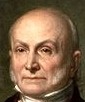
John Quincy Adams
____ served from 1825 to 1829. He benefited from the "corrupt bargain" of 1824; Henry Clay threw Adams his support in order to prevent Jackson from getting the presidency (Jackson had won the popular vote and electoral college). He was widely criticized for his vision of the American government; he wanted it to promote arts and education while building infrastructure and institutions. A brilliant Secretary of State under Monroe, he turned out to be a less than successful president.
Andrew Jackson
___ served two terms from 1829 to 1837.
Seen a military hero and champion of small government at the time, he is now mostly remembered for civil rights violations against Native Americans. He defeated the national bank, thus leaving the nation no way to deal with the economic crisis of 1837. He extended federal power by threatening to use military action against South Carolina during the Tariff Controversy of 1828 to 1833.

Martin Van Buren
___ served as president from 1837 to 1841.
He became the heir apparent due to his undying loyalty to Andrew Jackson. In the end, this savvy, brilliant New York political strategist turned out to be an unremarkable president.

William Henry Harrison
____ died about one month after taking office in 1841. He contracted pneumonia after talking too long at his rainy inauguration.

John Tyler
___ became president after Harrison's death in 1841. Although he had run as a Whig, his ideals were really much more Republican.
He is best known for establishing that a Vice President, acting after the death of a seating president, would exercise the full powers of the presidency. He annexed Texas at the very end of his term in 1845.

James K. Polk
____ served from 1845 to 1849. He considered his election a mandate for his slogan "54-40 or fight." He managed to settle the boundary with Canada and start a war with Mexico; the war conveniently served as an excuse to seize most of the Southwest from Mexico.

Zachary Taylor
_____________ was a general and national hero in the United States Army from the time of the Mexican-American War. He served from March 1849 until his death in July 1850.

Millard Fillmore
President _________was a member of the Whig party. He served from 1850 to 1853 and was the last President not to be affiliated with either the Democratic or Republican parties.

Franklin Pierce
_____________ became 14th President of the United States at a time of great controversy (1853-1857). By pursuing the recommendations of southern advisers, Pierce -- a New Englander -- hoped to ease the divisions that led eventually to Civil War. The Kansas-Nebraska Act, Gadsden Purchase, Bleeding Kansas, etc, did much to keep the nation moving toward civil war.

James Buchanan
____________ was the 15th President of the United States (1857-1861). He served immediately prior to the American Civil War. He remains the only President to be elected from Pennsylvania and to remain a lifelong bachelor. He apparently saw no obligation in act in the face of southern secession in 1860.

Abraham Lincoln
_______served as president from 1861 to his assassination in 1865. He issued the Emancipation Proclamation in 1863 and saved the Union as a whole. He was assassinated in April of 1865.

Andrew Johnson
______ became president after Lincoln's assassination. He had been the only Democrat to remain in Congress after secession. He wanted to punish the Confederates but saw no obligation to protect Southern blacks. He was also impeached for violating the Tenure in Office Act and opposing the Radical Republicans in Congress.

Ulysses S.Grant
_____ served as president from 1869 to 1877. He did little to fight for the rights of Southern Blacks as he felt this would just lead to more violence against them. Until the early 1900's, he was remembered as a great president; this changed as more and more of his scandals came to light.

Rutherford B. Hayes
___ became President thanks to Compromise of 1877. With three states left contested, Southern democrats agreed to give the election to the Republican candidate if the Republicans would end military Reconstruction. Serving until 1881, he oversaw the end of Reconstruction, began the efforts that led to civil service reform, and attempted to reconcile the divisions left over from the Civil War.

James Garfield
______ was a good man and would have made a good president. Unfortunately, he was assassinated by disgruntled office-seeker Charles Guiteau in 1881. His term lasted only 200 days.

Chester Arthur
___ became president after the assassination of James Garfield. He served president from 1881 to 1885.

Grover Cleveland
___ was the only American President to lose the presidency and then win it back. He served from 1885 to 1889 and 1893 to 1897. Nicknamed "ugly honest" he refused to annex Hawaii because the indigenous people did not want it. He created 13 new national forests at the very end of his second term.

Benjamin Harrison
Republican president served from 1889 to 1893. He signed the McKinley Tariff of 1890 and the Sherman Anti-Trust Act. More States were admitted during presidency than any other except Washington's. He also signed the first Forest Reserve Act into law in 1891.

William McKinley
___ was president 1897-1901. He was responsible for Spanish-American War, Philippine-American War, and the annexation of Hawaii. TR became president after this man was assassinated by Czech anarchist Leon Czolgosz.
