Week 8: Healthy Aging
0.0(0)
Studied by 1 person Call Kai
 Learn
Learn Practice Test
 Spaced Repetition
 Match
Match Flashcards
 Knowt Play
Card Sorting
1/30

Earn XP
Description and Tags
Last updated 12:10 PM on 10/11/26
Name | Mastery | Learn | Test | Matching | Spaced | Call with Kai | Chat |
|---|
No analytics yet
Send a link to your students to track their progress
31 Terms
1
New cards
The National Framework on Agings mission
"Canada, a society for all ages, promotes the well-being and contributions of older people in all aspects of life" (Health Canada, 1998).
* The vision for healthy aging seeks to further specify how this will play out by providing age-friendly environments and opportunities for older Canadians to make healthy choices, which will enhance their independence and quality of life.
* The vision for healthy aging seeks to further specify how this will play out by providing age-friendly environments and opportunities for older Canadians to make healthy choices, which will enhance their independence and quality of life.
2
New cards
Planning for Canada’s Aging Population: A Framework
3 pillars
3 pillars
* health, wellness and security
* continuous learning, work and participation in society
* supporting and caring in the community.
\
(specifically health, wellness and security)
* continuous learning, work and participation in society
* supporting and caring in the community.
\
(specifically health, wellness and security)
3
New cards
In 1998, some __percent of Canadians aged 55-64 and __ percent of Canadians over 65 spent an average of 2.2 hours a day as volunteers.
The economic value to our communities is thought to be $___ billion each year
The economic value to our communities is thought to be $___ billion each year
42
44
$60.2 billion
44
$60.2 billion
4
New cards
falls and costs associated
It is estimated that fall-related injuries in Canada among those 65 and older cost the economy $2.8 billion a year.
* The Public Health Agency of Canada estimates that a reduction in falls by 20 percent could result in 7,500 fewer hospitalizations and 1,800 fewer permanently disabled seniors; as well as national savings of $138 million annually
* The Public Health Agency of Canada estimates that a reduction in falls by 20 percent could result in 7,500 fewer hospitalizations and 1,800 fewer permanently disabled seniors; as well as national savings of $138 million annually
5
New cards
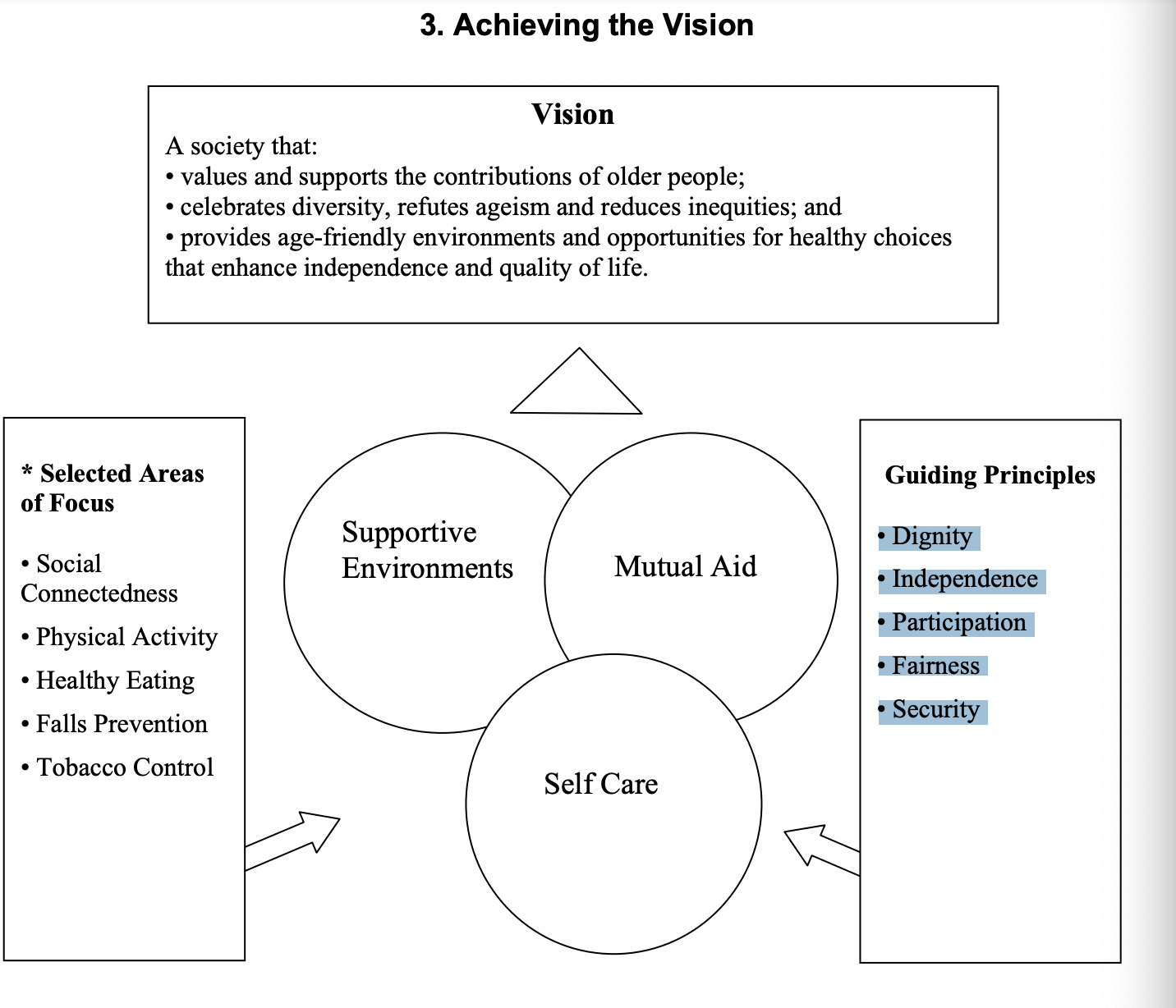
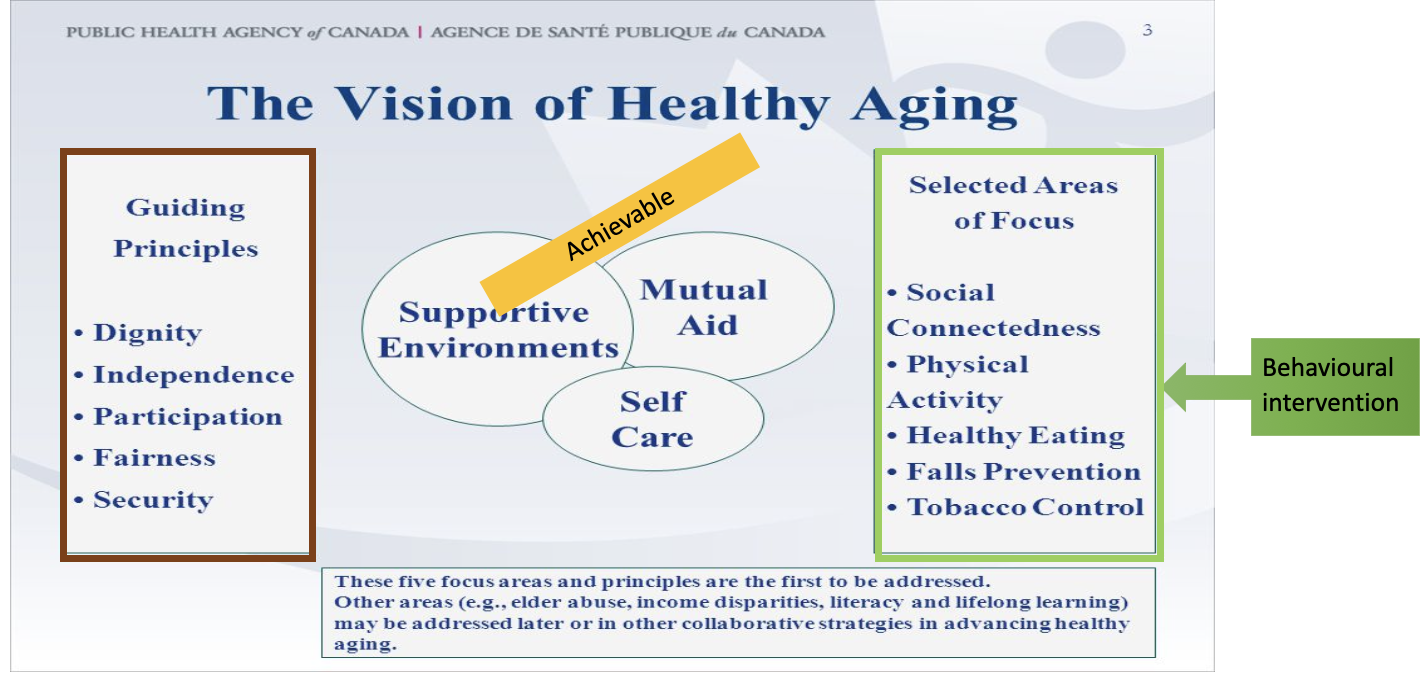
The vision:
A society that:
* values and supports the contributions of older people
* celebrates diversity, refutes ageism and reduces inequities; and
* provides age-friendly environments and opportunities for healthy choices that enhance independence and quality of life.
* values and supports the contributions of older people
* celebrates diversity, refutes ageism and reduces inequities; and
* provides age-friendly environments and opportunities for healthy choices that enhance independence and quality of life.
6
New cards
5 selected areas of focus
* Social Connectedness
* Physical Activity
* Healthy Eating
* Falls Prevention
* Tobacco Control
* Physical Activity
* Healthy Eating
* Falls Prevention
* Tobacco Control
7
New cards
Guiding principles
* Dignity
* Independence
* Participation
* Fairness
* Security
* Independence
* Participation
* Fairness
* Security
8
New cards
the middle circles
* Supportive environments
* mutual aid
* self care
* mutual aid
* self care
9
New cards
_________components are as important as biological components in healthy aging.
psychosocial
10
New cards
core principles of the social and behavioural aspects on aging
* heterogeneity of the older population
* aging as a life course phenomenon
* aging and social context
* the potential for intervention
* aging as a life course phenomenon
* aging and social context
* the potential for intervention
11
New cards
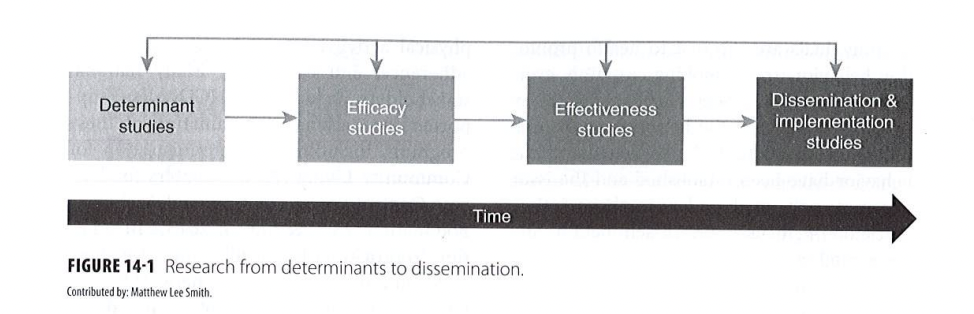
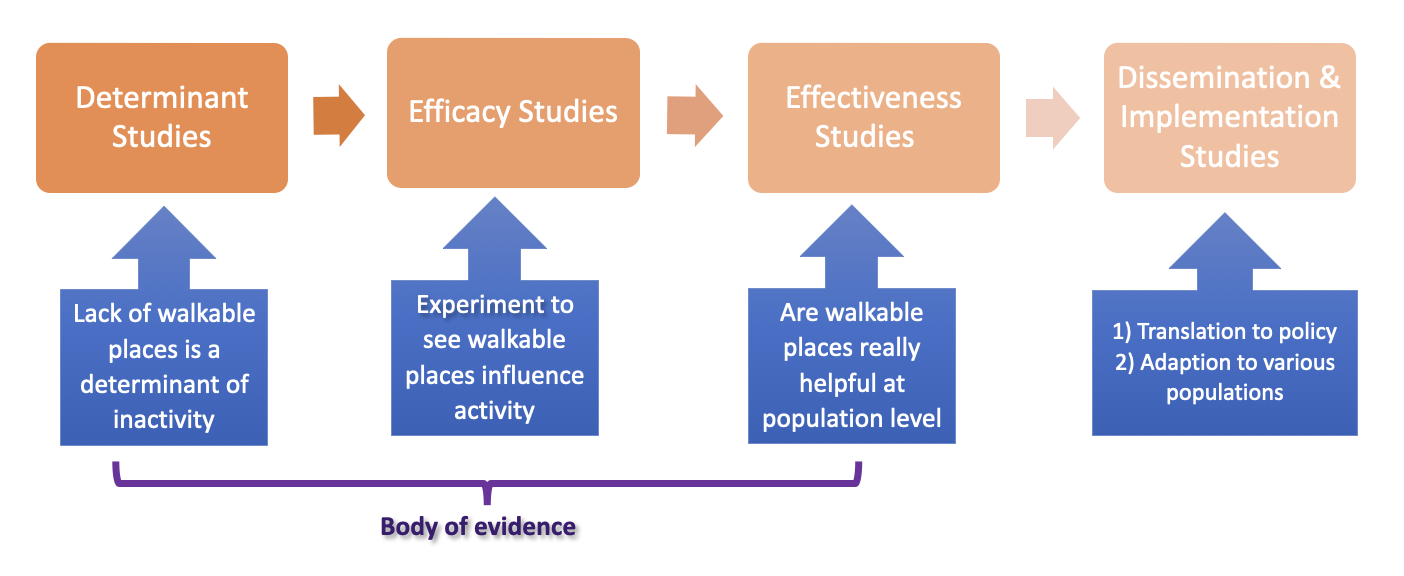
research study continuum
1. determinant studies
2. efficacy studies
3. effectiveness studies
4. Dissemination & implementation studies
12
New cards
the ‘silo approach’
the formation of groups who examine only the amount of change in the health behaviour needed to have a meaningful effect or only focused practice implementation
13
New cards
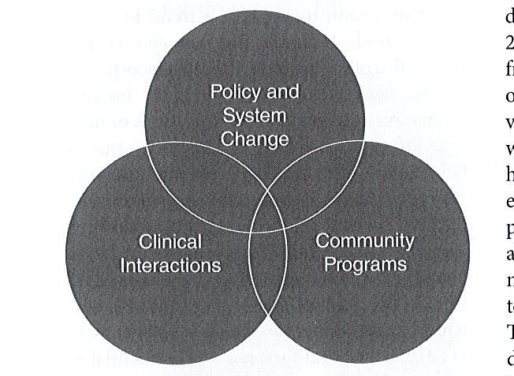
multilevel approaches and multidisciplinary teams for behaviour change and health and well-being improvement
14
New cards
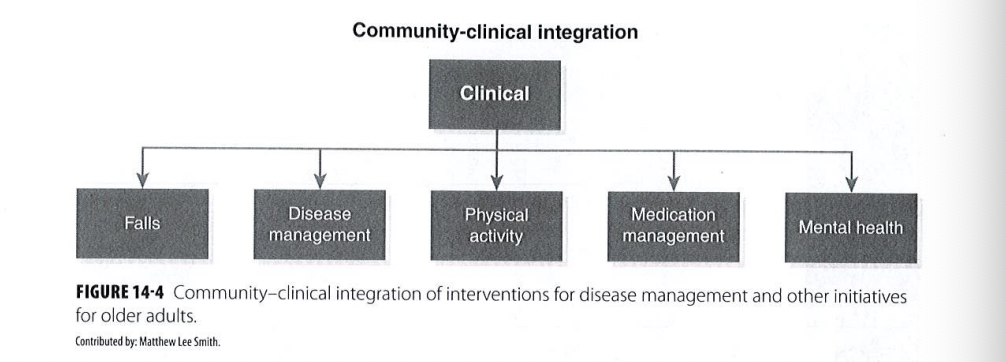
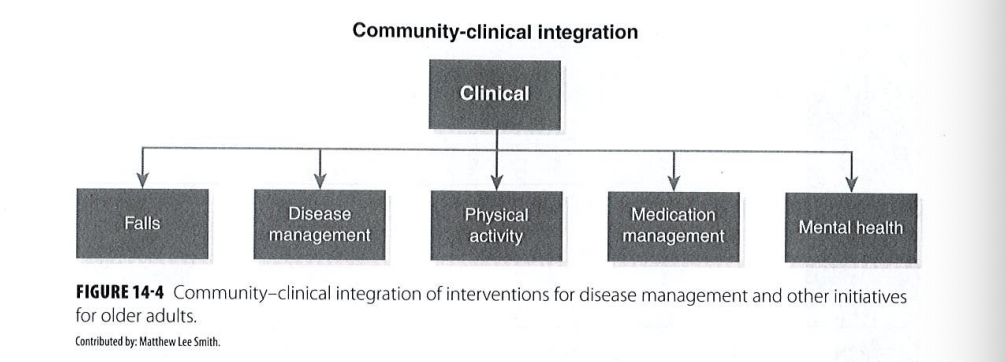
Community clinical integration
15
New cards
WHO definition of healthy aging
“the process of developing and maintaining the functional ability that enables wellbeing in older age”
ability to:
* meet basic needs
* learn, grow, and make decisions
* be mobile
* build and maintain relationships
* contribute to society
ability to:
* meet basic needs
* learn, grow, and make decisions
* be mobile
* build and maintain relationships
* contribute to society
16
New cards
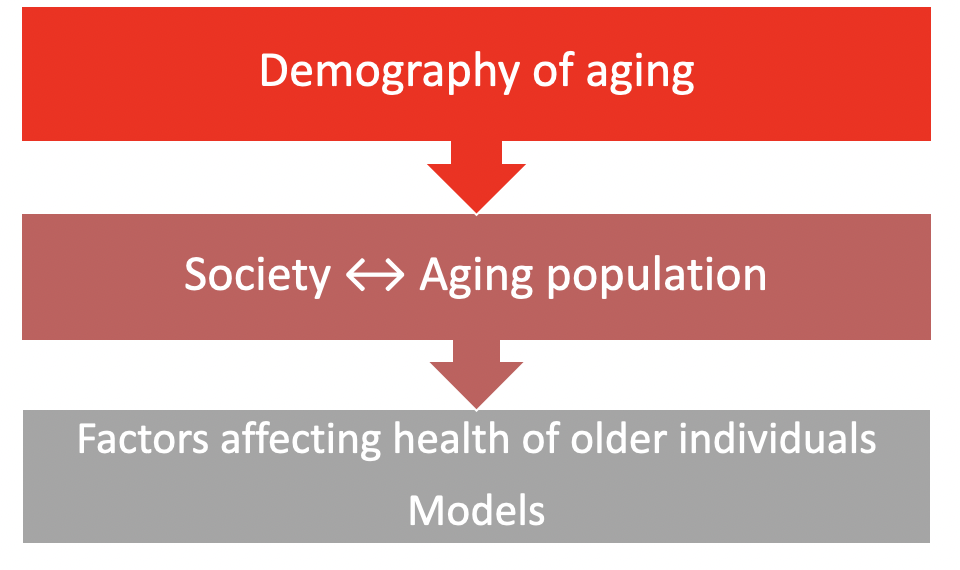
Key considerations in healthy aging
**1. There is no typical older person**
* Goal: improvement the functional ability of all older people, whether they are robust, care dependent or in between.
\
2. **A large proportion of differences in capacity in older age is due to the cumulative (lifecourse) impacts of advantage and disadvantage across people’s lives**
* Healthy aging starts at birth!
* Relationships with environments
* Shaped by factors such as sex, age cohort, ethnicity, family, education and financial resources
\
3. **Intervention is possible**
* Given we identify harming factors
* And target them
* A good intervention considers the big picture
4. Focus on improving quality of (remaining) life rather than only lengthening life
* Goal: improvement the functional ability of all older people, whether they are robust, care dependent or in between.
\
2. **A large proportion of differences in capacity in older age is due to the cumulative (lifecourse) impacts of advantage and disadvantage across people’s lives**
* Healthy aging starts at birth!
* Relationships with environments
* Shaped by factors such as sex, age cohort, ethnicity, family, education and financial resources
\
3. **Intervention is possible**
* Given we identify harming factors
* And target them
* A good intervention considers the big picture
4. Focus on improving quality of (remaining) life rather than only lengthening life
17
New cards
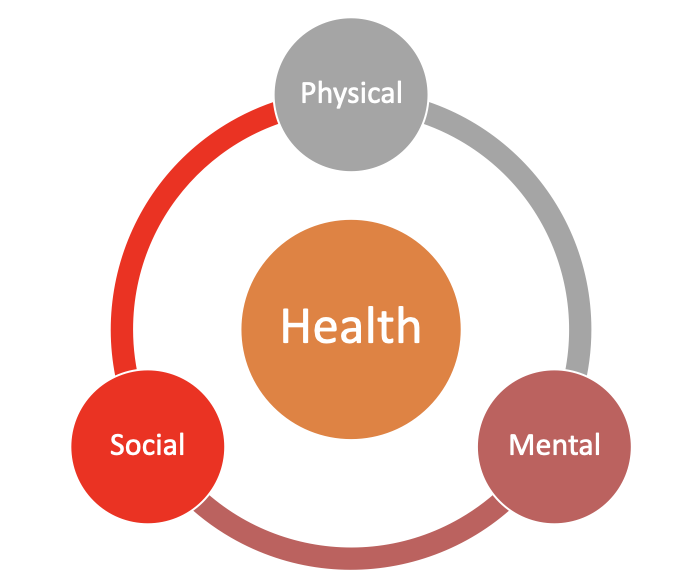
To achieve healthy aging…
18
New cards
differences between successful aging, healthy aging and aging well
Successful Aging is more about Individual Health
\
Healthy Aging involves the Society
\
Aging Well involves policymakers
\
however…
* In this course we call all healthy aging and won’t focus on these subtle differences.
\
Healthy Aging involves the Society
\
Aging Well involves policymakers
\
however…
* In this course we call all healthy aging and won’t focus on these subtle differences.
19
New cards
Aging successfully
How do you want to be when you are 65? 75? 85?
What are you willing to do to achieve those targets?
*Does not mean not experiencing the natural aging process of aging*
\
* Low chance of chronic conditions and disability1
* High mental, physical, and social functioning
* Think of WHO definition of health
What are you willing to do to achieve those targets?
*Does not mean not experiencing the natural aging process of aging*
\
* Low chance of chronic conditions and disability1
* High mental, physical, and social functioning
* Think of WHO definition of health
20
New cards
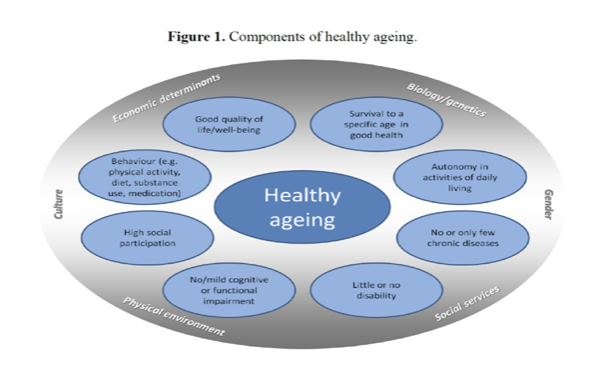
Indicators of healthy aging
* Functioning and disability
* Physical activity
* Cognitive capability
\
* Prevalence of chronic diseases and multi-morbidity
* Social engagement and contribution
Measurable, quantifiable
* Physical activity
* Cognitive capability
\
* Prevalence of chronic diseases and multi-morbidity
* Social engagement and contribution
Measurable, quantifiable
21
New cards
The vision of healthy aging
22
New cards
Important questions of the vision of healthy aging
Important questions:
1. How can the big picture (bio-psych-social aspects) be addressed?
2. How make sure the ‘intervention’ worked?
3. Does the society think healthy aging is achievable?
1. How can the big picture (bio-psych-social aspects) be addressed?
2. How make sure the ‘intervention’ worked?
3. Does the society think healthy aging is achievable?
23
New cards
Aging in place
A policy to keep established social connection, continuous use of resources, no need to (many) additional direct individual-based interventions
* Older adults strive to live in their family home unless forced to move
* Established ties
* People
* Physical/built environment
* Community
* Provides a sense of identity and security
* Emotional, financial
* Older adults strive to live in their family home unless forced to move
* Established ties
* People
* Physical/built environment
* Community
* Provides a sense of identity and security
* Emotional, financial
24
New cards
How aging in place works
* **Adaptations needed as health, financial, and family situations change**
* E.g. redesigning bathrooms and kitchens
* **Sometime occurs naturally**
* A whole community ages
* **Mostly needs (some) interventions**
* Planned retirement communities
* Various types of housing
* At the contextual (society) level
* E.g. redesigning bathrooms and kitchens
* **Sometime occurs naturally**
* A whole community ages
* **Mostly needs (some) interventions**
* Planned retirement communities
* Various types of housing
* At the contextual (society) level
25
New cards
Society vs. healthy aging
Opinions:
Aging is inevitable, and health (linearly) decline until physical and mental frailty and we can’t do anything about it
\
* For example, in all older people body and mind decline. It is nature’ law, so, why even waste resources to intervene?
* Look at Alzheimer, there is nothing we can do
* Why bother with interventions? They will not work in older adults anyway!
Aging is inevitable, and health (linearly) decline until physical and mental frailty and we can’t do anything about it
\
* For example, in all older people body and mind decline. It is nature’ law, so, why even waste resources to intervene?
* Look at Alzheimer, there is nothing we can do
* Why bother with interventions? They will not work in older adults anyway!
26
New cards
Physical activity
*Fact: Older adults are the least active age group*
* Why?
* Wrong information:
* It is harmful
* Older adults are unwilling to exercise
\
**Canadian guidelines for older adults**
*“At least 150 minutes of moderate to vigorous aerobic physical activity/week, in bouts of 10 minutes or more”*
\
What are the features of a good intervention for promoting physical activity?
* Why?
* Wrong information:
* It is harmful
* Older adults are unwilling to exercise
\
**Canadian guidelines for older adults**
*“At least 150 minutes of moderate to vigorous aerobic physical activity/week, in bouts of 10 minutes or more”*
\
What are the features of a good intervention for promoting physical activity?
27
New cards
design and evaluation of an intervention
28
New cards
Why don’t some interventions work?
1. The evidence is wrong
2. Implementation is wrong
3. Wrong modifications
* Some “experts” think they are better than science
29
New cards
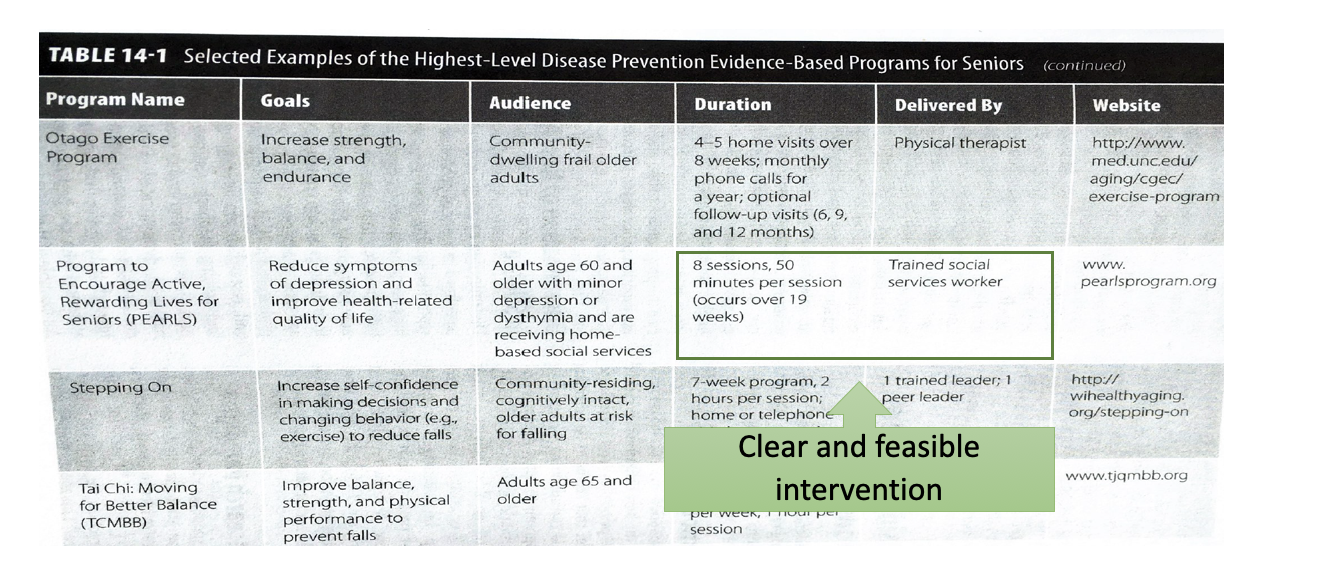
A good intervention
1. Has clear and specific goals
2. Focuses on a particular sub-population of older adults
3. Intervention is clearly defined
* Duration, method of delivery
4. Outcome is measurable
\
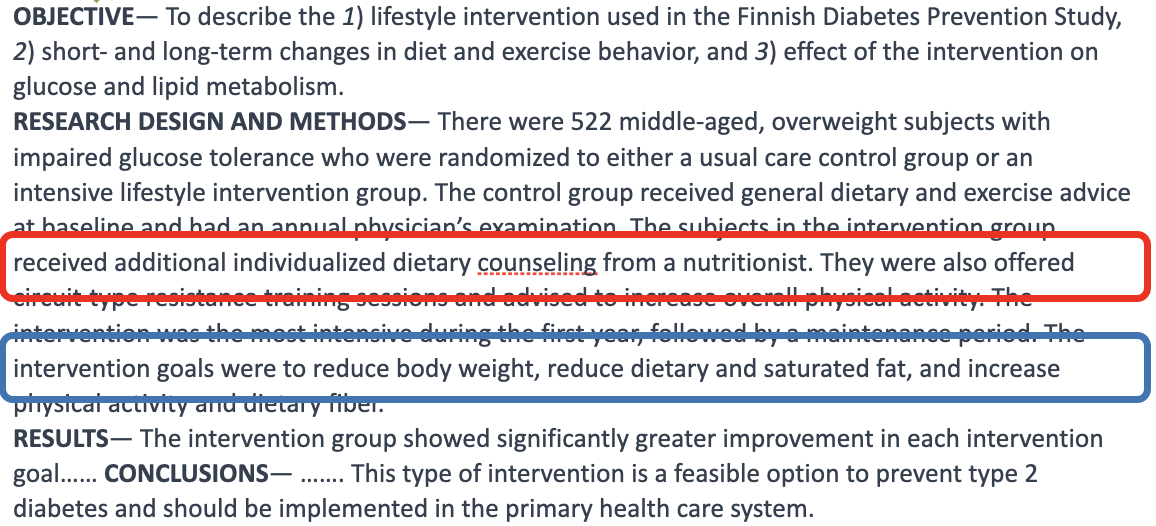
Interventions aiming on healthy aging should also consider feasibility at the population level
30
New cards
feasible at the population level?
31
New cards
Takeaways
* Healthy aging is living a life at old age with **full capacity**, not merely living without diseases
* Achieving ‘healthy aging’ is possible by adopting evidence-based and well-implemented interventions
* After understanding the patterns of occurrence of health-related conditions in old age
* What we learned in weeks 4 to 7
* Achieving ‘healthy aging’ is possible by adopting evidence-based and well-implemented interventions
* After understanding the patterns of occurrence of health-related conditions in old age
* What we learned in weeks 4 to 7