Ch. 14 : The Parietal Lobes & Networks
 Call Kai
 Learn
 Practice Test
 Spaced Repetition
 Match
 Flashcards
 Knowt Play
1/25

There's no tags or description
Looks like no tags are added yet.
26 Terms
Functional Regions of the Parietal Lobe
parietal lobe can be subdivided into multiple functional regions: post central gyrus (primary somatosensory cortex), posterior parietal cortex, angular gyrus, precuneus, & supramarginal gyrus
interior parietal lobe consists of the supra marginal & angular gyrus
parietal cortex, particularly the inferior portion, has expanded during human evolution + has a homunculus
Broadmann & von Economo both mapped the parietal cortex based on cytoarchitecture, but disagree on boundaries

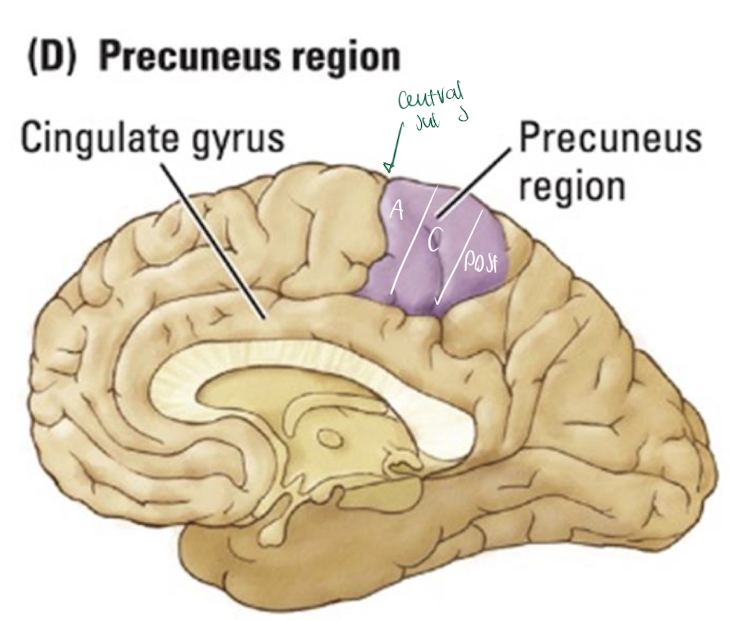
Precuneus = inside region of the parietal lobe, next to the postcentral gyrus
3 sections:
Anterior : sensorimotor (close to post central gyrus)
central : cognitive
Posterior : visual
Connections of the Parietal Cortex (parietal lobe)
→ somatosensory areas of the postcentral gyrus (in parietal lobe) project to secondary somatosensory areas in the parietal lobes & motor planning and motor control areas in the frontal lobe
Area PE = secondary somatosensory area that projects to motor areas to guide movement by providing info abt limb position (kinaesthetic info)
Area PF = receives input from somatosensory areas VIA PE → projects to motor areas
receives info from primary & PE (backup for PE)
Area PG = integrates info from visual, somatosensory, auditory, vestibular, & oculomotor systems WITH cognitive input from the cingulate to control spatially guided behaviour
gets info directly from PRIMARY somatosensory (not PE or PF) & integrates, thus more important
related to V5 of occipital
combines everything to make a whole picture
NOT a secondary area, its an assoc. areas bc its integrating
more complex - sends to frontal, temporal & motor

Anatomy of the Dorsal Stream in the Parietal Lobe
dorsal visual stream : contains info abt how/where for action
Parietal Lobe DORSAL stream: composed of 3 proposed pathways
Parieto-Premotor pathway = primary “how” path for motor control
planing how we will move
Parieto-Prefrontal pathway = involved in working memory for visuospatial objects
remembering what movements to do, in order to plan - “creating muscle memory”
Parieto-Medial-Temporal pathway = protects to the hippocampus & parahippocampal regions in temporal lobe - suggested importance in spatial recognition & navigation
bc temporal is part of the “what” ventral pathway for vision, thus helps with navigation
→ posterior parietal cortex is important for visuospatial behaviours
→ more ventral regions of parietal cortex are involved in perceptual fxns
Theory of Parietal Lobe’s Function
Theory: Parietal lobe’s main goal is controlling movement
anterior region (front part) : processes somatosensory info (info from body senses)
posterior region (back part) : integrates somatosensory info & visual info to control movement
→ parietal lobe is involved in creating a multisensory map of the world around us to enable effortless interactions with the world
consists of multiple maps - each serving a specific behavioural need, thus diff ppl can have diff types of maps
Parietal Lobe’s Functions: Sensorimotor Transformation
sensorimotor transformation = integration of movement intention with sensory feedback abt how the intended movement compares to the actual movement to perform smooth movements twds the target
similar to the cerebellum, but cerebellum is more gross motor whereas this is more fine movements
Area PRR = involved in motor planning by encoding the desired outcome of the movement
damage to this area can alter how we move
recordings (electrical activity) from PRR can be used to control a prosthetic device/limbs
ex. moving with the mind study:
rewarded if the monkey’s brain activity indicates they’re PLANNING to reach for the green triangle cue, don’t have to physically reach
thus, rewarding for a certain thought process rather than physical behaviour
idea that them thinking abt the movement can control a prosthetic

Parietal Lobe’s Functions: Spatial Navigation
→ to navigate the world we need an internal map of the world & a list of what to do at each decision point in the route
info abt navigation is likely to be delocalized - thus info abt a single map is prob NOT stored together so that damage to one area wont destroy everything
research suggests the medial-parietal region is important for route knowledge in humans
cells are active when a specific movement is made at a particular location (ex. diff cells activating based on a decision made along the route)
cells control body movements to specific locations (ex. using your leg at the gym vs. walking)
→ if the medial-parietal region is inactivated in a monkey: animal gets lost & CANT navigate correctly
THUS, the parietal lobe if more about goal/fxn of movement, rather than body area homunculus
Parietal Lobe’s Functions: Complexity of spatial information
→ posterior-parietal damage impairs the ability to tell left from right + the mental manipulation of objects
background:
control of some movements (limbs, eyes) is fairly simple
defining left and right is more complex + depends on frame of reference
manipulation of mental images can be considered application or extension of manipulating objects with ur hands - THUS, same cells are active in brain as tho you were physically manipulating them
non-notes to support this: the posterior region (back part) of the parietal lobe integrates somatosensory info & visual info to control movement, thus when damaged it cannot do this
Other Parietal-Lobe Functions
Arithmetic
some pts w parietal-lobe dysfunction have a condition known as Acalculia ( inability to perform calculations )
may be bc math can be interpreted as having a spatial component that would require the parietal lobe (ex. having to borrow in a subtraction problem)
Language
pts w posterior-parietal damage may have language difficulties bc the spatial organization of letters in words & words in a sentence matters
can result in symptoms of dyslexia
Movement Sequences
posterior-parietal damage makes it difficult to copy observed movements
bc mirror neurons are involved
Parietal Lesions: Somatosensory Symptoms
→ damage to the postcentral gyrus (somatosensory cortex) & adjacent posterior-parietal cortex results in somatosensory symptoms
ex. not feeling when you touch something
postcentral gyrus damageresults in:
high sensory thresholds (need increased stimulation to perceive)
impaired ability to sense position
impaired stereognosis (struggle to identify objects by touch)
w afferent (twd CNS) paresis, postcentral gyrus damage results in:
loss of feedback abt limb positions → causing clumsy movements
→ bc we’re NOT receiving feedback due to afferent paresis (not sent to CNS)
Parietal Lesions: Somatoperceptual Disorders
Astereognosis = loss of the ability to identify an object by touch
with damage to secondary somatosensory cortex
ex. present pt with 2 objects at same time and remove them at same time (simultaneous extinction) → ask how many objects they held
pts w damage to secondary somatosensory cortex notice & only report holding ONE object (didn’t identify the other by touch)
Numb Touch = reports loss of sensation from a region, BUT can still accurately report where they were touched in that region
consciously CANT feel, but physically can
somatosensory equivalent of blind sight
tests of tactical perception of objects:
test A : blindfolded & have to identify what pattern of block was in their hand using only touch
test B : have to identify which 2 objects are the same using only touch

Parietal Lesions: Somatosensory Agnosias
Asomatognosia = pt loses knowledge abt their own body or condition (what their body currently feels)
types:
Anosognosia = unawareness of illness (dont realize they’re sick)
Anosodiasphoria = indifference to illness (know they’re sick, but DODNT care)
ex. wont take medicine bc they dont care abt their health
Autopasgnosia = inability to locate & name body parts on themselves and/or others
Fingeragnosia = more common in kids w spinibifida or if they struggle w #’s
Asymbolia for pain = lack of typical avoidance rxns to pain
can feel & react to pain, but don’t learn to avoid it after
Parietal Lesions: Balint Syndrome
Balint syndrome = rare condition requiring pt to have all 4:
normal vision + can recognize and use objects, pictures, and colours
can move their eyes, but CANT fixate on a target
has simulatagnosia
has optic ataxia & is unable to reach a specified target using visual guidance
- lack dorsal stream, thus CANT incorporate vision & movement
→ results from BILATERAL parietal lesions (both sides)
Parietal Lesions: Contralateral neglect
Contralateral neglect = pts neglect the LEFT side of their own body & visual field (bc its controlled by R-hemis)
symptoms:
only copy right side of a picture
only dress right side of body
only read the right half of compounded words (ex. read cream in the word “ice cream” or read ball in “football”)
ignore tactile stimualtion to L-body (ex. wont react to being tickled on the L-side of body)

usually dont know there is anything wrong
can recover by looking around & starting to respond to stimuli on neglected side
start to neglect both sides is untreated or treated incorrectly
causes:
results from RIGHT parietal stroke (right parietal lesion)
can also occur w damage to frontal lobes, cingulate cortex or subcortical regions - most common w damage to parietal tho
can be induced in healthy ppl by applying TMS to the Right intraparietal sulcus & angular gyrus

why?
neglect may be due to impaired sensation & perception (parietal lobe damage) OR impaired attention (frontal lobe/cingulate damage)
Parietal Lesions: Effect on Object Recognition
→ pts w POSTERIOR parietal damage : may have difficulty recognizing objects in unfamiliar views/orientations
bc: difficulty mentally rotating the image to match the traditional depiction w this damage

Parietal lesions: LEFT Parietal Syndromes & symptoms
Gerstmann syndrome = pt experiences finger agnosia, left-right confusion, agraphia (CANT write), & acalculia
results from damage to LEFT parietal lobe near area PG
→ other LEFT parietal lesions are associated with these symptoms:
difficulties writing, reading & grammar
apraxia
dyscalculia
decreased digit span in verbal working memory (now 5± 2 instead of 7 ± 2)
difficulty with left-right discrimination
Parietal lesions: Apraxia
Apraxia = loss of skilled movement
types:
Ideomotor apraxia = unable to copy movements made by other ppl
results from LEFT parietal lesions
ex. can do the dance, but cant copy others doing it
Construction apraxia = issues w spatial organization + unable to assemble puzzles, draw pictures, or copy facial movements
struggle to construct a whole image, but can see individual pieces
results from right or left POSTERIOR parietal damage
Testing for Apraxia
serial arm-movement copying test = asked to copy movements - degree they’re able to copy shows degree of ideomotor apraxia
assesses ideomotor (copying movements)
serial facial-movement copying test = asked to copy facial movements
assesses ideomotor (copying) & construction (copy facial movements)
after this you do another test to see if its ideomotor or construction apraxia

Parietal Lesions: Effect on Drawing
→ damage to either hemisphere of parietal love causes impairments in drawing ability
more severe impairment w damage to RIGHT parietal
findings:
Left parietal damage : make fewer recognizable drawings + use fewer lines
bc:
damage to L-hemisphere damages lang & can make a mental list of what to draw
damaged feedback to correct/refine fine motor for drawing
ex. drawing a stick figure, while intact brain would draw more detail
Right parietal damage : tend to neglect the LEFT side of the image
note: drawing assessments tell us a lot abt brain fxn (damage in any lobe)
Parietal Lesions: Disorders of Spatial Cognition
→ damage to the Left & right parietal lobes results in deficits in spatial cognition (ex. poor mental rotation)
bc: tasks like mental rotation require the formation of mental images AND the manipulation of that image
ex. w parietal damage u struggle to picture route from CCIS to SUB
findings:
Left parietal damage: may impair formation of the mental image
suggests L-parietal is involved in formation
Right parietal damage: may impair the manipulation of mental images
suggests R-parietal is involved in manipulation
Other Functions of Parietal Lobe: Spatial attention
→ research suggests the parietal cortex many fxn to shift attention b/w stimuli - the ACT of shifting, NOT deciding when to switch
bc: shifting attention involves resetting the visuomotor guidance system associated with the parietal lobe b/w targets
→ explains why contralateral neglect occurs w parietal damage - cant shift attention to other side
Comparing the Left & Right Parietal Lobes
→ there are differences in the symptoms experienced by pts w Left vs Right parietal lesions
THUS, some asymmetries are predictable
overlapping of some symptoms suggests functions of the parietal hemispheres aren’t completely lateralized (integration theory)
these overlapping symptoms may be due to the preferred cogntive mode of the pt
findings:
RIGHT-hemis of parietal :
dominance in cube counting & paper cutting
more r-parietal lesion pts w unilateral neglect, dressing disabilities, & topographical loss
LEFT-hemis of parietal:
dominance in right-left discrimination & wiggles sorting test

Major Parietal Lesions symptoms & their Assessment
→ lesions localized to a single brain area are rare, so symptoms dont usually present clearly bc multiple areas are damaged
findings:
lesions resulting in symptoms that involve multiple senses tend to occur at PG
areas for movement (reaching, eye movements, tactile agnosia) tend to occur BEFORE PG, thus at PE and/or PF

Assessment: Testing for Areas of the Parietal lobe damaged
Test 1 = identifies if the parietal is damaged
tests somatosensory threshold & tactile form recognition
Test 2 = identifies if damage is to R-hemis parietal
tests for contralateral neglect & visual perception
Test 3 = identifies if damage is to L-hemis parietal
tests spatial relations, language, & apraxia
Assessment: Test 1
assessment tests 1 = identifies is parietal lobe is damaged
increased somatosensory threshold & poor tactile form recognition indicate parietal lobe damage
→ Somatosensory threshold: blindfolded subject reports whether they felt 1 or 2 touches
2 points are initially set 3cm apart & distance is reduced until they only detect 1 touch
→ Tactile form recognition: blindfolded subject manipulates blocks & has to place them into a matching hole shape + shapes are removed → asked to draw shapes from memory
2nd part goes beyond somatosensory, thus requires integration of other areas info
shape manipulation likely involves areas PE & PF
drawing task likely involves area PG
→ increased somatosensory threshold (requires increased stimulation to perceive) or poor tactile form recognition indicates parietal lobes is damaged
Assessment: Test 2
assessment test 2 = indicates if damage is on R-hemis parietal (can also be on left, but its rare)
contralateral neglect & poor visual perception indicate R-parietal damage
→ Contralateral neglect: subjects need to draw a vertical line in the middle of a horizontal line where theres lines of L-side and R-side of page (side they can recognize)
subjects w contralateral neglect: shift the horizontal line more to the right & skip the examples on L-side of page
indicates neglect of L-side, thus R-hemis parietal damage
→ Visual perception: pts have to draw the remainders of incomplete faces/objects
sensitive to damage on R-hemisphere temporoparietal junction (for ability to indemnify object & its manipulation)
if unable to : indicates damage to R-hemisphere temporoparietal junction
→ neglect of L-side of body/visual field or inability to draw the remainders of faces/obhects (poor visual perception) indicates RIGHT parietal lobe is damaged
Assessment: Test 3
assessment test 3 = indicates if damage is on L-hemis parietal
poor spatial relations (left-right distinction), poor language & apraxia (loss of skilled movement) indicate L-parietal damage
→ Spatial relations: have to identify diff orientations of body parts in space as left or right (identify L&R on others) OR ask pt to touch their right ear w left damage (identify L&R on themselves)
sensitive to L-parietal damage & L-frontal damage
thus, if unable to: indicates L-parietal damage & L-frontal damage
→ Language: asked to touch certain colour ( CAN do w L-damage), touch blue circle & red triangle (CANT do w L-damage, bc they mix up the colour & shape info)
impairments are assoc w L-hemis area PG damage
→ Apraxia: doesn’t have a standardized test
ex. Kimura Box test = asks subject to make a sequence of precise movements
if they cant = apraxia
→ poor spatial relations (L&R distinction), mixing up language info to identify objects & apraxia (loss of skilled movement) indicates LEFT Parietal damage
Parietal Lobe Networks
→ fMRI studies suggest the parietal lobe is involved in more behaviours than predicted from lesion studies
see more deficits in humans than using animal models, bc lesioning animals doesn’t show how complex our parietal lobe is
(-) : fMRI studies DONT show all the areas involved in a task, unlike lesion studies
Temporoparietal junction = involved in attention, lang, memory, social processing & self-perception
research suggests 5 diff networks within this junction:
R-side: favours attention
if damaged: contralateral neglect (displayed by fMRI)
L-side: favours memory & language
Inferior-Parietal lobe (IPL) = connects & communicates with temporal lobe
connected to STS pathway

Networks of Parietal lobe
Default mode network (always on): inferior parietal lobule is active
Parietal Memory network = involved in learning & memory (watching something happen → become able to do that thing)
includes: precuneus, angular gyrus & midcingulate cortex
Dorsolateral parietal network = performs a variety of spatial fxns by connecting prefrontal cortex, temporal cortex & hippocampus
this network is involved in mental map & navigating