biochem post quiz
 Call Kai
 Learn
 Practice Test
 Spaced Repetition
 Match
 Flashcards
 Knowt Play
1/63

There's no tags or description
Looks like no tags are added yet.
64 Terms
spingolipids
sphingosine provides the backbone, rather than glycerol
parent compound is ceramide
at least 60 different ones exist (phospholipids and glycolipids)
typically, a fatty acid is joined to C2 on sphingosine via an amide linkages
3 major subclasses of sphingolipid (all derivatives of ceramide)
phosphosphingolipids
sphingomyelins- phosphate (myeline sheath common in nerve, brain and spinal cord)
Glycosphingolipids
cerebrosides- one sugar
gangliosides- multiple sugars
- sphingomyelins insulate the axons of some neurons, therefore sphingolipids are important in the membranes of nervous tissue in higher animals
- glycosphingolipids are also important components of never and muscle membranes
different variations of sphingolipids (different things you can add on to C3)

more complex glycosphingolipids
ceramide backbone with two or more esterified sugars
one must be a silica acid (produces net negative charge on lipid)
determine certain elements of tissue and organ specificity
cell-cell regongtiion and tissue immunity, never impulse transmission, ect.
see buildup of GM2 in Tay-sachs disease victims
sialic acid
adds negative charge at neutral ph which can determine tissue and organ specificity
phospholipid and sphingolipid degradation
cells continually degrade and replace membrane lipids
phospholipids and sphingolipids are degraded in lysosomes by enzymes called lipases
each hydrolyzable bond has its own enzyme

defects I the turnover of membrane lipids lead to a number diseases
gangliosides are degraded by a set of lysosomal enzymes that catalyze the stepwise removal sugar units, finally yielding the parent coumdpond, ceramide
a genetic defect in any of these hydrolytic enzymes leads to dangerous accumulation of lipids in the cell
known as lysosomal storage disease

blood groups

sterols and cholesterol
sterols-
present in most eukaryotic cell membranes, bacteria cannot synthesize sterols
steroid nucelus: four fused rings (almost planar)
hydroxyl group (polar head) in the A-ring
various non polar side chains
precursors to steroid hormones (lack non polar side chain)- potent biological signals that regulate gene expression
sterols such as colestterol are present where
in most eukaryotic cel membranes. affect membrane fluidity. increase fluidity in saturated fat portions and (destabilize) decrease membrane fluidity in non saturated fats and increases stability
isoprenoids
steriods
steroid hormones testosterone, estradiol, cortisol
terpenes
diverse group of molecules often recognized by their characteristic flavors, ordors and color
lipid vitamins
A, D, E, K
Eicosanoids
prostaglandins
thromboxanes
leukotrienes
steroid hormoones
oxidized derivatives of sterols
have the sterol nucleus but lack the non polar alkyl chain attached to the D ring of cholesterol
amazing array of. cellular functions including salt balance, metabolic function and sexual funciton
steroid hormones are potentent signalers that move through the bloodstream on protein carriers to target issues where they enter cells, bind to receptor proteins in the nucleus, and trigger changes in gene expression and metabolism
terpenes
based on the isoprene structure comprised of five-carbon units with conjugated double bonds (abs visible light)
many are recognized by their characteristic flavors odors, and colors
vitamin A (retinol)
20- carbon terpene hormone and visual pigment of vertebrate eye obtained in the diet either directly or indirectly from beta-carotene it is a precursor to retinal and retinoid acid
retinal initiates the response of rod and cone cells of the retina to light, producing. neuronal signal to the brain
retinoid acid regulates gene expression in the development of skin cells

fat soluble vitamins
cannot be synthesized in body, need to get in diet for proper health
fat soluble (A, D E K)
vitamin A
found in fish oils liver, eggs, whole milk, ubtter
deficientcy- dry skin and eyes, retarded eye development, night blindness
vitamin D
found in milk, butter
vitamin D deficiency defective bone formation- rickets (need sunlight)
Vitamin D3
formed in skin from exposure to UV light
regulates metabolism of calcium uptake in kidney, intestine, and bone
fat soluble vitamins
vitamin E
destroys oxygen radicals
found din eggs, oils, wheat germ
deficinec- scaly skin, muscle weakness
vitamin K
deficiency shows blood clotting
K1 found in green plant leaves
ubinquinonne (VItamin Q- not actually a vitamin)
electron carriers in the redox reactions that drive ATP synthesis in mitochondria and chloroplasts
eicosanoids
paracrine hormones derived form the 20-carbon polyunsaturated fatty acid, arachidonic acid (20:4 delta 5,8,11,14)
prostaglandins
thromboxanes
leukotrienes
they all serve as potent biological signals
prostaglandins
contain a 5-carbon ring- first identified in prostate- some stimulate smooth muscle contraction, others elevate body temperature, inflammation, and pain
thromboxane
have a 6 membered ring contain either
they are produced by platelets for blood clotting
NSAIDS inhibit…
COX (cyclooxyrgenase) enzymes that form prostaglandins and thromboxane from arachidonic acid

leukotrienes
contain 3 conjugated double bonds. they trigger smooth muscle contrition in the airway leading to asthma and anaphylaxis
prednisone targets the enzyme that converts arachidonic acid to specific leukotrienes

chapter 10: important notes
lipids are a structurally and functionally diverse class of molecules that are poorly soluble in water
TAGs are the main storage lipids
phospholipids are the main constituents of membranes
sphingolipids play roles in cell regognition
cholesterol is both a membrane lipid and the precursor for steroid hormones
some lipids carry signals form cell to cell and from tissue to tissue (biologically active)
nucleic acids
do not break it down it for energy (dont metabolize it), only use it for its primary purpose
information transfer in cells (central dogma)
information encoded in a DNA molecule is transcribed via synthesis of an RNA molecule
the sequence of the RNA molecule is read and is translated into the sequence of amino acids in a protein
DNA replication→ transcription → translation
nucleic acids structure
contain nucleobases (nitrogenous bases)
nucleic acids are the polymers and nucleotides are the monomers
include a 4 carbon sugar, phosphate, and nucelobases
nitrogenousb uses are pyrimidines or purines
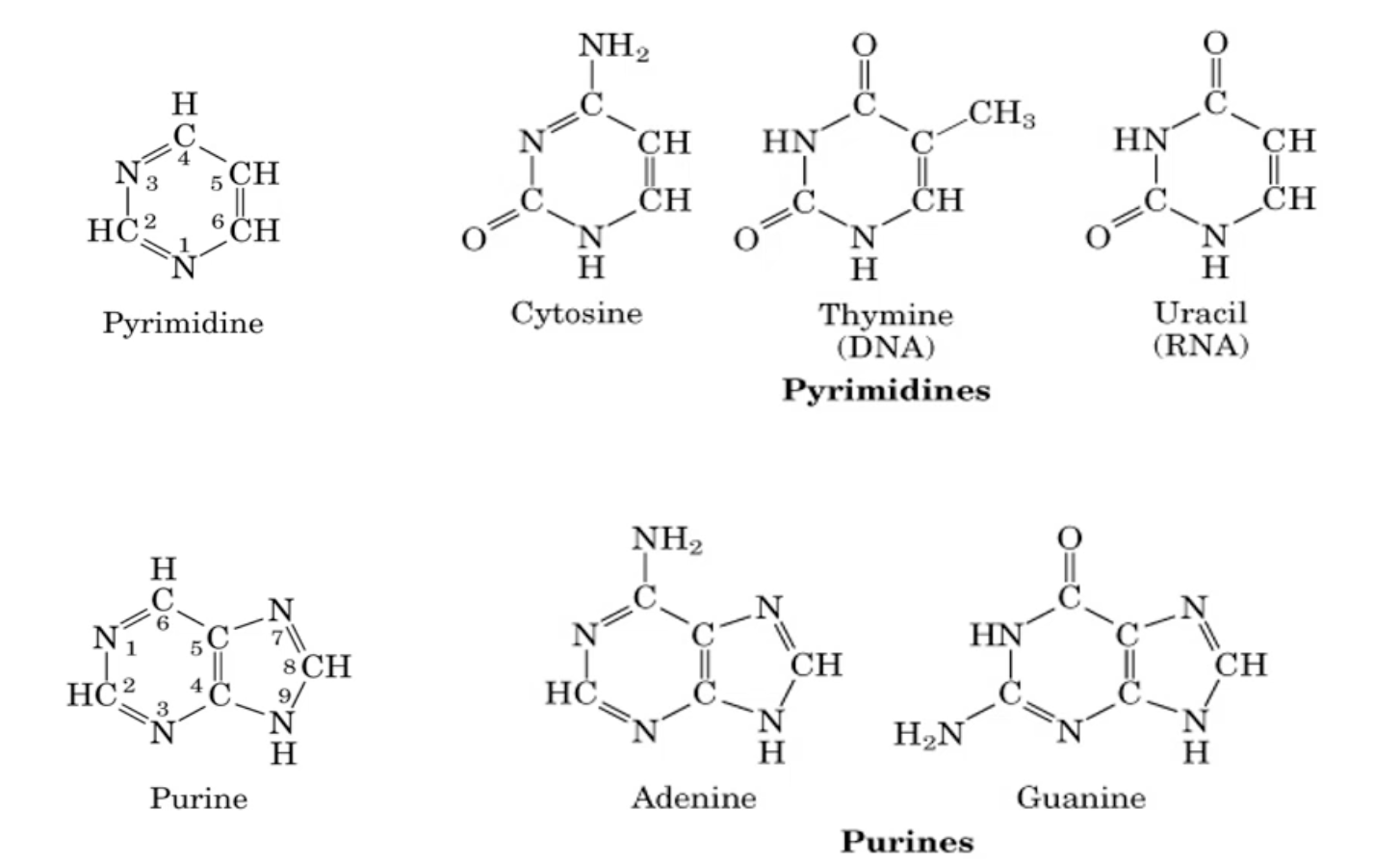
pyrimidine
have a benzene with two nitrogens include
cytosine
thyamine
uracil
purines
benzene with two nitrogens and an attached face carbon sugar
include:
adenine and guanine know the numbers the nitrogen nitrogen 1 vs 9
cytosine
has an amine group

thiamine
has a methyl group
and double bonded oxygen
(keynote)
biggest pyrimidines

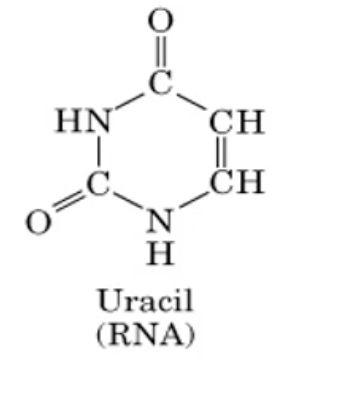
uracil
two amides (=o)
found on RNA
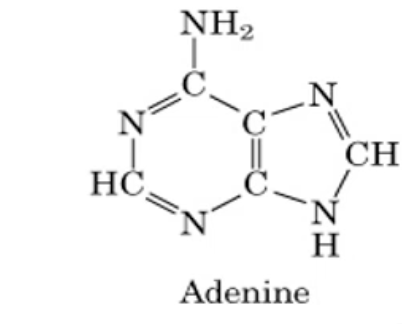
adenine
nitrogen at the top
guanine
contains amine and is buffer than adenine

structure and chemistry of baes
nitrogen containing heterocyclic aromatic amines
planar or almost planar structures
resonance in cyclic rings allows nucleotide bases to absorb UV light around 250-270 nm (260)
good H-bond donors and acceptors
nucleases contain
nitrogenous base
nucleoside contain
nitrogenous base
pentose sugar
what bond if we are attached to a sugar
N-linked
typically in beta form
reacting with anomeric carbon

nucleotides contain
nitrogenous base
pentose sugar
phosphate (1+)

nomenclature
just recognize

functions of nucleic acids
storage of genetic information (DNA)
transmission of genetic information (MRNA)
protein synthesis (t-RNA and rRNA)
processing of pre-mRNA (small nuclear RNA)
functions of nucleotides
energy for metabolism (ATP)
coenzymes (NAD+)
single transduction (cAMP)
pentose sugar in nucleic acids and nucleotides
beta-D-ribofruranose
4 different puckers
c2 endo
c2 exo
c3 endo
c3 exo

ribose vs deoxyribose
small difference affects secondary structure function and stability

syn and anti conformatoins
rotation around the glycosidic bond is sterically hindered. two conformations are possible- anti and syn
anti confirmation is favored in normal DNA (B DNA)

how to form DNA bond
the phosphate residue slows nucleotides to be joined to form oligo and poly nucleotides
adjacent nucleotides are held together by 3’,5’ phosphodiester bonds
the 3’ OH group in one NT and the 5’ OH in teh second are bonded through ester links to the same phosphate
rna/dna backbone
backbone is negatively charged
sequence is always read 5’ to 3’ !!!!! phosphate to OH
in terms of genetic information, this corresponds to N to C in proteins
secondary structure of RNA
single stranded
pretty hydrophobic, so they dont want to be touching all the liquid near them
folds in to specific 3D structures
determining structure is very complicated
hydrolysis of RNA
RNA is unstable, if slightly acidic conditions transesterification reaction can occur :(